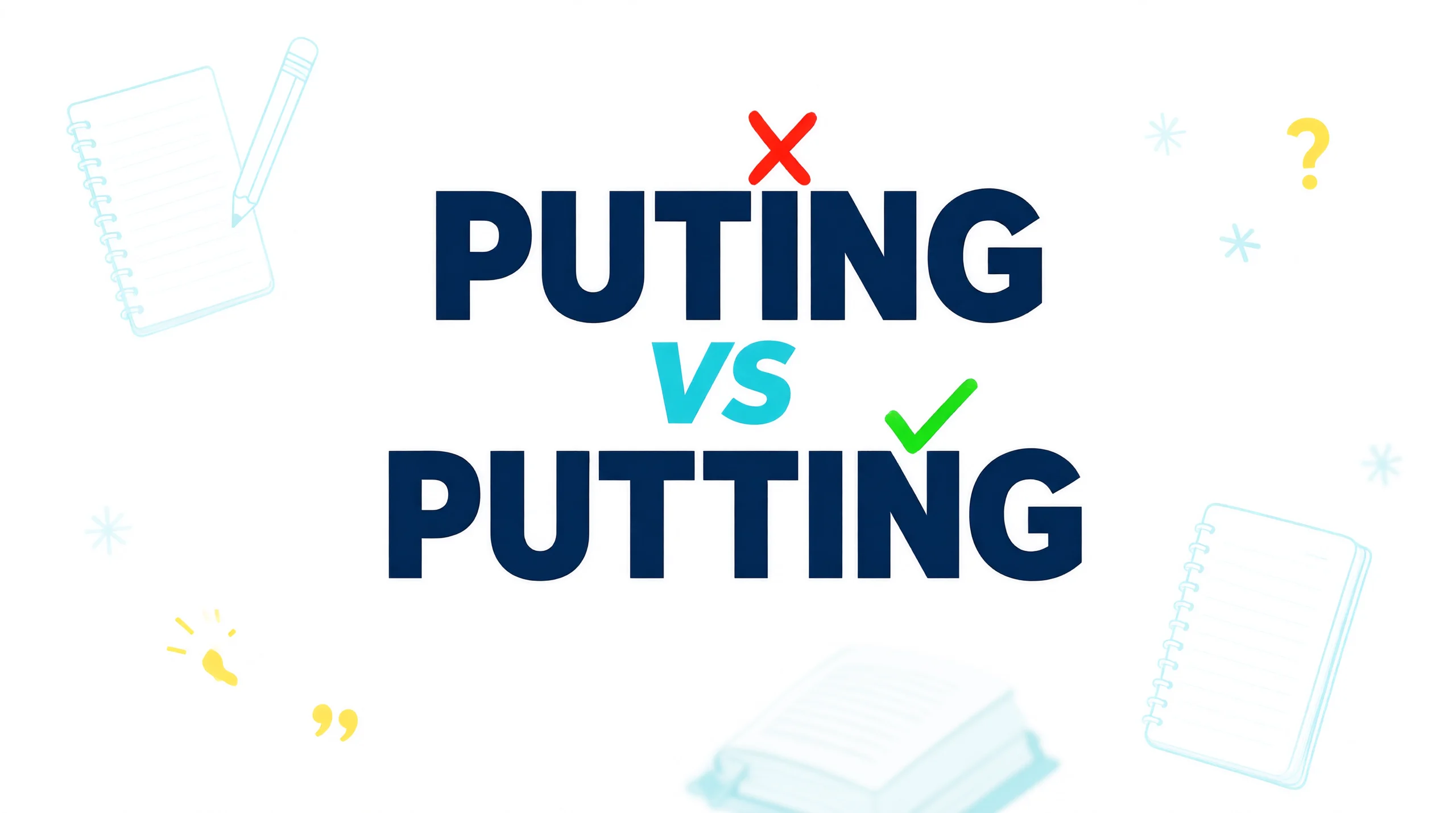
Have you ever wondered if to write puting or putting? These two spellings look almost identical, but only one is correct in standard English. The correct spelling is putting, with a double t. Puting is a common spelling mistake that occurs when people forget to double the final consonant before adding -ing.
Understanding the difference between puting vs. putting can help you improve your spelling, write more confidently, and avoid mistakes in school assignments, emails, essays, and everyday messages. The confusion often happens because English spelling rules can be difficult to remember, especially when a short verb ends in a consonant.
In this guide, you will learn why putting is correct, how the spelling rule works, when to use the word, and how to remember it easily. You will also find practical examples, a comparison table, common mistakes, and answers to frequently asked questions.
Quick Answer: Puting or Putting?
Putting is the correct spelling; puting is incorrect in standard English. The word putting is the present participle of put and can also function as a gerund. When adding -ing to put, you double the final t because the verb has one syllable and follows the consonant-vowel-consonant spelling pattern. For example: “She is putting the books on the shelf.”
Why Do People Confuse Puting and Putting?
People often confuse these spellings because they assume that adding -ing simply means attaching the suffix to the original verb. However, English spelling sometimes requires a final consonant to be doubled.
The verb put has three letters: p-u-t. It contains a short vowel sound followed by a consonant. When you add -ing, you double the final t to create putting.
This rule also applies to other short verbs, such as:
- Sit → Sitting
- Run → Running
- Stop → Stopping
- Get → Getting
- Plan → Planning
The spelling puting leaves out one t, making it incorrect in standard written English.
First Word: Puting
Puting is a misspelling of putting.
In standard English, puting is not the correct form of the verb put. Writers sometimes use it accidentally because they forget to double the final consonant before adding -ing.
Incorrect example:
“She is puting her phone in her bag.”
Correct version:
“She is putting her phone in her bag.”
If you are writing an essay, text message, report, or school assignment, always use putting.
Second Word: Putting
Putting is the correct spelling of the -ing form of the verb put.
The verb put generally means to place, move, or position something somewhere. Adding -ing creates putting, which can describe an action happening now or an activity.
Examples:
- “I am putting my shoes away.”
- “He is putting sugar in his tea.”
- “Putting your ideas into words can be challenging.”
- “She enjoys putting puzzles together.”
The word putting is also used in golf, where it refers to striking the ball with a putter toward the hole.
Puting vs. Putting: Comparison Table
| Feature | Puting | Putting |
| Correct spelling | Incorrect | Correct |
| Number of t’s | One | Two |
| Standard English usage | Misspelling | Accepted spelling |
| Base verb | Intended form of put | Put |
| Grammar | Incorrect as the intended -ing form | Present participle or gerund |
| Example | She is puting it away. | She is putting it away. |
When Should You Use Each Spelling?
When to Use Putting
Use putting whenever you need the -ing form of the verb put.
For an action happening now:
- “I am putting the groceries away.”
- “They are putting chairs around the table.”
For an ongoing activity or habit:
- “He is putting extra effort into his studies.”
- “She is putting money aside for a holiday.”
As a gerund:
- “Putting others first can be kind.”
- “Putting things in order makes the room easier to use.”
In golf:
– “His putting improved after several practice sessions.”
When to Use Puting
In ordinary English writing, you should not use puting as the -ing form of put. Replace it with putting.
12 Examples of Putting in Sentences
Here are 12 examples showing how to use putting correctly.
- Putting books away: She is putting her books back on the shelf.
- Putting on clothes: I am putting on my jacket before leaving.
- Putting food away: He is putting the leftover food in the refrigerator.
- Putting in effort: They are putting a lot of effort into the project.
- Putting something down: Please stop putting your bag on the floor.
- Putting money aside: We are putting money aside for our vacation.
- Putting things together: She is putting the furniture together.
- Putting ideas into words: Putting your thoughts into words takes practice.
- Putting someone first: He believes in putting his family first.
- Putting a plan into action: The team is putting its new plan into action.
- Putting in golf: His putting has improved this season.
- Putting things right: She is putting things right after the misunderstanding.
Each sentence uses putting with two t’s.
Common Mistakes With Putting
Even confident English speakers can make spelling mistakes when adding suffixes. Here are some common errors to avoid.
| Incorrect | Correct |
| Puting the bag down | Putting the bag down |
| Puting on shoes | Putting on shoes |
| Puting things away | Putting things away |
| Puting in effort | Putting in effort |
| Puting money aside | Putting money aside |
Another common mistake is assuming that every verb follows the same spelling pattern. Some verbs simply take -ing, while others require changes to their final letters.
For example:
- Help → Helping
- Read → Reading
- Make → Making
- Sit → Sitting
- Put → Putting
Remember that spelling rules depend on the structure of the base verb.
Memory Trick: How to Remember Putting
Use this simple trick: Put has one t, but putting has two.
Think of the spelling as:
PUT + T + ING = PUTTING
When you add -ing to put, double the final t. You can also remember the similar words sitting, running, and stopping, which double their final consonants too.
A useful practice technique is to write this sentence a few times:
“I am putting my things away.”
After using the correct spelling in context, you will find it easier to remember.
American vs. British English: Is the Spelling Different?
No. There is no spelling difference between American and British English for this word.
| Variety of English | Correct spelling | Example |
| American English | Putting | She is putting the dishes away. |
| British English | Putting | She is putting the dishes away. |
Both varieties use putting with two t’s. The misspelling puting is not the standard form in either variety.
Similar Words That Follow the Same Rule
Learning related words can help you understand why putting is correct.
| Base verb | Correct -ing form | Example |
| Sit | Sitting | He is sitting by the window. |
| Run | Running | She is running in the park. |
| Stop | Stopping | The bus is stopping here. |
| Get | Getting | I am getting ready. |
| Set | Setting | They are setting the table. |
| Cut | Cutting | She is cutting the paper. |
| Hit | Hitting | He is hitting the ball. |
| Plan | Planning | We are planning a trip. |
These verbs generally double their final consonant when adding -ing because they have one syllable and end in a consonant-vowel-consonant pattern.
FAQs:
1. Is puting or putting correct?
Putting is correct. The word puting is a misspelling when you intend to use the -ing form of put. Always write putting with two t’s.
2. Why does putting have two t’s?
The verb put has one syllable and ends in a consonant-vowel-consonant pattern. When adding -ing, the final consonant is doubled, producing putting.
3. Is puting ever a correct English word?
Puting is not the standard spelling of the -ing form of put. In ordinary English writing, use putting instead.
4. What is the base word of putting?
The base word is put. Adding the suffix -ing after doubling the final t gives you putting.
5. What is an example sentence using putting?
“She is putting her notebook in her backpack.” In this sentence, putting describes the action she is performing.
6. Is putting a verb or a noun?
Putting can function as a verb form or a gerund, which is an -ing form used as a noun. For example, “He is putting the box down” uses it as part of a verb phrase, while “Putting requires patience” uses it as a gerund.
7. Does American English spell it differently from British English?
No. Both American and British English use putting. The spelling does not change between these varieties.
Remember This
- Putting is correct.
- Puting is incorrect when intended as the -ing form of put.
- Double the final t when adding -ing to put.
- Similar words include sitting, running, and stopping.
- American and British English use the same spelling.
Conclusion
The difference between puting and putting is simple once you understand the spelling rule. Putting is the only correct standard spelling when you want the -ing form of the verb put. The extra t is necessary because the verb follows a consonant-vowel-consonant pattern that requires the final consonant to be doubled before adding -ing.
To avoid this common mistake, remember the pattern in words such as sitting, running, and stopping. Practice writing putting in everyday sentences, if you are describing an action, explaining an activity, or discussing golf. With a little practice, you will recognize the correct spelling naturally and write with greater confidence.