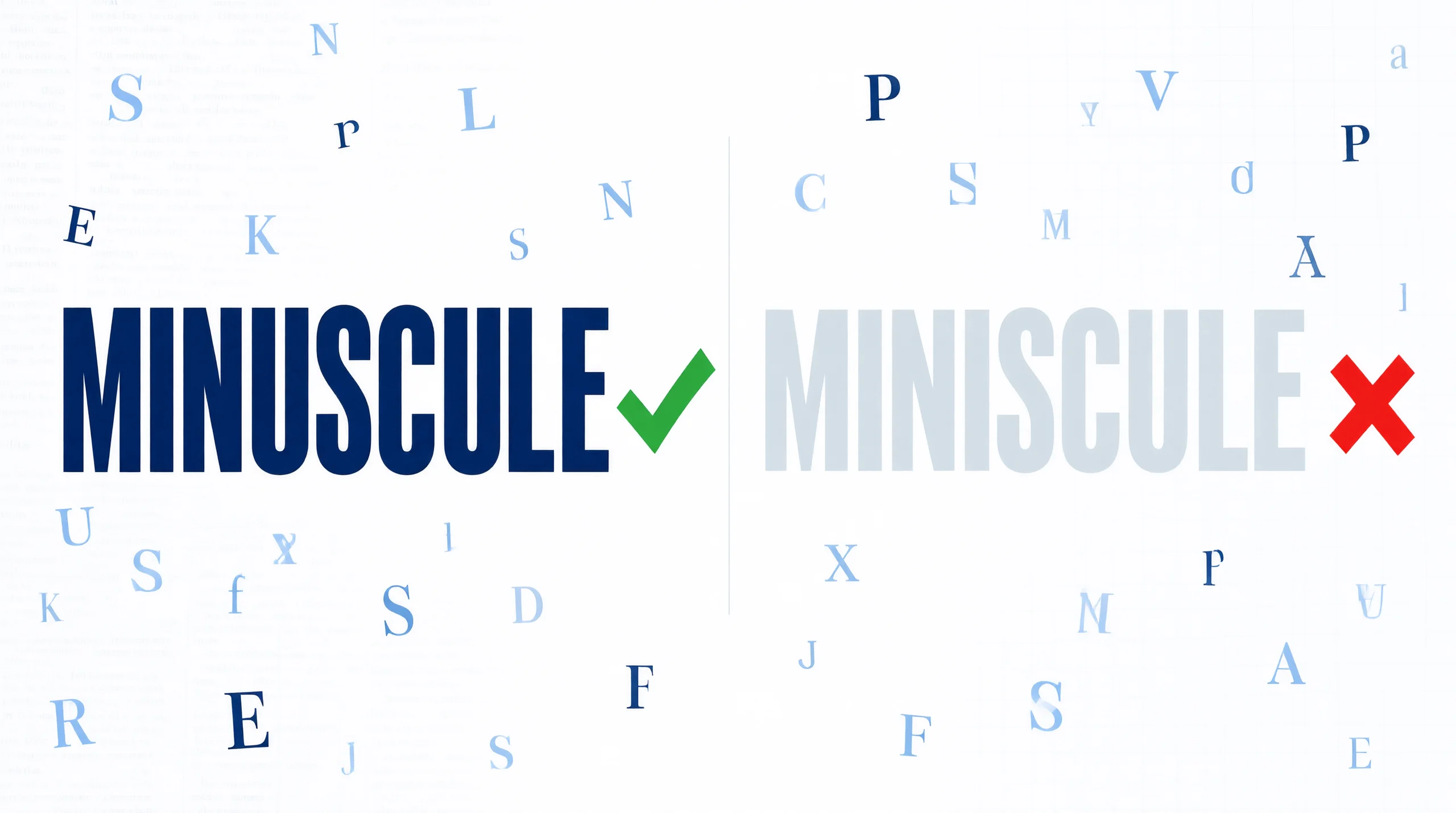
The difference between minuscule vs. miniscule is a common source of confusion in English spelling. Both words are used to describe something very small, but minuscule is the standard and traditionally correct spelling. Miniscule is a common alternative spelling, but it is generally considered nonstandard in formal writing.
If you are writing an essay, email, report, or academic assignment, choose minuscule to ensure your spelling is appropriate. Understanding why these two forms look so similar can help you avoid mistakes and improve your English vocabulary.
The confusion often comes from pronunciation. Many English speakers pronounce minuscule as if it contains the sound or spelling pattern of mini, a familiar word element meaning small. This makes miniscule seem logical, even though it is not the preferred standard spelling. Learning the correct form, its meaning, and a few practical examples will help you remember it whenever you write.
Quick Answer
Minuscule is the standard spelling of the word meaning extremely small or very slight. Miniscule is a common misspelling or nonstandard variant that likely developed because people associate the word with mini. For formal, academic, and professional writing, always use minuscule. Both forms are commonly understood to refer to something tiny.
Why Do People Confuse Minuscule and Miniscule?
People confuse these words for three main reasons.
- Similar pronunciation: In everyday speech, the two spellings can sound almost identical.
- The influence of “mini”: The prefix mini- means small, so miniscule may look like a natural spelling.
- Unfamiliar word origin: Minuscule comes from a Latin word meaning “rather small.” Its spelling is not based on the English word mini.
Because the difference is only one letter, writers may overlook the mistake when proofreading. Spell-checking tools can also handle variant spellings differently, so understanding the standard form is more reliable than depending entirely on software.
First Word: Minuscule
Minuscule is the standard English spelling. It is an adjective meaning extremely small, tiny, or very slight.
It can describe physical size, small amounts, narrow differences, or insignificant chances.
Examples:
- The insect was minuscule.
- There was a minuscule difference between the two measurements.
- She made a minuscule error in the calculation.
- The company earned a minuscule profit last month.
The word can also be used as a noun in specialized contexts. In typography and handwriting, a minuscule is a lowercase letter, in contrast to a majuscule, or capital letter.
Remember: Minuscule is the spelling to use in standard written English.
Second Word: Miniscule
Miniscule is a widely encountered spelling variant of minuscule, but traditional dictionaries and formal writing generally prefer minuscule.
It usually carries the same intended meaning: extremely small or insignificant. The spelling likely arose through association with mini, which makes it seem intuitive to many writers.
Examples of how the nonstandard spelling might appear include:
- The difference was miniscule.
- They had a miniscule amount of time left.
- The chance of success seemed miniscule.
In edited writing, these sentences should use minuscule instead.
Although readers will usually understand miniscule, it is best to avoid it in schoolwork, professional documents, and other contexts where standard spelling matters.
Minuscule vs. Miniscule: Comparison Table
| Feature | Minuscule | Miniscule |
| Spelling status | Standard spelling | Common nonstandard variant |
| Meaning | Extremely small or slight | Usually intended to mean extremely small |
| Part of speech | Primarily adjective; also a noun | Generally used as an adjective |
| Formal writing | Recommended | Best avoided |
| Academic writing | Correct choice | May be marked as a spelling error |
| Pronunciation | Often pronounced similarly to miniscule | Often pronounced similarly to minuscule |
| Example | A minuscule amount remained. | A miniscule amount remained. |
| Best advice | Use this spelling | Replace it with minuscule |
When Should You Use Each Spelling?
When to Use Minuscule
Use minuscule whenever you want to describe something extremely small or slight.
It works in a wide range of situations:
- Physical size: “A minuscule insect landed on the window.”
- Amounts: “Only a minuscule quantity of sugar was added.”
- Differences: “There was a minuscule gap between the results.”
- Probability: “The likelihood of finding the rare item was minuscule.”
- Importance: “The mistake had a minuscule effect on the final score.”
It is the safest choice in every ordinary writing context.
When to Use Miniscule
In standard writing, there is generally no reason to choose miniscule over minuscule. You may encounter it in informal messages, online posts, or published material, but that does not make it the preferred spelling.
If you are editing a sentence containing miniscule, replace it with minuscule unless you have a specific reason to preserve the original wording, such as quoting a source exactly.
Minuscule vs. Miniscule: 12 Examples
These examples show how to use the standard spelling naturally in everyday English.
1. The kitten had minuscule paws.
The kitten’s paws were extremely small.
2. There is a minuscule difference between these two colors.
The colors are almost identical.
3. We had a minuscule amount of water left.
Very little water remained.
4. The scientist discovered a minuscule organism.
The organism was extremely tiny.
5. She made a minuscule adjustment to the design.
She changed only a very small detail.
6. The team had a minuscule chance of winning.
The possibility of winning was extremely low.
7. A minuscule crack appeared in the glass.
The crack was very small.
8. The new policy had a minuscule effect on sales.
The policy barely affected sales.
9. He noticed a minuscule mark on the page.
The mark was tiny.
10. The machine uses a minuscule quantity of energy.
The machine consumes a very small amount of energy.
11. Their scores differed by a minuscule margin.
The difference between their scores was very slight.
12. Even a minuscule error can affect a scientific measurement.
A very small mistake can influence the result.
Common Mistakes to Avoid
Here are some common errors involving minuscule and miniscule.
1. Using Miniscule in Formal Writing
Incorrect for standard edited writing: “The difference was miniscule.”
Correct: “The difference was minuscule.”
2. Assuming Mini Determines the Spelling
The word miniature and the prefix mini- may make miniscule look correct. However, minuscule has its own historical origin and standard spelling.
3. Thinking the Words Have Different Meanings
In ordinary use, writers who choose miniscule generally intend the same meaning as minuscule. The main distinction is spelling status, not meaning.
4. Confusing Minuscule With Minuscule Letters
In typography, minuscule can refer to a lowercase letter. This is a specialized use of the correctly spelled word, not a different spelling.
5. Overlooking the Word During Proofreading
Because the two spellings look similar, the error can be easy to miss. Check for the u after the initial min- when proofreading.
Memory Trick: How to Remember Minuscule
Use this simple memory trick:
Minuscule contains “minus.” Think of something becoming smaller or less.
The spelling is m-i-n-u-s-c-u-l-e. Remember the u after min.
You can also memorize this sentence:
“A minuscule mistake is usually a minor mistake.”
Both minuscule and minor describe something small or limited in this context. Connecting the two words can help you recall the correct spelling.
American vs. British English: Minuscule or Miniscule?
There is no major American-versus-British spelling difference here.
| English variety | Preferred spelling | Nonstandard variant |
| American English | Minuscule | Miniscule |
| British English | Minuscule | Miniscule |
| Canadian English | Minuscule | Miniscule |
| Australian English | Minuscule | Miniscule |
Although spelling conventions differ between American and British English for words such as color/colour and organize/organise, minuscule is the standard spelling in both varieties.
If you are preparing a document for an international audience, minuscule is the recommended choice.
Similar Words to Minuscule
If you want alternatives to minuscule, several words express the idea of being very small. The best choice depends on the sentence.
| Word | Meaning | Example |
| Tiny | Very small | A tiny bird sat on the branch. |
| Minute | Extremely small | A minute detail changed the result. |
| Microscopic | Too small to see clearly without magnification | Microscopic particles entered the sample. |
| Minute in amount | Very slight or limited | Only a minute quantity was needed. |
| Petite | Small and delicately proportioned | She chose a petite handbag. |
| Negligible | So small that it can be ignored in context | The difference was negligible. |
| Insignificant | Not important or meaningful | The change had an insignificant effect. |
| Infinitesimal | Extremely, almost immeasurably small | The probability was infinitesimal. |
| Slight | Small in degree or amount | There was a slight improvement. |
| Minimized | Made as small as possible | The team minimized the risk. |
Note that these words are not always interchangeable. For example, petite often describes a person’s build or an object’s proportions, while negligible emphasizes that something is too small to matter in a particular context.
Final Verdict: Minuscule or Miniscule?
Minuscule is correct for standard English writing. It means extremely small, tiny, or very slight, and it is the spelling preferred in formal, academic, and professional contexts.
Miniscule is a common alternative spelling, likely influenced by the word mini, but it is generally treated as nonstandard.
When in doubt, choose minuscule. It is accepted across American, British, Canadian, and Australian English and will help you avoid a preventable spelling mistake.
FAQs:
1. Is minuscule or miniscule correct?
Minuscule is the standard spelling. Miniscule is a common nonstandard variant. Use minuscule in formal writing, essays, business communication, and academic work.
2. Why do people spell minuscule as miniscule?
Many people associate the word with mini, which means small. That association makes the spelling miniscule seem logical, even though minuscule is the traditional standard form.
3. Do minuscule and miniscule mean the same thing?
They generally express the same intended meaning: extremely small or slight. The difference is primarily one of spelling, with minuscule preferred in standard English.
4. How do you pronounce minuscule?
It is commonly pronounced MIN-uh-skyool or MIN-uh-skyool, with variations in accent and pronunciation. The exact pronunciation may differ slightly among English speakers.
5. Is minuscule correct in American English?
Yes. Minuscule is the standard spelling in American English. Miniscule is generally regarded as a nonstandard variant.
6. Is minuscule correct in British English?
Yes. British English also uses minuscule as the standard spelling. There is no established British spelling rule that makes miniscule preferable.
7. What is a good synonym for minuscule?
Common synonyms include tiny, minute, microscopic, infinitesimal, and very small. Use negligible when you mean that something is so small that it has little practical effect.
Remember This
- Minuscule = the standard spelling.
- Miniscule = a common nonstandard variant.
- Both are generally intended to mean extremely small.
- The preferred spelling is the same in American and British English.
- For school, work, and formal writing, always choose minuscule.
Conclusion
The difference between minuscule and miniscule is simple once you know which spelling to trust. Although both forms appear in everyday writing, minuscule is the standard choice for describing something extremely small, slight, or limited. The alternative spelling is likely influenced by the familiar word mini, which explains why it can seem correct at first glance.
To improve your spelling, remember the u in minuscule and practice using the word in everyday sentences. If you are writing an essay, preparing a report, or communicating professionally, choosing minuscule will help you write clearly and confidently. When you are unsure, use the standard form and avoid the unnecessary confusion.