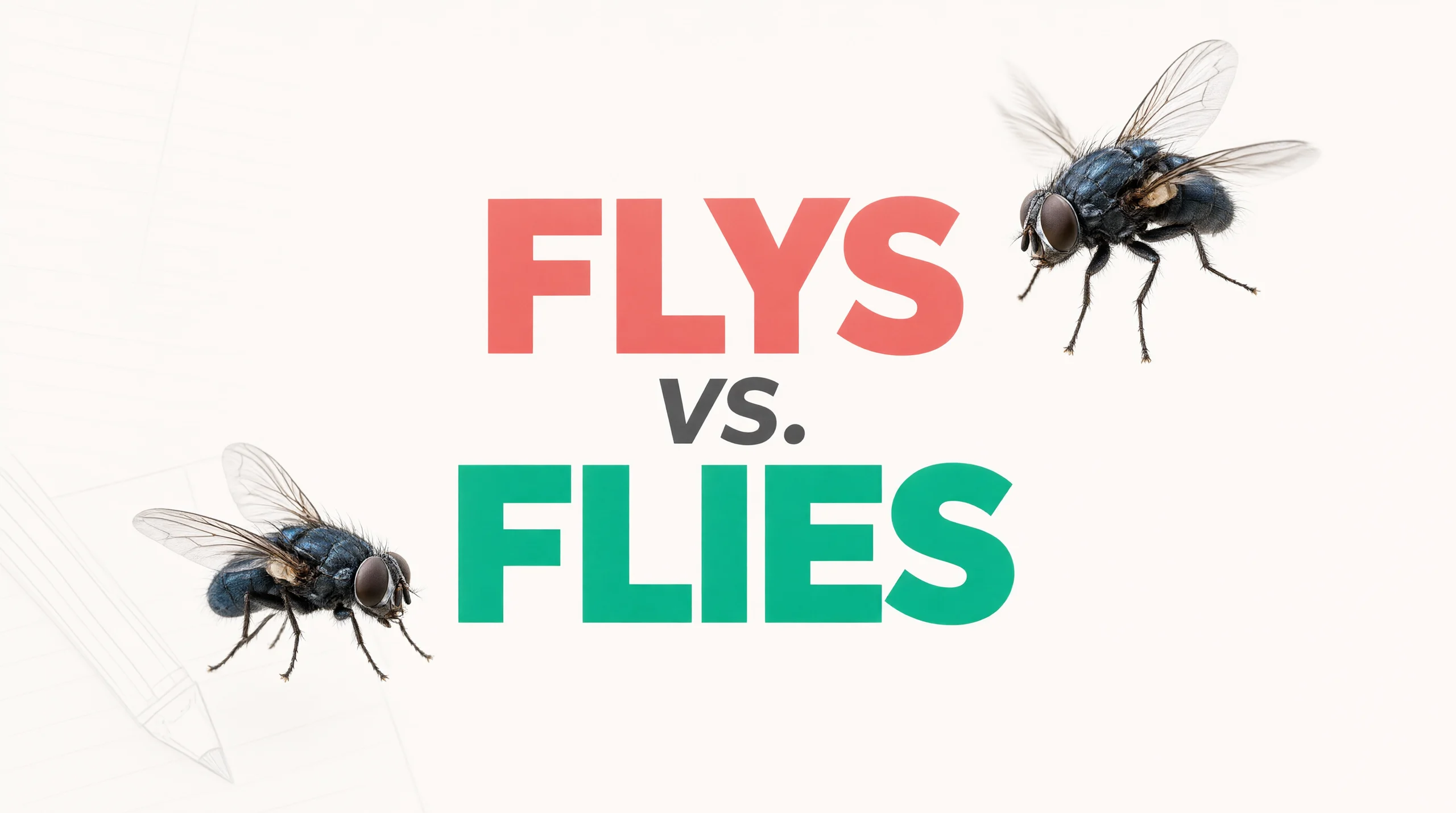
The difference between flys vs. flies can be confusing because both spellings look similar, but they are not interchangeable in standard English. If you are writing about insects, describing movement through the air, or talking about someone flying a plane, choosing the correct spelling matters. In most situations, flies is the correct spelling, while flys is generally considered a misspelling.
The word flies has two common uses. It is the plural form of fly, meaning more than one flying insect, and it is also the third-person singular form of the verb fly. For example, you can say, “Three flies are sitting on the window” or “The bird flies over the trees.” Although the pronunciation is the same, the meaning depends on the sentence. Understanding the spelling rule will help you use the word correctly in school assignments, emails, professional writing, and everyday conversations.
Quick Answer: Flys vs. Flies
Flies is the correct standard spelling when referring to more than one insect or describing the action of flying in the present tense with he, she, or it. The word flys is generally incorrect in ordinary English writing. For example, “The bird flies away” and “Two flies are buzzing around” are both correct.
Why Do People Confuse Flys and Flies?
People often confuse these words because English has different rules for forming plurals and verb forms. Many words simply add -s to form a plural, such as book → books and car → cars. However, words ending in a consonant followed by y usually change the y to i before adding -es.
The word fly follows this spelling rule:
- Fly → Flies
- Try → Tries
- Cry → Cries
- Baby → Babies
Because flys may look like a natural extension of the word fly, people sometimes use it by mistake. In standard English, however, flies is the correct spelling for both the insect plural and the relevant verb form.
First Word: What Does “Flys” Mean?
Flys is generally a misspelling of flies when referring to insects or the act of flying.
In standard English, you should not write flys when you mean multiple insects or when describing an action performed by a single subject in the present tense.
Examples of incorrect usage:
- Incorrect: Two flys are inside the room.
- Correct: Two flies are inside the room.
- Incorrect: She flys to London every month.
- Correct: She flies to London every month.
There are limited specialized contexts in which flys can appear as a technical or industry-specific term, but these exceptions do not change the ordinary spelling rule. For everyday writing, use flies.
Second Word: What Does “Flies” Mean?
Flies is a standard English word with two main grammatical uses.
1. Flies as a plural noun
As a noun, flies means more than one insect called a fly.
Examples:
- The flies are near the food.
- Several flies entered through the open window.
- These flies are difficult to catch.
2. Flies as a verb
As a verb, flies describes the action of flying when the subject is he, she, it, or a singular noun.
Examples:
- She flies to New York for work.
- The eagle flies above the mountains.
- Time flies when you are having fun.
In all these examples, flies is correctly spelled. The sentence determines whether the word functions as a noun or a verb.
Flys vs. Flies: Comparison Table
| Feature | Flys | Flies |
| Standard spelling | Generally incorrect for ordinary usage | Correct |
| Meaning as an insect plural | Incorrect | More than one fly |
| Meaning as a verb | Incorrect in standard usage | Third-person singular of fly |
| Example | The flys are outside. | The flies are outside. |
| Example with a verb | He flys a plane. | He flies a plane. |
| Recommended for everyday writing | No | Yes |
When Should You Use Each Word?
When to use “flies”
Use flies in standard English when you are talking about multiple insects or describing someone or something flying.
Use it as a noun when:
- You see several insects.
- You describe insects around food.
- You talk about flies in a garden or room.
Examples:
- The flies are sitting on the wall.
- I noticed three flies near the fruit.
Use it as a verb when:
- A person travels by plane regularly.
- A bird moves through the air.
- An object or aircraft travels through the sky.
Examples:
- My brother flies to Dubai for business.
- The helicopter flies over the city.
When would “flys” be appropriate?
In ordinary English, flys is not the correct choice for these meanings. If you are writing about a specialized product, brand, surname, or technical term that specifically uses this spelling, follow the official name or terminology. Otherwise, choose flies.
12 Examples of Flys vs. Flies in Sentences
Here are practical examples to help you understand the difference.
1. Correct: The flies are buzzing around the kitchen.
Incorrect: The flys are buzzing around the kitchen.
2. Correct: She flies to Paris every summer.
Incorrect: She flys to Paris every summer.
3. Correct: A bird flies over our house every morning.
Incorrect: A bird flys over our house every morning.
4. Correct: Several flies landed on the fruit.
Incorrect: Several flys landed on the fruit.
5. Correct: My father flies an airplane.
Incorrect: My father flys an airplane.
6. Correct: Time flies when you are enjoying yourself.
Incorrect: Time flys when you are enjoying yourself.
7. Correct: The little girl watches the flies near the window.
Incorrect: The little girl watches the flys near the window.
8. Correct: The butterfly flies from flower to flower.
Incorrect: The butterfly flys from flower to flower.
9. Correct: The pilot flies passengers across the country.
Incorrect: The pilot flys passengers across the country.
10. Correct: Two flies are trapped inside the jar.
Incorrect: Two flys are trapped inside the jar.
11. Correct: The kite flies high in the sky.
Incorrect: The kite flys high in the sky.
12. Correct: A commercial airline flies to several international destinations.
Incorrect: A commercial airline flys to several international destinations.
These examples show that flies is the appropriate spelling in both noun and verb contexts.
Common Mistakes When Using Flys and Flies
Here are some frequent mistakes and how to avoid them.
Mistake 1: Adding only -s to fly
Incorrect: The flys are everywhere.
Correct: The flies are everywhere.
Mistake 2: Forgetting the subject-verb agreement rule
Incorrect: He fly every week.
Correct: He flies every week.
Remember that the third-person singular present-tense form requires flies.
Mistake 3: Confusing the noun with the verb
In “The flies are annoying,” flies is a noun. In “The plane flies smoothly,” it is a verb.
The spelling remains the same, but the grammatical role changes.
Mistake 4: Assuming every word ending in y changes to -ies
This rule applies when a word ends in a consonant followed by y. When a vowel comes before y, the usual rule is to add -s.
For example:
- Fly → Flies
- Toy → Toys
- Boy → Boys
- Key → Keys
Understanding the difference helps prevent spelling errors in many other English words.
Memory Trick: How to Remember Flys vs. Flies
Use this simple rule:
Consonant + y → change y to i and add -es.
The word fly ends in l followed by y. Since l is a consonant, the correct form is flies.
Think of these examples:
- Fly → Flies
- Try → Tries
- Reply → Replies
- Apply → Applies
Remember the phrase: “A fly becomes flies.”
This quick trick works for both the plural noun and the third-person singular verb form.
American vs. British English: Is There a Difference?
There is no spelling difference between American and British English for flies.
Both varieties use flies as the plural of the insect fly and as the third-person singular present-tense form of the verb fly.
| Usage | American English | British English |
| More than one insect | Flies | Flies |
| A bird in the air | The bird flies. | The bird flies. |
| A person traveling by plane | She flies to London. | She flies to London. |
| Incorrect ordinary spelling | Flys | Flys |
Although American and British English differ in spellings such as color/colour and organize/organise in some style conventions, the word flies is spelled the same way in both.
Similar Words: Fly, Flies, Flying, and Flew
Learning related forms of fly can make English spelling and grammar easier.
| Word | Part of speech | Meaning | Example |
| Fly | Noun or verb | An insect or the action of traveling through the air | A fly is on the wall. |
| Flies | Plural noun or verb | Multiple insects or present-tense action | The bird flies away. |
| Flying | Verb form or adjective | Moving through the air | The plane is flying overhead. |
| Flew | Past-tense verb | Traveled through the air | The bird flew away. |
| Flown | Past participle | Used with helping verbs | She has flown before. |
| Fly’s | Possessive noun form | Belonging to one fly | The fly’s wings are delicate. |
Notice that fly’s is different from flies. The apostrophe indicates possession, as in “the fly’s wings.” For multiple insects, use flies without an apostrophe.
Final Verdict: Flys or Flies?
The correct choice in standard English is flies.
Use flies when referring to more than one insect or when describing a flying action performed by he, she, or it in the present tense. Avoid flys in ordinary writing because it is generally considered a spelling mistake.
For example:
- Correct: The flies are in the garden.
- Correct: She flies to work every Monday.
- Incorrect: The flys are in the garden.
- Incorrect: She flys to work every Monday.
If you remember one thing, remember that fly changes to flies when forming its plural or its third-person singular present-tense verb form.
FAQs:
1. Is “flys” ever correct?
In ordinary English, flys is generally incorrect when referring to insects or the action of flying. It may appear in specialized names or terminology, but flies is the standard spelling for everyday writing.
2. Why is the plural of fly “flies” instead of “flys”?
When a noun ends in a consonant followed by y, the usual plural rule changes y to i and adds -es. Therefore, fly becomes flies, just as baby becomes babies.
3. Is “flies” a noun or a verb?
It can be both. As a noun, flies means more than one fly insect. As a verb, it is the third-person singular present-tense form of fly, as in “He flies a plane.”
4. Is it “the flys” or “the flies”?
The correct phrase is “the flies.” Use flies when referring to multiple insects. For example, “The flies are near the window” is correct.
5. Is “she flys” grammatically correct?
No. The correct expression is “she flies.” The verb fly changes to flies when used with he, she, or it in the simple present tense.
6. What is the difference between “flies” and “fly’s”?
Flies can be a plural noun or a verb. Fly’s is the possessive form of the singular noun fly, indicating that something belongs to one fly. For example, “The flies are outside” and “The fly’s wings are small.”
7. Do American and British English spell “flies” differently?
No. Both American and British English use flies. The spelling does not change according to regional English conventions.
Remember This
- Flies = the correct plural of fly.
- Flies = the present-tense verb used with he, she, or it.
- Flys = generally an incorrect spelling in ordinary English.
- Fly’s = the possessive form of the singular noun fly.
- Flying = the -ing form of the verb fly.
The easiest rule to remember is: when a word ends in a consonant followed by y, the plural usually changes y to i and adds -es.
Conclusion
Understanding the difference between flys and flies is simple once you learn the spelling rule. In standard English, flies is correct when talking about multiple insects and when using the verb fly with a singular third-person subject. The spelling flys should generally be avoided in everyday writing.
If you are learning English, preparing a school assignment, or improving your writing, remembering the rule for words ending in a consonant and y will help you avoid similar mistakes. Use flies in standard sentences, check if the word is functioning as a noun or a verb, and remember that the correct spelling is the same in American and British English.