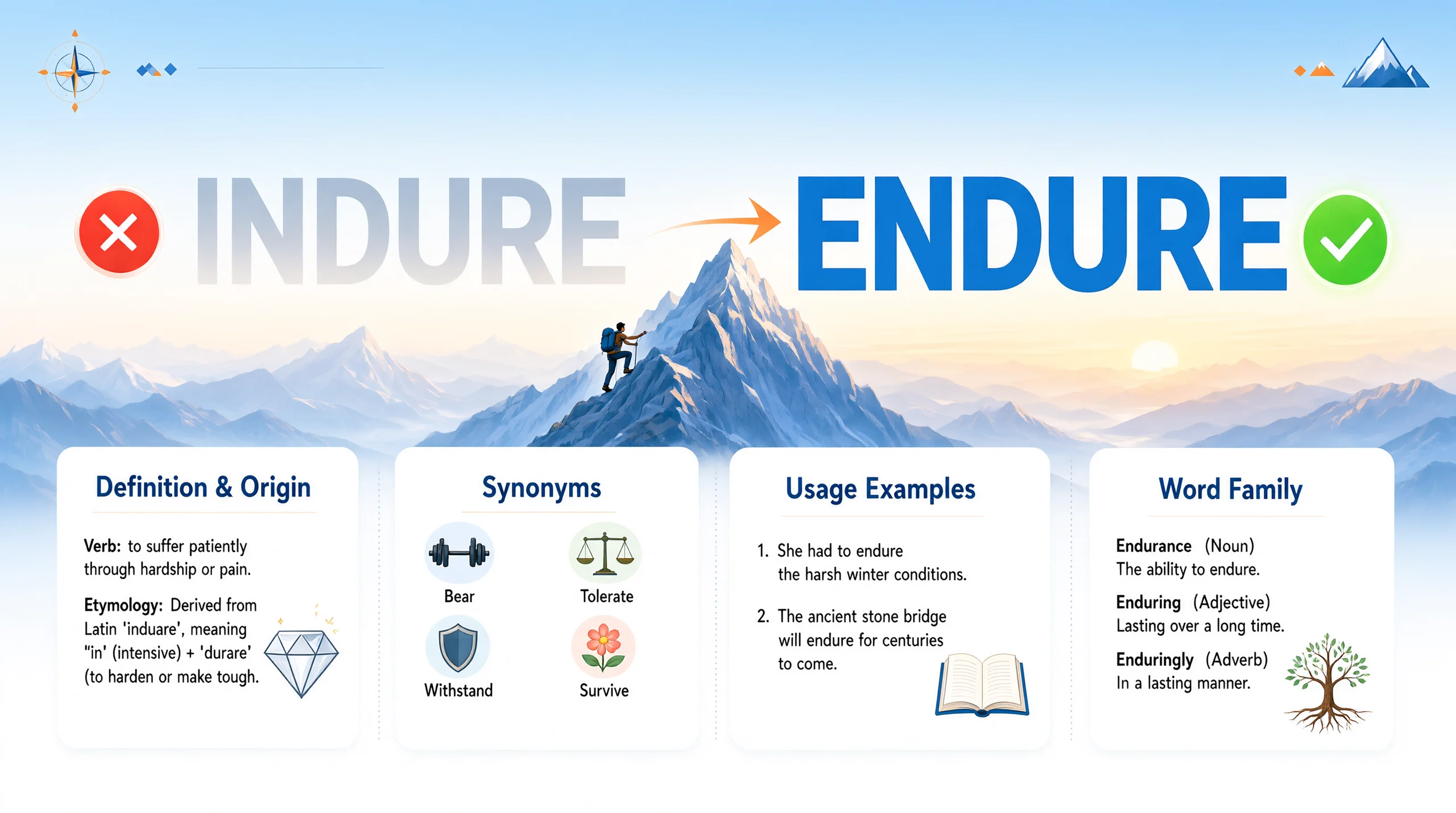
When comparing indure vs. endure, the correct word in modern everyday English is usually endure. It means to suffer through something difficult, tolerate pain, or continue despite challenges. Indure is an obsolete or historical variant of endure and is rarely used in contemporary writing. If you are writing an essay, email, school assignment, or professional document, choose endure.
These words look and sound similar, which makes them easy to confuse. However, understanding their spelling, meaning, and modern usage will help you avoid mistakes. If you are learning English, improving your vocabulary, or checking which spelling belongs in a sentence, knowing the difference is straightforward.
Quick Answer
Endure is the standard modern English word meaning to tolerate hardship, suffer through difficulty, or continue despite challenges. Indure is an obsolete or historical spelling that may appear in older texts but is not normally appropriate in modern writing. For almost every contemporary sentence, use endure.
Why Do People Confuse Indure and Endure?
People confuse indure and endure because they have similar spellings and historically related meanings. The initial letters i and e are the main visible difference.
Older English texts sometimes use spelling variations that are no longer standard. Readers who encounter indure in historical writing may assume it is an alternative spelling that remains acceptable today.
In modern English, however, endure is the preferred and widely accepted spelling. Using indure in ordinary contemporary writing may be interpreted as a spelling mistake.
1. What Does Indure Mean?
Indure is an obsolete or archaic variant of endure. It has appeared in historical English texts with meanings associated with enduring, tolerating, or withstanding something.
Today, it is rarely used outside historical, literary, or linguistic contexts.
Examples:
- Indure may appear in an old text describing someone who withstands hardship.
- A modern writer would normally replace indure with endure when expressing the same idea.
Usage tip: Avoid indure in modern essays, business writing, everyday messages, and academic assignments unless you are quoting or discussing a historical source.
2. What Does Endure Mean?
Endure is a standard English verb meaning to experience something difficult without giving up, tolerate an unpleasant situation, or last over time.
It can describe physical pain, emotional hardship, challenging experiences, or something that continues to exist.
Examples:
- She had to endure months of physical therapy.
- We endured the cold weather during our camping trip.
- Their friendship has endured for decades.
- The building was designed to endure strong winds.
Common synonyms include tolerate, withstand, survive, bear, and persevere through, depending on the context.
Indure vs. Endure: Comparison Table
| Feature | Indure | Endure |
| Part of speech | Verb | Verb |
| Meaning | Historical variant of endure | Tolerate, withstand, or last |
| Modern usage | Obsolete or very rare | Standard and common |
| Accepted in everyday writing | Generally avoid | Yes |
| Common contexts | Historical texts and linguistic discussion | Everyday, academic, and professional writing |
| Example | An old text may use “indure” | She can endure hardship. |
| Best choice today | Rarely appropriate | Correct modern choice |
When Should You Use Each Word?
Use Indure When Discussing Historical English
Use indure only when the historical spelling itself matters, such as when quoting an old document, analyzing an older literary work, or discussing the development of English spelling.
For example:
– The historical manuscript uses the spelling indure.
Here, the word is being discussed as a historical spelling rather than recommended for ordinary modern writing.
Use Endure in Modern English
Use endure whenever you mean to tolerate pain, experience hardship, withstand pressure, or continue over time.
For example:
- The athletes endured a difficult training session.
- Their traditions have endured for generations.
- He learned to endure disappointment without losing hope.
Simple rule: If you are unsure, use endure.
12 Examples of Indure vs. Endure
The following examples show how to use endure naturally and how indure may appear in historical contexts.
1. Correct: She had to endure a long and exhausting journey.
Meaning: She experienced the difficult journey without giving up.
2. Correct: We cannot endure this level of noise forever.
Meaning: We cannot tolerate the noise indefinitely.
3. Correct: The team endured several setbacks before winning.
Meaning: The team experienced difficulties and continued.
4. Correct: Their love endured despite the distance.
Meaning: Their love continued over time.
5. Correct: This material can endure extreme temperatures.
Meaning: The material can withstand very hot or cold conditions.
6. Correct: She endured the pain bravely.
Meaning: She tolerated the pain courageously.
7. Correct: Good friendships can endure many challenges.
Meaning: Strong friendships can survive difficulties.
8. Correct: The workers endured harsh conditions.
Meaning: The workers continued despite unpleasant conditions.
9. Correct: His influence will endure for many years.
Meaning: His influence will continue into the future.
10. Correct: Everyone must sometimes endure disappointment.
Meaning: Everyone sometimes has to tolerate an upsetting experience.
11. Historical context: The old manuscript uses indure where modern English would normally use endure.
Meaning: The text preserves an older spelling.
12. Modern correction: She had to indure the hardship. → She had to endure the hardship.
Meaning: The modern spelling is endure.
Common Mistakes to Avoid
Mistake 1: Using Indure in Modern Writing
Incorrect: He had to indure many difficulties.
Correct: He had to endure many difficulties.
Mistake 2: Assuming Both Spellings Are Equally Common
Although indure has historical usage, it is not a normal alternative spelling in contemporary English.
Mistake 3: Confusing Endure With Ensure
These words have different meanings:
- Endure: To tolerate or withstand something.
- Ensure: To make certain that something happens.
Example: We must ensure that the building can endure strong winds.
Mistake 4: Using Endure When You Mean Enjoy
Incorrect: I endured the party because it was wonderful.
Better: I enjoyed the party because it was wonderful.
Endure usually suggests difficulty, discomfort, or simply lasting through time.
Memory Trick: How to Remember Endure
Use this simple association:
Endure = Experience difficulty and continue.
Think of the e in endure as standing for experience. When you experience a difficult situation and keep going, you endure it.
Examples:
- Endure pain.
- Endure hardship.
- Endure pressure.
- Endure difficult times.
Remember that indure is an older spelling, while endure is the normal modern choice.
American vs. British English
There is no meaningful difference between American and British English in the standard spelling of endure. Both varieties use endure as the accepted modern spelling.
| Usage | American English | British English |
| Standard spelling | Endure | Endure |
| Past tense | Endured | Endured |
| Present participle | Enduring | Enduring |
| Historical variant | Indure | Indure |
For example:
- American English: We must endure the difficult winter.
- British English: We must endure the difficult winter.
The spelling remains the same in both varieties. Indure is not the normal modern spelling in either one.
Similar Words to Indure and Endure
Understanding related words can help you choose the best expression for your sentence.
| Word | Meaning | Example |
| Tolerate | Accept something unpleasant | I cannot tolerate constant noise. |
| Withstand | Resist force or pressure | The bridge can withstand strong winds. |
| Bear | Accept or experience something difficult | She could barely bear the pain. |
| Survive | Remain alive or continue after difficulty | The business survived the crisis. |
| Persist | Continue despite obstacles | He persisted despite criticism. |
| Persevere | Continue working toward a goal | She persevered through difficult lessons. |
| Last | Continue for a period of time | Their friendship lasted for years. |
| Sustain | Maintain or support over time | The team sustained its efforts. |
These words are related to endure, but they are not always interchangeable. Choose one according to whether you mean tolerating discomfort, resisting force, surviving danger, or continuing over time.
Final Verdict: Indure or Endure?
Endure is the correct choice for modern everyday English. It means to tolerate difficulty, withstand something challenging, or continue to exist over time.
Indure is an obsolete or historical variant that may be encountered in older writing. Unless you are quoting a historical source or specifically discussing old spelling conventions, avoid it.
For schoolwork, professional documents, emails, and general communication, always choose endure.
FAQs:
1. Is Indure a Correct English Word?
Indure is a historical or obsolete English spelling associated with endure. However, it is not normally used in contemporary English. In modern writing, endure is the appropriate choice.
2. Is Endure or Indure the Correct Spelling?
Endure is the standard modern spelling. Use it when describing someone tolerating pain, experiencing hardship, withstanding pressure, or continuing over time.
3. What Does Endure Mean in Simple English?
To endure means to go through something difficult without giving up, tolerate something unpleasant, or last for a long time. For example, a person may endure pain or a friendship may endure for decades.
4. Why Does Indure Appear in Older Books?
Older English writing sometimes used spelling variations that are uncommon today. Indure may appear in historical texts as a variant of endure. Its presence does not mean it is the preferred modern spelling.
5. What Is the Past Tense of Endure?
The past tense of endure is endured. For example: “They endured a difficult winter.” The past participle is also endured, as in “She has endured many challenges.”
6. What Are the Best Synonyms for Endure?
Common synonyms include tolerate, withstand, bear, survive, and persevere. The best choice depends on the sentence. For example, withstand often describes resisting physical force, while tolerate emphasizes putting up with something unpleasant.
7. Is Endure Used the Same Way in American and British English?
Yes. Both American and British English use endure with the same standard spelling and broadly the same meanings. Indure is not the usual modern spelling in either variety.
Remember This
- Endure: The standard modern English spelling.
- Indure: An obsolete or historical spelling variant.
- Endured: The past tense and past participle of endure.
- Enduring: The present participle of endure; it can also describe something lasting over time.
When writing in modern English, choose endure unless you have a specific historical reason to use indure.
Conclusion
Understanding the difference between indure and endure helps you write more accurately and confidently. Although the two spellings are historically related, they do not have the same status in modern English. Indure is rarely encountered outside older texts and discussions of historical spelling, whereas endure remains a standard, widely understood verb.
Whenever you want to describe tolerating hardship, withstanding pressure, or continuing despite challenges, use endure. Remembering this simple distinction will help you avoid spelling mistakes in essays, professional documents, everyday conversations, and other forms of modern writing.