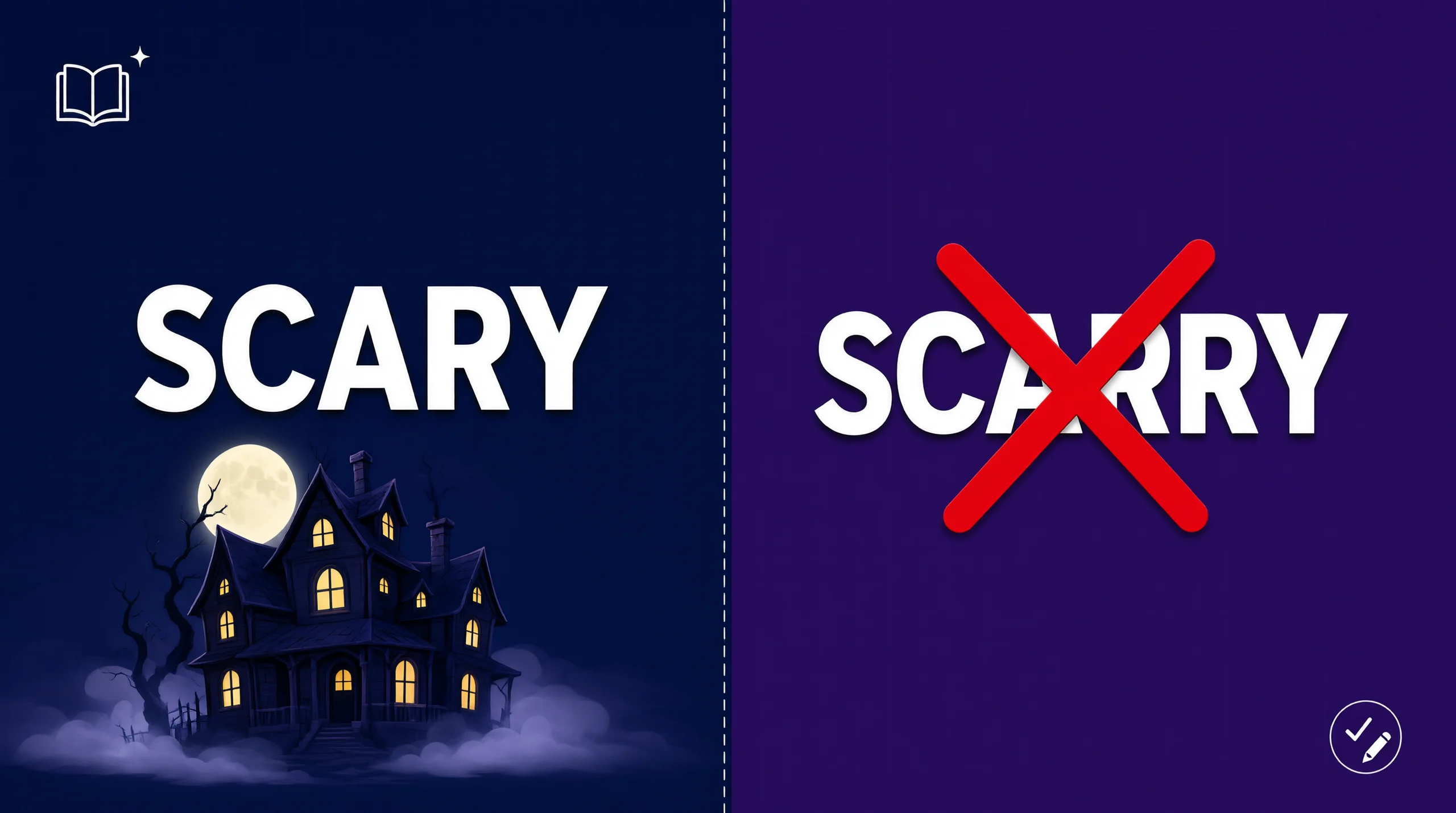
The words scary and scarry look almost identical, but there is an important difference between them. If you are writing an essay, sending a message, completing homework, or improving your English, knowing which spelling to use can help you avoid common mistakes. The good news is that the difference is simple once you understand the meaning and spelling of each word.
Scary is the correct standard English spelling of the adjective meaning frightening, causing fear, or making someone feel afraid. For example, “That was a scary movie.” The spelling scarry is generally considered a misspelling of scary when someone intends to describe something frightening. It may occasionally appear as a surname, a name, or a specialized spelling, but it is not the standard adjective.
In this guide, you will learn the meanings of scary and scarry, see how they differ, explore practical examples, and discover easy ways to remember the correct spelling.
Quick Answer: Scary vs. Scarry
Scary is the correct spelling when describing something that causes fear or fright. Scarry is usually a spelling mistake in standard English when used with this meaning. For example, write “a scary story,” not “a scarry story.” Remember that scary contains one r and ends with y.
Why Do People Confuse Scary and Scarry?
People often confuse these spellings because they sound the same when spoken. Both contain the same basic sounds, so pronunciation does not help distinguish them.
Another reason is that English spelling can be unpredictable. Some words use doubled consonants, while others do not. Writers may mistakenly add an extra r to scary, especially when typing quickly or relying on how a word looks rather than its standard spelling.
However, in ordinary English writing, the distinction is straightforward: use scary to describe something frightening.
First Word: Scary
Scary is a standard English adjective that describes something frightening, alarming, or capable of causing fear.
It can describe movies, stories, places, experiences, dreams, situations, and even people whose behavior makes others feel afraid.
Meaning of Scary
Scary means causing fear, worry, or nervousness.
Examples:
- The movie was scary.
- We heard a scary noise outside.
- Walking alone through the dark forest felt scary.
- It was a scary experience for the young child.
When Is Scary Used?
Use scary whenever you want to explain that something makes a person feel afraid or uncomfortable.
For example:
- Scary movie: A movie that causes fear.
- Scary story: A story intended to frighten readers or listeners.
- Scary situation: A situation that feels dangerous or frightening.
- Scary experience: An event that causes fear or distress.
Synonyms of Scary
Common synonyms include:
- Frightening
- Terrifying
- Spooky
- Alarming
- Chilling
- Creepy
- Fearsome
- Intimidating
These words have slightly different meanings. For example, spooky often suggests something mysterious, while terrifying usually describes something extremely frightening.
Second Word: Scarry
Scarry is generally not the correct spelling of the adjective scary in standard English.
When someone writes “scarry movie” or “scarry situation,” they usually mean “scary movie” or “scary situation.” In these examples, the extra r is a spelling error.
Meaning of Scarry
As a standard English adjective meaning frightening, scarry has no accepted role in ordinary usage. It should not replace scary in schoolwork, professional writing, or everyday communication.
However, Scarry can occur as a surname or proper name. Proper names follow their own established spellings, so the spelling should be preserved when referring to a person or another named entity.
Examples of Incorrect Usage
- Incorrect: That was a scarry dream.
- Correct: That was a scary dream.
- Incorrect: The old house looks scarry.
- Correct: The old house looks scary.
- Incorrect: I watched a scarry movie yesterday.
- Correct: I watched a scary movie yesterday.
Scary vs. Scarry: Comparison Table
| Feature | Scary | Scarry |
| Standard adjective | Yes | No |
| Meaning | Causing fear | Usually a misspelling of scary |
| Part of speech | Adjective | Not a standard adjective with this meaning |
| Correct for school writing | Yes | No, unless used as a proper name |
| Example | A scary story | Incorrect: a scarry story |
| Number of letters | 5 | 6 |
| Number of r’s | 1 | 2 |
The key difference is spelling: scary has one r, while scarry has two.
When Should You Use Scary or Scarry?
Choosing the right spelling depends on what you want to communicate.
Use Scary When Describing Fear
Choose scary when talking about something frightening or unsettling.
Examples:
- The thunderstorm was scary.
- My brother told me a scary story.
- Driving in heavy fog can be scary.
- The character looked scary in the dark.
Use Scarry Only When It Is a Proper Name
Use Scarry when it is the established spelling of a surname or another proper name.
For example, Richard Scarry was an American children’s author and illustrator. His surname is correctly spelled Scarry.
Do not use scarry as a replacement for the adjective scary.
12 Examples of Scary vs. Scarry in Sentences
The following examples show how to use the correct spelling in everyday English.
1. Correct: The haunted house was scary. Incorrect: The haunted house was scarry.
2. Correct: I watched a scary movie last night. Incorrect: I watched a scarry movie last night.
3. Correct: The little boy had a scary dream. Incorrect: The little boy had a scarry dream.
4. Correct: It was scary to hear footsteps behind me. Incorrect: It was scarry to hear footsteps behind me.
5. Correct: The storm became scary as the wind grew stronger. Incorrect: The storm became scarry as the wind grew stronger.
6. Correct: She told us a scary story around the campfire. Incorrect: She told us a scarry story around the campfire.
7. Correct: That was a scary experience for everyone. Incorrect: That was a scarry experience for everyone.
8. Correct: The dark tunnel looked scary. Incorrect: The dark tunnel looked scarry.
9. Correct: Some insects look scary, but they are harmless. Incorrect: Some insects look scarry, but they are harmless.
10. Correct: The sudden noise was scary. Incorrect: The sudden noise was scarry.
11. Correct: Speaking in front of a large audience can feel scary. Incorrect: Speaking in front of a large audience can feel scarry.
12. Correct proper name: Richard Scarry wrote and illustrated children’s books. Here, Scarry is a surname, so the spelling is correct.
These examples demonstrate that scary is the appropriate choice when describing fear, while Scarry is appropriate when preserving a correctly spelled proper name.
Common Mistakes When Using Scary and Scarry
English learners and native speakers alike sometimes make spelling mistakes. Here are a few to avoid.
1. Adding an Extra R
Incorrect: The film was scarry.
Correct: The film was scary.
Remember that scary has only one r.
2. Assuming Both Spellings Are Interchangeable
Incorrect: That was a scarry situation.
Correct: That was a scary situation.
The two spellings are not interchangeable when describing something frightening.
3. Confusing Spelling With Pronunciation
Both forms may be pronounced similarly when scarry is written by mistake. However, similar pronunciation does not make a spelling standard.
Always use scary for the adjective.
4. Changing a Proper Name
If a person’s established surname is Scarry, do not automatically change it to Scary. Names should retain their correct spelling.
Memory Trick: How to Remember Scary
Here is a simple way to remember the difference:
Scary = one R = frightening.
Think of the word scare. Remove the final e and add y, and you get scary.
- Scare → Scary
- One r → Correct adjective
- Two r’s → Usually incorrect when describing fear
You can also remember this sentence:
“A scary story has one R.”
Repeating this short rule can help you choose the correct spelling when writing quickly.
American vs. British English: Scary or Scarry?
There is no standard American-versus-British spelling difference between scary and scarry.
Both American English and British English use scary as the standard adjective for something that causes fear.
| English variety | Correct spelling | Example |
| American English | Scary | That movie was scary. |
| British English | Scary | That film was scary. |
| Both varieties | Scarry as a surname, where applicable | Richard Scarry was an author. |
American and British English may differ in spellings such as color and colour, but that distinction does not apply here.
Similar Words to Scary
Several English words have meanings similar to scary. Understanding their differences can help you express yourself more accurately.
| Word | Meaning | Example |
| Frightening | Causing fear | The sound was frightening. |
| Terrifying | Extremely frightening | The experience was terrifying. |
| Spooky | Mysterious or slightly frightening | The house looked spooky. |
| Creepy | Causing uneasiness or discomfort | That noise was creepy. |
| Alarming | Causing concern or fear | The news was alarming. |
| Chilling | Producing a strong feeling of fear | It was a chilling story. |
| Intimidating | Making someone feel nervous or less confident | The interview seemed intimidating. |
| Fearsome | Inspiring fear or respect | The animal looked fearsome. |
These words can replace scary in some contexts, but they are not always exact synonyms. Choose the word that best expresses the intensity and type of fear you mean.
Final Verdict: Scary vs. Scarry
The correct spelling is scary when you want to describe something frightening, frightening-looking, or fear-inducing.
Scarry is generally a misspelling of scary in this context. However, it is a valid spelling in proper names, including surnames.
For everyday writing, remember this simple rule: write scary movie, scary story, and scary situation—not scarry movie, scarry story, or scarry situation.
FAQs:
1. Is scary or scarry correct?
Scary is correct when describing something that causes fear. Scarry is generally a misspelling in this context, although it can be correct as a proper name.
2. What does scarry mean?
Scarry is not the standard English adjective for something frightening. It is usually a misspelling of scary, but it may appear in surnames and other proper names.
3. Why do people spell scary as scarry?
People may add an extra r because they are unsure of the spelling or because they type quickly. Since both forms may sound similar, the mistake can go unnoticed.
4. How do you spell scary correctly?
Spell it S-C-A-R-Y. It contains five letters and only one r.
5. Is scarry a real word?
Scarry exists as a spelling in proper names, but it is not the standard adjective used to describe something frightening. For that meaning, use scary.
6. Is scary the same in American and British English?
Yes. Both American and British English use scary as the standard spelling. There is no regional spelling difference between these two forms.
7. What is another word for scary?
Common alternatives include frightening, terrifying, spooky, creepy, and alarming. The best choice depends on how frightening the situation is and what kind of fear it creates.
Remember This
- Scary: The correct adjective for something frightening.
- Scarry: Usually a spelling mistake when used as an adjective, but potentially correct as a proper name.
- American and British English: Both use scary.
- Easy memory trick: A scary story has one R.
Conclusion
Understanding the difference between scary and scarry is simple once you focus on spelling and meaning. The word scary is the standard English adjective used to describe frightening movies, stories, situations, experiences, and objects. Because both spellings may sound similar, it is easy to make a mistake, but remembering the correct form can improve your everyday writing.
Use scary in essays, emails, messages, school assignments, and other ordinary writing whenever you mean something frightening. Reserve Scarry for proper names when that is the established spelling. With this simple distinction in mind, you can write confidently and avoid one of the common spelling mistakes in English.