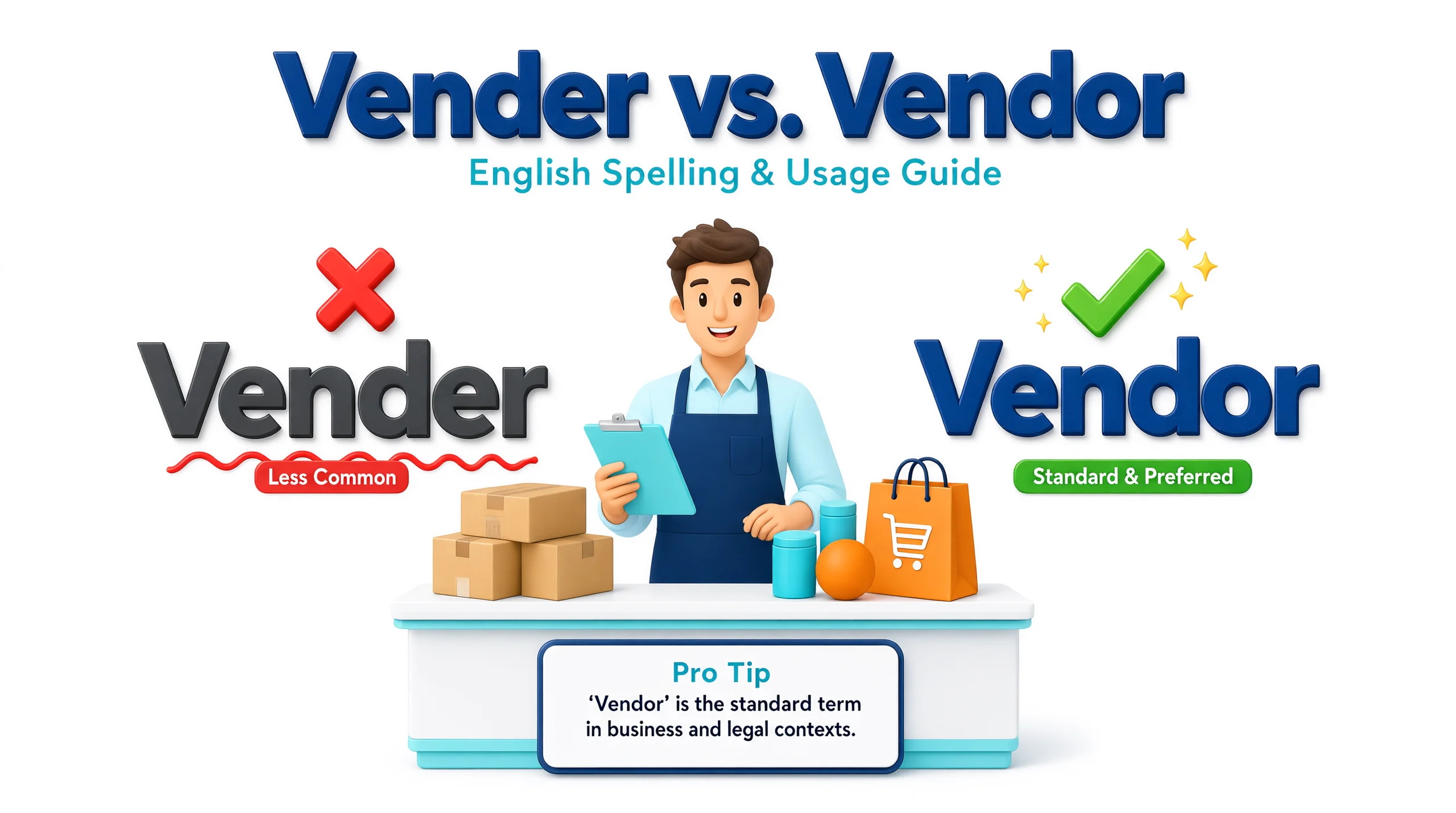
The difference between vender and vendor is mainly their usage and spelling preference. Both words can refer to someone who sells goods or services, but vendor is the standard and widely preferred spelling in modern English. Vender is a less common alternative spelling, especially in American English, and is most often encountered in dictionaries or older texts.
If you are writing an email, preparing a business report, completing a school assignment, or communicating with customers, choosing the correct word matters. Although both spellings can refer to a seller, vendor is the safer choice in almost every everyday and professional situation.
Understanding the difference is simple once you learn how each word is used. This guide explains the meaning of vender and vendor, compares their spelling and usage, and provides practical sentences to help you choose the right word confidently.
Quick Answer: Vender vs. Vendor
Vendor is the preferred spelling for a person or company that sells products or services. Vender is a less common variant that has the same basic meaning. In modern business writing, vendor is generally the better choice because it is more widely recognized and commonly used in professional communication.
Why Do People Confuse Vender and Vendor?
People confuse these words because they have almost identical spellings and the same basic meaning. Both can describe someone who sells goods or services.
The difference is the vowel in the middle: vender uses e, while vendor uses o.
Because English contains many words with similar spellings, it is easy to wonder whether one form is incorrect. In this case, vender is not necessarily a misspelling, but vendor is much more common and is the preferred form in most contexts.
First Word: What Does Vender Mean?
Vender is a noun meaning a person or business that sells something. It is an accepted but uncommon spelling variant of vendor.
You might encounter vender in dictionaries, historical documents, or writing that uses this alternative spelling. However, it is not the usual choice in modern business communication.
Examples:
- The street vender sold fresh fruit near the station.
- We contacted a local vender about the handmade baskets.
- The vender offered several products at the weekend market.
In these sentences, vender means the same thing as vendor. Nevertheless, using vendor will usually make your writing more familiar to modern readers.
Second Word: What Does Vendor Mean?
Vendor is a noun that refers to a person, company, or organization that sells goods or services. It is the standard spelling in everyday, commercial, and professional English.
Vendors can sell almost anything, from food and clothing to software, office equipment, and consulting services.
Examples:
- The vendor delivered the office supplies on Monday.
- We selected a new vendor for our website hosting.
- The market vendor sold fresh vegetables to customers.
Vendor is especially common in business, purchasing, accounting, technology, and supply chain management.
Vender vs. Vendor: Comparison Table
| Feature | Vender | Vendor |
| Part of speech | Noun | Noun |
| Meaning | A person or business that sells goods or services | A person or business that sells goods or services |
| Spelling status | Less common variant | Standard, widely preferred spelling |
| Modern usage | Uncommon | Very common |
| Business writing | Usually avoid | Recommended |
| Everyday English | Rarely used | Commonly used |
| Example | The vender sold flowers. | The vendor sold flowers. |
The main difference is not the meaning but the frequency and preference of use. Both forms can refer to a seller, but vendor is the more practical choice for most writers.
When Should You Use Vender or Vendor?
Choosing between these spellings depends on the context, but the decision is straightforward.
When to Use Vender
Use vender when you are quoting a source that uses this spelling, discussing spelling variations, or reproducing a historical text in which the word appears.
For example:
- The old document refers to a local vender.
- The dictionary lists vender as a variant of vendor.
In ordinary writing, however, there is little reason to choose vender over vendor.
When to Use Vendor
Use vendor in emails, reports, academic assignments, contracts, business documents, and everyday communication.
For example:
- We need to approve the vendor before placing the order.
- The vendor provided a detailed price estimate.
- Our company works with several software vendors.
Practical tip: If you are unsure which spelling to use, choose vendor.
12 Examples of Vender vs. Vendor in Sentences
The following examples show how both spellings can be used and why vendor is generally preferred.
- Vendor: The vendor delivered the furniture yesterday.
- Vender: The vender delivered the furniture yesterday.
- Vendor: Our company hired a new vendor for IT support.
- Vender: The local vender sold handmade jewelry.
- Vendor: The restaurant contacted its food vendor.
- Vender: A street vender offered cold drinks to visitors.
- Vendor: We compared three vendors before making a purchase.
- Vender: The vender displayed colorful fabrics at the market.
- Vendor: The software vendor released a security update.
- Vendor: The vendor sent us an invoice by email.
- Vendor: Each vendor must follow the company’s payment policy.
- Vendor: The event organizer contacted every food vendor.
Notice that vender and vendor can communicate the same basic idea. However, vendor is the more natural and recognizable choice in modern writing.
Common Mistakes When Using Vender and Vendor
1. Assuming Vender Is Always Incorrect
Vender is a recognized spelling variant, so calling it universally incorrect is misleading. However, vendor is the standard choice for most contemporary writing.
2. Using Vender in Professional Documents
Writing vender in a business proposal or formal email may look unusual to readers. Use vendor unless you have a specific reason to preserve the alternative spelling.
3. Thinking the Words Have Different Meanings
Both words can refer to a seller. The primary distinction is spelling preference and frequency, not a different definition.
4. Confusing Vendor With Customer
A vendor sells products or services. A customer purchases them. These terms describe opposite sides of a transaction.
Incorrect: The customer supplied the products to the store.
Correct, if the store purchased the products: The vendor supplied the products to the store.
5. Forgetting the Standard Spelling
A useful habit is to remember that the spelling with o, vendor, is the one commonly used in business English.
Memory Trick: How to Remember Vendor
Use this simple memory trick:
VEND + OR = VENDOR
Think of a vendor as the person or company that sells something. Remember the o in vendor as the standard spelling for orders, offices, and organizations.
You can also remember this sentence:
Our vendor delivered the order.
Because vendor appears frequently in business situations, connecting the word with orders and deliveries can help you remember its spelling.
American vs. British English: Vender or Vendor?
The spelling vendor is widely used in both American and British English. It is the normal choice in modern business writing on both sides of the Atlantic.
Vender is a less common alternative spelling, particularly in American English dictionaries and references. It is not a distinct British spelling that must be used in place of vendor.
Examples:
- American English: The vendor supplied the equipment.
- British English: The vendor supplied the equipment.
Both sentences use the same spelling and meaning.
Unlike some words that have established American and British variants, such as color and colour, vendor does not require a regional spelling change.
Similar Words to Vender and Vendor
Several related words describe people or businesses involved in selling goods and services. However, they are not always interchangeable.
| Word | Meaning | Example |
| Seller | A person or business that sells something | The seller listed the car online. |
| Merchant | A person or business engaged in trade | The merchant imported silk fabrics. |
| Retailer | A business that sells directly to consumers | The retailer opened a new store. |
| Supplier | A person or company that provides goods or materials | The supplier delivered the raw materials. |
| Dealer | A person or business that buys and sells particular products | The car dealer offered several models. |
| Distributor | A business that supplies products to retailers or other businesses | The distributor delivered the products to local shops. |
| Tradesperson | A person skilled in a practical trade | The tradesperson repaired the kitchen cabinets. |
A vendor may also be a supplier, merchant, or retailer, depending on the business relationship. The terms describe different roles, so choose the one that best fits the situation.
Final Verdict: Which Spelling Is Correct?
Both vender and vendor can mean a person or business that sells goods or services. However, vendor is the standard and widely preferred spelling in modern English.
Use vendor in business emails, reports, schoolwork, professional documents, and everyday conversations. Reserve vender for situations where the alternative spelling is specifically relevant, such as discussing spelling variants or quoting a source.
If your goal is to write clearly and naturally, vendor is the best choice in almost every situation.
FAQs:
1. Is vender or vendor the correct spelling?
Vendor is the standard and preferred spelling. Vender is an accepted but much less common variant with the same basic meaning.
2. Is vender a real word?
Yes. Vender is a recognized English noun meaning a person or business that sells goods or services. However, it is far less common than vendor.
3. What is the difference between vender and vendor?
The primary difference is spelling preference and usage frequency. Both can mean a seller, but vendor is the usual form in modern English.
4. Should I use vender or vendor in a business email?
Use vendor. It is the more familiar spelling in professional communication, including emails, invoices, contracts, and purchasing documents.
5. Is vendor used in American English?
Yes. Vendor is commonly used in American English. Vender also appears as a less common spelling variant.
6. Is vendor British or American English?
Vendor is used in both American and British English. Its spelling does not change between these varieties.
7. What is another word for vendor?
Common alternatives include seller, merchant, supplier, retailer, dealer, and distributor. The best alternative depends on what the person or business sells and its role in the transaction.
Remember This
- Vendor: The standard and preferred spelling.
- Vender: A less common spelling variant.
- Meaning: Both words can refer to someone who sells goods or services.
- Best choice: Use vendor in everyday and professional writing.
Conclusion
Understanding vender vs. vendor is easy once you recognize that the two words share the same basic meaning but differ in common usage. Vender is a legitimate alternative spelling, while vendor is the form most readers expect to see. Knowing this distinction helps you avoid unnecessary spelling confusion and communicate more confidently.
When writing a business email, preparing a report, describing a seller, or discussing a company that provides products or services, choose vendor. It is widely recognized in both American and British English and works naturally in professional and everyday contexts. If you remember just one rule, remember this: vendor is the preferred spelling, and vender is the less common alternative.