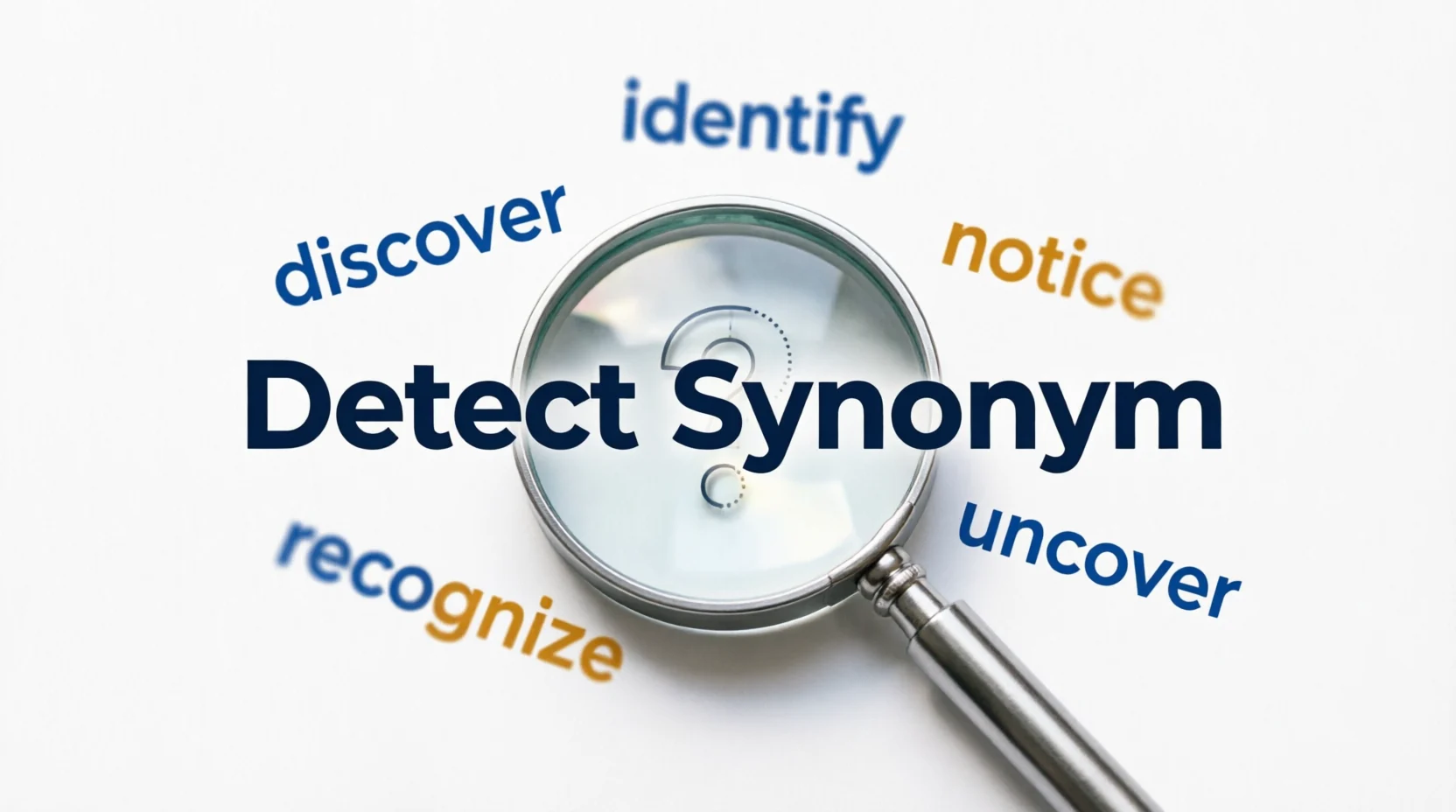
The best synonyms for detect include discover, identify, notice, spot, recognize, observe, uncover, and find. These words describe finding something, becoming aware of it, or discovering information that was not immediately obvious. The right choice depends on the situation, if you are detecting a mistake, identifying a problem, noticing a change, or discovering hidden information.
Quick Answer: What Is a Synonym for Detect?
A synonym for detect is a word that means to discover, notice, identify, or recognize something. The most suitable alternative depends on what you are trying to find.
- Discover: To find something previously unknown.
- Identify: To determine what something is.
- Notice: To become aware of something.
- Spot: To see or find something quickly.
- Recognize: To identify something familiar.
- Uncover: To reveal something hidden.
- Observe: To watch and notice details.
- Find: To locate something or discover information.
What Does Detect Mean?
The verb detect means to discover or notice something that is difficult to see, hear, recognize, or identify. It often involves careful observation, testing, investigation, or the use of special equipment.
For example, a doctor may detect an illness through medical tests, a security system may detect movement, and a teacher may detect a mistake in a student’s work.
Example sentence: The technician detected a problem in the computer system.
In this sentence, detected means the technician discovered that something was wrong.
30 Synonyms for Detect With Meanings and Examples
Here are 30 useful alternatives to detect, along with simple definitions, example sentences, and guidance on when to use each word.
1. Discover
Meaning: To find something that was previously unknown.
Example: Scientists discovered a new species of plant.
Best usage/context: Use discover when finding new information, facts, places, or things.
2. Identify
Meaning: To determine or establish what someone or something is.
Example: The police identified the person in the photograph.
Best usage/context: Use identify when determining a person’s identity, a problem, a cause, or a specific object.
3. Notice
Meaning: To become aware of something through observation.
Example: She noticed a small crack in the window.
Best usage/context: Use notice for everyday observations, changes, mistakes, or details.
4. Spot
Meaning: To see or recognize something, often quickly.
Example: The lifeguard spotted a swimmer in trouble.
Best usage/context: Use spot in informal conversations and situations involving quick visual recognition.
5. Recognize
Meaning: To identify someone or something from previous knowledge or experience.
Example: I recognized a familiar voice in the crowd.
Best usage/context: Use recognize when something becomes familiar or identifiable.
6. Observe
Meaning: To watch something carefully and notice details.
Example: The researcher observed unusual behavior in the animals.
Best usage/context: Use observe in scientific research, formal writing, and careful examination.
7. Uncover
Meaning: To reveal something hidden or unknown.
Example: The investigation uncovered evidence of fraud.
Best usage/context: Use uncover for hidden facts, secrets, evidence, or wrongdoing.
8. Find
Meaning: To discover or locate something.
Example: The engineer found a fault in the machine.
Best usage/context: Use find as a simple, general alternative in everyday English.
9. Noticeably identify — Pinpoint
Meaning: To locate or identify something precisely.
Example: The doctor pinpointed the source of the pain.
Best usage/context: Use pinpoint when the exact location, cause, or source matters.
10. Perceive
Meaning: To become aware of something through the senses or understanding.
Example: She perceived a change in his attitude.
Best usage/context: Use perceive in formal writing or when describing subtle awareness and interpretation.
11. Discern
Meaning: To recognize or understand something that is not immediately clear.
Example: It was difficult to discern the writing in the faded letter.
Best usage/context: Use discern for subtle differences, unclear details, or careful judgment.
12. Reveal
Meaning: To make something known or visible.
Example: The scan revealed a small abnormality.
Best usage/context: Use reveal when a test, report, event, or person brings information to light.
13. Expose
Meaning: To reveal something hidden, especially something harmful or dishonest.
Example: The journalist exposed corruption in the organization.
Best usage/context: Use expose for wrongdoing, risks, hidden problems, or concealed facts.
14. Unmask
Meaning: To reveal the true identity or nature of someone or something.
Example: The detective unmasked the fraudster.
Best usage/context: Use unmask when exposing deception, disguises, or false identities.
15. Diagnose
Meaning: To identify an illness or determine the cause of a problem.
Example: The mechanic diagnosed the engine problem.
Best usage/context: Use diagnose for medical conditions and technical problems when determining their underlying cause.
16. Verify
Meaning: To check whether something is true, accurate, or correct.
Example: The officer verified the driver’s identity.
Best usage/context: Use verify when confirming information rather than simply noticing it.
17. Check
Meaning: To examine something to find out whether it is correct or present.
Example: The software checks for errors in the document.
Best usage/context: Use check in everyday and technical situations involving inspection or testing.
18. Examine
Meaning: To inspect something carefully.
Example: The scientist examined the sample under a microscope.
Best usage/context: Use examine when careful inspection is required before reaching a conclusion.
19. Inspect
Meaning: To look at something closely to assess its condition.
Example: The technician inspected the equipment for damage.
Best usage/context: Use inspect for equipment, buildings, products, documents, and safety checks.
20. Monitor
Meaning: To watch or measure something over time to identify changes.
Example: The system monitors the network for suspicious activity.
Best usage/context: Use monitor when detection happens continuously or repeatedly.
21. Sense
Meaning: To become aware of something through feeling, perception, or a device.
Example: The alarm senses smoke in the room.
Best usage/context: Use sense for physical sensations, intuitive awareness, and automatic detection systems.
22. Register
Meaning: To record or respond to a signal, event, or change.
Example: The instrument registered a sudden rise in temperature.
Best usage/context: Use register for instruments, sensors, measurements, and noticeable reactions.
23. Recognize — Realize
Meaning: To become aware of or understand something.
Example: She realized that she had made a mistake.
Best usage/context: Use realize when becoming mentally aware of a fact or situation rather than physically finding an object.
24. Catch
Meaning: To notice, discover, or identify something, often a mistake or wrongdoing.
Example: The editor caught a spelling error.
Best usage/context: Use catch in informal contexts involving errors, lies, or rule-breaking.
25. Flag
Meaning: To mark something for attention because it may be important or problematic.
Example: The system flagged a suspicious transaction.
Best usage/context: Use flag in workplaces, software systems, security, and reviewing processes.
26. Trace
Meaning: To follow something back to its source or origin.
Example: Investigators traced the email to its sender.
Best usage/context: Use trace when finding the origin, path, history, or cause of something.
27. Locate
Meaning: To find the position or place of something.
Example: The rescue team located the missing hikers.
Best usage/context: Use locate when the main goal is finding where someone or something is.
28. Infer
Meaning: To reach a conclusion based on evidence or clues.
Example: From the footprints, the detective inferred that someone had entered the room.
Best usage/context: Use infer when drawing a conclusion from indirect evidence rather than directly observing something.
29. Investigate
Meaning: To examine a situation systematically to discover facts.
Example: The company investigated the reported security breach.
Best usage/context: Use investigate when discovering something requires research, questioning, or a detailed inquiry.
30. Unravel
Meaning: To solve or understand something complicated or mysterious.
Example: The detective unraveled the mystery behind the missing documents.
Best usage/context: Use unravel for complicated cases, mysteries, confusing events, and hidden explanations.
Comparison Table: Detect vs. Similar Words
| Word | Main meaning | Best situation |
|---|---|---|
| Detect | Discover or become aware of something | Finding a signal or problem |
| Discover | Find something previously unknown | New facts or information |
| Identify | Determine what something is | Naming a person, object, or cause |
| Notice | Become aware of something | Everyday observations |
| Spot | See something quickly | Visual recognition |
| Discern | Recognize subtle details | Careful judgment |
| Uncover | Reveal hidden information | Secrets or evidence |
| Verify | Confirm accuracy | Checking facts |
| Monitor | Watch for changes | Ongoing observation |
| Diagnose | Determine the cause of a condition | Medical or technical problems |
| Trace | Find the origin or path | Tracking a source |
| Infer | Draw a conclusion from evidence | Indirect clues |
How to Choose the Right Synonym for Detect
Not every synonym for detect works in every sentence. Choose a word that matches your intended meaning, tone, and purpose.
1. For Everyday Conversations
Choose notice, spot, find, or catch.
- I noticed a strange sound.
- She spotted her friend across the street.
- We found a mistake in the report.
- The teacher caught an error in my answer.
These words sound natural in everyday speech.
2. For Formal or Academic Writing
Choose identify, observe, discern, or discover.
- Researchers identified a pattern in the results.
- The team observed a change in behavior.
- The analysis revealed a meaningful difference.
These words are useful in academic reports, research papers, and professional communication.
3. For Science and Technology
Choose sense, monitor, register, or detect.
- The device senses changes in pressure.
- The software monitors network activity.
- The instrument registered a temperature increase.
These words describe systems that measure, record, or respond to changes.
4. For Hidden Information or Wrongdoing
Choose uncover, expose, unmask, or investigate.
- The audit uncovered financial irregularities.
- The report exposed serious safety concerns.
- Investigators worked to uncover the truth.
These words are appropriate when information is concealed or requires investigation.
5. For Finding Causes or Sources
Choose diagnose, pinpoint, trace, or infer.
- The technician diagnosed the fault.
- The team pinpointed the source of the leak.
- Investigators traced the problem to a damaged component.
- The detective inferred the likely sequence of events.
Use the word that describes the actual process: identifying a cause, locating a source, following a trail, or drawing a conclusion.
Common Mistakes When Using Synonyms for Detect
1. Using Discover and Detect Interchangeably
Although these words overlap, their meanings are not always identical.
- Detect: The sensor detected smoke.
- Discover: Scientists discovered a previously unknown planet.
Detect often emphasizes noticing or identifying a signal or condition. Discover often emphasizes finding something new or previously unknown.
2. Confusing Notice With Verify
Notice means becoming aware of something, while verify means checking whether it is true or accurate.
- Correct: I noticed a difference in the figures.
- Correct: I verified that the figures were accurate.
Noticing a detail does not automatically confirm its accuracy.
3. Using Diagnose for Every Problem
Diagnose usually refers to determining the cause of a medical condition or technical fault. For a simple spelling mistake, identify or spot is usually more natural.
4. Using Infer When Something Is Directly Observed
Infer means reaching a conclusion from evidence or clues. If you directly see a person enter a room, say you observed the person entering. If you conclude someone entered because of footprints, infer may be more appropriate.
5. Ignoring Tone and Context
Some alternatives are casual, while others are formal or technical. Spot works well in conversation, while discern may suit a formal discussion of subtle differences. Select the word that sounds natural in your sentence.
FAQs:
1. What is the closest synonym for detect?
Discover, identify, and notice are among the closest synonyms. The best choice depends on whether you mean finding something new, determining what something is, or becoming aware of a detail.
2. What is another word for detect in formal writing?
Identify, observe, discern, uncover, and establish can work in formal writing, depending on the sentence. For example, “The researchers identified a significant pattern” sounds appropriate in an academic report.
3. What is a simple word for detect?
Find, notice, and spot are simple alternatives. For example, “I spotted a mistake” is an easy, natural way to say “I detected a mistake.”
4. What is the opposite of detect?
Possible opposites include miss, overlook, ignore, and fail to notice. The best antonym depends on the context. For example, if someone detects an error, someone who does not notice it may overlook it.
5. What is the difference between detect and identify?
Detect means discovering or becoming aware that something exists or is happening. Identify means determining exactly what that thing is. For example, a sensor may detect an unknown substance before a laboratory identifies it.
6. What is a synonym for detect a problem?
Useful alternatives include identify, spot, uncover, recognize, and diagnose. Use diagnose when determining the cause of a medical or technical problem, and spot when noticing an error quickly.
7. What is a synonym for detect a change?
Good alternatives include notice, observe, recognize, register, and identify. Use notice for everyday changes and register when a device or instrument records a measurable change.
8. Can discover always replace detect?
No. The words have related meanings but are not always interchangeable. You can say “The device detected movement,” but “The device discovered movement” may sound less natural when describing a sensor’s immediate function.
Conclusion
Choosing the right synonym for detect helps make your English clearer, more precise, and more natural. Words such as notice, spot, identify, discover, and recognize work well in everyday communication, while discern, verify, monitor, diagnose, and investigate suit more specific situations.
Consider what you are trying to express before selecting an alternative. Are you noticing something, confirming a fact, finding a hidden detail, or identifying the cause of a problem? Matching the word to your meaning will help you write more effectively, communicate accurately, and expand your vocabulary.