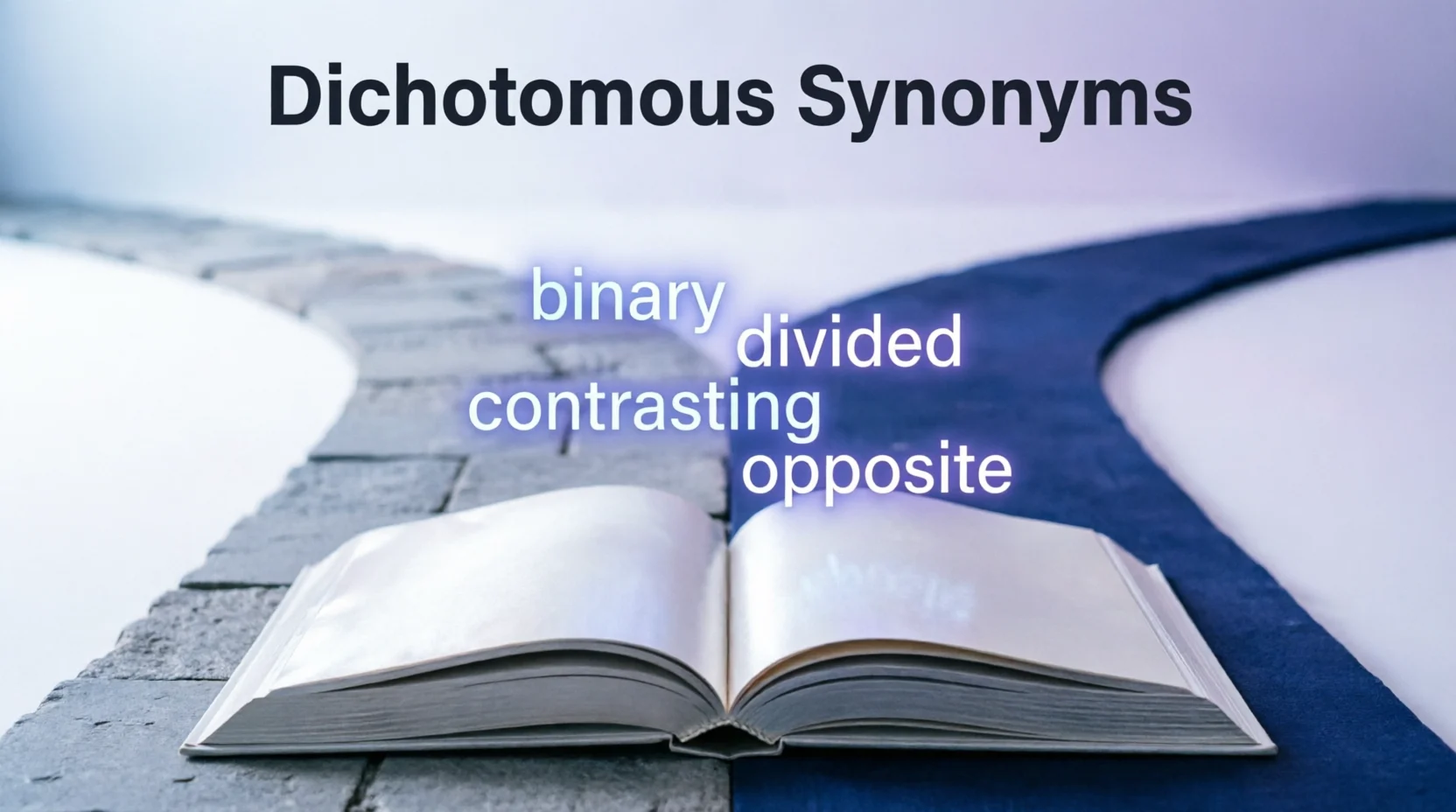
The word dichotomous describes something divided into two distinct, often contrasting or mutually exclusive parts. Common dichotomous synonyms include binary, dual, twofold, divided, contrasting, opposite, and either-or. The best synonym depends on whether you are describing two categories, opposing ideas, or a clear division.
Quick Answer: What Is a Synonym for Dichotomous?
The closest synonyms for dichotomous are binary, dual, divided, twofold, and bipartite. In academic writing, binary is often the most suitable alternative when something is separated into two categories.
What Does Dichotomous Mean?
Dichotomous is an adjective that describes something divided into two distinct groups, choices, classifications, or contrasting parts.
For example, a dichotomous question offers two possible answers, such as yes or no. In biology, a dichotomous key helps identify organisms by presenting two contrasting choices at each step.
The word is commonly used in science, research, philosophy, education, and everyday discussions about opposing ideas.
Example Sentences
- The survey used a dichotomous question with only two possible answers.
- The researcher classified the results into two dichotomous categories.
- Her argument presented a dichotomous view of success and failure.
30 Synonyms for Dichotomous With Meanings and Examples
1. Binary
Meaning: Consisting of two parts, options, or categories.
Example: The questionnaire included a binary response of yes or no.
Best usage: Research, computing, statistics, and classification.
2. Dual
Meaning: Having two parts, functions, or aspects.
Example: The project serves a dual purpose in education and research.
Best usage: General writing when emphasizing two functions or aspects.
3. Twofold
Meaning: Having two parts or being twice as great.
Example: The plan has a twofold objective: saving money and improving quality.
Best usage: Formal writing and explanations of two-part purposes.
4. Divided
Meaning: Separated into different parts or groups.
Example: The participants were divided into two groups.
Best usage: Everyday language and general descriptions.
5. Bipartite
Meaning: Consisting of two parts or sections.
Example: The agreement established a bipartite committee.
Best usage: Legal, academic, organizational, and technical contexts.
6. Opposing
Meaning: In conflict or disagreement with something else.
Example: The debate presented two opposing views of the policy.
Best usage: Arguments, opinions, and disagreements.
7. Contrasting
Meaning: Showing clear differences between two things.
Example: The essay explored two contrasting approaches to leadership.
Best usage: Comparative writing and literary analysis.
8. Opposite
Meaning: Completely different or contrary in direction, meaning, or position.
Example: The two candidates proposed opposite solutions.
Best usage: Everyday conversations and general writing.
9. Polarized
Meaning: Divided into two strongly opposing groups or positions.
Example: The issue left the community polarized.
Best usage: Politics, public opinion, and social debates.
10. Antithetical
Meaning: Directly opposed to something in meaning or nature.
Example: Dishonesty is antithetical to the principles of trust.
Best usage: Formal essays, philosophy, and critical analysis.
11. Dichotomic
Meaning: Relating to a division into two parts.
Example: The researcher adopted a dichotomic classification system.
Best usage: Technical and academic writing.
12. Dichotomized
Meaning: Divided into two categories or treated as having only two sides.
Example: The results were dichotomized into positive and negative responses.
Best usage: Research, data analysis, and scientific discussions.
13. Dualistic
Meaning: Based on the idea that something consists of two distinct or opposing principles.
Example: The philosopher presented a dualistic view of mind and body.
Best usage: Philosophy, religion, psychology, and intellectual discussions.
14. Binary-opposed
Meaning: Arranged as two contrasting or mutually exclusive categories.
Example: The critic examined the binary-opposed concepts of freedom and control.
Best usage: Literary criticism, linguistics, and theoretical analysis.
15. Two-part
Meaning: Consisting of two sections or components.
Example: The teacher introduced a two-part assessment.
Best usage: Clear, simple, and accessible writing.
16. Two-sided
Meaning: Having two sides, aspects, or viewpoints.
Example: The discussion offered a two-sided perspective on the issue.
Best usage: Debates, arguments, and balanced explanations.
17. Dual-sided
Meaning: Involving two sides or aspects.
Example: The campaign addressed a dual-sided challenge.
Best usage: General and professional writing, when the context supports it.
18. Contradictory
Meaning: Inconsistent with or opposed to another statement or idea.
Example: The witness provided two contradictory explanations.
Best usage: Arguments, evidence, statements, and reports.
19. Mutually exclusive
Meaning: Unable to exist or be true at the same time in a particular context.
Example: The survey offered two mutually exclusive answer choices.
Best usage: Statistics, logic, probability, and research.
20. Discrete
Meaning: Separate and distinct rather than continuous.
Example: The analyst organized the observations into discrete categories.
Best usage: Mathematics, science, data analysis, and classification.
21. Separate
Meaning: Not joined together or treated as distinct.
Example: The report examined the two separate outcomes.
Best usage: Everyday and professional writing.
22. Distinct
Meaning: Clearly different or recognizable as separate.
Example: The study identified two distinct patterns in the data.
Best usage: Academic writing and explanations of categories.
23. Alternative
Meaning: Offering another possibility or choice.
Example: The committee considered two alternative approaches.
Best usage: Decision-making, planning, and problem-solving.
24. Either-or
Meaning: Presenting a choice between two possibilities.
Example: The question created an either-or situation for the participants.
Best usage: Informal writing and descriptions of limited choices.
25. Polar
Meaning: Situated at opposite ends or representing contrasting extremes.
Example: The speakers expressed polar opinions about the proposal.
Best usage: Describing extreme differences in opinions or positions.
26. Contrapositional
Meaning: Relating to a proposition formed by contraposition in logic.
Example: The student used a contrapositional argument to examine the claim.
Best usage: Formal logic and specialized academic discussions.
27. Binary-based
Meaning: Organized or structured around two categories or states.
Example: The system relies on a binary-based classification method.
Best usage: Technical explanations and classification systems.
28. Bipolar
Meaning: Having two poles, extremes, or contrasting ends.
Example: The debate revealed a bipolar pattern of public opinion.
Best usage: Scientific or social contexts where two poles or extremes are relevant.
29. Dualistic in nature
Meaning: Characterized by two distinct or opposing principles.
Example: The theory is dualistic in nature, separating mental and physical processes.
Best usage: Philosophy and detailed theoretical explanations.
30. Two-way
Meaning: Involving two directions, parties, or possible paths.
Example: The team developed a two-way classification process.
Best usage: Communication, processes, relationships, and practical explanations.
Comparison Table: Which Dichotomous Synonym Is Best?
| Synonym | Main meaning | Best context |
| Binary | Consisting of two categories | Science and data |
| Dual | Having two aspects | General writing |
| Twofold | Having two parts or purposes | Formal writing |
| Bipartite | Divided into two parts | Technical writing |
| Opposing | In conflict with another | Debates |
| Contrasting | Showing differences | Comparisons |
| Polarized | Divided into opposing camps | Social issues |
| Antithetical | Directly contrary | Academic arguments |
| Mutually exclusive | Cannot both apply at once | Logic and statistics |
| Distinct | Clearly separate | Classification |
How to Choose the Right Synonym for Dichotomous
The right alternative depends on what you want to communicate.
For Academic and Scientific Writing
Use binary, bipartite, dichotomic, or dichotomized when discussing classifications, experiments, or research methods.
Example: “The researchers used a binary classification system.”
For Everyday English
Use divided, two-part, dual, or two-sided for simpler, more natural communication.
Example: “The project has two parts.”
For Opposing Ideas
Use opposing, contrasting, opposite, antithetical, or polarized when describing disagreement or contrasting viewpoints.
Example: “The article compares two opposing perspectives.”
For Logic and Statistics
Use binary, mutually exclusive, or either-or when describing two choices or categories that cannot both apply.
Example: “The participants selected one of two mutually exclusive options.”
For Philosophical Discussions
Use dualistic when describing theories built around two distinct principles, such as mind and body.
Example: “The author explores a dualistic understanding of human experience.”
Common Mistakes When Using Dichotomous Synonyms
1. Treating Every Synonym as an Exact Replacement
Not all synonyms have the same meaning. Dual simply means having two aspects, while opposing emphasizes conflict or contrast.
2. Confusing Dichotomous With Contradictory
A dichotomous classification divides something into two categories. Contradictory statements conflict with one another. Two categories do not necessarily contradict each other.
3. Using Polarized When You Mean Divided
Polarized usually suggests strong disagreement or movement toward opposing extremes. Use divided when you only mean that something has been separated.
4. Assuming All Dichotomies Are Mutually Exclusive
Some two-part classifications allow overlap, depending on their design. Use mutually exclusive only when the categories cannot apply simultaneously.
5. Using Technical Words in Simple Contexts
Words such as bipartite and contrapositional may sound unnatural in everyday writing. Choose familiar terms when they communicate the intended meaning clearly.
FAQs:
1. What is the closest synonym for dichotomous?
Binary is often the closest synonym when describing something divided into two categories. Dual and twofold are also useful alternatives, depending on context.
2. What does dichotomous mean in simple words?
Dichotomous means divided into two distinct parts, groups, or choices. A yes-or-no question is a simple example.
3. Is binary the same as dichotomous?
They are closely related. Binary describes something involving two states or categories, while dichotomous emphasizes a division into two distinct parts.
4. What is another word for dichotomous thinking?
Useful alternatives include either-or thinking, black-and-white thinking, and binary thinking. These terms describe viewing a situation through two opposing options, often while overlooking possibilities in between.
5. What is the opposite of dichotomous?
There is no single universal antonym. Depending on the context, possible opposites include continuous, unified, undivided, or multidimensional.
6. How is dichotomous used in research?
Researchers use dichotomous to describe variables or responses with two possible categories, such as yes/no or present/absent. The exact categories depend on the study.
7. Can I use dual instead of dichotomous?
Sometimes. Dual works when something has two parts or functions, but dichotomous is more precise when emphasizing a division into two distinct categories.
Conclusion
Dichotomous describes something divided into two distinct categories, parts, or contrasting possibilities. The most useful synonyms include binary, dual, twofold, divided, bipartite, contrasting, and opposing. For scientific writing, binary is often a strong choice; for everyday communication, two-part or divided may be clearer. When describing conflicting viewpoints, consider opposing or antithetical. Always choose a synonym that preserves the intended meaning and fits your audience.