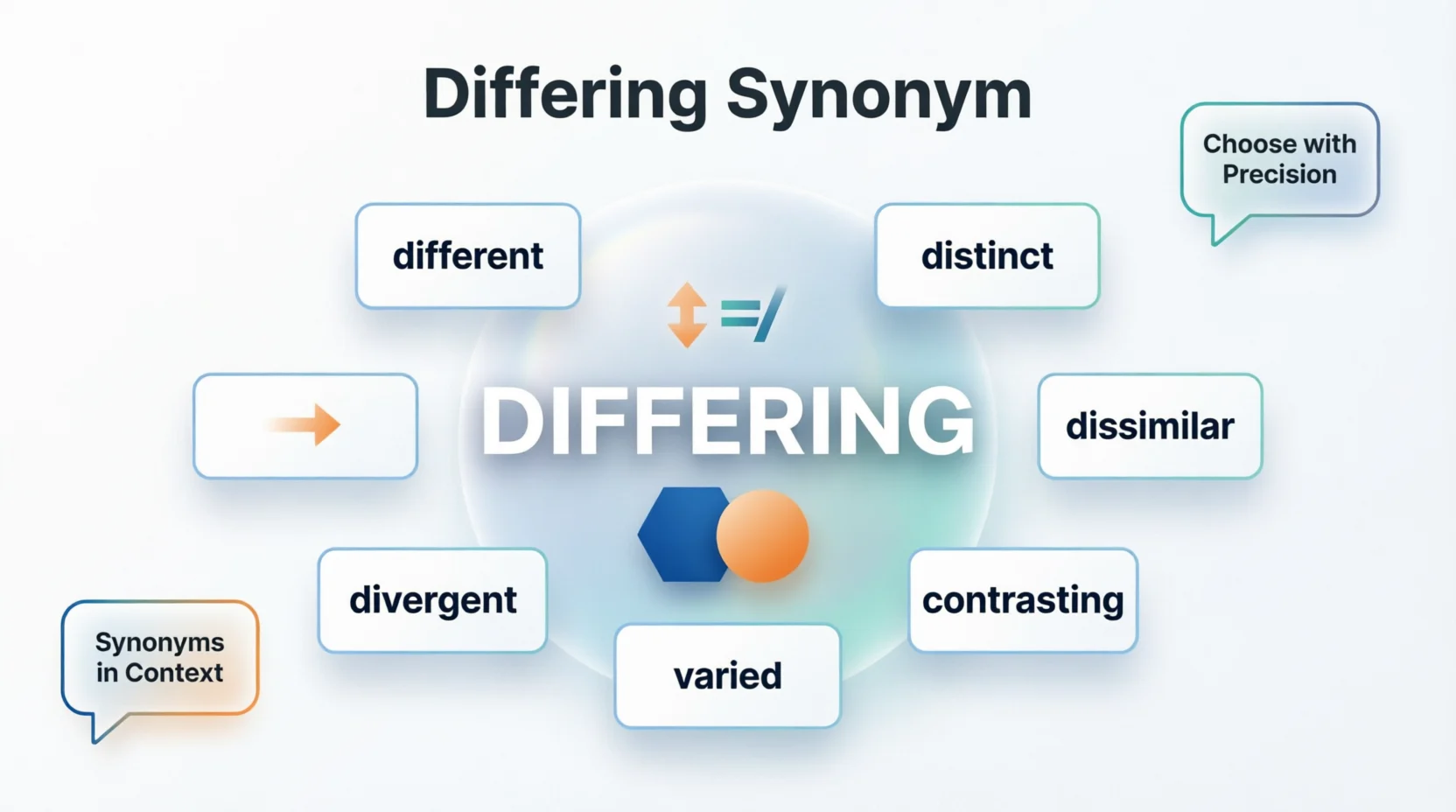
The word “differing” means being different, having distinct opinions, or not being the same in some way. A differing synonym can help you express contrast, disagreement, or variation more clearly in writing and everyday conversation. Common synonyms for differing include different, distinct, dissimilar, contrasting, divergent, and varying.
Choosing the right alternative depends on your sentence and the meaning you want to communicate. For example, “differing opinions” can be rewritten as “contrasting opinions” or “conflicting opinions,” depending on whether you want to emphasize a simple difference or a disagreement.
In this guide, you will discover 30 useful synonyms for differing, their simple meanings, practical example sentences, and the situations in which each word works best. These alternatives can help students, English learners, writers, and professionals improve their vocabulary and communicate more precisely.
Quick Answer: What Is a Synonym for Differing?
The best synonyms for differing include:
- Different
- Distinct
- Dissimilar
- Contrasting
- Divergent
- Varying
- Conflicting
- Inconsistent
- Unalike
- Disparate
Best overall choice: Different is the simplest and most widely understood alternative. Use contrasting for noticeable differences, divergent for ideas or opinions moving apart, and conflicting when two views disagree.
Meaning and Usage of Differing
Differing is an adjective or participle commonly used to describe things, opinions, approaches, or characteristics that are not the same.
It can express two main ideas:
- Being different: Two products have differing features.
- Disagreeing: Two people have differing opinions about a decision.
The word often appears before nouns, as in “differing perspectives,” “differing needs,” and “differing experiences.”
Examples of Differing in Sentences
- The students had differing opinions about the story.
- The two reports presented differing results.
- People have differing preferences when choosing a career.
- The researchers offered differing explanations for the findings.
In each example, you can replace “differing” with another word, but the best choice depends on the intended meaning.
30 Synonyms for Differing With Meanings and Examples
1. Different
Meaning: Not the same as something else.
Example: We have different ideas about how to solve the problem.
Best usage/context: Everyday conversations, school assignments, and general writing.
2. Distinct
Meaning: Clearly separate or recognizable.
Example: The two paintings have distinct styles.
Best usage/context: Describing clearly recognizable characteristics, features, or categories.
3. Dissimilar
Meaning: Not alike in appearance, nature, or qualities.
Example: The brothers have dissimilar personalities.
Best usage/context: Formal writing and comparisons between people, objects, or ideas.
4. Contrasting
Meaning: Showing clear differences between two or more things.
Example: The report presents contrasting views on education.
Best usage/context: Essays, comparisons, reviews, and discussions of opposing characteristics.
5. Divergent
Meaning: Developing in different directions or moving apart.
Example: The committee members expressed divergent opinions.
Best usage/context: Academic writing, discussions, research, and intellectual disagreements.
6. Varying
Meaning: Changing or being different in amount, type, or degree.
Example: The course is suitable for students with varying levels of experience.
Best usage/context: Describing changing conditions, needs, abilities, or quantities.
7. Conflicting
Meaning: Being in disagreement or opposition.
Example: The witnesses provided conflicting accounts of the incident.
Best usage/context: Disagreements, contradictory reports, competing interests, and opposing claims.
8. Inconsistent
Meaning: Not staying the same or not agreeing with something else.
Example: The employee gave inconsistent explanations.
Best usage/context: Describing statements, behavior, results, or actions that do not match.
9. Unalike
Meaning: Not similar to each other.
Example: Although they are friends, their interests are unalike.
Best usage/context: Simple descriptions of differences between people or things.
10. Disparate
Meaning: Very different in kind, nature, or character.
Example: The project brought together people from disparate backgrounds.
Best usage/context: Formal and academic writing, especially when describing diverse groups or unrelated elements.
11. Unequal
Meaning: Not equal in amount, value, size, or status.
Example: The two teams had unequal resources.
Best usage/context: Comparisons involving quantities, opportunities, resources, or treatment.
12. Opposing
Meaning: Taking a position against another position.
Example: The candidates presented opposing arguments.
Best usage/context: Debates, political discussions, disagreements, and competing viewpoints.
13. Contrary
Meaning: Opposite or in disagreement with something.
Example: Contrary opinions emerged during the meeting.
Best usage/context: Formal writing and situations involving opposing ideas or evidence.
14. Incompatible
Meaning: Unable to exist, work, or function together successfully.
Example: Their differing goals proved incompatible.
Best usage/context: Describing goals, systems, personalities, requirements, or ideas that cannot easily coexist.
15. Disagreeing
Meaning: Having different opinions or beliefs.
Example: The disagreeing members continued to discuss the proposal.
Best usage/context: Describing people who do not share the same views. In many sentences, “members who disagreed” sounds more natural.
16. Discrepant
Meaning: Showing a difference or inconsistency between things that are expected to match.
Example: The researchers investigated discrepant results.
Best usage/context: Technical, scientific, and formal writing.
17. Varied
Meaning: Including different types or forms.
Example: The library offers a varied selection of books.
Best usage/context: Describing diversity in choices, experiences, activities, or materials.
18. Diverse
Meaning: Including a range of different types or characteristics.
Example: The conference attracted a diverse group of speakers.
Best usage/context: People, cultures, experiences, backgrounds, and collections.
19. Alternative
Meaning: Different from the usual or original option.
Example: The team considered alternative solutions.
Best usage/context: Discussing choices, methods, plans, and possible replacements.
20. Discriminating
Meaning: Showing the ability to recognize fine differences and make careful judgments.
Example: A discriminating reader notices subtle differences in writing style.
Best usage/context: Describing careful judgment or refined preferences, rather than ordinary disagreement.
21. Opposite
Meaning: Completely different or contrary in direction, position, or meaning.
Example: They reached opposite conclusions from the same evidence.
Best usage/context: Strong contrasts, opposing views, directions, or meanings.
22. Antithetical
Meaning: Directly opposed to something in meaning or principle.
Example: Their approach was antithetical to the organization’s values.
Best usage/context: Formal or academic discussions of fundamentally opposing ideas.
23. Discontinuous
Meaning: Interrupted or not forming a continuous sequence.
Example: The data showed discontinuous patterns over time.
Best usage/context: Scientific, mathematical, and technical descriptions. It is not a general replacement for differing.
24. Fluctuating
Meaning: Changing frequently or irregularly.
Example: The business experienced fluctuating demand throughout the year.
Best usage/context: Describing prices, demand, temperatures, performance, or other changing measurements.
25. Mutable
Meaning: Capable of changing.
Example: Their plans remained mutable as new information became available.
Best usage/context: Formal writing about things that can change over time.
26. Incongruent
Meaning: Not fitting together or not matching appropriately.
Example: His actions seemed incongruent with his stated beliefs.
Best usage/context: Formal analysis of behavior, ideas, expectations, or evidence that does not align.
27. Nonidentical
Meaning: Not exactly the same.
Example: The two documents contained nonidentical wording.
Best usage/context: Precise or technical comparisons where exact sameness matters.
28. Disagreeable
Meaning: Unpleasant or difficult to accept; sometimes describing someone who is argumentative.
Example: They found the working conditions disagreeable.
Best usage/context: Describing unpleasant situations or behavior. It is not normally a synonym for differing when simply expressing variation.
29. Inconsonant
Meaning: Not in agreement or harmony with something.
Example: The conclusion was inconsonant with the available evidence.
Best usage/context: Rare, highly formal writing. “Inconsistent with” is usually clearer and more natural.
30. Unconformable
Meaning: Not conforming or not matching an established standard or pattern.
Example: The results were unconformable to the expected pattern.
Best usage/context: Uncommon or specialized usage. In most everyday contexts, “nonconforming” or “inconsistent” is more natural.
Comparison Table: Best Alternatives to Differing
| Synonym | Main meaning | Best context |
| Different | Not the same | Everyday English |
| Distinct | Clearly separate | Identifying features |
| Dissimilar | Not alike | Comparisons |
| Contrasting | Clearly different | Essays and analysis |
| Divergent | Moving apart in thought or direction | Opinions and research |
| Varying | Different in degree or type | Needs and quantities |
| Conflicting | In disagreement | Claims and arguments |
| Inconsistent | Not matching or staying the same | Evidence and behavior |
| Disparate | Different in nature | Formal writing |
| Diverse | Showing variety | People and backgrounds |
| Opposing | Against another position | Debates |
| Incompatible | Unable to work together | Goals and systems |
| Fluctuating | Changing irregularly | Prices and measurements |
| Incongruent | Not fitting together | Ideas and behavior |
| Antithetical | Fundamentally opposed | Academic discussions |
How to Choose the Right Synonym for Differing
The best synonym depends on your intended meaning, the tone of your writing, and the relationship between the things being compared.
Choose According to Tone
For everyday English: Use different, varied, or unalike. These words are straightforward and easy to understand.
For academic writing: Use divergent, disparate, discrepant, or incongruent when they accurately express the intended meaning.
For professional writing: Use distinct, varying, or inconsistent to explain differences in features, requirements, or results.
Choose According to Meaning
- Simple difference: Different, dissimilar, distinct.
- Clear contrast: Contrasting, opposite, contrary.
- Disagreement: Conflicting, opposing, divergent.
- Variation in amount or degree: Varying, fluctuating, unequal.
- Lack of compatibility: Incompatible, incongruent.
- Variety within a group: Diverse, varied, disparate.
Choose According to Intent
If you want to describe two things without suggesting disagreement, use “different” or “dissimilar.”
If you want to highlight a strong contrast, use “contrasting” or “opposite.”
If you want to show that opinions or conclusions do not agree, use “conflicting” or “divergent.”
If you want to explain that figures or statements do not match, use “inconsistent” or “discrepant.”
Common Mistakes When Using Differing Synonyms
1. Treating Every Synonym as Interchangeable
Not every synonym communicates the same meaning. “Different opinions” simply means opinions are not the same, while “conflicting opinions” suggests disagreement.
2. Using Conflicting When You Mean Different
Two products can have different features without those features contradicting each other. In this situation, “different” or “distinct” is more accurate.
3. Confusing Diverse With Divergent
“Diverse” emphasizes variety, while “divergent” often describes ideas, opinions, or paths moving apart.
For example:
- Diverse backgrounds: people have different experiences or characteristics.
- Divergent opinions: people hold views that differ or move apart.
4. Choosing Unnecessarily Complicated Words
Words such as “antithetical” and “discrepant” can be useful, but they may make ordinary sentences harder to read. Choose simple words when they communicate your meaning accurately.
5. Ignoring Grammar and Sentence Structure
Some alternatives fit naturally before nouns, while others may require a different sentence structure.
- Natural: The researchers reported differing results.
- Natural: The researchers reported conflicting results.
- Natural: The results differed.
Always check that your chosen word fits the sentence grammatically.
FAQs:
1. What is the best synonym for differing?
Different is the best general synonym for differing because it is simple, common, and suitable for most everyday situations. However, “contrasting” or “conflicting” may be more precise when describing opposing opinions.
2. What is another word for differing opinions?
Common alternatives include different opinions, contrasting views, divergent perspectives, opposing viewpoints, and conflicting opinions. Choose the phrase that best reflects the degree of disagreement.
3. What is a formal synonym for differing?
Formal alternatives include divergent, disparate, discrepant, incongruent, and antithetical. Their meanings vary, so select one that accurately describes the relationship between the ideas or things.
4. Is varying a synonym for differing?
Yes. “Varying” can be a synonym for differing when describing differences in amount, type, level, or degree. For example, “students with differing abilities” can also be written as “students with varying abilities.”
5. What is the difference between differing and conflicting?
“Differing” means not being the same, while “conflicting” suggests opposition or disagreement. Two approaches may differ without being incompatible, but conflicting approaches may work against each other.
6. What is a synonym for differing in academic writing?
Depending on the context, use divergent for opinions or ideas, discrepant for results that do not match, or distinct for clearly separate characteristics.
7. Can different replace differing in every sentence?
No. Although the words often overlap, grammar and meaning matter. “Differing opinions” and “different opinions” are both natural, but “differing results” may emphasize variation between findings, while “different results” is a more general expression.
Conclusion
Learning synonyms for differing helps you express differences, contrasts, disagreements, and variations more precisely. Words such as different, distinct, dissimilar, contrasting, and varying work well in everyday writing, while divergent, discrepant, and antithetical suit more specific or formal contexts.
The most effective choice depends on what you want to communicate. Use simple vocabulary when possible, choose precise alternatives when necessary, and consider the tone and meaning of the complete sentence. With practice, you can make your writing clearer, more natural, and more engaging.