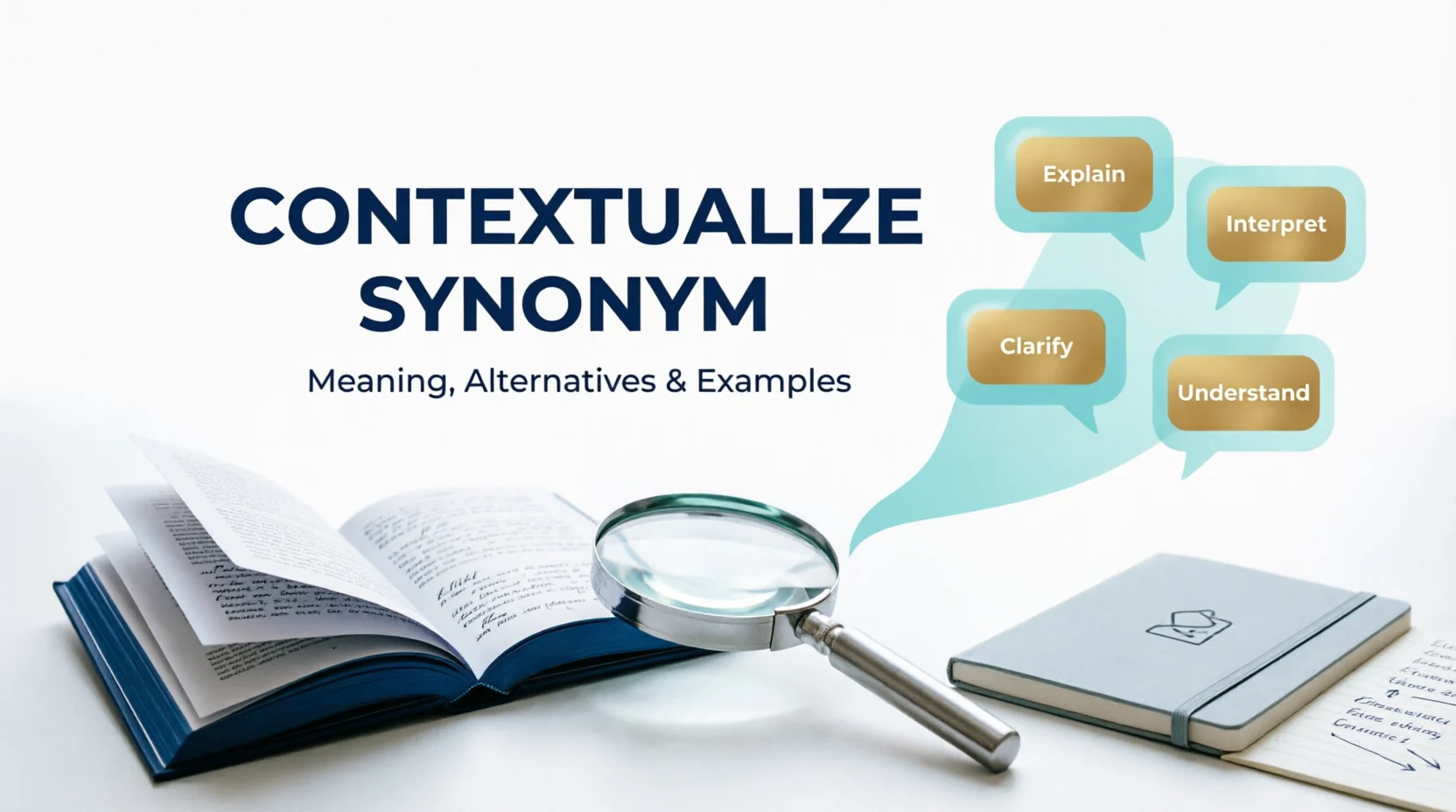
When you need a contextualize synonym, the best alternatives include explain, clarify, interpret, frame, situate, describe, illustrate, and put into context. The right choice depends on if you want to add background, explain meaning, show relationships, or help someone understand an idea more clearly.
Quick Answer: What Is a Synonym for Contextualize?
The most useful synonyms for contextualize are explain, clarify, frame, situate, interpret, qualify, describe, illustrate, and provide background for.
Contextualize means to explain something by giving the surrounding information, circumstances, history, or situation that helps people understand it properly.
For example:
- Original: The teacher contextualized the historical event.
- Alternative: The teacher explained the historical event by providing relevant background.
The best synonym depends on what kind of context you want to add.
What Does Contextualize Mean?
Contextualize means to place an idea, statement, event, or piece of information within its relevant background or circumstances.
It helps readers or listeners understand why something happened, what influenced it, or how it relates to other information.
For example:
The author contextualized the character’s decision by explaining her difficult childhood.
Here, the childhood information gives readers a better understanding of the character’s decision.
Contextualize in Simple English
In simple terms, contextualize means to give background information so something makes more sense.
You might contextualize:
- A historical event
- A quotation
- A political decision
- A scientific discovery
- A person’s behavior
- A literary passage
- A cultural tradition
- A controversial statement
- A research finding
30 Synonyms for Contextualize
1. Explain
Simple meaning: Make something easier to understand.
Example: The professor explained the theory using a simple example.
Best usage/context: General writing and everyday communication.
2. Clarify
Simple meaning: Make something clearer or less confusing.
Example: The manager clarified the reasons behind the new policy.
Best usage/context: When information is unclear or confusing.
3. Interpret
Simple meaning: Explain the meaning of something.
Example: The critic interpreted the poem in relation to its historical period.
Best usage/context: Literature, art, research, and complex ideas.
4. Frame
Simple meaning: Present something in a particular way or context.
Example: The journalist framed the decision as a response to economic pressure.
Best usage/context: Journalism, academic writing, politics, and persuasive communication.
5. Situate
Simple meaning: Place something within a particular setting or context.
Example: The researcher situated the discovery within the development of modern medicine.
Best usage/context: Academic, historical, and scholarly writing.
6. Describe
Simple meaning: Give information about something.
Example: The historian described the social conditions of the period.
Best usage/context: General explanations and informative writing.
7. Illustrate
Simple meaning: Explain something by giving an example.
Example: The teacher illustrated the concept with a real-life situation.
Best usage/context: Teaching, presentations, and explanatory writing.
8. Elaborate
Simple meaning: Give more details about something.
Example: The researcher elaborated on the causes of the problem.
Best usage/context: Formal and academic writing.
9. Qualify
Simple meaning: Add information that limits or modifies a statement.
Example: The scientist qualified her conclusion by mentioning the study’s limitations.
Best usage/context: Academic, scientific, and careful analytical writing.
10. Put into context
Simple meaning: Give background information that helps explain something.
Example: The speaker put the incident into context by describing what happened earlier.
Best usage/context: Everyday, educational, and professional communication.
11. Provide Background
Simple meaning: Give important information about what came before.
Example: The article provides background on the country’s political history.
Best usage/context: Articles, reports, essays, and educational materials.
12. Give Context
Simple meaning: Provide surrounding information that makes something easier to understand.
Example: The introduction gives context for the author’s argument.
Best usage/context: General and academic writing.
13. Explain the Background
Simple meaning: Describe the circumstances surrounding something.
Example: The documentary explains the background of the conflict.
Best usage/context: Historical, educational, and documentary writing.
14. Set the Scene
Simple meaning: Establish the circumstances or situation.
Example: The opening chapter sets the scene for the events that follow.
Best usage/context: Storytelling, literature, presentations, and journalism.
15. Establish Context
Simple meaning: Provide the information needed to understand something.
Example: The introduction establishes context for the research findings.
Best usage/context: Academic and professional writing.
16. Place in Context
Simple meaning: Show how something relates to its surrounding circumstances.
Example: We need to place the statistic in context before drawing conclusions.
Best usage/context: Research, analysis, journalism, and formal discussions.
17. Relate
Simple meaning: Show a connection between things.
Example: The lecturer related the theory to everyday experiences.
Best usage/context: Teaching, explanation, and analytical writing.
18. Connect
Simple meaning: Show how different ideas or events are related.
Example: The author connects the character’s actions to her past experiences.
Best usage/context: General writing, education, and analysis.
19. Account For
Simple meaning: Explain why something happened or exists.
Example: The report accounts for the sudden increase in demand.
Best usage/context: Analytical, academic, and professional writing.
20. Expound
Simple meaning: Explain an idea in detail.
Example: The professor expounded on the historical significance of the discovery.
Best usage/context: Formal or scholarly writing.
21. Elucidate
Simple meaning: Make something complicated clearer.
Example: The diagram helps elucidate the relationship between the two processes.
Best usage/context: Formal, academic, and technical writing.
22. Demonstrate
Simple meaning: Show clearly how something works or is true.
Example: The experiment demonstrates the importance of temperature.
Best usage/context: Academic, scientific, and instructional writing.
23. Highlight
Simple meaning: Draw attention to an important part.
Example: The report highlights the social factors behind the decision.
Best usage/context: Reports, presentations, articles, and professional writing.
24. Characterize
Simple meaning: Describe the qualities or nature of something.
Example: The historian characterized the period as a time of major social change.
Best usage/context: Literature, history, criticism, and academic writing.
25. Define
Simple meaning: State the exact meaning or nature of something.
Example: The textbook defines the term before discussing its broader implications.
Best usage/context: Educational, technical, and academic writing.
26. Analyze
Simple meaning: Examine something carefully to understand it.
Example: The essay analyzes the speech within its historical setting.
Best usage/context: Academic, research, literary, and critical writing.
27. Examine
Simple meaning: Look at something carefully and in detail.
Example: The study examines the decision in its social context.
Best usage/context: Research, academic writing, and formal analysis.
28. Reframe
Simple meaning: Present something from a different perspective.
Example: The writer reframed the problem as an opportunity for improvement.
Best usage/context: Communication, psychology, business, and persuasive writing.
29. Ground
Simple meaning: Support an idea by connecting it to relevant facts or circumstances.
Example: The author grounded the argument in historical evidence.
Best usage/context: Academic, analytical, and professional writing.
30. Explain in Context
Simple meaning: Explain something by considering its surrounding circumstances.
Example: The teacher explained the quotation in context.
Best usage/context: Education, literature, history, and general explanation.
Contextualize Synonyms Comparison Table
| Synonym | Main Meaning | Formality | Best Context |
|---|---|---|---|
| Explain | Make something understandable | Neutral | General writing |
| Clarify | Remove confusion | Neutral | Explanations |
| Interpret | Explain meaning | Formal | Literature and analysis |
| Frame | Present from a particular perspective | Formal | Journalism and analysis |
| Situate | Place within a context | Formal | Academic writing |
| Describe | Give details | Neutral | General writing |
| Illustrate | Explain with examples | Neutral | Teaching |
| Elaborate | Add details | Formal | Academic writing |
| Qualify | Add limitations or conditions | Formal | Research |
| Put into context | Add background | Neutral | General communication |
| Provide background | Explain what came before | Neutral | Articles and reports |
| Relate | Show a connection | Neutral | Education |
| Connect | Show relationships | Neutral | General writing |
| Account for | Explain a cause | Formal | Analysis |
| Elucidate | Make clearer | Very formal | Scholarly writing |
| Reframe | Present differently | Neutral/Formal | Communication |
| Ground | Support with context or evidence | Formal | Academic writing |
How to Choose the Right Synonym for Contextualize
The best synonym depends on your meaning, tone, and purpose.
For Simple and Everyday Writing
Choose:
- Explain
- Clarify
- Describe
- Give context
- Put into context
These words are easy for most readers to understand.
Example:
Instead of:
The speaker contextualized the issue.
You can write:
The speaker explained the issue by providing background information.
For Academic Writing
Choose:
- Situate
- Interpret
- Analyze
- Establish context
- Examine
- Elucidate
- Qualify
These alternatives work well when discussing research, history, literature, or theory.
Example:
The researcher situated the findings within previous studies.
For Journalism and Media
Choose:
- Frame
- Explain
- Provide background
- Put into context
- Highlight
- Characterize
These words help explain how an event or statement should be understood.
Example:
The article put the recent figures into context by comparing them with previous years.
When You Mean “Make Something Clearer”
Use:
- Clarify
- Explain
- Elucidate
- Illustrate
- Elaborate
Example:
The diagram clarifies how the process works.
When You Mean “Show a Relationship”
Use:
- Relate
- Connect
- Situate
- Place in context
- Ground
Example:
The author connected the character’s behavior to her childhood experiences.
When You Mean “Present From a Particular Perspective”
Use:
- Frame
- Reframe
- Characterize
- Interpret
Example:
The article framed the decision as an economic necessity.
Contextualize vs. Explain
Contextualize and explain are closely related, but they are not always interchangeable.
Explain means making something understandable.
Contextualize means making something understandable by giving relevant surrounding information.
For example:
The teacher explained the war.
This means the teacher made the subject understandable.
The teacher contextualized the war.
This suggests that the teacher discussed the historical, political, social, or cultural circumstances surrounding the war.
Therefore, contextualize is more specific than explain when background information is important.
Contextualize vs. Clarify
Clarify means removing confusion or ambiguity.
Contextualize means adding background or surrounding circumstances.
For example:
The manager clarified the instructions.
The manager made the instructions easier to understand.
The manager contextualized the instructions.
The manager explained why the instructions existed or how they related to a larger situation.
Contextualize vs. Interpret
Interpret focuses on determining or explaining meaning.
Contextualize focuses on the circumstances surrounding something.
For example:
The student interpreted the poem.
The student explained what the poem means.
The student contextualized the poem.
The student explained the historical, cultural, or literary circumstances surrounding the poem.
Common Mistakes When Using Contextualize Synonyms
Using “Explain” When Background Is Important
Although explain is often a good substitute, it can be less precise when the main purpose is to provide historical or situational background.
Using “Clarify” for Every Situation
Clarify means removing confusion. It does not necessarily mean giving broader context.
Using “Interpret” When You Only Mean Describe
Interpretation involves meaning or significance. If you simply provide factual details, describe may be more appropriate.
Using “Elucidate” in Casual Writing
Elucidate is correct, but it sounds highly formal. In everyday communication, explain or clarify usually sounds more natural.
Choosing a Synonym Without Considering Tone
Words such as situate, elucidate, expound, and qualify are more formal than explain, describe, and clarify.
Always consider your audience before choosing an alternative.
FAQs:
What is the best synonym for contextualize?
The best general synonym is put into context. Depending on the situation, explain, clarify, situate, frame, or interpret may be more precise.
What is a simple word for contextualize?
A simple alternative is explain. If you specifically mean adding background information, give context is also very clear.
What is a formal synonym for contextualize?
Formal alternatives include situate, elucidate, interpret, qualify, frame, analyze, and establish context.
Is “explain” the same as “contextualize”?
Not exactly. Explain means making something understandable, while contextualize usually means explaining something by giving relevant background or surrounding circumstances.
What is the opposite of contextualize?
Depending on the situation, possible opposites include isolate, decontextualize, separate, detach, or take out of context.
How do you use contextualize in a sentence?
You can say: “The historian contextualized the event by explaining the political and social conditions of the period.”
What is another word for putting something into context?
You can use situate, frame, contextualize, place in context, or provide background for something.
Which contextualize synonym is best for academic writing?
Situate is especially useful in academic writing when you want to show how an idea, study, or event relates to a broader historical or theoretical setting.
Conclusion
Choosing the right contextualize synonym depends on exactly what you want to communicate. Explain is the safest general alternative, while clarify works when something is confusing. Situate is useful for academic and historical writing, interpret focuses on meaning, and frame emphasizes perspective.
For simple writing, phrases such as give context, provide background, and put into context are natural and easy to understand. By considering your intended meaning, audience, and tone, you can select a synonym that makes your writing clearer, more precise, and more effective.