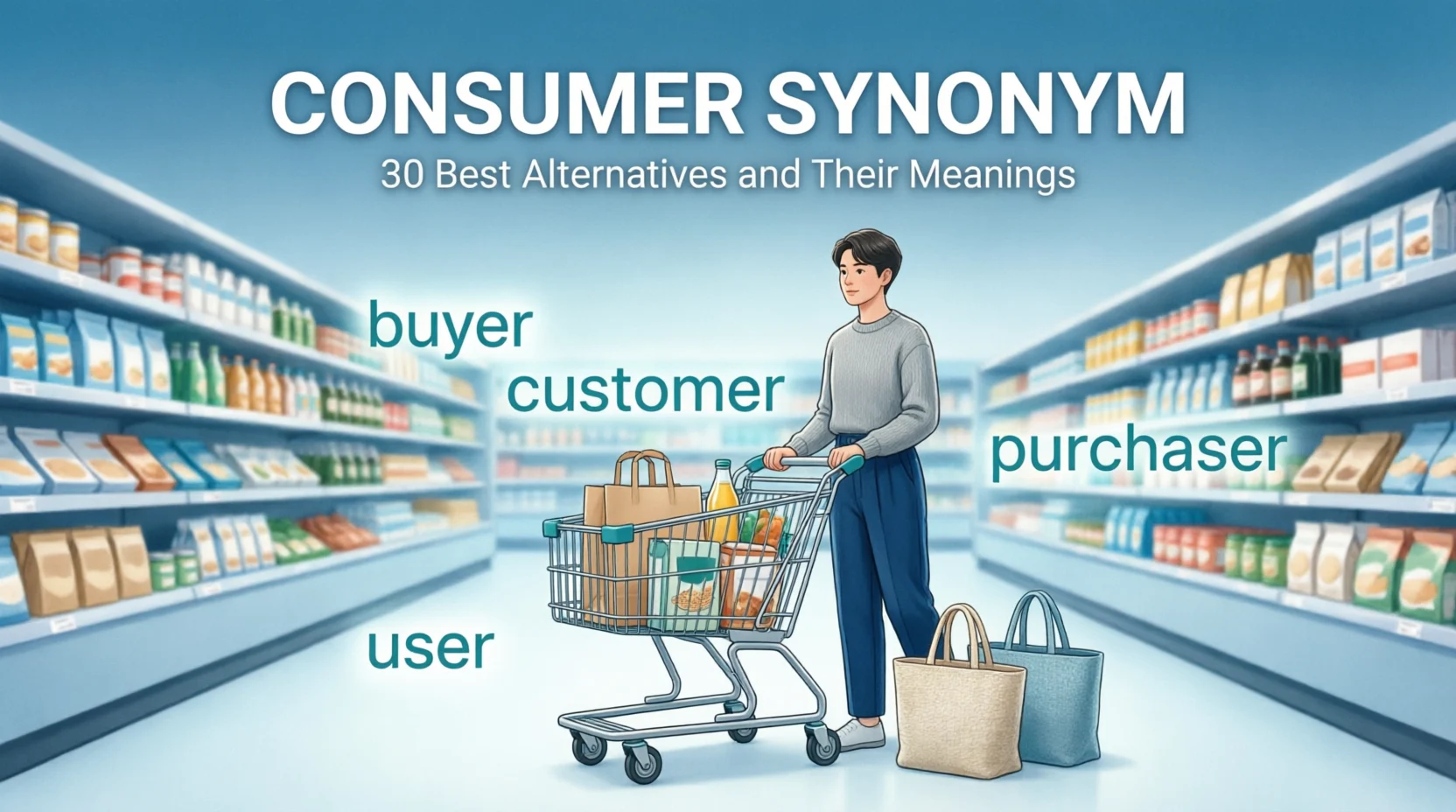
The word consumer usually refers to a person who buys, uses, or receives goods and services. Depending on the context, you may want a more specific word such as customer, buyer, purchaser, shopper, user, client, or end user. Choosing the right synonym can make your writing clearer and more natural.
If you are looking for a consumer synonym, the best choice depends on what you mean. In everyday shopping, customer or buyer may work well. In business writing, purchaser, client, or end user can be more precise. In economics, household, individual, or consumer may describe the intended group differently.
This guide provides 30 useful synonyms for consumer, along with simple meanings, examples, and the situations where each word works best.
Quick Answer
The most common synonyms for consumer are customer, buyer, purchaser, shopper, client, user, end user, patron, and purchaser.
However, these words are not always interchangeable. A buyer purchases something, while a user actually uses it. A customer may buy a product or service, while a client usually has an ongoing professional relationship with a business.
What Does Consumer Mean?
A consumer is a person or organization that buys, uses, or consumes a product or service.
For example:
Consumers often compare prices before buying a new phone.
Here, consumers means people who purchase or use products.
The word can also have a broader meaning in economics. A consumer may be someone who uses goods and services to satisfy personal or household needs.
30 Synonyms for Consumer
1. Customer
Simple meaning: A person who buys goods or services from a business.
Example: The customer asked whether the shoes were available in another size.
Best usage/context: Everyday shopping, retail, restaurants, and business communication.
2. Buyer
Simple meaning: A person who buys something.
Example: The buyer carefully checked the car before making an offer.
Best usage/context: Sales, shopping, real estate, cars, and general purchasing situations.
3. Purchaser
Simple meaning: Someone who purchases something.
Example: The purchaser received a receipt after completing the transaction.
Best usage/context: Formal, legal, commercial, and business writing.
4. Shopper
Simple meaning: Someone who is looking for or buying products.
Example: The shopper compared several brands before choosing one.
Best usage/context: Retail, supermarkets, clothing stores, and online shopping.
5. User
Simple meaning: A person who uses a product, service, or system.
Example: The user found the new application easy to navigate.
Best usage/context: Technology, software, apps, products, and services.
6. Client
Simple meaning: A person or organization that receives professional services.
Example: The client asked the designer to make a few changes.
Best usage/context: Lawyers, consultants, designers, agencies, accountants, and professional services.
7. End User
Simple meaning: The person who ultimately uses a product or service.
Example: The software was redesigned to make it easier for the end user.
Best usage/context: Technology, software, manufacturing, product development, and business writing.
8. Patron
Simple meaning: A person who regularly uses or supports a business or service.
Example: Every patron received a discount during the restaurant’s anniversary week.
Best usage/context: Restaurants, theaters, libraries, arts organizations, and traditional formal writing.
9. Guest
Simple meaning: A person receiving hospitality or using a service.
Example: Every hotel guest received a complimentary breakfast.
Best usage/context: Hotels, hospitality, restaurants, and events.
10. Subscriber
Simple meaning: A person who pays for or signs up for a service.
Example: Each subscriber received access to the new video library.
Best usage/context: Streaming platforms, magazines, newsletters, software, and membership services.
11. Member
Simple meaning: A person who belongs to an organization, club, or service.
Example: Every gym member can use the fitness center at any time.
Best usage/context: Clubs, gyms, organizations, memberships, and subscription communities.
12. Account Holder
Simple meaning: A person who owns or controls an account.
Example: The account holder must verify their identity before making a payment.
Best usage/context: Banking, websites, digital services, telecommunications, and financial services.
13. Buyer
Simple meaning: Someone who makes a purchase.
Example: The buyer wanted to know whether delivery was included.
Best usage/context: Commerce, retail, property, vehicles, and transactions.
14. Purchaser
Simple meaning: A person or organization that obtains something by paying for it.
Example: The purchaser agreed to the terms before completing the order.
Best usage/context: Contracts, formal business documents, and commercial transactions.
15. Clientele
Simple meaning: The group of clients served by a business.
Example: The restaurant has a loyal clientele from the local community.
Best usage/context: Business writing when referring to a group rather than one person.
16. Audience
Simple meaning: The people who receive, watch, read, or listen to something.
Example: The company created the campaign for a younger audience.
Best usage/context: Media, advertising, publishing, entertainment, and marketing.
17. Recipient
Simple meaning: A person who receives something.
Example: The recipient received the package two days after ordering it.
Best usage/context: Deliveries, payments, gifts, communications, and formal writing.
18. Beneficiary
Simple meaning: Someone who receives a benefit or advantage.
Example: The beneficiary received financial assistance from the program.
Best usage/context: Insurance, trusts, financial programs, charities, and legal contexts.
19. Household
Simple meaning: The people living together in one home, considered as an economic unit.
Example: The survey asked each household about its monthly spending.
Best usage/context: Economics, statistics, research, government reports, and market studies.
20. Individual
Simple meaning: One person considered separately.
Example: Each individual can choose the service that best fits their needs.
Best usage/context: Formal writing, research, statistics, economics, and general contexts.
21. Buyer-User
Simple meaning: A person who both purchases and uses a product.
Example: The company designed the product for buyer-users who want convenience.
Best usage/context: Product discussions where the purchaser and user are the same person.
22. Customer
Simple meaning: A person or organization that buys from a business.
Example: The store values every customer and responds quickly to complaints.
Best usage/context: Retail, services, e-commerce, restaurants, and general business writing.
23. Client User
Simple meaning: A user who receives or uses a service provided to clients.
Example: The platform allows client users to access their documents online.
Best usage/context: Professional services and business-to-business technology.
24. Subscriber
Simple meaning: Someone who regularly pays for or receives a service.
Example: The subscriber received a notification about the price change.
Best usage/context: Digital services, magazines, streaming platforms, newsletters, and memberships.
25. Service User
Simple meaning: A person who uses a particular service.
Example: Service users can submit feedback through the online portal.
Best usage/context: Public services, healthcare, social services, transportation, and formal organizations.
26. Consumerist
Simple meaning: A person strongly focused on buying and consuming goods.
Example: The novel portrays a consumerist society driven by constant shopping.
Best usage/context: Social commentary and discussions about consumer culture.
27. Purchaser Representative
Simple meaning: A person who buys products on behalf of another person or organization.
Example: The purchaser representative negotiated better prices with suppliers.
Best usage/context: Procurement, corporate purchasing, and organizational buying.
28. Market Participant
Simple meaning: A person or organization involved in buying or selling within a market.
Example: Every market participant responds to changes in supply and demand.
Best usage/context: Economics, finance, business analysis, and market research.
29. Buyer Persona
Simple meaning: A fictional profile representing a typical customer or buyer.
Example: The company created a buyer persona to understand its target audience.
Best usage/context: Business research, product planning, advertising, and customer analysis.
30. Demand-Side User
Simple meaning: A person or group representing the demand for goods or services.
Example: The research examined how demand-side users responded to higher prices.
Best usage/context: Economics, market research, policy discussions, and analytical writing.
Consumer Synonyms Comparison Table
| Synonym | Main Meaning | Formality | Best Context |
| Customer | Person who buys from a business | Neutral | Retail and services |
| Buyer | Person who purchases something | Neutral | Sales and shopping |
| Purchaser | Person who makes a purchase | Formal | Business and legal writing |
| Shopper | Person looking for products | Casual/Neutral | Retail and shopping |
| User | Person who uses something | Neutral | Products and technology |
| Client | Person receiving professional services | Formal | Professional services |
| End user | Final person using a product | Formal | Technology and business |
| Patron | Person supporting or using a business | Formal | Restaurants and arts |
| Guest | Person receiving hospitality | Neutral | Hotels and events |
| Subscriber | Person signed up for a service | Neutral | Digital services |
| Member | Person belonging to a group | Neutral | Clubs and organizations |
| Recipient | Person receiving something | Formal | Deliveries and payments |
| Audience | People receiving content | Neutral | Media and advertising |
| Beneficiary | Person receiving a benefit | Formal | Legal and financial contexts |
| Household | Economic unit of people in a home | Formal | Economics and research |
Consumer vs. Customer
Consumer and customer are closely related, but they can have different meanings.
A customer is generally someone who buys something from a business. A consumer is someone who uses or consumes the product or service.
For example, a parent may purchase a toy for a child. The parent is the customer, while the child may be the consumer.
Consumer vs. Buyer
A buyer specifically emphasizes the act of purchasing.
A consumer can emphasize the use or consumption of a product.
Buyer: The buyer paid for the laptop.
Consumer: The consumer uses the laptop for work and entertainment.
In many everyday situations, the two words can be used interchangeably, but their focus is slightly different.
Consumer vs. User
A user is someone who uses a product, service, application, or system. The user does not necessarily have to purchase it.
For example, an employee may use software purchased by their company. The employee is the user, while the company may be the buyer.
Consumer vs. Client
A client usually has a relationship with a professional or service provider.
For example:
- A person buying a shirt is usually a customer.
- A person hiring a lawyer is usually a client.
- A person using an application is usually a user.
- A person purchasing a product is a buyer.
How to Choose the Right Synonym for Consumer
For Everyday Situations
Use customer, buyer, shopper, or user.
These words sound natural in everyday conversations and general writing.
Example: The customer returned the jacket because it was too small.
For Business Writing
Use customer, purchaser, client, end user, or buyer.
These terms can make business communication more precise.
Example: The company collected feedback from end users before launching the product.
For Technology
Use user, end user, account holder, or subscriber.
These words describe different relationships with digital products and services.
Example: The developer improved the application based on user feedback.
For Professional Services
Use client.
This is usually more appropriate than customer when someone receives professional advice or specialized services.
Example: The lawyer explained the contract to the client.
For Economics
Use consumer, household, individual, or market participant, depending on the intended meaning.
Example: Consumer spending increased during the holiday season.
For Marketing
Use customer, buyer, target audience, buyer persona, or consumer.
The best word depends on whether you are discussing actual purchasers, potential purchasers, or a broader audience.
Common Mistakes When Using Consumer Synonyms
Using Customer When You Mean User
Not every user is a customer.
Someone can use a product without personally buying it.
Less precise: Every customer must install the application.
Better: Every user must install the application.
Using Client for Every Customer
The word client is generally associated with professional or ongoing services.
A person buying a snack from a store is normally called a customer, not a client.
Confusing Buyer and Consumer
The buyer and consumer can be different people.
For example, a parent may buy cereal, but the child may consume it.
Using Shopper After the Purchase
A shopper usually describes someone who is browsing or buying products.
After the transaction, customer or buyer may be more appropriate depending on the context.
Using Audience as a Direct Replacement
An audience receives or engages with content. It does not necessarily purchase anything.
For example, people watching a video are an audience, even if they never buy the advertised product.
FAQs:
What is the best synonym for consumer?
The best general synonym is customer. However, buyer, user, purchaser, shopper, or client may be more accurate depending on the situation.
Is customer another word for consumer?
Yes, in many everyday contexts. However, a customer usually emphasizes purchasing from a business, while a consumer can emphasize using or consuming a product or service.
What is a formal synonym for consumer?
Formal alternatives include purchaser, end user, service user, beneficiary, individual, household, and market participant, depending on the context.
What is another word for consumer in business?
Common business alternatives include customer, buyer, purchaser, client, end user, and account holder.
What is the opposite of consumer?
A commonly used opposite in an economic context is producer, meaning a person or organization that creates or supplies goods and services.
What is a synonym for consumer in economics?
Depending on the context, household, individual, buyer, market participant, or consumer itself may be appropriate.
Is user a synonym for consumer?
Yes, sometimes. A user is someone who uses a product or service, while a consumer can refer more broadly to someone who purchases or consumes it.
What is the difference between a consumer and a purchaser?
A purchaser specifically buys something. A consumer may buy the product, use it, or consume it. Therefore, the two roles can belong to different people.
Conclusion
The word consumer has many useful alternatives, but the best synonym depends on the exact meaning you want to communicate. Customer is ideal for general business situations, while buyer emphasizes purchasing. User focuses on using a product or service, and client is usually better for professional relationships. Purchaser works well in formal and commercial writing, while shopper is natural for retail situations.
Choosing a precise synonym can make your writing clearer, more natural, and easier to understand. Before replacing consumer, consider if you are talking about someone who buys, uses, receives, or benefits from a product or service.