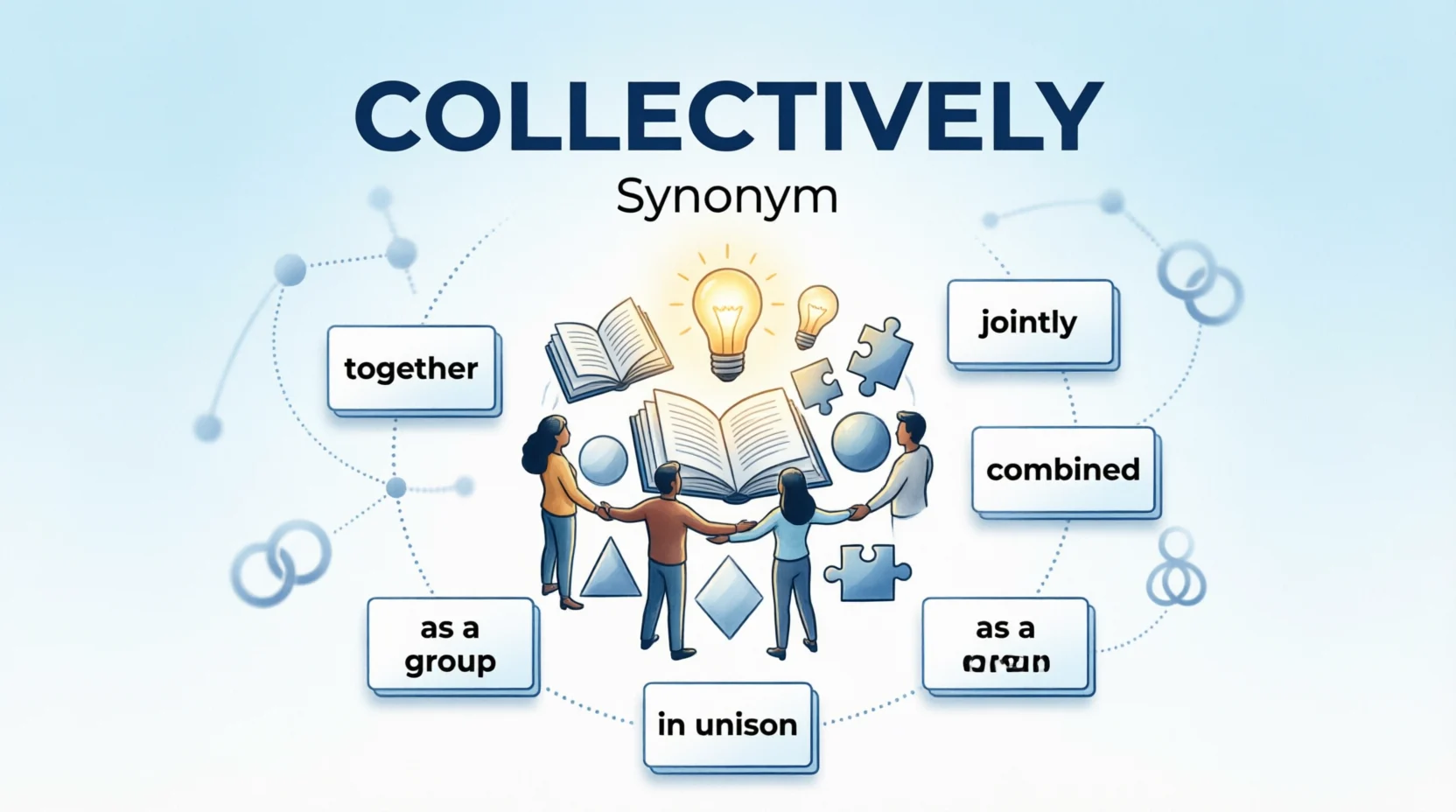
When you need a synonym for “collectively,” useful alternatives include together, jointly, as a group, in total, combined, mutually, altogether, cooperatively, and as a whole. The best choice depends on whether you are describing people acting together, things considered as one unit, or a combined total.
Quick Answer
Collectively means together as a group or considered as a whole.
For example:
- The students collectively completed the project.
- The companies collectively invested $2 million.
- These factors collectively contributed to the problem.
Common synonyms for collectively include together, jointly, as a group, altogether, combined, as a whole, in total, cooperatively, mutually, and unitedly.
What Does “Collectively” Mean?
Collectively is an adverb used when several people, things, or actions are considered together rather than separately.
It can describe people working toward the same goal:
The team collectively decided to change the schedule.
It can also describe several things producing one combined result:
These factors collectively affect the final outcome.
Another common use is to describe a total:
The three departments collectively employ 500 people.
In simple terms, collectively = together, as a group, or taken as a whole.
30 Synonyms for Collectively
1. Together
Simple meaning: With each other or as one group.
Example: The friends worked together to organize the event.
Best usage/context: Everyday writing and speech when people or things act as a group.
2. Jointly
Simple meaning: Done or shared by two or more people or groups.
Example: The two organizations jointly released the report.
Best usage/context: Formal, professional, business, and academic writing.
3. As a Group
Simple meaning: Considered or acting as one group.
Example: The students decided as a group to support the proposal.
Best usage/context: Clear, straightforward explanations.
4. Altogether
Simple meaning: Completely or with everything considered together.
Example: Altogether, the project required six months of work.
Best usage/context: Summarizing totals or considering several things together.
5. As a Whole
Simple meaning: Considering everything or everyone as one unit.
Example: The community as a whole supported the initiative.
Best usage/context: Groups, communities, systems, and larger subjects.
6. Combined
Simple meaning: Joined together into one total or result.
Example: Their combined efforts helped the company grow.
Best usage/context: Numbers, resources, efforts, effects, and contributions.
7. In Total
Simple meaning: Adding everything together.
Example: The stores sold 2,000 products in total.
Best usage/context: Numbers, amounts, quantities, and totals.
8. Unitedly
Simple meaning: In a united or joined manner.
Example: The residents unitedly opposed the proposed changes.
Best usage/context: Situations involving unity or common action; less common in everyday English.
9. Cooperatively
Simple meaning: By working together.
Example: The departments worked cooperatively to solve the issue.
Best usage/context: Teamwork, organizations, education, and professional settings.
10. Collaboratively
Simple meaning: By working together to achieve something.
Example: The researchers collaboratively developed a new approach.
Best usage/context: Academic, professional, creative, and workplace contexts.
11. In Concert
Simple meaning: Acting together toward the same purpose.
Example: Several groups acted in concert to improve public safety.
Best usage/context: Formal writing and coordinated actions.
12. In Combination
Simple meaning: Used or considered together.
Example: These treatments work well in combination.
Best usage/context: Technical, academic, medical, and analytical contexts.
13. In Conjunction
Simple meaning: Together with something else.
Example: The new system operates in conjunction with existing software.
Best usage/context: Formal and technical writing.
14. Collectively Considered
Simple meaning: Viewed together rather than separately.
Example: These factors, collectively considered, explain the difference.
Best usage/context: Formal analysis and academic writing.
15. In Unison
Simple meaning: Acting or speaking together at the same time.
Example: The audience applauded in unison.
Best usage/context: Physical or vocal actions performed simultaneously.
16. Mutually
Simple meaning: Shared between two or more people or groups.
Example: The agreement was mutually beneficial.
Best usage/context: Relationships, agreements, benefits, and shared effects.
17. In Common
Simple meaning: Shared by several people or things.
Example: The two cultures have several traditions in common.
Best usage/context: Shared characteristics, interests, qualities, or experiences.
18. Corporately
Simple meaning: As a corporation or organized body.
Example: The companies corporately accepted responsibility for the initiative.
Best usage/context: Business or organizational contexts; relatively specialized.
19. Simultaneously
Simple meaning: Happening at the same time.
Example: The two teams simultaneously entered the final round.
Best usage/context: Events occurring at the same time rather than simply being grouped together.
20. In Tandem
Simple meaning: Working together or alongside each other.
Example: The two systems operate in tandem.
Best usage/context: Processes, systems, organizations, and coordinated activities.
21. Side by Side
Simple meaning: Together or alongside one another.
Example: The two teams worked side by side on the project.
Best usage/context: Informal and descriptive writing.
22. In Partnership
Simple meaning: Working together toward a shared goal.
Example: The organizations developed the program in partnership.
Best usage/context: Business, community projects, and formal collaborations.
23. In Cooperation
Simple meaning: By working together.
Example: The project was completed in cooperation with local authorities.
Best usage/context: Formal writing and institutional contexts.
24. In Collaboration
Simple meaning: By working jointly with others.
Example: The book was created in collaboration with several researchers.
Best usage/context: Research, publishing, business, education, and creative work.
25. Together as One
Simple meaning: Acting as a single united group.
Example: The community stood together as one during the crisis.
Best usage/context: Emphasizing unity and solidarity.
26. Taken Together
Simple meaning: Considered together.
Example: Taken together, the results suggest a significant change.
Best usage/context: Academic, analytical, and explanatory writing.
27. In Aggregate
Simple meaning: Considered as a total or combined amount.
Example: In aggregate, the investments generated substantial returns.
Best usage/context: Formal, financial, statistical, and analytical writing.
28. In Sum
Simple meaning: When everything is considered together.
Example: In sum, the changes produced several important benefits.
Best usage/context: Formal summaries and conclusions.
29. Overall
Simple meaning: Considering everything together.
Example: Overall, the results were positive.
Best usage/context: General summaries and broad conclusions.
30. On the Whole
Simple meaning: Considering everything together.
Example: On the whole, the plan worked well.
Best usage/context: General writing when giving an overall assessment.
Comparison Table
| Synonym | Main Meaning | Best Context | Formality |
| Together | With each other | Everyday use | Neutral |
| Jointly | Shared by multiple parties | Business, formal writing | Formal |
| As a group | As one group | General writing | Neutral |
| Altogether | Everything considered | Totals and summaries | Neutral |
| As a whole | One complete unit | Groups and systems | Neutral |
| Combined | Joined into one | Numbers, efforts, effects | Neutral |
| In total | Added together | Numbers and quantities | Neutral |
| Collaboratively | Working together | Work and research | Formal |
| Cooperatively | Working together | Teamwork | Neutral |
| In concert | Acting together | Formal contexts | Formal |
| In unison | At the same time | Actions and speech | Neutral |
| Mutually | Shared between parties | Relationships and benefits | Formal |
| Taken together | Considered together | Analysis | Formal |
| In aggregate | As a combined total | Statistics and finance | Very formal |
| Overall | Broadly considered | Summaries | Neutral |
| On the whole | Generally considered | General conclusions | Neutral |
How to Choose the Right Synonym for Collectively
The best synonym depends on meaning, tone, and intent.
For Everyday Writing
Use:
- Together
- As a group
- As a whole
- Overall
- Altogether
Example:
The children worked together on the assignment.
These choices sound natural and are easy to understand.
For Formal or Academic Writing
Use:
- Jointly
- Taken together
- In combination
- In conjunction
- In aggregate
- In concert
Example:
Taken together, these findings provide a clearer understanding of the issue.
These alternatives work well when discussing evidence, research, results, or multiple factors.
When Talking About Numbers
Use:
- In total
- Combined
- Altogether
- In aggregate
Example:
The two branches had a combined revenue of $5 million.
Here, combined or in total is usually clearer than simply replacing “collectively.”
When Describing Teamwork
Use:
- Together
- Jointly
- Collaboratively
- Cooperatively
- In partnership
Example:
The researchers collaboratively developed the study.
These words emphasize cooperation rather than merely treating people as a group.
When Emphasizing Unity
Use:
- In unison
- Unitedly
- Together as one
- In concert
Example:
The members responded in unison.
Choose these when the idea of unity or coordinated action is important.
Collectively vs. Together
Collectively and together are closely related, but they are not always interchangeable.
Together usually emphasizes people or things being or acting with one another.
The children walked together.
Collectively often emphasizes considering multiple people or things as a single group.
The children collectively raised $500.
The second sentence focuses on their combined contribution.
Collectively vs. Jointly
Collectively means considering several people or things together.
Jointly usually means that two or more parties share responsibility or perform an action together.
The employees collectively supported the decision.
The two companies jointly announced the agreement.
Use jointly when shared participation or responsibility is particularly important.
Collectively vs. Altogether
Collectively focuses on a group acting or being considered together.
Altogether can mean completely, entirely, or with everything added together.
The team collectively made the decision.
Altogether, there were 150 participants.
Because altogether has several meanings, context matters.
Common Usage Mistakes
Using “collectively” when “individually” is intended
“Collectively” refers to a group rather than separate actions.
Incorrect meaning:
Each student collectively submitted a different assignment.
If students submitted assignments separately, individually is more appropriate.
Confusing “collectively” with “simultaneously”
These words have different meanings.
Collectively means as a group.
Simultaneously means at the same time.
Several people can work collectively without doing something simultaneously.
Using overly formal alternatives unnecessarily
Words such as in aggregate and in conjunction can sound unnecessarily formal in casual writing.
Instead of:
We worked in conjunction to complete the task.
A simpler option is:
We worked together to complete the task.
Choose the word that matches your audience and context.
Assuming every synonym has exactly the same meaning
Synonyms often overlap without being completely interchangeable.
For example, together, jointly, in total, and as a whole can all relate to “collectively,” but they emphasize different ideas.
FAQs:
What is the best synonym for collectively?
Together is one of the most natural synonyms for “collectively” in everyday English. In formal writing, jointly, as a whole, or taken together may be more suitable depending on the sentence.
What is another word for collectively?
Other words and phrases include together, jointly, as a group, altogether, combined, as a whole, in total, collaboratively, cooperatively, and taken together.
What is the opposite of collectively?
The opposite is usually individually, meaning separately or one person or thing at a time.
Is “jointly” the same as “collectively”?
They are similar but not identical. Jointly emphasizes shared participation or responsibility, while collectively emphasizes a group considered or acting together.
Can “together” replace “collectively”?
Often, yes. However, the exact meaning can change slightly. Together commonly emphasizes acting with one another, while collectively can emphasize the combined group or result.
What is a formal synonym for collectively?
Formal alternatives include jointly, in aggregate, taken together, in conjunction, in combination, and collectively considered.
What is a simple synonym for collectively?
Together and as a group are simple and easy-to-understand alternatives.
What is the difference between collectively and individually?
Collectively describes people or things considered together, while individually describes them separately.
Conclusion
The word collectively is useful when you want to describe several people, things, actions, or factors as a group or combined whole. Depending on your sentence, you can replace it with together, jointly, as a group, combined, as a whole, in total, collaboratively, taken together, or overall.
For everyday writing, “together” is often the simplest choice, while formal contexts may call for “jointly,” “in aggregate,” or “taken together.” Always choose the alternative that preserves the exact meaning and tone of your sentence.