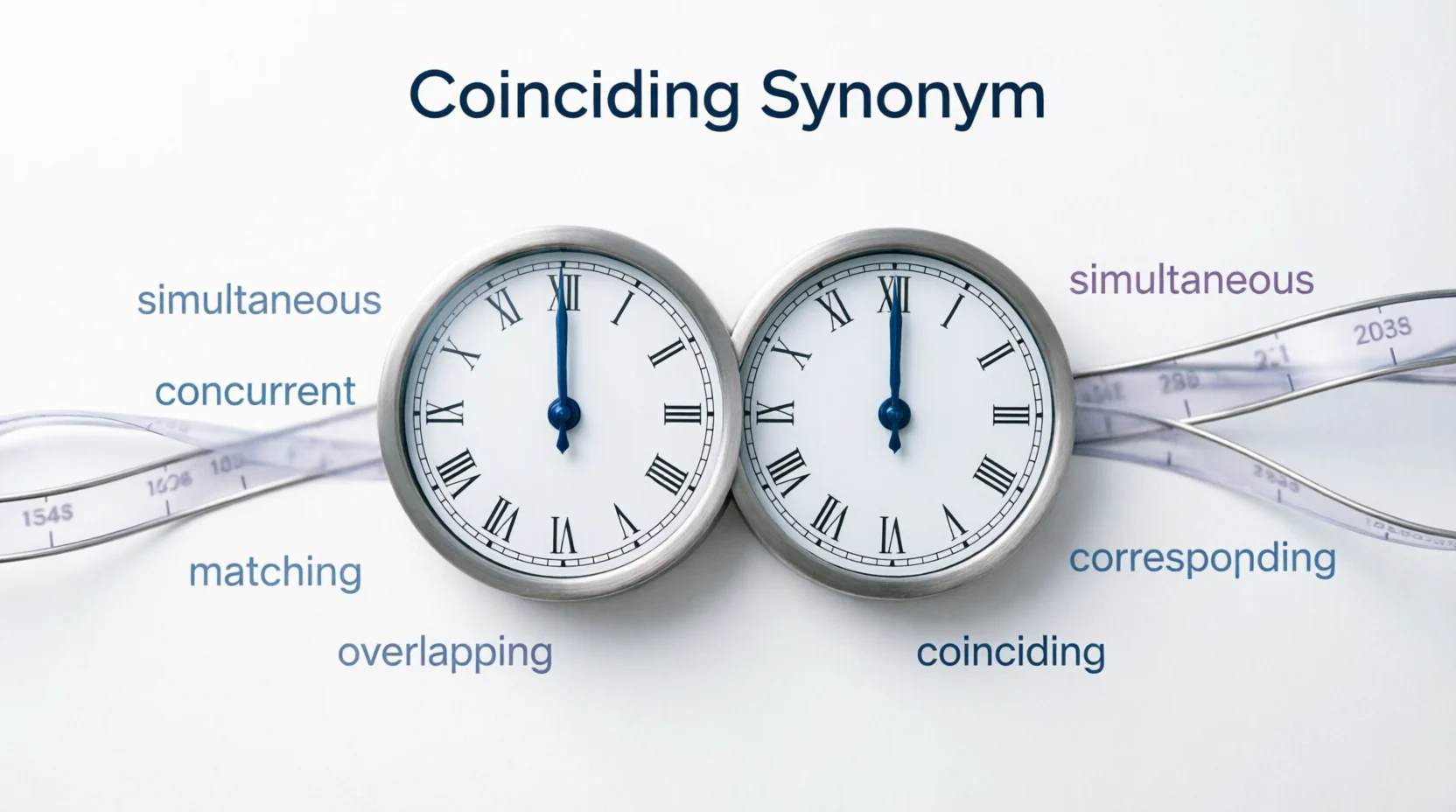
When you need a synonym for “coinciding,” useful alternatives include overlapping, occurring together, corresponding, concurrent, simultaneous, matching, aligning, and happening at the same time. The best choice depends on whether you are describing events, dates, ideas, opinions, patterns, or circumstances.
Quick Answer
Coinciding means happening at the same time, occurring together, or matching in some way. Depending on context, you can use concurrent, simultaneous, overlapping, corresponding, matching, aligning, synchronizing, or co-occurring.
For example:
- The two events are coinciding.
- The two events are occurring simultaneously.
- Their schedules are overlapping.
- Her opinion coincides with mine.
- The dates correspond.
What Does “Coinciding” Mean?
Coinciding is the present participle of coincide. It generally describes two or more things that happen at the same time or agree, match, or correspond with each other.
The word can be used in several ways.
Coinciding as Happening at the Same Time
When events occur during the same period, they can be described as coinciding.
Example:
“The concert is coinciding with the city festival.”
Here, the two events happen during the same time.
Coinciding as Matching or Agreeing
The word can also describe ideas, opinions, facts, or circumstances that correspond.
Example:
“Her explanation coincides with the evidence.”
In this sentence, her explanation agrees with or matches the evidence.
30 Synonyms for Coinciding
1. Simultaneous
Simple meaning: Happening at exactly the same time.
Example: The two announcements were simultaneous.
Best usage/context: Formal writing, events, actions, and occurrences happening together.
2. Concurrent
Simple meaning: Happening during the same period.
Example: The company faced two concurrent challenges.
Best usage/context: Formal, academic, business, and professional writing.
3. Overlapping
Simple meaning: Existing or happening partly during the same time.
Example: The two meetings are overlapping.
Best usage/context: Schedules, periods, activities, responsibilities, and events.
4. Occurring Together
Simple meaning: Happening at the same time.
Example: Several changes were occurring together.
Best usage/context: Clear, simple explanations and general writing.
5. Corresponding
Simple meaning: Matching or being connected in a similar way.
Example: The results are corresponding with earlier findings.
Best usage/context: Data, facts, patterns, relationships, and formal writing.
6. Matching
Simple meaning: Being the same or very similar.
Example: Their answers were matching.
Best usage/context: Answers, colors, information, patterns, and characteristics.
7. Aligning
Simple meaning: Agreeing or fitting together.
Example: Her goals are aligning with the company’s plans.
Best usage/context: Goals, opinions, plans, interests, and strategies.
8. Synchronizing
Simple meaning: Happening or operating at the same time.
Example: The dancers were synchronizing their movements.
Best usage/context: Technology, movements, schedules, systems, and coordinated activities.
9. Co-occurring
Simple meaning: Happening at the same time as something else.
Example: The symptoms were co-occurring with other problems.
Best usage/context: Academic, scientific, medical, and technical contexts.
10. Simultaneous
Simple meaning: Taking place at the same moment.
Example: The simultaneous celebrations attracted thousands of people.
Best usage/context: Formal descriptions of events or actions.
11. Concurrently Happening
Simple meaning: Taking place during the same period.
Example: Several projects were concurrently happening.
Best usage/context: Formal or professional contexts.
12. Overlapping in Time
Simple meaning: Sharing some of the same time.
Example: The two courses are overlapping in time.
Best usage/context: Classes, schedules, projects, appointments, and events.
13. Agreeing
Simple meaning: Having the same opinion or position.
Example: His findings are agreeing with previous research.
Best usage/context: Opinions, statements, explanations, and conclusions.
14. Corresponding With
Simple meaning: Matching or being consistent with something.
Example: The figures are corresponding with the original report.
Best usage/context: Statistics, information, reports, and evidence.
15. Consistent
Simple meaning: Matching or agreeing with something else.
Example: The new evidence is consistent with her explanation.
Best usage/context: Evidence, facts, theories, explanations, and formal writing.
16. Compatible
Simple meaning: Able to exist or work well together.
Example: Their plans are compatible with each other.
Best usage/context: Ideas, systems, plans, technologies, and relationships.
17. Complementary
Simple meaning: Working well together by adding different useful qualities.
Example: Their skills are complementary.
Best usage/context: Skills, ideas, products, designs, and approaches.
18. Converging
Simple meaning: Moving toward the same point or becoming similar.
Example: The two research studies are converging on the same conclusion.
Best usage/context: Ideas, research, trends, paths, and opinions.
19. Correlating
Simple meaning: Showing a relationship or connection.
Example: The results are correlating with changes in temperature.
Best usage/context: Research, statistics, science, and data analysis.
20. Coexisting
Simple meaning: Existing at the same time or in the same place.
Example: Different traditions are coexisting peacefully in the community.
Best usage/context: People, cultures, systems, conditions, and ideas.
21. Coextensive
Simple meaning: Having the same boundaries or extent.
Example: The two areas are nearly coextensive.
Best usage/context: Academic, geographical, legal, and technical writing.
22. Contemporaneous
Simple meaning: Existing or happening during the same period.
Example: The documents provide contemporaneous evidence of the event.
Best usage/context: Historical, academic, legal, and formal writing.
23. Consistent With
Simple meaning: Agreeing with or not contradicting something.
Example: His statement is consistent with the available evidence.
Best usage/context: Evidence, facts, explanations, research, and arguments.
24. In Agreement
Simple meaning: Having the same view or conclusion.
Example: The two experts are in agreement about the issue.
Best usage/context: Opinions, professional discussions, academic writing, and arguments.
25. In Step
Simple meaning: Moving or developing at the same pace.
Example: The two departments are working in step with each other.
Best usage/context: Progress, movement, organizations, and coordinated activities.
26. Parallel
Simple meaning: Similar or developing in a comparable way.
Example: The two projects followed parallel paths.
Best usage/context: Development, experiences, processes, and trends.
27. Matching Up
Simple meaning: Being similar or agreeing.
Example: The information is matching up with the records.
Best usage/context: Informal conversations and everyday writing.
28. Taking Place Together
Simple meaning: Happening during the same time.
Example: Several celebrations were taking place together.
Best usage/context: Simple explanations and general conversation.
29. Happening Simultaneously
Simple meaning: Happening at the same moment.
Example: Both incidents were happening simultaneously.
Best usage/context: Formal descriptions of events and actions.
30. Falling Together
Simple meaning: Happening or occurring around the same time.
Example: Several important events were falling together during that month.
Best usage/context: Less common literary or descriptive writing.
Coinciding Synonyms Comparison Table
| Synonym | Main Meaning | Tone | Best Context |
| Simultaneous | Happening at the same moment | Formal | Events and actions |
| Concurrent | Happening during the same period | Formal | Business and academic writing |
| Overlapping | Sharing part of the same time | Neutral | Schedules and activities |
| Corresponding | Matching or relating | Formal | Facts and information |
| Matching | Being the same or similar | Neutral | Answers and details |
| Aligning | Agreeing or fitting together | Neutral | Goals and opinions |
| Synchronizing | Happening in coordination | Formal | Systems and movements |
| Co-occurring | Happening together | Formal | Academic and scientific writing |
| Consistent | Agreeing with something | Formal | Evidence and explanations |
| Converging | Moving toward the same point | Formal | Ideas and research |
| Correlating | Showing a relationship | Formal | Data and statistics |
| Coexisting | Existing at the same time | Neutral | Conditions and groups |
| Parallel | Developing similarly | Neutral | Processes and trends |
| Contemporaneous | Existing during the same period | Formal | Historical and legal writing |
| Compatible | Able to work together | Neutral | Systems and plans |
How to Choose the Right Synonym for Coinciding
The best synonym depends on what is coinciding and what relationship you want to describe.
For Events Happening at the Same Time
Use:
- Simultaneous
- Concurrent
- Co-occurring
- Happening simultaneously
Example:
“The two ceremonies were simultaneous.”
For Schedules or Time Periods
Use:
- Overlapping
- Concurrent
- Overlapping in time
- Taking place together
Example:
“The training sessions are overlapping.”
For Ideas or Opinions
Use:
- Aligning
- Agreeing
- Corresponding
- In agreement
- Converging
Example:
“Her views are aligning with those of her colleagues.”
For Evidence and Information
Use:
- Consistent
- Corresponding
- Matching
- Consistent with
- Correlating
Example:
“The new evidence is consistent with the original theory.”
For Formal or Academic Writing
Choose:
- Concurrent
- Simultaneous
- Contemporaneous
- Co-occurring
- Corresponding
- Converging
These words can provide greater precision than the general word “coinciding.”
Common Mistakes When Using Coinciding Synonyms
Using “Simultaneous” When Events Only Partly Overlap
“Simultaneous” usually suggests that things happen at the same moment, while “overlapping” can describe events that share only part of a time period.
Less precise:
“The two classes were simultaneous.”
More precise:
“The two classes overlapped for thirty minutes.”
Confusing “Corresponding” With “Happening Together”
“Corresponding” generally focuses on a relationship or match rather than simply occurring at the same time.
Example:
“The two numbers correspond.”
This means they match or relate to each other, not necessarily that they occurred simultaneously.
Using “Correlating” as a Direct Replacement
“Correlating” is usually used when two variables or sets of information show a relationship. It should not automatically replace “coinciding.”
Choosing a Formal Word for Casual Conversation
Words such as contemporaneous and coextensive may sound overly formal in everyday speech. In casual situations, happening together, matching, or overlapping may be clearer.
FAQs:
What is the best synonym for coinciding?
There is no single best synonym for every situation. Simultaneous works well for events happening at the same moment, while overlapping is useful for periods or schedules.
What is a simple synonym for coinciding?
Simple alternatives include happening together, matching, overlapping, and occurring together.
Is “concurrent” a synonym for coinciding?
Yes. Concurrent describes things that happen during the same period, making it a useful synonym when discussing events, activities, or processes.
What is the difference between coinciding and overlapping?
Coinciding can mean happening at the same time or matching in some way. Overlapping specifically suggests that two periods, activities, or things share some portion of time or space.
Can coinciding mean matching?
Yes. In some contexts, coinciding means agreeing, matching, or corresponding.
Example:
“His account coincides with the witness’s statement.”
What is a formal synonym for coinciding?
Depending on the context, formal alternatives include concurrent, simultaneous, contemporaneous, corresponding, co-occurring, and converging.
What is the opposite of coinciding?
Possible opposites include differing, conflicting, separating, diverging, and occurring at different times, depending on the intended meaning.
Can “aligning” replace “coinciding”?
Sometimes. Aligning works when you mean that ideas, goals, opinions, or plans agree. It is not always appropriate when simply describing events occurring at the same time.
Conclusion
The word coinciding can describe events that happen together, periods that overlap, or ideas and information that match. The most suitable synonym depends on the exact relationship you want to express.
Use simultaneous for the same moment, concurrent for the same period, overlapping for shared time, and corresponding or aligning for matching ideas or information. Choosing a precise synonym makes your writing clearer and helps readers understand exactly how two things are related.