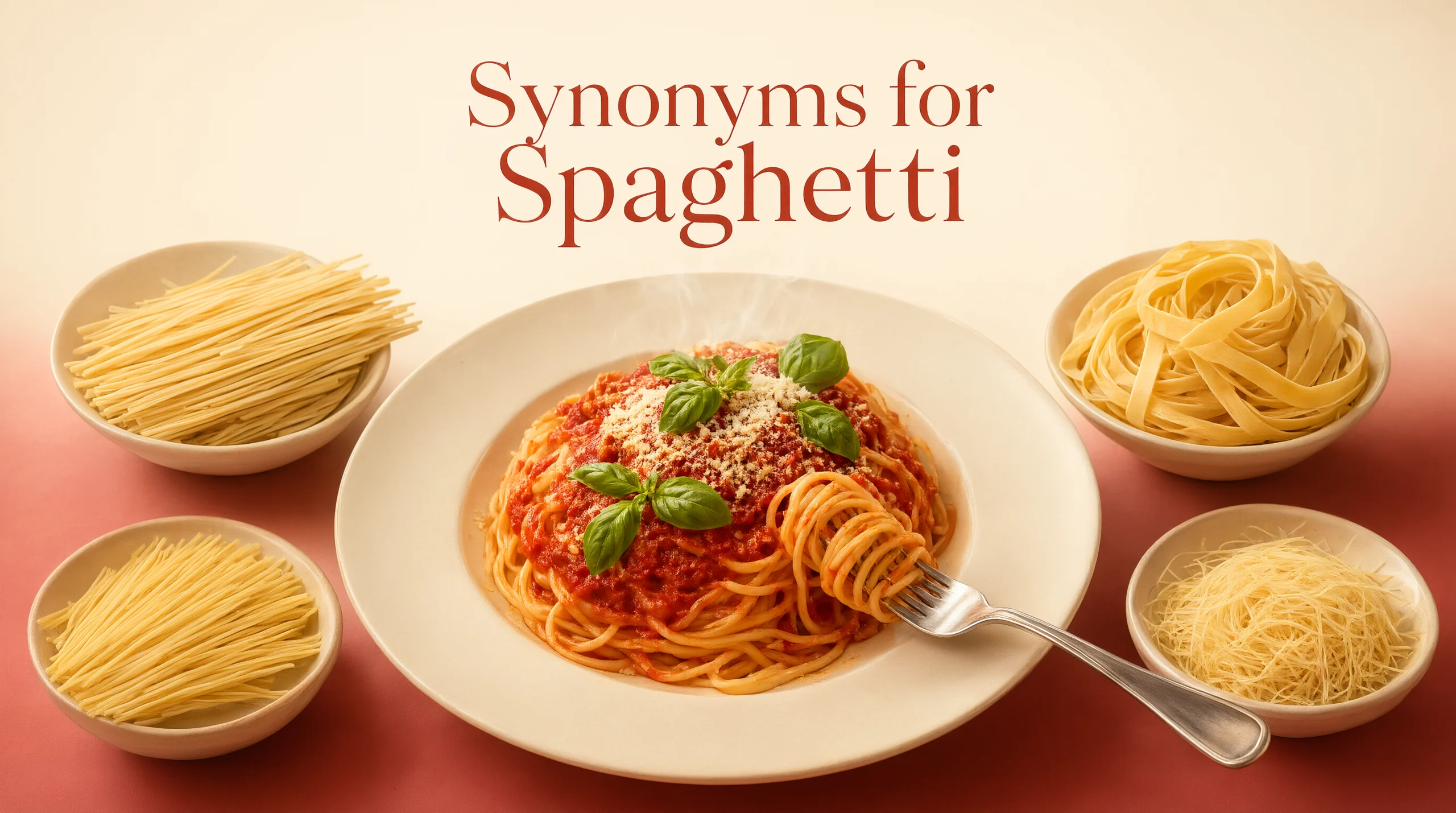
Spaghetti is a popular Italian pasta known for its long, thin, noodle-like shape. If you are looking for synonyms for spaghetti, useful alternatives include pasta, noodles, vermicelli, linguine, fettuccine, and angel hair pasta. However, these words do not always mean exactly the same thing. Some describe similar pasta shapes, while others refer to broader food categories or specific varieties.
If you are a student, an English learner, a writer, or a food enthusiast, understanding these related words can help you describe spaghetti more accurately in conversations, recipes, menus, and creative writing.
Quick Answer: What Are Synonyms for Spaghetti?
The closest alternatives to spaghetti include pasta, noodles, vermicelli, angel hair pasta, linguine, and spaghettini. The general word pasta is the most useful alternative, while the other terms describe particular types of pasta or similar noodle-shaped foods.
Meaning and Usage of Spaghetti
Spaghetti is a type of Italian pasta made primarily from wheat flour and water. It usually has a long, thin, cylindrical shape and is commonly served with tomato sauce, meat sauce, olive oil, cheese, vegetables, or seafood.
The word spaghetti comes from Italian and is the plural form of spaghetto, meaning a small cord or string.
In everyday English, spaghetti is commonly used when discussing Italian meals, cooking, restaurants, and food preferences.
For example:
- “We had spaghetti with tomato sauce for dinner.”
- “She cooked spaghetti for the whole family.”
- “The restaurant serves delicious spaghetti with fresh herbs.”
Although people sometimes use noodles as an alternative, spaghetti is technically a particular kind of pasta. Not every noodle is spaghetti, and not every pasta shape resembles it.
30 Synonyms and Related Words for Spaghetti
The following words include close alternatives, similar pasta varieties, and related food terms. Some are true category alternatives rather than exact synonyms.
1. Pasta
Meaning: A food made from dough, usually prepared with wheat flour and water.
Example: We cooked pasta for dinner.
Best usage/context: Use this broad term when the exact pasta shape does not matter.
2. Noodles
Meaning: Long, narrow strips or strands of dough used in many cuisines.
Example: He added noodles to his favorite sauce.
Best usage/context: Suitable for casual conversation and general descriptions of noodle-shaped foods.
3. Vermicelli
Meaning: Very thin strands of pasta or noodles, depending on the culinary tradition.
Example: She prepared vermicelli with vegetables.
Best usage/context: Use when referring to thin pasta or noodle varieties. The exact shape and ingredients vary by cuisine.
4. Angel Hair Pasta
Meaning: An extremely thin type of long pasta.
Example: The chef served angel hair pasta with garlic and olive oil.
Best usage/context: Ideal when describing a delicate pasta that resembles spaghetti but is thinner.
5. Spaghettini
Meaning: A thinner variety of spaghetti.
Example: We ordered spaghettini with a light tomato sauce.
Best usage/context: Use when referring to pasta that looks like spaghetti but has a smaller diameter.
6. Linguine
Meaning: Long pasta strands that are flatter than spaghetti.
Example: She made linguine with creamy mushroom sauce.
Best usage/context: Useful for describing a similar long pasta shape, especially in Italian recipes.
7. Fettuccine
Meaning: Long, flat ribbons of pasta.
Example: The restaurant served fettuccine with Alfredo sauce.
Best usage/context: Use when discussing flat pasta rather than round strands.
8. Tagliatelle
Meaning: Long, flat ribbons of Italian pasta.
Example: He prepared tagliatelle with a rich meat sauce.
Best usage/context: Appropriate for traditional Italian dishes featuring broad pasta ribbons.
9. Bucatini
Meaning: Thick, spaghetti-like pasta with a small hole running through the center.
Example: We enjoyed bucatini with a savory tomato sauce.
Best usage/context: Use when describing thick, hollow pasta strands.
10. Capellini
Meaning: A very thin Italian pasta variety.
Example: The cook used capellini in a light seafood dish.
Best usage/context: Suitable for recipes that call for delicate, thin pasta.
11. Macaroni
Meaning: A type of pasta commonly shaped into short tubes.
Example: The children ate macaroni with cheese.
Best usage/context: Use as a related pasta term, especially when discussing pasta dishes generally. It is not a direct synonym for spaghetti.
12. Rigatoni
Meaning: Large, ridged pasta tubes.
Example: She filled the bowls with rigatoni and tomato sauce.
Best usage/context: Useful when describing a different pasta shape in recipes or menus.
13. Penne
Meaning: Short, tube-shaped pasta with angled ends.
Example: We prepared penne with roasted vegetables.
Best usage/context: Use when discussing short pasta varieties as alternatives in a recipe.
14. Fusilli
Meaning: Spiral-shaped pasta.
Example: He added fusilli to a fresh vegetable salad.
Best usage/context: Suitable for describing twisted pasta that holds sauce well.
15. Rotini
Meaning: Short, twisted pasta with a spiral shape.
Example: The family enjoyed rotini with homemade sauce.
Best usage/context: Common in casual cooking discussions and pasta salad recipes.
16. Farfalle
Meaning: Bow-tie-shaped pasta.
Example: She cooked farfalle with spinach and cream.
Best usage/context: Use when describing decorative pasta shapes.
17. Pappardelle
Meaning: Wide, flat ribbons of pasta.
Example: The chef served pappardelle with slow-cooked beef.
Best usage/context: Appropriate for hearty Italian dishes with rich sauces.
18. Orecchiette
Meaning: Small, rounded pasta shapes resembling little ears.
Example: We ate orecchiette with broccoli and garlic.
Best usage/context: Use when referring to small, cup-shaped pasta.
19. Gemelli
Meaning: A type of pasta formed into twisted strands.
Example: She used gemelli in a creamy pasta dish.
Best usage/context: Useful for describing short, twisted pasta varieties.
20. Cavatappi
Meaning: Spiral, tube-shaped pasta.
Example: He served cavatappi with cheese sauce.
Best usage/context: Appropriate for recipes involving curved pasta that holds thick sauces.
21. Ziti
Meaning: Long, hollow pasta tubes, often cut into shorter pieces for cooking.
Example: They prepared baked ziti for dinner.
Best usage/context: Use when discussing baked Italian-American pasta dishes.
22. Lasagna
Meaning: Wide, flat pasta sheets used in layered dishes.
Example: We made lasagna with tomato sauce and cheese.
Best usage/context: A related pasta term, particularly when comparing different pasta-based meals.
23. Soba
Meaning: Japanese noodles traditionally made with buckwheat flour.
Example: She ordered soba with fresh vegetables.
Best usage/context: Use when referring to Japanese noodles, not as an exact synonym for spaghetti.
24. Udon
Meaning: Thick Japanese wheat noodles.
Example: He enjoyed a warm bowl of udon.
Best usage/context: Suitable for describing thick noodles in Japanese cuisine.
25. Ramen
Meaning: Japanese wheat noodles commonly served in broth.
Example: We ate ramen on a cold evening.
Best usage/context: Use when discussing Japanese noodle dishes or noodle-based meals.
26. Rice Noodles
Meaning: Noodles made primarily from rice flour and water.
Example: She added rice noodles to the stir-fry.
Best usage/context: Useful when describing gluten-free noodle options or Asian-inspired dishes, depending on the ingredients.
27. Egg Noodles
Meaning: Noodles made with eggs and flour.
Example: He served egg noodles with a savory sauce.
Best usage/context: Appropriate when discussing noodles made with eggs rather than traditional dried durum-wheat spaghetti.
28. Wheat Noodles
Meaning: Noodles made primarily from wheat flour.
Example: The recipe calls for wheat noodles and fresh vegetables.
Best usage/context: Use as a broad category for wheat-based noodle products.
29. Italian Pasta
Meaning: Pasta associated with Italian cooking traditions.
Example: Italian pasta is served in many shapes and sizes.
Best usage/context: Useful in food writing when referring to Italian pasta generally rather than spaghetti specifically.
30. Long Pasta
Meaning: A general descriptive term for elongated pasta varieties.
Example: Long pasta works well with many traditional sauces.
Best usage/context: Ideal for recipes, food descriptions, and explanations comparing spaghetti with other long pasta shapes.
Comparison Table: Spaghetti Synonyms and Related Words
| Word | Main meaning | Best use |
| Pasta | General category of pasta foods | Everyday conversation |
| Noodles | Long strands or strips of dough | General food descriptions |
| Vermicelli | Thin pasta or noodles | Delicate noodle dishes |
| Angel hair pasta | Extremely thin pasta | Light sauces |
| Spaghettini | Thin spaghetti | Italian recipes |
| Linguine | Long, flat pasta | Seafood and cream sauces |
| Fettuccine | Flat pasta ribbons | Alfredo-style dishes |
| Bucatini | Thick, hollow pasta | Rich sauces |
| Penne | Short, angled tubes | Baked dishes and salads |
| Fusilli | Spiral pasta | Pasta salads |
| Ramen | Japanese noodles | Japanese noodle soups |
| Soba | Buckwheat-based Japanese noodles | Japanese cuisine |
| Rice noodles | Rice-based noodles | Asian-inspired dishes |
| Long pasta | General term for elongated pasta | Food writing |
How to Choose the Right Synonym for Spaghetti
The best word depends on what you want to communicate. Since many alternatives describe different pasta shapes, choosing the right term can make your writing clearer.
For Everyday Conversation
Choose pasta or noodles when speaking casually.
Examples:
- “We are having pasta tonight.”
- “Would you like noodles for lunch?”
Pasta is particularly appropriate when discussing Italian food, while noodles is a broader everyday term.
For Recipes and Cooking
Choose a specific pasta variety when the shape matters.
Examples:
- Use linguine for a recipe calling for long, flat pasta.
- Use angel hair pasta for a delicate, thin pasta dish.
- Use bucatini for a recipe requiring thick, hollow strands.
Remember that changing the pasta shape may affect how a sauce coats the food and how the finished dish feels.
For Formal or Descriptive Writing
Choose Italian pasta, long pasta, or the precise variety when writing about food.
Examples:
- “Long pasta pairs well with several traditional sauces.”
- “The chef prepared linguine with fresh seafood.”
Specific terminology helps readers picture the dish accurately.
For International Cuisine
Use the name of the particular noodle variety, such as soba, udon, or ramen.
These words refer to distinct noodle types and culinary traditions. They can be alternatives to spaghetti in a meal, but they are not exact synonyms.
For Creative Writing
Use pasta, noodles, or a descriptive phrase such as “long strands of pasta” to avoid repeating spaghetti too often.
For example:
“Steam rose from the bowl as the long strands of pasta glistened with tomato sauce.”
This phrasing provides variety without changing the basic meaning.
Common Mistakes When Using Spaghetti Synonyms
1. Treating Every Pasta Shape as an Exact Synonym
Penne, macaroni, and lasagna are types of pasta, but they do not mean spaghetti. Use these terms when describing alternatives, not when the specific shape is important.
2. Assuming Pasta and Noodles Always Mean the Same Thing
The terms overlap in everyday usage, but they can refer to different culinary categories. Pasta is especially associated with Italian foods, while noodles appear in many cuisines worldwide.
3. Confusing Vermicelli Across Different Cuisines
Vermicelli can refer to different products depending on the region. Italian vermicelli and rice vermicelli, for example, may differ in ingredients and texture.
4. Using a Specific Variety Without Checking the Recipe
Linguine, fettuccine, and angel hair pasta have different shapes and thicknesses. They may be substituted for spaghetti in some recipes, but the results will not always be identical.
5. Using “Spaghetti” as a General Term for All Noodles
Spaghetti is a specific pasta variety. If you mean different kinds of noodles or pasta, use the broader term that best fits your sentence.
FAQs:
1. What is the closest synonym for spaghetti?
Pasta is the closest broad alternative. Noodles is also common in casual conversation, although it does not always refer to Italian pasta.
2. What is another word for spaghetti noodles?
You can use pasta strands, long pasta, or noodles, depending on the context. Spaghettini and angel hair pasta describe similar but distinct varieties.
3. Is pasta a synonym for spaghetti?
Yes, in a broad category sense. Spaghetti is one type of pasta, so the terms are related, but pasta includes many other shapes.
4. Are spaghetti and noodles the same thing?
Not exactly. Spaghetti is a specific Italian pasta, while noodles is a broader term for elongated foods made from dough. The words may overlap in informal conversation.
5. What pasta is most similar to spaghetti?
Spaghettini, linguine, vermicelli, and angel hair pasta are similar in that they are long varieties. However, they differ in thickness, shape, or ingredients.
6. What is a fancy word for spaghetti?
There is no single fancy synonym. Spaghettini, linguine, and capellini are more specific culinary terms for related pasta varieties.
7. Can I replace spaghetti with another type of pasta?
Yes. Linguine, spaghettini, and angel hair pasta are common alternatives. Penne and fusilli can also work in many dishes, although their shapes change the texture and presentation.
8. What words describe spaghetti in creative writing?
Phrases such as “long pasta strands,” “thin noodles,” “tangled strands of pasta,” and “sauce-coated noodles” can add variety. Choose descriptions that match the dish and the tone of your writing.
Conclusion
Understanding synonyms for spaghetti helps you communicate more clearly about food, recipes, and Italian cuisine. Words such as pasta and noodles are useful general alternatives, while vermicelli, spaghettini, linguine, and angel hair pasta refer to more specific varieties. Other terms, including penne, fusilli, and fettuccine, describe different pasta shapes that can serve as alternatives in many meals.
When choosing a synonym, consider if you need a broad food category, a similar long pasta, or a completely different noodle variety. Using the right term makes your writing more precise, your recipes easier to understand, and your everyday conversations about food more natural.