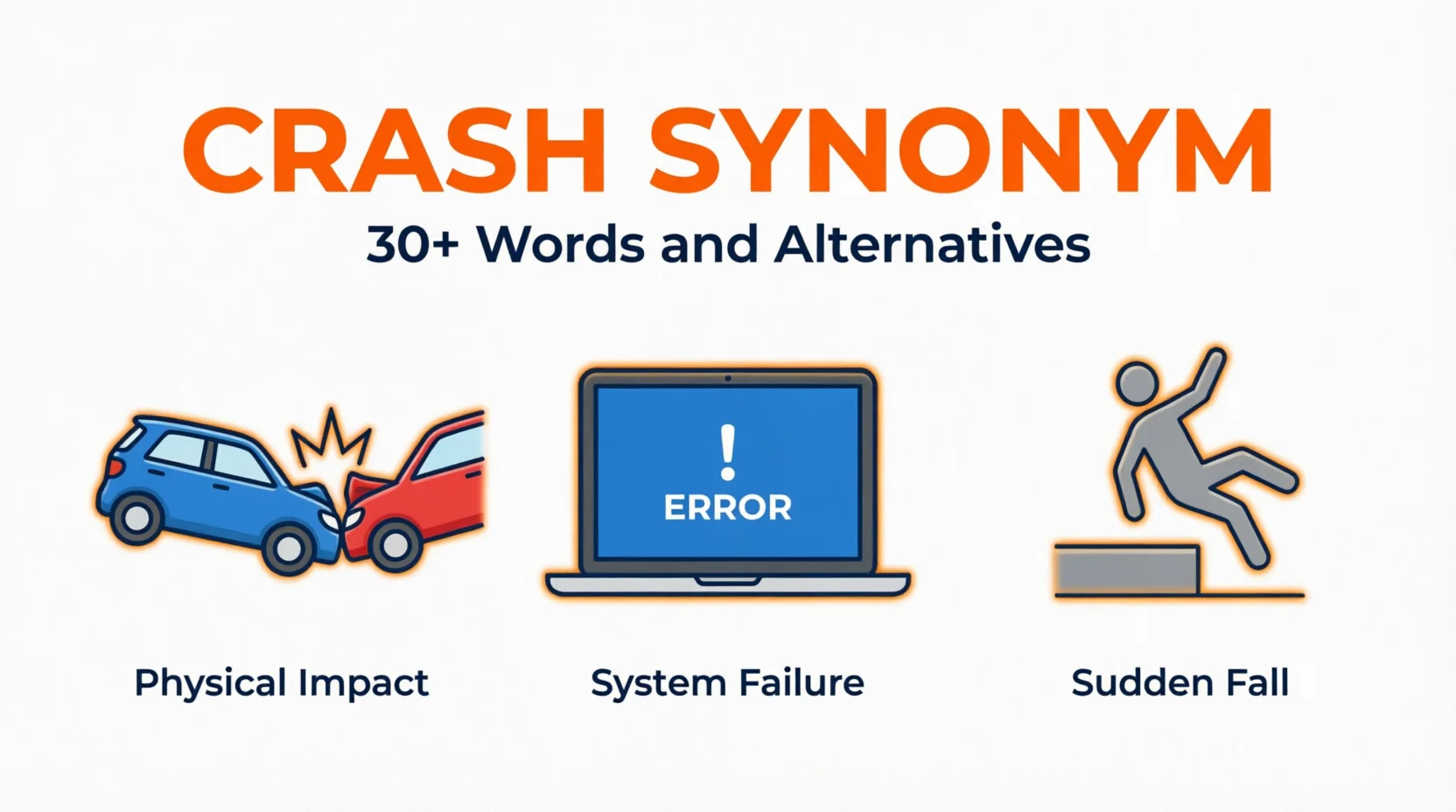
The word crash has several meanings, depending on the situation. It can describe a vehicle accident, a sudden fall, a computer failure, a loud collision, or a sharp decrease in value. Common synonyms for crash include collide, smash, collide with, wreck, strike, shatter, plummet, collapse, and fail. Choosing the right synonym depends on what happened and how you want to describe it. This guide explains 30 useful crash synonyms with simple meanings, example sentences, and the best contexts for using each word.
Quick Answer: What Are the Best Synonyms for Crash?
The best synonyms for crash include:
- Collide: To hit another object.
- Smash: To hit something with great force.
- Wreck: To damage or destroy something badly.
- Crumple: To collapse or become folded from impact.
- Collapse: To fall down or suddenly fail.
- Plummet: To fall rapidly in value or level.
- Shatter: To break into many pieces.
- Fail: To stop working successfully.
- Slam: To hit something forcefully.
- Break down: To stop functioning.
For a car crash, use collision or accident. For a computer crash, use failure or shutdown. For a sudden market decline, use plummet or tumble.
What Does Crash Mean?
Crash is a verb and a noun. As a verb, it means to hit something violently, fall suddenly, or stop working unexpectedly. As a noun, it can describe an accident, a system failure, or a sudden decline.
Examples:
- Accident: The car crashed into a tree.
- Computer failure: My laptop crashed during the presentation.
- Financial decline: Stock prices crashed overnight.
- Sudden fall: The waves crashed against the rocks.
- Loud impact: We heard a crash from the kitchen.
Because crash has several meanings, no single synonym works in every situation. Understanding the context helps you choose a more precise word.
30 Synonyms for Crash With Meanings and Examples
1. Collide
Simple meaning: To hit another person, vehicle, or object.
Example: Two cars collided at the intersection.
Best usage/context: Vehicle accidents, physical impacts, and objects moving into each other.
2. Smash
Simple meaning: To hit or break something with great force.
Example: The truck smashed into the wall.
Best usage/context: Forceful impacts that cause serious damage or destruction.
3. Wreck
Simple meaning: To damage or destroy something badly.
Example: The accident wrecked the front of the car.
Best usage/context: Vehicle damage, ruined objects, and situations involving extensive destruction.
4. Strike
Simple meaning: To hit something or someone.
Example: The falling branch struck the roof.
Best usage/context: Formal writing, reports, and descriptions of sudden impacts.
5. Slam
Simple meaning: To hit something hard and suddenly.
Example: The vehicle slammed into the barrier.
Best usage/context: Forceful collisions, doors closing loudly, and sudden impacts.
6. Shatter
Simple meaning: To break into many small pieces.
Example: The ball crashed through the window and shattered the glass.
Best usage/context: Glass, fragile objects, and figurative descriptions of destroyed hopes.
7. Break
Simple meaning: To separate into pieces or stop functioning.
Example: The old machine crashed and broke during operation.
Best usage/context: Everyday language about damaged objects, equipment, and systems.
8. Collapse
Simple meaning: To fall down suddenly or fail completely.
Example: The damaged roof collapsed during the storm.
Best usage/context: Buildings, structures, businesses, and systems that suddenly fail.
9. Plummet
Simple meaning: To fall rapidly to a much lower level.
Example: The company’s shares plummeted after the announcement.
Best usage/context: Stock prices, sales, temperatures, and other measurable declines.
10. Tumble
Simple meaning: To fall or drop suddenly.
Example: Oil prices tumbled after the news.
Best usage/context: Markets, falling objects, and sudden downward movements.
11. Fall
Simple meaning: To move downward or drop.
Example: The cyclist fell after hitting the curb.
Best usage/context: General descriptions of people, objects, numbers, or prices moving downward.
12. Drop
Simple meaning: To decrease or fall to a lower level.
Example: Website traffic dropped sharply overnight.
Best usage/context: Numbers, prices, performance, and physical objects.
13. Fail
Simple meaning: To stop working or to be unsuccessful.
Example: The computer failed during the software update.
Best usage/context: Machines, computer systems, plans, and processes that do not work properly.
14. Malfunction
Simple meaning: To work incorrectly or stop working as expected.
Example: The aircraft’s navigation system malfunctioned during the flight.
Best usage/context: Technical, mechanical, and electronic problems.
15. Break down
Simple meaning: To stop working, especially because of a mechanical problem.
Example: Our car broke down on the highway.
Best usage/context: Vehicles, machinery, and equipment failures.
16. Shatter into pieces
Simple meaning: To break violently into several fragments.
Example: The vase shattered into pieces when it hit the floor.
Best usage/context: Describing the result of a strong impact on a fragile object.
17. Crumple
Simple meaning: To become crushed, folded, or wrinkled.
Example: The car’s hood crumpled in the collision.
Best usage/context: Damaged vehicles, paper, metal, and objects compressed by force.
18. Dent
Simple meaning: To create a hollow mark by hitting or pressing something.
Example: The shopping cart dented the car door.
Best usage/context: Minor physical damage to metal surfaces, vehicles, and appliances.
19. Destroy
Simple meaning: To damage something so severely that it no longer exists or works.
Example: The explosion destroyed the old warehouse.
Best usage/context: Severe damage to buildings, property, equipment, or systems.
20. Demolish
Simple meaning: To destroy a structure completely or almost completely.
Example: The runaway vehicle demolished the garden wall.
Best usage/context: Buildings, walls, structures, and figurative descriptions of overwhelming defeat.
21. Burst
Simple meaning: To break open suddenly.
Example: The tire burst while the vehicle was moving.
Best usage/context: Tires, pipes, balloons, containers, and sudden releases of pressure.
22. Bang
Simple meaning: To hit something and make a loud noise.
Example: The motorcycle banged into the metal gate.
Best usage/context: Informal descriptions of loud impacts and sudden collisions.
23. Ram
Simple meaning: To drive or push something forcefully into another object.
Example: The truck rammed the security barrier.
Best usage/context: Forceful vehicle impacts and deliberate collisions.
24. Hit
Simple meaning: To come into contact with something forcefully.
Example: The car hit a roadside pole.
Best usage/context: Everyday speech and simple descriptions of accidents.
25. Impact
Simple meaning: To strike or come into forceful contact with something.
Example: The falling object impacted the pavement.
Best usage/context: Technical reports and formal descriptions of physical collisions. In ordinary English, hit or struck often sounds more natural as a verb.
26. Plunge
Simple meaning: To fall or move suddenly and steeply downward.
Example: The company’s profits plunged after demand weakened.
Best usage/context: Financial losses, steep declines, and sudden downward movements.
27. Sink
Simple meaning: To move downward or decline.
Example: The company’s reputation sank after the scandal.
Best usage/context: Figurative declines in reputation, confidence, performance, or value.
28. Crumble
Simple meaning: To break apart or lose strength gradually or suddenly.
Example: The old wall crumbled after years of neglect.
Best usage/context: Weak structures, deteriorating plans, and systems losing stability.
29. Go offline
Simple meaning: To stop being available or connected to a network.
Example: The website went offline after a server failure.
Best usage/context: Websites, internet services, networks, and online platforms. It does not always mean the system has completely crashed.
30. Freeze
Simple meaning: To stop responding temporarily or become unable to continue operating.
Example: My computer froze while I was editing the document.
Best usage/context: Computers, applications, software, and electronic devices that become unresponsive.
Crash Synonyms Comparison Table
| Synonym | Main meaning | Best context |
| Collide | Hit another object | Vehicle accidents |
| Smash | Hit with great force | Violent impacts |
| Wreck | Damage severely | Vehicles and property |
| Strike | Hit something | Formal descriptions |
| Slam | Hit suddenly and hard | Forceful collisions |
| Shatter | Break into pieces | Glass and fragile objects |
| Collapse | Fall or fail suddenly | Structures and systems |
| Plummet | Fall rapidly | Prices and statistics |
| Tumble | Drop suddenly | Markets and objects |
| Fail | Stop working successfully | Systems and machinery |
| Malfunction | Work incorrectly | Technical equipment |
| Break down | Stop functioning | Vehicles and machines |
| Crumple | Become crushed or folded | Metal and vehicles |
| Destroy | Cause severe damage | Property and equipment |
| Ram | Drive forcefully into | Vehicle collisions |
| Freeze | Stop responding | Computers and software |
How to Choose the Right Synonym for Crash
The best alternative depends on the meaning, tone, and purpose of your sentence.
Choose Based on Meaning
- Physical collision: Use collide, strike, hit, or slam.
- Severe damage: Use smash, wreck, destroy, or demolish.
- Breaking into pieces: Use shatter or burst.
- Sudden decrease: Use plummet, tumble, drop, or plunge.
- Technical failure: Use fail, malfunction, freeze, or break down.
- Sudden structural failure: Use collapse or crumble.
Choose Based on Tone
| Tone | Suitable synonyms | Example |
| Everyday | Hit, fall, break | The car hit the fence. |
| Formal | Collide, strike, malfunction | The vehicles collided at the junction. |
| Technical | Fail, freeze, go offline | The application froze during testing. |
| Dramatic | Smash, shatter, demolish | The vehicle smashed into the barrier. |
| Financial | Plummet, tumble, plunge | The share price plummeted. |
Choose Based on Intent
If you want to describe an accident objectively, collision is often a good noun. If you want to emphasize the force of an impact, smash or slam may be more effective. If you are discussing a sudden financial decline, plummet is usually more precise than crash.
For example:
- Basic: The market crashed.
- More specific: The market plummeted after the announcement.
- Technical: The application crashed during startup.
- More specific: The application froze during startup.
The goal is to choose a word that communicates exactly what happened.
Common Mistakes When Using Crash Synonyms
1. Using Plummet for Physical Accidents
Incorrect: The car plummeted into another car on the road.
Better: The car collided with another vehicle.
Plummet usually describes a rapid downward movement rather than a typical collision between vehicles.
2. Using Shatter for Every Type of Damage
Incorrect: The mechanic shatter the engine.
Better: The impact severely damaged the engine.
Shatter usually refers to something breaking into fragments. It is not the natural choice for most mechanical damage.
3. Treating Crash and Malfunction as Identical
A crash often means a system stops operating unexpectedly. A malfunction means it operates incorrectly. A malfunction does not always cause a complete crash.
Example: The sensor malfunctioned, but the machine continued running.
4. Using Collapse for Every Price Decrease
A price can fall or drop without the market collapsing. Use plummet for a sharp decline and reserve collapse for a much broader or more severe failure when appropriate.
5. Ignoring Grammar
Some synonyms are verbs, while others are nouns or phrasal verbs.
- Verb: The vehicles collided.
- Noun: The vehicles were involved in a collision.
- Phrasal verb: The engine broke down.
Choosing the correct grammatical form makes your sentence clearer.
FAQs:
1. What is the closest synonym for crash?
Collide is a close synonym when crash describes two objects hitting each other. For a computer, fail or stop responding may be more appropriate.
2. What is another word for a car crash?
Common alternatives include car accident, collision, vehicle accident, and motor vehicle collision. The most suitable term depends on the context and level of formality.
3. What is a synonym for crash in computer terminology?
Useful alternatives include fail, freeze, malfunction, and stop responding. Use freeze when the computer becomes unresponsive and crash when an application or system terminates unexpectedly.
4. What is another word for a market crash?
You can use market collapse, sharp decline, plunge, tumble, or sell-off. These expressions differ slightly: a sell-off describes widespread selling, while a plunge emphasizes a rapid decrease.
5. What is the difference between crash and collide?
Crash can describe a violent impact, a system failure, or a sudden decline. Collide specifically means that two or more moving things hit each other.
6. Is smash a stronger word than crash?
Often, yes. Smash emphasizes forceful impact or destruction, while crash has a wider range of meanings and does not always imply that something breaks.
7. What is the formal word for crash?
Depending on the context, formal alternatives include collision, impact, system failure, and sharp decline. For professional writing, choose the term that most accurately describes the event.
Conclusion
Crash has many useful synonyms, but the right choice depends on what you want to communicate. Use collide for objects hitting each other, smash for forceful impacts, collapse for sudden structural or organizational failure, and plummet for a rapid decrease.
For technology, words such as freeze, malfunction, and fail can describe different kinds of problems more precisely. Learning these 30 crash synonyms will help you improve your vocabulary, write clearer sentences, and communicate more naturally in everyday, academic, and professional English.