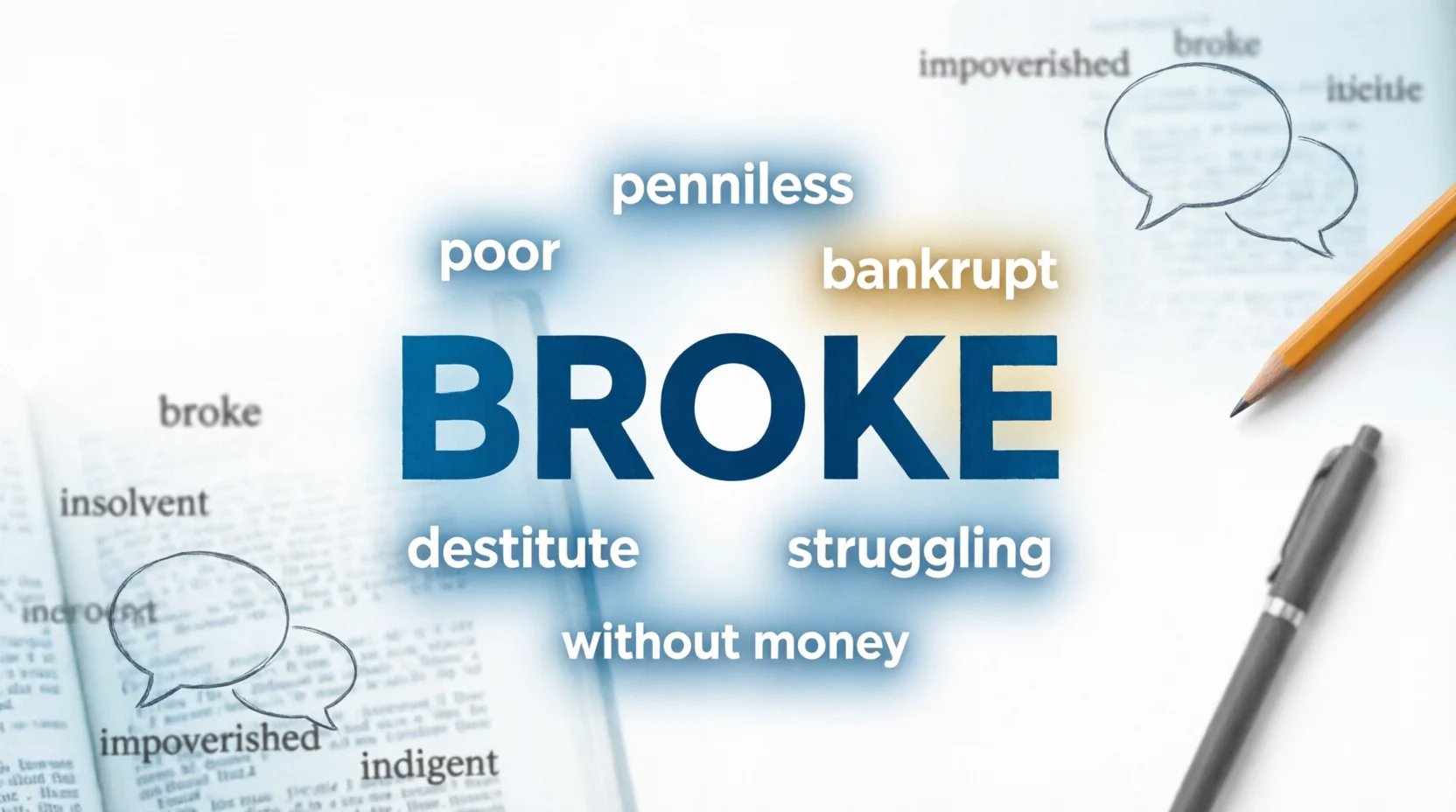
If you need a synonym for broke, the best choice depends on what you mean. Broke can describe having no money, being damaged, or being emotionally exhausted. Common synonyms include penniless, poor, bankrupt, damaged, shattered, exhausted, and drained. Choosing the right word makes your writing more precise and natural.
Quick Answer
The most suitable synonym for broke depends on its meaning:
- Broke = having little or no money: penniless, poor, cash-strapped, impoverished
- Broke = financially failed: bankrupt, insolvent, ruined
- Broke = damaged or not working: damaged, faulty, defective, malfunctioning
- Broke = physically separated: shattered, split, cracked, fractured
- Broke = emotionally or physically exhausted: drained, exhausted, worn-out, depleted
What Does “Broke” Mean?
The word broke has several meanings in English.
Most commonly, broke is an informal adjective meaning that someone has very little or no money.
Example:
“I’m broke until payday.”
However, broke can also be the past tense of break.
Example:
“She broke the glass.”
In this sense, it can refer to something being damaged, fractured, separated, or disrupted.
Because broke has multiple meanings, there is no single synonym that works in every sentence. The context determines which alternative is most appropriate.
30 Synonyms for Broke
1. Penniless
Simple meaning: Having no money.
Example: After paying his rent, he was completely penniless.
Best usage/context: Use this when emphasizing that someone has almost no money at all.
2. Poor
Simple meaning: Having little money or few financial resources.
Example: The family was poor but worked hard to improve their situation.
Best usage/context: A broad term for financial hardship, but it can sound sensitive when describing people.
3. Bankrupt
Simple meaning: Unable to pay debts.
Example: The company became bankrupt after years of financial losses.
Best usage/context: Best for serious financial failure, especially businesses and formal situations.
4. Impoverished
Simple meaning: Very poor or lacking financial resources.
Example: The organization supports children from impoverished communities.
Best usage/context: Formal writing and discussions about long-term poverty.
5. Destitute
Simple meaning: Having almost nothing and lacking basic necessities.
Example: The disaster left several families destitute.
Best usage/context: Strong and serious; often used for extreme poverty.
6. Insolvent
Simple meaning: Unable to pay debts when they are due.
Example: The company became insolvent after losing its main customer.
Best usage/context: Formal financial, legal, and business contexts.
7. Cash-strapped
Simple meaning: Having very little available money.
Example: The cash-strapped student searched for a cheaper apartment.
Best usage/context: Informal or semi-formal discussions about temporary financial difficulty.
8. Financially troubled
Simple meaning: Experiencing money problems.
Example: The financially troubled business reduced its expenses.
Best usage/context: Neutral and professional descriptions of financial difficulty.
9. Struggling
Simple meaning: Having difficulty managing financially or generally.
Example: Many students are struggling to cover their living expenses.
Best usage/context: Useful when describing ongoing difficulties without sounding overly harsh.
10. Hard up
Simple meaning: Having very little money.
Example: I’m a little hard up this month.
Best usage/context: Informal English, especially for temporary money problems.
11. Broke
Simple meaning: Having no money or very little money.
Example: I can’t go shopping today because I’m broke.
Best usage/context: Casual everyday conversation.
12. Ruined
Simple meaning: Completely damaged or financially destroyed.
Example: The failed investment left him financially ruined.
Best usage/context: Strong language for severe financial or personal loss.
13. Depleted
Simple meaning: Greatly reduced or used up.
Example: After the emergency, their savings were completely depleted.
Best usage/context: Useful for money, savings, supplies, energy, or resources.
14. Drained
Simple meaning: Having almost no energy or resources left.
Example: After working two shifts, she felt completely drained.
Best usage/context: Best when broke means lacking energy rather than lacking money.
15. Exhausted
Simple meaning: Extremely tired.
Example: He was exhausted after working all night.
Best usage/context: Physical or mental tiredness.
16. Worn-out
Simple meaning: Extremely tired or used heavily.
Example: I felt worn-out after the long journey.
Best usage/context: Informal descriptions of tiredness or old, heavily used objects.
17. Damaged
Simple meaning: Harmed or no longer in its original condition.
Example: The package arrived with a damaged box.
Best usage/context: Use this instead of broke when referring to an object that has been harmed.
18. Broken
Simple meaning: Damaged or not functioning properly.
Example: My phone screen is broken.
Best usage/context: General descriptions of damaged objects or equipment.
19. Faulty
Simple meaning: Not working correctly because of a defect.
Example: The technician replaced the faulty cable.
Best usage/context: Products, machines, equipment, and technical problems.
20. Defective
Simple meaning: Having a fault or manufacturing problem.
Example: The customer returned the defective appliance.
Best usage/context: Formal or commercial contexts.
21. Malfunctioning
Simple meaning: Not operating correctly.
Example: The machine stopped because one of its sensors was malfunctioning.
Best usage/context: Machines, electronics, software, and technical systems.
22. Cracked
Simple meaning: Having a narrow split or break.
Example: She replaced her cracked phone screen.
Best usage/context: Glass, screens, walls, ceramics, and similar materials.
23. Fractured
Simple meaning: Broken or split, especially into pieces.
Example: The accident left him with a fractured arm.
Best usage/context: Medical, technical, or formal descriptions.
24. Shattered
Simple meaning: Broken into many small pieces.
Example: The ball shattered the window.
Best usage/context: Glass, objects, or figurative descriptions of something completely destroyed.
25. Split
Simple meaning: Divided or separated into two or more parts.
Example: The wooden board split down the middle.
Best usage/context: Physical objects, groups, decisions, and relationships.
26. Ruptured
Simple meaning: Broken or burst open suddenly.
Example: The pipe ruptured during the freezing weather.
Best usage/context: Pipes, vessels, structures, and formal or technical contexts.
27. Collapsed
Simple meaning: Fell down or failed suddenly.
Example: Part of the old building collapsed during the storm.
Best usage/context: Buildings, structures, systems, or figurative situations.
28. Defunct
Simple meaning: No longer operating or existing.
Example: The company is now defunct.
Best usage/context: Businesses, organizations, systems, and institutions that have stopped operating.
29. Depleted
Simple meaning: Used up or greatly reduced.
Example: The team’s energy was depleted by the end of the match.
Best usage/context: Resources, savings, supplies, energy, and reserves.
30. Spent
Simple meaning: Having used all available energy, money, or resources.
Example: By the end of the day, I was completely spent.
Best usage/context: Energy, money, time, or resources depending on the sentence.
Comparison Table: Broke and Its Synonyms
| Synonym | Main Meaning | Tone | Best Context |
|---|---|---|---|
| Penniless | No money | Neutral | Personal finances |
| Poor | Little money | Neutral | General poverty |
| Bankrupt | Unable to pay debts | Formal | Business/finance |
| Impoverished | Very poor | Formal | Social issues |
| Destitute | Extremely poor | Strong | Severe hardship |
| Insolvent | Unable to pay debts | Formal | Finance/legal |
| Cash-strapped | Limited money | Informal | Temporary financial problems |
| Hard up | Short of money | Informal | Everyday conversation |
| Struggling | Experiencing difficulty | Neutral | Financial hardship |
| Depleted | Used up | Neutral | Money/resources |
| Drained | Lacking energy | Informal | Tiredness |
| Exhausted | Extremely tired | Neutral | Physical/mental fatigue |
| Damaged | Harmed | Neutral | Objects |
| Faulty | Not working correctly | Neutral | Products/equipment |
| Defective | Having a defect | Formal | Manufacturing |
| Malfunctioning | Not operating correctly | Technical | Machines |
| Cracked | Partly broken | Neutral | Glass/screens |
| Fractured | Broken/split | Formal | Bones/materials |
| Shattered | Broken into pieces | Strong | Glass/objects |
| Split | Divided or separated | Neutral | Objects/groups |
| Collapsed | Fell or failed | Neutral | Structures/systems |
How to Choose the Right Synonym for “Broke”
For Casual Financial Situations
Use broke, hard up, or cash-strapped.
Example:
“I’m broke this week.”
These expressions work well in everyday conversations.
For Serious Poverty
Use destitute, impoverished, or penniless.
Example:
“The war left many families destitute.”
These words communicate a more serious level of financial hardship.
For Business and Finance
Use bankrupt or insolvent.
Example:
“The company became insolvent.”
These terms are more precise than the informal word broke.
For Damaged Objects
Use damaged, broken, faulty, defective, or malfunctioning.
Example:
“The washing machine is malfunctioning.”
The specific choice depends on whether the object is physically damaged or simply failing to work properly.
For Physical Breakage
Use cracked, fractured, shattered, split, or ruptured.
Example:
“The glass was shattered.”
These words describe different types and degrees of physical damage.
For Tiredness
If broke is being used to describe a lack of energy, choose exhausted, drained, worn-out, or spent.
Example:
“After the long trip, I was completely exhausted.”
Common Mistakes When Using Synonyms for Broke
Using “Bankrupt” for a Person Who Simply Has No Cash
Someone who has no money today is not necessarily bankrupt.
Less precise:
“I’m bankrupt until Friday.”
Better:
“I’m broke until Friday.”
Bankrupt usually refers to serious financial failure and has a more specific financial meaning.
Using “Poor” When You Mean Temporarily Short of Money
Being poor generally suggests a broader or longer-term lack of financial resources.
If you simply spent your paycheck and have little money left, broke or cash-strapped may be more appropriate.
Using “Broken” for Financial Problems
Broken usually describes something damaged or not functioning.
Incorrect:
“My bank account is broken.”
Better:
“I’m broke.”
Using “Faulty” for Everything That Is Broken
Faulty usually suggests a defect or problem that prevents something from working properly.
For simple physical damage, damaged or broken may be more natural.
Confusing “Broke” With “Broken”
Broke can be the past tense of break:
“She broke the cup.”
Broken is commonly used as a past participle or adjective:
“The cup is broken.”
The correct form depends on the grammatical structure of the sentence.
FAQs:
What is the best synonym for broke?
For having no money, penniless is a close synonym. For informal everyday speech, hard up or cash-strapped can also work.
What is a formal synonym for broke?
Depending on the meaning, formal alternatives include insolvent, bankrupt, impoverished, and financially troubled.
What is a synonym for broke when talking about money?
Common choices include penniless, poor, cash-strapped, hard up, impoverished, and destitute.
What is a synonym for broke when something is damaged?
Use broken, damaged, faulty, defective, cracked, fractured, shattered, or malfunctioning, depending on the type of damage.
Is “penniless” stronger than “broke”?
Usually, penniless emphasizes having no money at all, while broke can mean having very little money or temporarily having no spending money.
Is “bankrupt” the same as “broke”?
No. Broke is informal and often describes a person’s temporary lack of money. Bankrupt describes a serious financial condition involving inability to pay debts and is especially common in business and legal contexts.
What is a synonym for broke meaning tired?
If you mean extremely tired, useful alternatives include exhausted, drained, worn-out, and spent.
Can “poor” replace “broke” in every sentence?
No. Poor usually refers to limited financial resources in a broader sense, while broke often describes a temporary lack of money. Context matters.
Conclusion
The word broke has several meanings, so the best synonym depends on the situation. When talking about money, words such as penniless, cash-strapped, hard up, poor, and destitute describe different levels or types of financial difficulty. In formal financial contexts, bankrupt and insolvent are more precise.
When broke refers to physical damage, words such as damaged, faulty, cracked, fractured, shattered, and malfunctioning provide more specific descriptions. If the intended meaning is extreme tiredness, exhausted, drained, worn-out, or spent may be better choices.
Using the right synonym helps make your English clearer, more natural, and more precise.