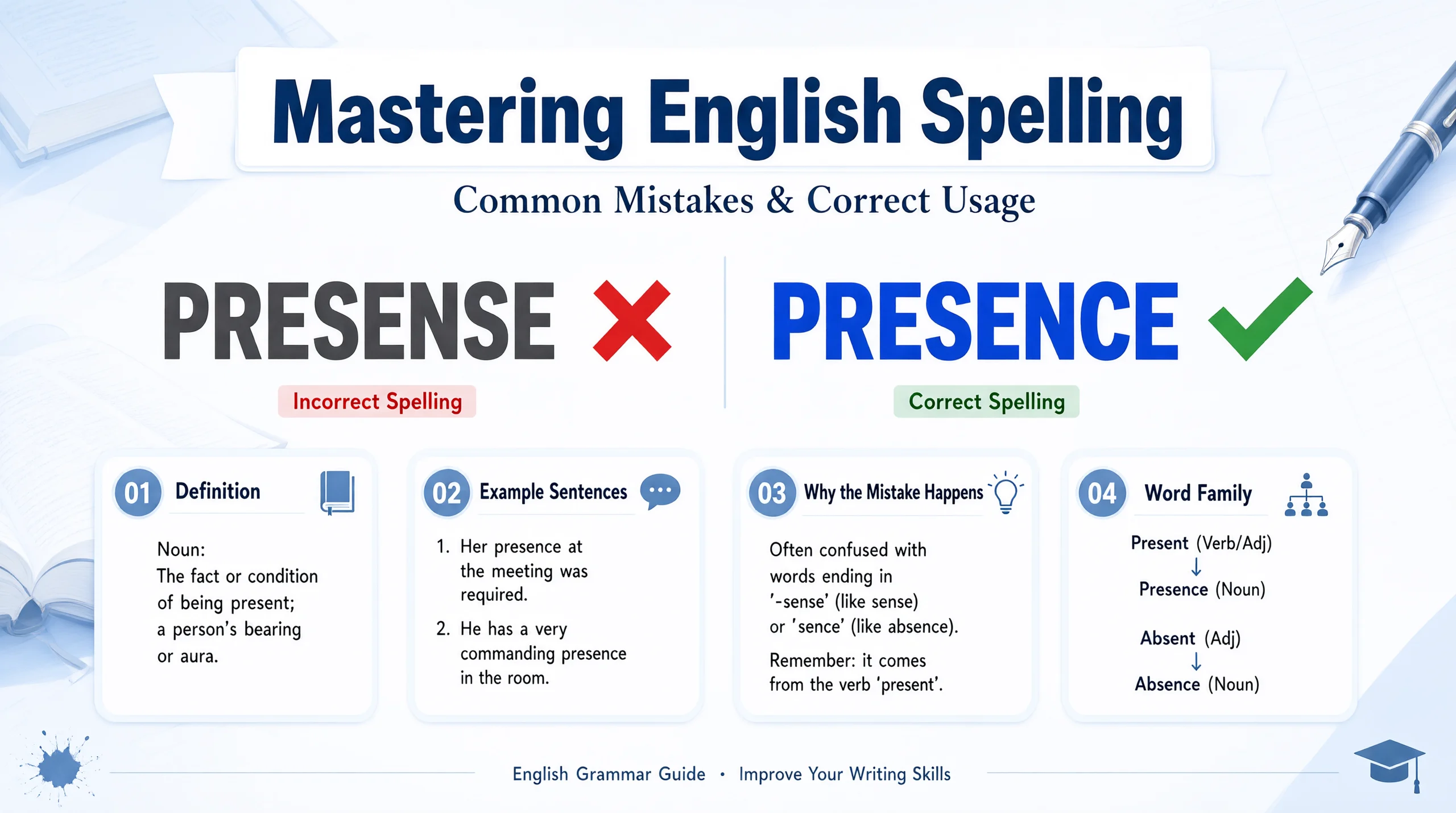
The English language has many words that sound similar or look almost identical but have different spellings. One common spelling confusion is presense vs presence. If you have ever wondered if to write presense or presence, you are not alone. This mistake often happens because the final sound of the word can make the correct spelling difficult to remember.
The correct spelling is presence, while presense is a misspelling. Presence is a noun that refers to the state of being somewhere, the existence of someone or something in a particular place, or the noticeable influence a person has on others.
You might use it when talking about someone’s attendance, a person’s confidence, or the existence of something. Learning the correct spelling will help you write more clearly in emails, school assignments, professional documents, and everyday conversations.
Quick Answer: Presense or Presence?
Presence is the correct spelling in English. Presense is incorrect and should not be used in formal or informal writing. Presence is a noun meaning the state of being present, existing, or being in a particular place. For example: “Her presence made everyone feel comfortable.”
Why Do People Confuse Presense and Presence?
People often confuse these two spellings because they look and sound very similar. Both contain the letters “presen,” and their pronunciation can make the final letters difficult to identify.
There are several reasons behind this common spelling mistake:
- Similar pronunciation: The ending of presence sounds like “s,” which can lead writers to use the wrong letter.
- Spelling confusion: English spelling does not always follow pronunciation rules.
- Unfamiliar word endings: Some writers mistakenly replace the correct “-ence” ending with “-ense.”
- Typing mistakes: Fast typing and autocorrect can sometimes allow spelling errors to go unnoticed.
The easiest way to avoid this mistake is to remember that the correct word always ends in -ence.
First Word: Presense
Presense is an incorrect spelling of presence. It is not the standard English spelling and should not be used in academic, professional, or everyday writing.
Some people write presense because they confuse the sound of the word with its spelling. However, it does not have an accepted independent meaning in standard English.
Incorrect example:
- Her presense was important at the meeting.
- I noticed his presense in the classroom.
- The teacher appreciated her presense.
Correct versions:
- Her presence was important at the meeting.
- I noticed his presence in the classroom.
- The teacher appreciated her presence.
Always use presence when referring to someone’s attendance, existence, or influence.
Second Word: Presence
Presence is the correct English word. It is a noun used to describe the state of being in a particular place, the existence of someone or something, or the noticeable effect a person has on others.
Meanings of Presence
Presence has several common meanings:
- Being somewhere: The state of being in a particular place.
- Existence: The fact that someone or something exists.
- Personal influence: The noticeable effect someone has on other people.
- Appearance or manner: The way someone attracts attention through confidence or personality.
Examples of Presence
- Her presence made the event more enjoyable.
- The manager requested everyone’s presence at the meeting.
- His presence gave the team confidence.
- The police confirmed the presence of fingerprints.
Presense vs Presence: Comparison Table
| Feature | Presense | Presence |
| Spelling | Incorrect | Correct |
| Word type | Not standard | Noun |
| Meaning | No accepted standard meaning | Being present or existing |
| Ending | -ense | -ence |
| Dictionary usage | Misspelling | Standard English word |
| Example | Wrong spelling | Her presence was appreciated. |
Remember: Presence is always the correct spelling when you mean being present or existing somewhere.
When to Use Each Word
Knowing when to use these spellings is simple because only one is correct in standard English.
When to Use Presence
Use presence when discussing someone’s attendance, existence, influence, or noticeable personality.
Examples:
- Your presence is important to us.
- The company confirmed the presence of its director.
- She has a strong presence on stage.
- Scientists discovered the presence of water.
When Not to Use Presense
Avoid presense in all normal English writing because it is a spelling error.
For example:
- Incorrect: His presense was noticeable.
- Correct: His presence was noticeable.
- Incorrect: We enjoyed your presense.
- Correct: We enjoyed your presence.
15 Examples of Presence in Sentences
Here are 15 practical examples showing how to use presence correctly in everyday English.
- Your presence makes this occasion special.
- The teacher appreciated everyone’s presence in class.
- Her presence brought happiness to the family.
- I felt nervous in the presence of the principal.
- The manager requested his presence at the office.
- His strong presence impressed the audience.
- The doctor confirmed the presence of an infection.
- We noticed the presence of several guests.
- Her presence helped everyone feel relaxed.
- The company has a strong online presence.
- The security guard noticed the presence of a stranger.
- Their presence made the celebration memorable.
- The scientist studied the presence of bacteria in water.
- He has a confident presence during presentations.
- Thank you for your presence and support.
These examples show that presence can describe physical attendance, existence, personality, and influence.
Common Mistakes When Using Presense and Presence
Writers sometimes make spelling mistakes because they focus more on pronunciation than correct spelling.
Here are some common mistakes to avoid:
1. Writing presense instead of presence
- Incorrect: I appreciate your presense.
- Correct: I appreciate your presence.
2. Using the wrong ending
The word presence ends with “-ence,” not “-ense.”
3. Treating presense as another English word
Presense is not an alternative spelling of presence.
4. Ignoring spelling mistakes during proofreading
Always check commonly confused words before submitting an assignment, email, or professional document.
5. Depending completely on pronunciation
A word may sound one way but have a different standard spelling. Learning its written form is important.
Easy Memory Trick: How to Remember Presence
A simple trick can help you remember the correct spelling.
Think of the word present.
- Present → Presence
- Both words contain the letter sequence “presen.”
- Presence ends with “-ence.”
Remember this sentence:
“Your presence is appreciated.”
Whenever you are unsure whether to write presense or presence, think of present and choose presence.
American vs British English: Presense or Presence
There is no spelling difference between American and British English for this word.
Both varieties use presence as the correct spelling.
| English Variety | Correct Spelling | Incorrect Spelling |
| American English | Presence | Presense |
| British English | Presence | Presense |
| Australian English | Presence | Presense |
| Canadian English | Presence | Presense |
Whether you are writing for an American, British, Canadian, or Australian audience, always use presence.
Similar Words to Presence
Several English words have similar meanings or related spelling patterns. Learning them can improve your vocabulary and spelling skills.
| Word | Simple Meaning |
| Present | Being in a particular place |
| Attendance | The act of being present |
| Existence | The state of being real |
| Appearance | The way someone or something looks |
| Availability | The state of being accessible |
| Influence | The power to affect others |
| Participation | Taking part in an activity |
| Visibility | The state of being seen |
| Aura | A distinctive quality or atmosphere |
| Company | Being with another person |
These words are related to presence, but they are not always interchangeable. Choose the word that best communicates your intended meaning.
FAQs:
1. Is it presense or presence?
Presence is the correct spelling. Presense is a common spelling mistake and should not be used in standard English writing.
2. What does presence mean?
Presence means the state of being in a particular place or the existence of someone or something. It can also describe a person’s influence, confidence, or noticeable personality.
3. Why is presense incorrect?
Presense is incorrect because it does not follow the standard spelling of the English word. The correct spelling ends in “-ence,” making presence the accepted form.
4. Is presence a noun or a verb?
Presence is a noun. It describes the state of being present, existing somewhere, or having a noticeable influence.
5. How do you pronounce presence?
Presence is pronounced approximately PREZ-uhns. It has two syllables, and the final sound is similar to “s.”
6. What is the plural form of presence?
The plural form is presences. It can be used when referring to multiple instances or forms of presence.
Example: The presences of several international guests were noted at the event.
7. Is presence spelled the same in American and British English?
Yes. Both American and British English use the spelling presence. There is no regional spelling difference.
Remember This
- Presence = Correct spelling.
- Presense = Incorrect spelling.
- Presence is a noun.
- It means being somewhere, existing, or having an influence.
- Both American and British English use presence.
- Remember the spelling pattern: present → presence.
The most important thing to remember is that presence always ends with -ence, not -ense.
Conclusion
The difference between presense and presence is simple: presence is the correct spelling, while presense is a spelling mistake. Presence is a useful English noun that describes someone’s attendance, existence, personality, or influence. You can use it in everyday conversations, school assignments, business emails, and professional writing.
To avoid this mistake, connect presence with the word present and remember its “-ence” ending. Practicing the example sentences and checking your spelling before submitting written work can help you use the word confidently. Whenever you are unsure, choose presence.