The words gummy and gummie look and sound almost identical, so it is easy to wonder which spelling is correct. You may have seen both versions when reading about gummy candies, chewy sweets, vitamins, or products with a soft, sticky texture. However, there is an important difference between their standard usage.
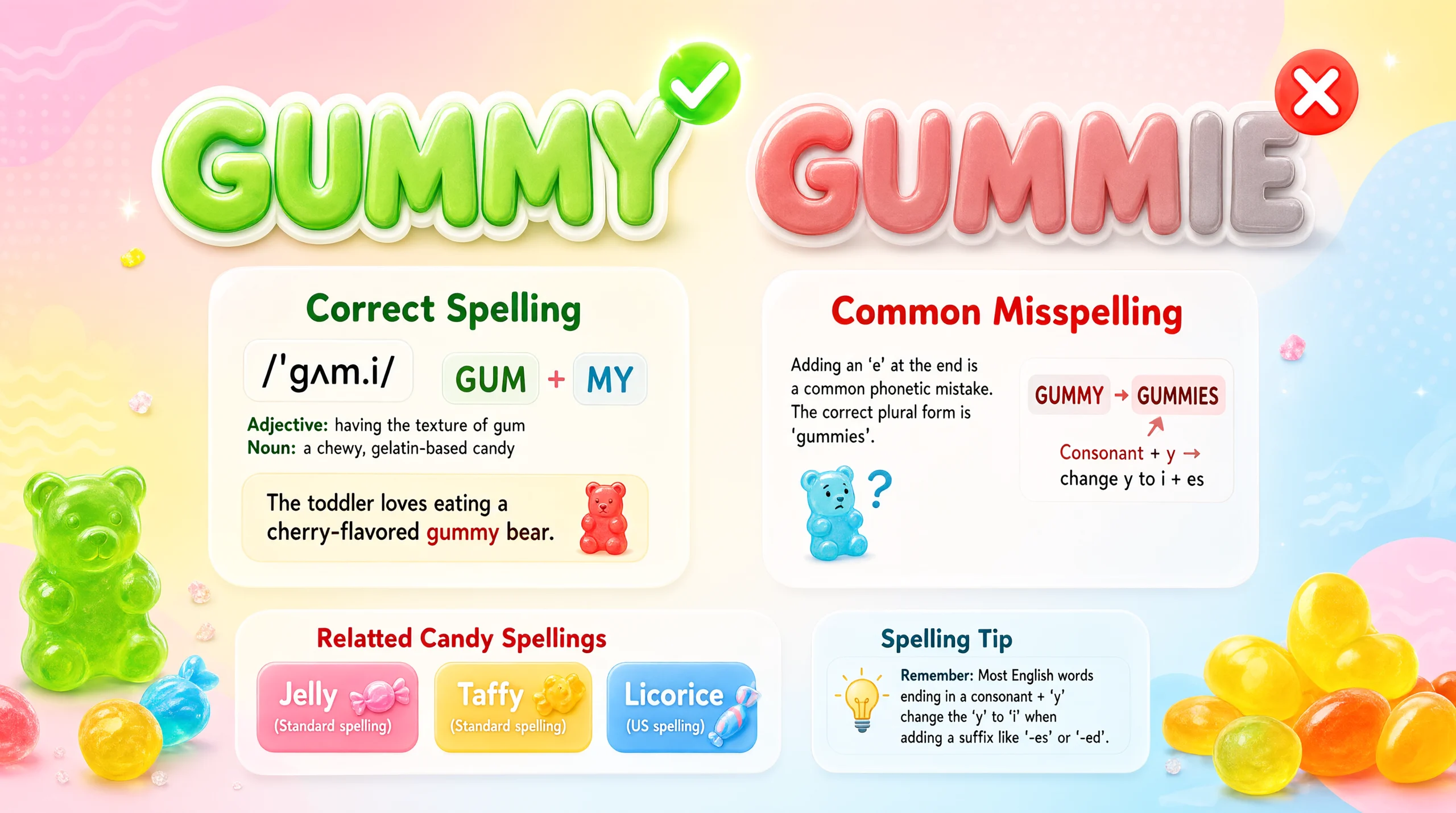
Gummy is the correct and widely accepted spelling in standard English. It can describe something sticky, chewy, or resembling gum. It is also commonly used in expressions such as gummy bears, gummy vitamins, and gummy candy. On the other hand, gummie is a nonstandard alternative spelling that occasionally appears in informal writing, brand names, or product descriptions.
Understanding the difference between gummy vs gummie will help you choose the right spelling in everyday conversations, school assignments, professional writing, and online content. This guide explains both forms, provides practical examples, and shows you how to remember the correct spelling.
Quick Answer
Gummy is the correct standard English spelling, while gummie is generally considered a misspelling or nonstandard variant. Use gummy when describing something sticky, chewy, or made with a gel-like texture. For example, write gummy bears, not gummie bears, unless a specific brand uses that spelling.
Why Do People Confuse Gummy and Gummie?
People often confuse these two spellings because they have the same pronunciation. Both look like possible ways to spell a word ending in the long E sound.
There are several reasons for this confusion:
- Similar pronunciation: Both words are usually pronounced the same way.
- Spelling patterns: English sometimes uses the letter combination -ie to represent a similar ending sound.
- Informal writing: People occasionally use alternative spellings in messages and online posts.
- Product names: Some brands may choose unusual spellings for marketing purposes.
- Limited spelling knowledge: Readers may not know that gummy is the established standard form.
The easiest way to avoid confusion is to remember that the standard spelling ends in -y.
1. What Does Gummy Mean?
Gummy is an adjective that describes something sticky, chewy, soft, or similar to gum.
It is also used as a noun in certain contexts, particularly when referring to gummy candies.
Meaning of Gummy
The word gummy can have several related meanings:
- Sticky: Something that feels adhesive or slightly wet.
- Chewy: Food that requires repeated chewing.
- Rubbery: Something with a soft, elastic texture.
- Gum-like: Something that resembles chewing gum.
- Containing gum: Something made with or having a gum-like substance.
Examples of Gummy in Sentences
- The candy has a soft and gummy texture.
- My little brother loves gummy bears.
- These gummy vitamins taste like fruit.
- The melted sugar made the surface gummy.
- The bread became gummy because it was undercooked.
Remember: Gummy is the correct spelling for standard English writing.
2. What Does Gummie Mean?
Gummie is a nonstandard spelling of gummy. It is sometimes used informally, but it is not the conventional spelling found in standard English dictionaries.
People may write gummie because they think the ending -ie looks more natural or because they have encountered it in a product name or informal online content.
Meaning of Gummie
When someone writes gummie, they usually intend the same meaning as gummy.
For example:
- Gummie bears instead of gummy bears.
- Gummie candy instead of gummy candy.
- Gummie vitamins instead of gummy vitamins.
However, these spellings should generally be avoided in formal writing.
Examples of Gummie in Sentences
The following sentences demonstrate the nonstandard spelling:
- I bought a bag of gummie bears.
- She likes eating gummie candy.
- The store sells fruit-flavored gummie vitamins.
For standard English, rewrite these sentences using gummy.
3. Gummy vs Gummie: Comparison Table
| Feature | Gummy | Gummie |
| Spelling status | Standard spelling | Nonstandard spelling |
| Pronunciation | /ˈɡʌmi/ | Usually /ˈɡʌmi/ |
| Part of speech | Adjective and noun | Informal spelling |
| Meaning | Sticky, chewy, or gum-like | Usually intended to mean gummy |
| Dictionary usage | Established word | Not the standard form |
| Formal writing | Correct choice | Avoid |
| Common phrase | Gummy bears | Gummie bears |
| Example | Gummy candy | Gummie candy |
The main difference is spelling, not pronunciation or intended meaning. Gummy is the form you should use in everyday and professional English.
4. When Should You Use Gummy or Gummie?
Choosing the correct spelling becomes easy when you understand the context.
When to Use Gummy
Use gummy in standard English writing whenever you describe something sticky, chewy, or gum-like.
Common situations include:
- Writing about gummy bears or other chewy candies.
- Describing gummy vitamins and supplements.
- Explaining the texture of food.
- Describing sticky substances.
- Writing product reviews or descriptions.
- Completing school assignments or professional documents.
Examples:
- These gummy candies are delicious.
- The dough became gummy after adding too much water.
- I prefer gummy vitamins over large tablets.
When to Use Gummie
Avoid gummie in ordinary English writing.
It may appear in:
- Informal messages.
- User-generated online content.
- Creative spellings.
- Specific product or brand names.
If a company officially uses Gummie as part of its brand name, preserve that exact spelling when referring to the brand.
5. Gummy vs Gummie: 12 Examples in Sentences
Here are practical examples to help you understand the correct usage.
| Incorrect or nonstandard | Correct sentence |
| I bought gummie bears. | I bought gummy bears. |
| She enjoys gummie candy. | She enjoys gummy candy. |
| These gummie vitamins taste good. | These gummy vitamins taste good. |
| The texture feels gummie. | The texture feels gummy. |
| He ate several gummie sweets. | He ate several gummy sweets. |
| My favorite snack is gummie worms. | My favorite snack is gummy worms. |
| The mixture became gummie. | The mixture became gummy. |
| I purchased a pack of gummie candies. | I purchased a pack of gummy candies. |
| The children love gummie snacks. | The children love gummy snacks. |
| This food has a gummie texture. | This food has a gummy texture. |
| She bought gummie supplements. | She bought gummy supplements. |
| The candy was soft and gummie. | The candy was soft and gummy. |
Additional Correct Examples
- The gummy candy came in different fruit flavors.
- My teeth felt gummy after eating the sweets.
- The recipe produces a soft, gummy texture.
- Gummy bears are popular among children and adults.
These examples show why gummy is the spelling to remember.
6. Common Mistakes When Using Gummy and Gummie
Even experienced English learners sometimes make spelling mistakes with similar-sounding words.
Here are common errors to avoid:
Mistake 1: Writing gummie instead of gummy
Incorrect: I love gummie bears.
Correct: I love gummy bears.
Mistake 2: Using gummie in professional writing
Incorrect: Our company sells gummie vitamins.
Correct: Our company sells gummy vitamins.
Mistake 3: Assuming both spellings are equally standard
Although both may appear online, they do not have the same status in standard English.
Mistake 4: Using the wrong spelling in product descriptions
Incorrect: Delicious fruit-flavored gummie candy.
Correct: Delicious fruit-flavored gummy candy.
Mistake 5: Ignoring the spelling in established expressions
The familiar expression is gummy bears, not gummie bears.
7. Memory Trick: How to Remember Gummy
A simple memory trick can help you remember the correct spelling.
Think of the word gum.
When something feels sticky or chewy like gum, you can describe it as gummy.
Remember this:
- Gum + my = Gummy.
- Gummy ends with the letter Y.
- Gummy bears are spelled with Y.
You can also remember this simple sentence:
“My gummy candy is chewy.”
Both my and gummy contain the letter Y, making the correct spelling easier to remember.
8. Gummy vs Gummie in American and British English
There is no major American-versus-British spelling difference between gummy and gummie.
Both American and British English use gummy as the standard spelling.
| English variety | Standard spelling | Example |
| American English | Gummy | Gummy bears |
| British English | Gummy | Gummy sweets |
| Canadian English | Gummy | Gummy candy |
| Australian English | Gummy | Gummy lollies |
The main difference is often vocabulary rather than spelling.
For example:
- Americans commonly say gummy candy.
- British speakers commonly say gummy sweets.
- Australians may use gummy lollies.
Regardless of the country, gummy remains the standard spelling.
9. Similar Words to Gummy
Learning related words can improve your vocabulary and help you describe textures more accurately.
Here are some useful alternatives:
| Word | Meaning | Example |
| Sticky | Tending to adhere to surfaces | The candy feels sticky. |
| Chewy | Requiring a lot of chewing | The sweets are chewy. |
| Rubbery | Having an elastic texture | The food became rubbery. |
| Gelatinous | Having a jelly-like consistency | The mixture is gelatinous. |
| Tacky | Slightly sticky | The surface feels tacky. |
| Viscous | Thick and slow-flowing | The liquid is viscous. |
| Elastic | Able to stretch and return to shape | The material is elastic. |
| Jelly-like | Similar to soft jelly | The dessert has a jelly-like texture. |
These words are not always interchangeable with gummy. Choose one according to the exact texture or meaning you want to communicate.
FAQs:
1. Is gummy or gummie correct?
Gummy is the correct standard English spelling. Gummie is generally considered a nonstandard spelling and should be avoided in formal and everyday writing.
2. Is gummie a real word?
Gummie appears in informal writing and may be used in certain brand names, but it is not the standard spelling of the English word gummy.
3. How do you spell gummy bears?
The correct spelling is gummy bears. The word gummy ends with Y, not IE.
4. Are gummy and gummie pronounced the same?
Yes. When gummie is intended as an alternative spelling of gummy, both are generally pronounced the same way: GUM-ee.
5. Is gummy an adjective or a noun?
Gummy is primarily an adjective describing something sticky, chewy, or gum-like. It can also function as a noun when referring to a gummy sweet or candy.
6. Is gummy the correct spelling in British English?
Yes. British English also uses gummy. The spelling does not change between American and British English.
7. Why do people spell gummy as gummie?
People may use gummie because of pronunciation similarities, informal spelling habits, or creative product naming. However, gummy remains the standard spelling.
11. Remember This
Here is the easiest way to remember the difference:
- Gummy: Correct standard English spelling.
- Gummie: Nonstandard alternative spelling.
- Pronunciation: Usually the same.
- Meaning: Generally intended to be the same.
- Best choice: Always use gummy in standard writing.
Whenever you write about gummy bears, gummy vitamins, chewy sweets, or sticky textures, choose the spelling ending in Y.
Conclusion
The difference between gummy vs gummie is simple: gummy is the standard and correct English spelling, while gummie is generally a nonstandard alternative. Although both forms may appear online and sound alike, they should not be treated as equally acceptable in standard writing.
To improve your spelling, remember the word gum and its familiar form gummy. Use it in schoolwork, professional communication, product descriptions, and everyday conversations. Once you remember that gummy ends with Y, you will no longer need to wonder which spelling to choose.