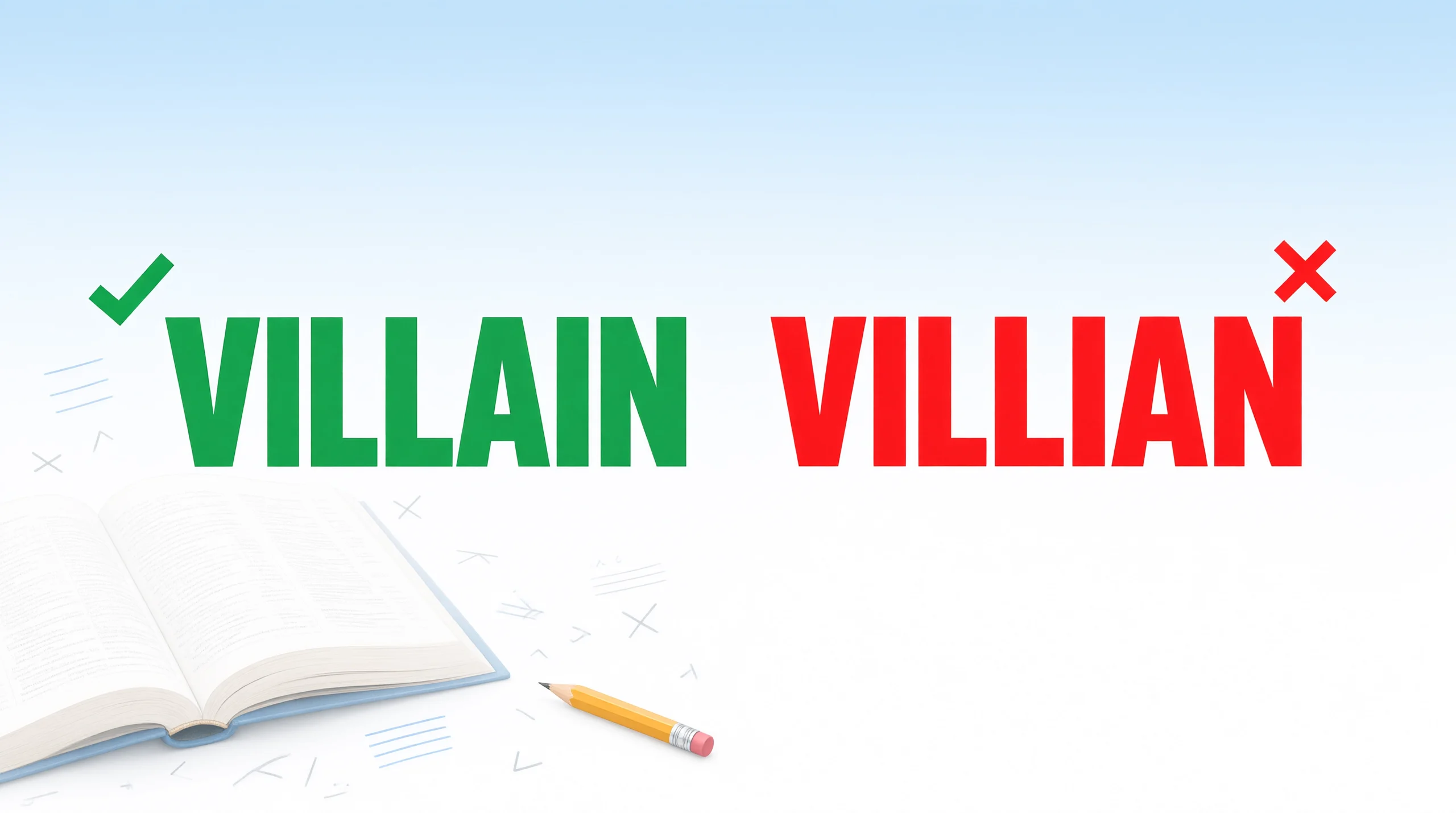
Have you ever wondered if the correct spelling is villain or villian? These two words look almost identical, so it is easy to mix them up when writing essays, stories, articles, or everyday messages. However, only one spelling is correct in standard English: villain. The spelling villian is a common misspelling and should generally be avoided.
Understanding the difference between villain and villian can help you improve your spelling, vocabulary, and writing skills. A villain is a bad or evil character in a story, movie, or real-life situation. The word is commonly used when discussing superheroes, novels, films, and fictional conflicts.
In this guide, you will learn the correct spelling, meaning, pronunciation, practical examples, and simple tricks to remember the word. You will also discover why people confuse these spellings and how to avoid making the same mistake.
Quick Answer
Villain is the correct spelling, while villian is incorrect. A villain is a character who performs evil actions or opposes the hero in a story. Remember the spelling as V-I-L-L-A-I-N, with two Ls followed by A-I-N.
Why Do People Confuse Villain and Villian?
People often confuse villain and villian because the two spellings contain almost the same letters. Both have six letters, begin with V, and include double L.
The confusion mainly happens because:
- Similar appearance: The words look nearly identical.
- Pronunciation: The difference between the vowel sounds is not always obvious to English learners.
- Typing mistakes: People sometimes type the wrong vowel combination without noticing.
- Spelling patterns: English has many words with unusual letter combinations, making spelling difficult.
- Limited practice: People who rarely write the word may forget its correct spelling.
The important thing to remember is that villain is the only standard spelling.
First Word: Villain (Correct Spelling)
Villain is a noun that describes an evil, cruel, or dishonest person. In literature and entertainment, it usually refers to a character who creates problems for the main character or works against the hero.
Correct spelling
Spelling: V-I-L-L-A-I-N
Pronunciation: VIL-uhn
Meaning: An evil person or an antagonist in a story.
Examples:
- The villain tried to destroy the city.
- Every superhero story needs an interesting villain.
- The movie’s villain was clever and dangerous.
- The villain planned to steal the valuable treasure.
- Everyone was surprised when the friendly character became the villain.
Synonyms of Villain:
- Antagonist
- Criminal
- Evildoer
- Wrongdoer
- Scoundrel
- Enemy
- Bad guy
- Malefactor
Example sentence: The villain in the movie was defeated by the brave superhero.
Second Word: Villian (Incorrect Spelling)
Villian is a common spelling mistake of the word villain. It is not accepted as the standard spelling in modern English dictionaries when referring to an evil person or fictional antagonist.
Spelling: V-I-L-L-I-A-N
Meaning: No standard English meaning as a spelling variant of villain.
Incorrect examples:
- The villian attacked the hero.
- The movie’s villian was very frightening.
- Everyone hated the villian.
Correct versions:
- The villain attacked the hero.
- The movie’s villain was very frightening.
- Everyone hated the villain.
Always use villain when you want to describe an evil character or person.
Villain vs Villian: Comparison Table
| Feature | Villain | Villian |
| Spelling | Correct | Incorrect |
| Word type | Noun | Misspelling |
| Meaning | Evil person or antagonist | No standard meaning |
| Pronunciation | VIL-uhn | Intended as villain |
| Dictionary usage | Standard English | Nonstandard spelling |
| Example | The villain escaped. | The villian escaped. |
| Correct for writing? | Yes | No |
When to Use Villain or Villian
Knowing when to use the correct spelling is simple because these words do not have two different standard meanings.
Use Villain When:
Use villain when describing:
- An evil character in a movie or novel.
- Someone who opposes the hero.
- A cruel or dishonest person.
- A criminal or wrongdoer.
- Someone responsible for harmful actions.
Examples:
- The villain escaped from prison.
- The author created a mysterious villain.
- The villain wanted to control the entire kingdom.
Use Villian When:
Avoid using villian in standard English writing. It is a misspelling of villain.
If you see this spelling in an essay, email, article, or school assignment, correct it to villain.
12 Examples of Villain vs Villian in Sentences
Here are 12 examples to help you understand the correct spelling in everyday English.
| Incorrect Sentence | Correct Sentence |
| The villian was very cruel. | The villain was very cruel. |
| Batman defeated the villian. | Batman defeated the villain. |
| The villian stole the money. | The villain stole the money. |
| Everyone feared the villian. | Everyone feared the villain. |
| The villian escaped the castle. | The villain escaped the castle. |
| The story has a powerful villian. | The story has a powerful villain. |
| The villian attacked the hero. | The villain attacked the hero. |
| The villian wanted revenge. | The villain wanted revenge. |
| The villian was secretly a prince. | The villain was secretly a prince. |
| The villian created a dangerous plan. | The villain created a dangerous plan. |
| The villian appeared at the end. | The villain appeared at the end. |
| The hero finally defeated the villian. | The hero finally defeated the villain. |
Common Mistakes When Writing Villain
English learners and even experienced writers sometimes make spelling mistakes with villain.
Here are some common errors to avoid:
- Writing villian instead of villain: Always use A before I in the final part of the word.
- Using one L: The correct spelling contains two Ls.
- Confusing spelling with pronunciation: Remember that the spelling is not always obvious from how a word sounds.
- Ignoring spelling corrections: Check your writing before submitting an assignment or publishing an article.
- Assuming both spellings are acceptable: Villain is the standard spelling.
Easy Memory Trick to Remember Villain
A simple spelling trick can help you remember the correct word.
Think of the word in three parts:
VIL + L + AIN = VILLAIN
Remember these points:
- Start with VIL.
- Write two Ls.
- Finish with AIN, not IAN.
You can also remember this sentence:
“A villain is a bad person, but the spelling is always VILLAIN.”
Practice writing the word five times to make the correct spelling easier to remember.
American vs British English: Villain or Villian
There is no spelling difference between American and British English for this word.
Both English varieties use villain as the correct spelling.
| English Variety | Correct Spelling | Incorrect Spelling |
| American English | Villain | Villian |
| British English | Villain | Villian |
| Canadian English | Villain | Villian |
| Australian English | Villain | Villian |
Whether you are writing for an American, British, Canadian, or Australian audience, always choose villain.
Similar Words to Villain
Learning related vocabulary can help you describe characters and people more accurately.
| Word | Simple Meaning | Example |
| Antagonist | A character who opposes the main character | The antagonist challenged the hero. |
| Hero | A person admired for courage or good actions | The hero saved the village. |
| Criminal | Someone who commits a crime | The criminal was arrested. |
| Evildoer | A person who does evil things | The evildoer harmed innocent people. |
| Scoundrel | A dishonest or untrustworthy person | The scoundrel cheated his friends. |
| Enemy | Someone who opposes another person | The hero faced his enemy. |
| Opponent | Someone competing or fighting against another | She defeated her opponent. |
| Nemesis | A persistent rival or enemy | The hero finally faced his nemesis. |
FAQs:
1. Is Villain or Villian Correct?
Villain is correct. Villian is a common misspelling and is not the standard English spelling. Always write villain when describing an evil person or character.
2. What Does Villain Mean?
A villain is an evil, cruel, or dishonest person. In stories, movies, and books, a villain usually opposes the hero or creates problems for the main character.
3. How Do You Spell Villain Correctly?
The correct spelling is V-I-L-L-A-I-N. It contains six letters, including two Ls, followed by A-I-N.
4. Why Do People Spell Villain as Villian?
People often write villian because the two spellings look similar and the correct vowel order can be difficult to remember. It is usually an accidental spelling mistake.
5. Is Villain the Same in American and British English?
Yes. Both American and British English use the spelling villain. There is no regional spelling variation between these forms.
6. What Is the Plural of Villain?
The plural of villain is villains. Simply add an S to the end.
Example: The villains in the movie worked together against the hero.
7. What Is Another Word for Villain?
Common alternatives include antagonist, evildoer, criminal, scoundrel, wrongdoer, and bad guy. The best choice depends on the context.
Remember This
- Villain = Correct spelling.
- Villian = Incorrect spelling.
- Villain means an evil or dishonest person.
- The plural form is villains.
- Both American and British English use villain.
- Remember the final letters: AIN, not IAN.
Conclusion
The difference between villain and villian is simple: villain is the correct spelling, while villian is a spelling mistake. Although these words look similar, only villain is accepted in standard English when referring to an evil person or antagonist. Learning the correct letter order will help you avoid this common writing error.
If you are writing a school assignment, creating a story, discussing a movie, or improving your English vocabulary, always remember to spell the word V-I-L-L-A-I-N. With regular practice and the simple memory trick in this guide, you can confidently use the correct spelling every time.