English spelling can be confusing, especially when two words look almost identical. One common example is “cancell vs cancel.” Both spellings may look reasonable at first, but only one is correct in standard English. If you are writing an email, completing an assignment, or communicating professionally, choosing the correct spelling helps make your writing clear and accurate.
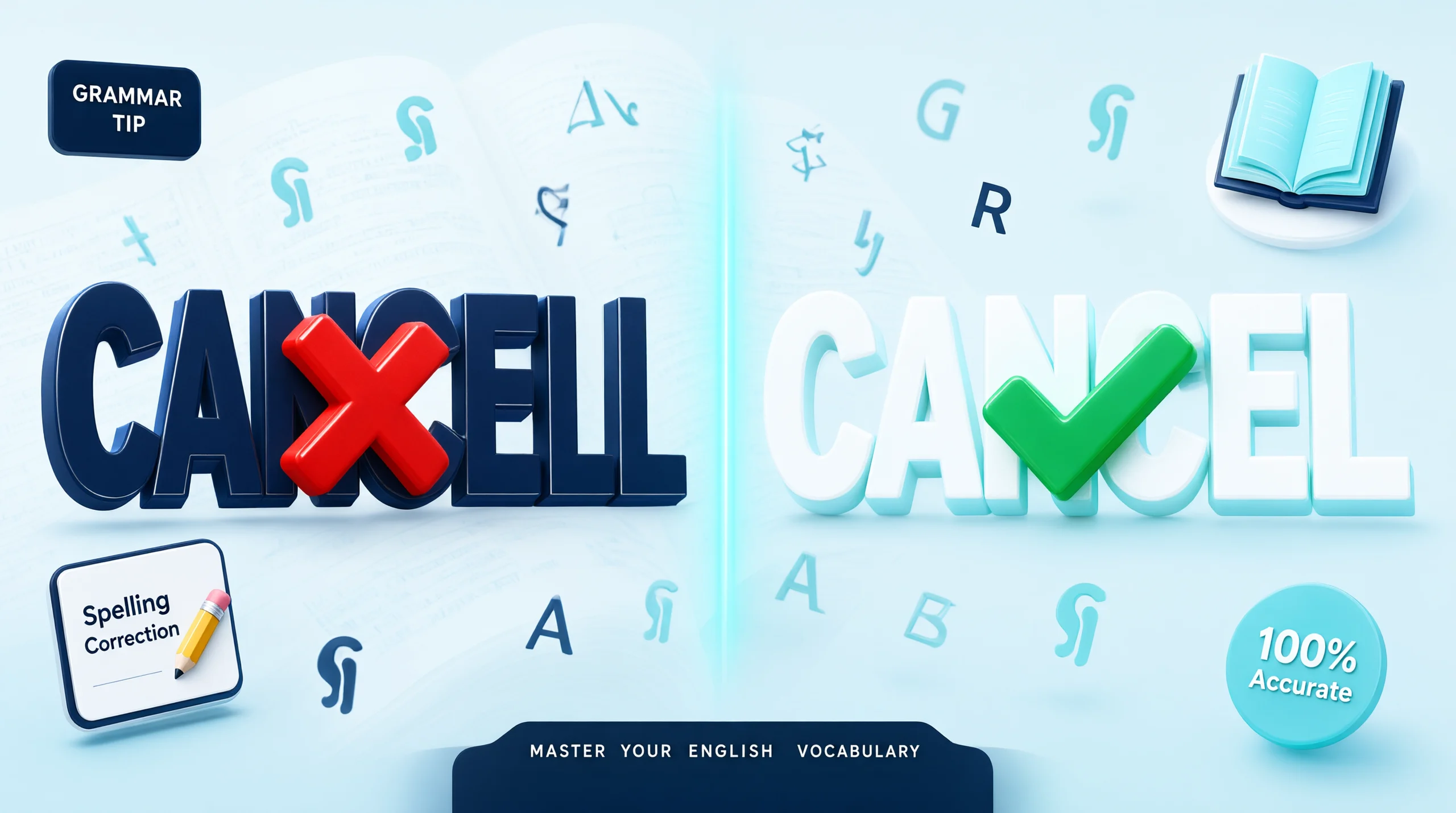
The correct spelling is cancel, with one L at the end. Cancell is a misspelling and is not accepted as a standard English word. However, confusion often happens because English sometimes doubles the final consonant when adding endings, as in cancelled and cancelling. This spelling pattern makes it easy to wonder if the original word should also have two Ls.
In this guide, you will learn the difference between cancell and cancel, understand how to use cancel correctly, and explore practical examples, spelling rules, and the differences between American and British English.
Quick Answer: Cancell or Cancel?
Cancel is the correct spelling in standard English. It means to call off, stop, or decide that something will not happen. Cancell is incorrect and should not be used in formal or informal writing. Remember: the base verb has one L, while some forms, such as cancelled and cancelling, use two Ls.
Why Do People Confuse Cancell and Cancel?
People often confuse these spellings because English has several words that double their final consonants when certain endings are added.
For example:
- Cancel → Cancelled
- Cancel → Cancelling
- Travel → Travelled
- Travel → Travelling
Seeing two Ls in cancelled and cancelling can make writers assume that cancell is also correct.
Another reason is the difference between American and British spelling conventions. Although both generally use cancel as the base verb, they differ in some related forms.
The important point is that the original verb always has one L.
1. Cancel: Correct Spelling and Meaning
Cancel is the correct spelling. It is a verb that means to stop, call off, or decide not to continue something that was previously planned or arranged.
It can refer to appointments, meetings, events, subscriptions, orders, reservations, and other arrangements.
Examples:
- I need to cancel my appointment.
- They decided to cancel the concert.
- Please cancel my online subscription.
- The school may cancel classes because of heavy rain.
- She wants to cancel her hotel reservation.
Word information:
| Feature | Details |
| Correct spelling | Cancel |
| Part of speech | Verb |
| Meaning | To call off or stop something |
| Pronunciation | KAN-suhl |
| Base form | Cancel |
| Past tense (American) | Canceled |
| Past tense (British) | Cancelled |
| Present participle | Canceling / Cancelling |
2. Cancell: Incorrect Spelling and Meaning
Cancell is an incorrect spelling of the English verb cancel. It is not recognized as a standard English word.
Writers sometimes use this spelling because they mistakenly double the final L in the base form.
However, adding an extra L does not make the original word correct.
Incorrect examples:
- I want to cancell my order.
- Please cancell the meeting.
- They will cancell the event tomorrow.
- She decided to cancell her membership.
Correct versions:
- I want to cancel my order.
- Please cancel the meeting.
- They will cancel the event tomorrow.
- She decided to cancel her membership.
Always write cancel, not cancell, when using the original verb.
Cancell vs Cancel: Key Differences
| Feature | Cancell | Cancel |
| Spelling | Incorrect | Correct |
| Standard English word | No | Yes |
| Part of speech | Not applicable | Verb |
| Meaning | No standard meaning | To stop or call off |
| Usage | Avoid | Use in all standard contexts |
| Example | Cancell the order. | Cancel the order. |
When Should You Use Cancel?
Use cancel whenever you want to describe stopping something that was planned, scheduled, ordered, or arranged.
Here are some common situations:
1. Cancel an appointment
Use it when you cannot attend a scheduled meeting with a doctor, teacher, or professional.
Example: I need to cancel my dentist appointment.
2. Cancel an event
Use it when an organized activity will not take place.
Example: The organizers decided to cancel the outdoor festival.
3. Cancel a subscription
Use it when you want to stop a paid or free service.
Example: He decided to cancel his streaming subscription.
4. Cancel an order
Use it when you no longer want something you purchased.
Example: I want to cancel my online order.
5. Cancel a reservation
Use it when you no longer need a booked table, room, or service.
Example: We had to cancel our restaurant reservation.
12 Examples of Cancel in Sentences
Here are 12 practical examples to help you understand the correct spelling and usage.
- I have to cancel my appointment because I am sick.
- The company decided to cancel the meeting.
- Please cancel my subscription before the next payment.
- Heavy snowfall may cancel tomorrow’s flight.
- She wants to cancel her hotel reservation.
- We cannot cancel the event at the last minute.
- He forgot to cancel his membership.
- The teacher had to cancel the class.
- They agreed to cancel the order.
- You can cancel your booking online.
- The airline may cancel flights because of bad weather.
- I decided to cancel my plans for the weekend.
Notice that every sentence uses cancel with only one L.
Common Spelling Mistakes to Avoid
Writers sometimes make mistakes when using cancel and its different grammatical forms.
Here are some common errors:
| Incorrect | Correct |
| Cancell | Cancel |
| Canceledd | Canceled |
| Cancellling | Cancelling |
| Cancelingg | Canceling |
| Cancele | Cancel |
| Cancle | Cancel |
Important spelling rule: The base word is cancel, but its spelling can change when you add certain endings.
- Cancel + ed = Canceled (American English)
- Cancel + ed = Cancelled (British English)
- Cancel + ing = Canceling (American English)
- Cancel + ing = Cancelling (British English)
Easy Memory Trick: How to Remember Cancel
Use this simple trick:
Cancel has one L before adding an ending.
Think of the word this way:
- Cancel = One L
- Canceled = One L (American English)
- Cancelled = Two Ls (British English)
- Canceling = One L (American English)
- Cancelling = Two Ls (British English)
Remember that cancell is never the correct base spelling.
American vs British English: Is Cancel Spelled Differently?
The base spelling cancel is the same in both American and British English.
However, the spelling changes when certain endings are added.
| Word Form | American English | British English |
| Base form | Cancel | Cancel |
| Past tense | Canceled | Cancelled |
| Past participle | Canceled | Cancelled |
| Present participle | Canceling | Cancelling |
| Noun | Cancellation | Cancellation |
Examples:
- American: The airline canceled the flight.
- British: The airline cancelled the flight.
- American: I am canceling my subscription.
- British: I am cancelling my subscription.
Both spelling systems are correct in their respective varieties of English.
One important detail: cancellation has two Ls in both American and British English.
Similar Words to Cancel
Learning related words can help you expand your vocabulary and express the idea of stopping or calling something off more naturally.
| Word | Simple Meaning | Example |
| Call off | Stop a planned event | They called off the match. |
| Abandon | Give up a plan | They abandoned the project. |
| Withdraw | Remove or take back | She withdrew her application. |
| Revoke | Officially take back | The authority revoked the license. |
| Annul | Declare legally invalid | The court annulled the agreement. |
| Terminate | Bring something to an end | They terminated the contract. |
| Rescind | Officially cancel a decision | The company rescinded its offer. |
| Postpone | Arrange for a later time | We postponed the meeting. |
Remember that these words are not always interchangeable. For example, postpone means to delay something, not necessarily to cancel it permanently.
Final Verdict: Cancell or Cancel?
The correct spelling is CANCEL, with one L.
Cancell is a spelling mistake and should not be used in standard English writing.
Use cancel when talking about stopping an appointment, event, subscription, booking, or order. When adding endings, remember that American English generally uses canceled and canceling, while British English uses cancelled and cancelling.
FAQs:
1. Is cancell or cancel correct?
Cancel is correct. It is the standard English spelling of the verb meaning to stop or call off something. Cancell is a misspelling and should be avoided.
2. Why does cancelled have two Ls?
In British English, the final L is doubled when adding the suffix -ed. Therefore, cancel becomes cancelled. American English generally uses canceled with one L.
3. Is cancell a real English word?
No. Cancell is not a standard English word. The correct base spelling is cancel, with one L.
4. Is it canceling or cancelling?
Both are correct, depending on the spelling convention. American English uses canceling, while British English uses cancelling.
5. What is the past tense of cancel?
The past tense is canceled in American English and cancelled in British English. Both forms are correct.
6. Is cancellation spelled with one L or two?
The correct spelling is cancellation, with two Ls. This spelling is used in both American and British English.
7. How do you pronounce cancel?
Cancel is pronounced KAN-suhl. It has two syllables, with the stress on the first syllable.
Remember This
- Cancel = Correct spelling.
- Cancell = Incorrect spelling.
- Canceled = American English.
- Cancelled = British English.
- Canceling = American English.
- Cancelling = British English.
- Cancellation = Correct in both varieties.
The easiest rule is to remember that the original word cancel always has one L.
Conclusion
Understanding the difference between cancell and cancel is simple once you learn the basic spelling rule. Cancel is the only correct spelling of the original verb. It means to stop, call off, or discontinue something that was previously planned or arranged. Whether you are writing about an appointment, event, subscription, or reservation, always use cancel with one L.
Remember that related forms can have different spellings in American and British English. Americans generally write canceled and canceling, while British writers prefer cancelled and cancelling. The noun cancellation has two Ls in both varieties. With these simple rules and examples, you can avoid common spelling mistakes and use the word confidently in everyday communication, school assignments, and professional writing.