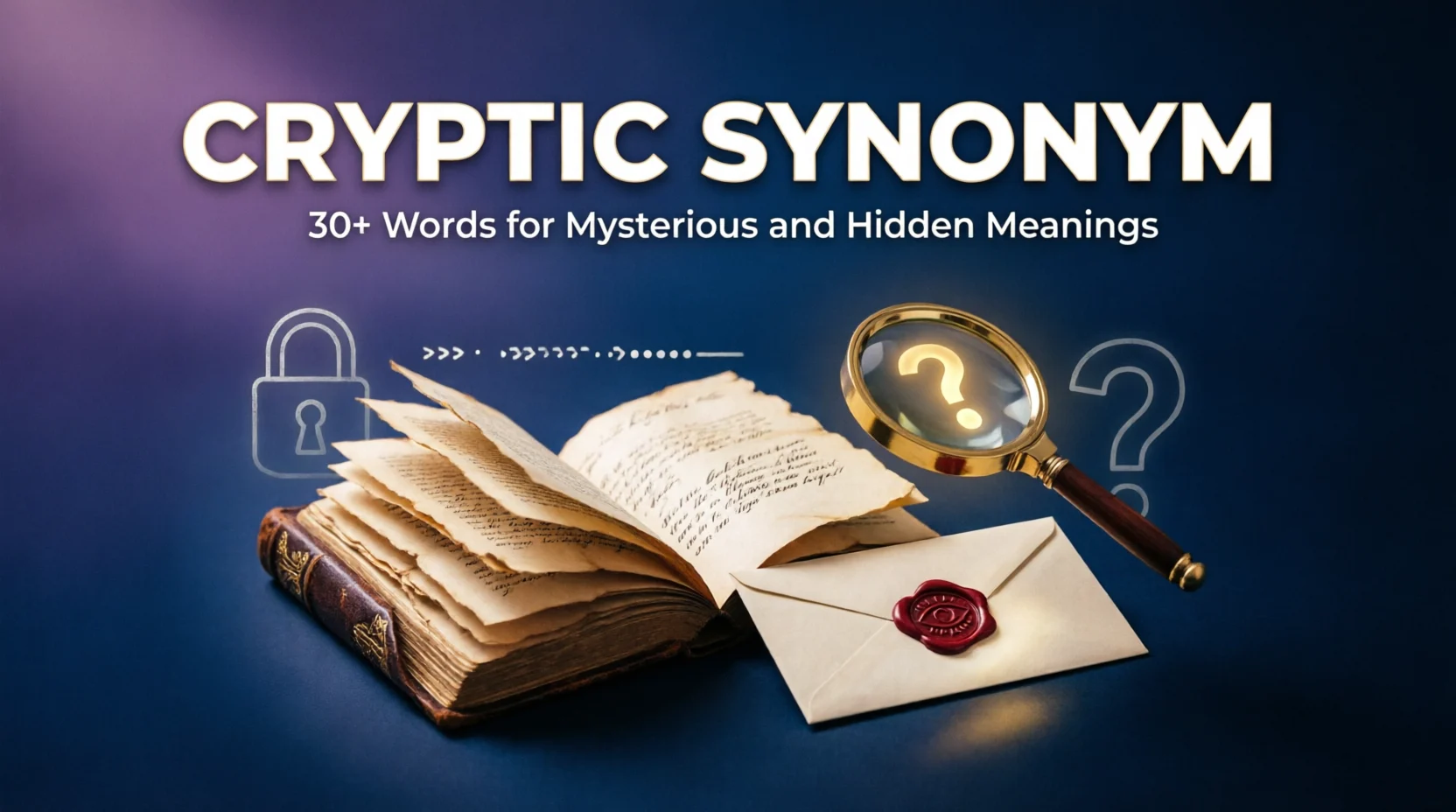
The best synonyms for cryptic include mysterious, obscure, puzzling, enigmatic, ambiguous, and perplexing. These words describe something that is difficult to understand, unclear in meaning, or deliberately hidden.
However, each synonym has a slightly different meaning and works best in a particular context. Understanding these differences can help students, ESL learners, writers, and content creators choose the right word for essays, conversations, stories, and professional writing.
Quick Answer: What Are the Best Synonyms for Cryptic?
The most useful synonyms for cryptic are:
- Mysterious: difficult to explain or understand.
- Enigmatic: mysterious and hard to interpret.
- Obscure: unclear or not easily understood.
- Puzzling: confusing or difficult to solve.
- Ambiguous: having more than one possible meaning.
- Perplexing: causing confusion.
- Inscrutable: impossible or very difficult to understand.
- Unfathomable: extremely difficult to comprehend.
- Arcane: understood by only a few people.
- Esoteric: intended for or understood by a specialized group.
The best choice depends on whether you want to describe a mysterious message, an unclear statement, a difficult puzzle, or something known only to a small group.
What Does Cryptic Mean?
The word cryptic is an adjective that describes something mysterious, puzzling, or difficult to understand. It often refers to messages, remarks, symbols, clues, or behavior whose meaning is not immediately clear.
For example, if someone says, “You will understand when the time comes,” without explaining anything further, their response may seem cryptic.
Cryptic can also describe something deliberately written or presented in a confusing way. In puzzles and games, cryptic clues often use indirect language, wordplay, or hidden meanings to challenge the reader.
Example Sentences Using Cryptic
- She sent me a cryptic message that left me wondering what she meant.
- The detective discovered a cryptic clue at the crime scene.
- His cryptic response made the conversation more confusing.
- The author included cryptic symbols throughout the novel.
- Her expression was cryptic, revealing nothing about her thoughts.
30 Synonyms for Cryptic With Meanings and Examples
1. Mysterious
Meaning: Difficult to explain, understand, or identify.
Example: A mysterious stranger appeared at the door late at night.
Best usage: Use mysterious when describing unusual events, people, places, or situations that create curiosity.
2. Enigmatic
Meaning: Mysterious and difficult to interpret.
Example: The artist was known for her enigmatic paintings.
Best usage: Use enigmatic for people, expressions, statements, or works of art that have hidden or uncertain meanings. It is a slightly more sophisticated alternative to mysterious.
3. Obscure
Meaning: Not clear, well-known, or easy to understand.
Example: The professor explained an obscure reference in the old book.
Best usage: Use obscure when information, language, or ideas are difficult to understand or unfamiliar to most people.
4. Puzzling
Meaning: Confusing or difficult to solve.
Example: The detective found a puzzling detail in the witness’s statement.
Best usage: Use puzzling for problems, clues, events, and situations that make someone think carefully.
5. Ambiguous
Meaning: Having more than one possible meaning or interpretation.
Example: His ambiguous answer left everyone uncertain about his decision.
Best usage: Use ambiguous when a statement, instruction, or message can reasonably be interpreted in different ways.
6. Perplexing
Meaning: Causing confusion or uncertainty.
Example: The scientist encountered a perplexing problem during the experiment.
Best usage: Use perplexing when something is particularly confusing or difficult to explain.
7. Inscrutable
Meaning: Very difficult or impossible to understand.
Example: The manager maintained an inscrutable expression throughout the meeting.
Best usage: Use inscrutable for people, facial expressions, motives, or situations that reveal very little.
8. Unfathomable
Meaning: Extremely difficult to understand or imagine.
Example: The universe contains mysteries that seem unfathomable.
Best usage: Use unfathomable for ideas, emotions, events, or concepts that are beyond ordinary understanding.
9. Arcane
Meaning: Known or understood by only a small number of people.
Example: The manual contained arcane rules about ancient rituals.
Best usage: Use arcane for specialized knowledge, technical details, obscure traditions, or complicated systems.
10. Esoteric
Meaning: Intended for or understood by a small, specialized group.
Example: The lecture covered esoteric theories of philosophy.
Best usage: Use esoteric when discussing specialized subjects, complex theories, or knowledge that requires particular expertise.
11. Cryptic-like: Coded
Meaning: Expressed in a code or a form that hides the intended meaning.
Example: The spy received a coded message before the mission.
Best usage: Use coded when a message is deliberately encoded or uses symbols that require a key or method to interpret.
12. Secretive
Meaning: Unwilling to share information or reveal plans.
Example: The organization remained secretive about its future projects.
Best usage: Use secretive to describe people, groups, or behavior that deliberately withhold information. Unlike cryptic, it emphasizes secrecy rather than unclear wording.
13. Veiled
Meaning: Hidden, indirect, or not openly expressed.
Example: She made a veiled criticism of the new policy.
Best usage: Use veiled for indirect remarks, subtle warnings, concealed intentions, or statements that suggest something without saying it directly.
14. Oblique
Meaning: Indirect or not expressed in a straightforward way.
Example: He made an oblique reference to their earlier disagreement.
Best usage: Use oblique for indirect comments, hints, references, or explanations.
15. Impenetrable
Meaning: Impossible or very difficult to understand or get through.
Example: The report was filled with impenetrable technical language.
Best usage: Use impenetrable when a text, argument, or explanation is exceptionally difficult to understand.
16. Baffling
Meaning: Extremely confusing or difficult to explain.
Example: The sudden disappearance of the documents was baffling.
Best usage: Use baffling for surprising events, strange behavior, or problems that seem to have no obvious explanation.
17. Bewildering
Meaning: Causing someone to feel completely confused.
Example: The instructions were bewildering to the new employees.
Best usage: Use bewildering when something overwhelms or confuses a person, especially because it is complicated or unexpected.
18. Confusing
Meaning: Difficult to understand clearly.
Example: The confusing announcement caused several misunderstandings.
Best usage: Use confusing as a simple, everyday alternative when a message, explanation, or situation is unclear.
19. Mysterious-looking: Uncanny
Meaning: Strange or unsettling in a way that is difficult to explain.
Example: The abandoned house had an uncanny atmosphere.
Best usage: Use uncanny when something feels strangely familiar, unusual, or almost beyond ordinary explanation.
20. Enigmatical
Meaning: Mysterious or difficult to interpret.
Example: The poet used enigmatical language throughout the poem.
Best usage: Use enigmatical when describing mysterious language or behavior. Enigmatic is more common in modern everyday and professional writing.
21. Riddling
Meaning: Full of riddles, hints, or puzzling statements.
Example: The old inscription was riddling and difficult to translate.
Best usage: Use riddling when something resembles a riddle or communicates through clues and indirect expressions.
22. Indecipherable
Meaning: Impossible or very difficult to read, decode, or understand.
Example: The handwritten note was almost indecipherable.
Best usage: Use indecipherable for handwriting, coded messages, symbols, or language that cannot easily be interpreted.
23. Incomprehensible
Meaning: Impossible or extremely difficult to understand.
Example: The speaker’s explanation was incomprehensible to the audience.
Best usage: Use incomprehensible when a statement, concept, or explanation cannot be understood by its intended audience.
24. Unclear
Meaning: Not expressed or presented in a way that is easy to understand.
Example: The email contained unclear instructions about the deadline.
Best usage: Use unclear for everyday communication, directions, explanations, or statements that need clarification.
25. Vague
Meaning: Not specific or detailed enough to understand precisely.
Example: His vague reply did not explain why he was leaving.
Best usage: Use vague when information lacks detail. A cryptic statement may have a hidden meaning, while a vague statement may simply lack precision.
26. Opaque
Meaning: Difficult to understand or explain clearly.
Example: The company used opaque language to describe its pricing policy.
Best usage: Use opaque for complicated policies, writing, reasoning, or systems whose workings are not transparent.
27. Perplexed
Meaning: Confused or uncertain about something.
Example: The perplexed student asked the teacher to explain the clue.
Best usage: Use perplexed to describe a person’s state of mind, not usually the mysterious message itself.
28. Concealed
Meaning: Hidden from view or kept from being discovered.
Example: The investigator found a concealed compartment behind the wall.
Best usage: Use concealed when something is physically hidden or deliberately kept out of sight. It describes hiddenness more directly than cryptic.
29. Symbolic
Meaning: Representing an idea, feeling, or concept through a symbol.
Example: The novel used symbolic imagery to express hope and loss.
Best usage: Use symbolic when an image, action, or object represents a deeper meaning. Symbolic material may be cryptic, but not all symbolism is difficult to understand.
30. Mystifying
Meaning: Making something difficult to understand or explain.
Example: The machine’s unexpected behavior was mystifying to the engineers.
Best usage: Use mystifying when something seems strange or inexplicable and leaves people searching for answers.
Cryptic Synonyms Comparison Table
The following table highlights the main differences between commonly used synonyms.
| Synonym | Main meaning | Best context |
| Mysterious | Difficult to explain | People, events, places |
| Enigmatic | Mysterious in meaning | Expressions, personalities, art |
| Obscure | Not easily understood or known | Information, references, language |
| Puzzling | Difficult to solve | Problems, clues, events |
| Ambiguous | Open to multiple interpretations | Statements, instructions |
| Perplexing | Causing confusion | Difficult situations |
| Inscrutable | Hard to read or interpret | Expressions, motives |
| Arcane | Known by few people | Specialized knowledge |
| Esoteric | Intended for a specialized audience | Philosophy, theories |
| Coded | Encoded to hide meaning | Secret messages |
| Veiled | Indirectly expressed | Criticism, threats, references |
| Vague | Lacking precise details | Explanations, answers |
| Indecipherable | Impossible to decode or read | Handwriting, codes |
| Incomprehensible | Impossible to understand | Complex ideas, explanations |
| Opaque | Not transparent or understandable | Policies, systems, writing |
How to Choose the Right Synonym for Cryptic
Choosing the right synonym depends on the meaning you want to communicate, the tone of your writing, and the reason something is difficult to understand.
Choose Based on Tone
For everyday conversation: Use mysterious, confusing, puzzling, or unclear.
Example: “That message is confusing.”
For formal or academic writing: Use obscure, ambiguous, perplexing, or incomprehensible.
Example: “The author uses obscure references to historical events.”
For literary or descriptive writing: Use enigmatic, inscrutable, veiled, or uncanny.
Example: “She gave him an enigmatic smile.”
For technical or specialized contexts: Use arcane, esoteric, coded, or indecipherable.
Example: “The researchers examined an arcane mathematical principle.”
Choose Based on Meaning
- Something has a hidden meaning: Use enigmatic, cryptic, or veiled.
- Something has several possible meanings: Use ambiguous.
- Something is difficult to solve: Use puzzling or baffling.
- Something is difficult to understand: Use obscure, perplexing, or incomprehensible.
- Something is understood by few people: Use arcane or esoteric.
- Something is deliberately hidden: Use concealed or secretive, depending on whether you mean an object or a person’s behavior.
- Something lacks specific details: Use vague or unclear.
- Something is difficult to decode: Use coded or indecipherable.
Choose Based on Intent
If you want to create curiosity, choose mysterious or enigmatic.
If you want to emphasize confusion, choose perplexing, baffling, or bewildering.
If you want to describe indirect communication, choose oblique or veiled.
If you want to emphasize specialized knowledge, choose arcane or esoteric.
If you want to describe an explanation that readers cannot follow, choose incomprehensible or impenetrable.
Common Mistakes When Using Cryptic Synonyms
1. Treating Cryptic and Ambiguous as Identical
These words are related, but their meanings differ.
- Cryptic suggests a hidden or mysterious meaning.
- Ambiguous means that more than one interpretation is possible.
Example: “The cryptic note contained a hidden clue.” This emphasizes mystery.
“The ambiguous instruction could be interpreted in two ways.” This emphasizes multiple meanings.
2. Using Vague When You Mean Mysterious
Vague usually means that details are missing or insufficient. Mysterious suggests that something is strange, hidden, or unexplained.
Example: “He gave a vague answer about his schedule.”
“She received a mysterious letter from an unknown sender.”
3. Confusing Secretive With Cryptic
Secretive describes a person or organization that avoids revealing information. Cryptic describes something difficult to interpret.
Example: “The secretive director refused to discuss the project.”
“The director gave a cryptic answer about the project’s future.”
4. Using Arcane for Every Difficult Idea
Arcane specifically suggests knowledge or details that are known to only a limited group. It is not simply another word for confusing.
Example: “The historian explained an arcane legal tradition.”
For a generally confusing explanation, confusing or perplexing is usually more appropriate.
5. Choosing an Overly Complicated Word
A sophisticated word is not always the best choice. In everyday communication, mysterious, unclear, and puzzling may express your meaning more naturally than inscrutable or incomprehensible.
Choose the word your audience can understand easily.
FAQs:
What is the closest synonym for cryptic?
Mysterious is one of the closest and most versatile synonyms for cryptic. Enigmatic is another strong choice when something has a hidden or difficult-to-interpret meaning.
What is a more sophisticated word for cryptic?
Enigmatic, inscrutable, and obscure are useful sophisticated alternatives. Enigmatic emphasizes mystery, inscrutable suggests that something is difficult to interpret, and obscure highlights a lack of clarity or familiarity.
What is the difference between cryptic and enigmatic?
Both words describe something mysterious or difficult to understand. Cryptic often refers to messages, clues, or statements with hidden meanings. Enigmatic more commonly describes people, expressions, personalities, and ideas that remain mysterious.
Is ambiguous a synonym for cryptic?
Yes, ambiguous can sometimes replace cryptic, but the meanings are not identical. Ambiguous means something has multiple possible interpretations, while cryptic usually suggests a hidden, puzzling, or mysterious meaning.
What is the opposite of cryptic?
Common antonyms include clear, straightforward, explicit, understandable, transparent, and unambiguous. The best choice depends on the context. For example, an explicit message states its meaning directly, while an unambiguous message has only one clear interpretation.
What is a simple word for cryptic?
Mysterious, confusing, and puzzling are simple alternatives. Use mysterious when something seems unusual or hidden, confusing when it is difficult to understand, and puzzling when it presents a problem or question.
How can I use cryptic in a sentence?
You can use cryptic to describe a message, statement, clue, or expression that is difficult to interpret. For example: “The writer left a cryptic note that hinted at a secret.”
Conclusion
Cryptic describes something mysterious, indirect, or difficult to understand. Its best synonyms include mysterious, enigmatic, obscure, puzzling, ambiguous, and perplexing, but each word communicates a slightly different idea. Some emphasize hidden meanings, while others describe confusion, uncertainty, specialized knowledge, or a lack of clarity.
When choosing a synonym, consider your intended meaning, audience, and tone. Use enigmatic for mysterious expressions, ambiguous for statements with multiple interpretations, arcane for specialized knowledge, and puzzling for difficult questions or problems. Understanding these distinctions will help you write more clearly, expand your vocabulary, and select the most accurate word for every situation.