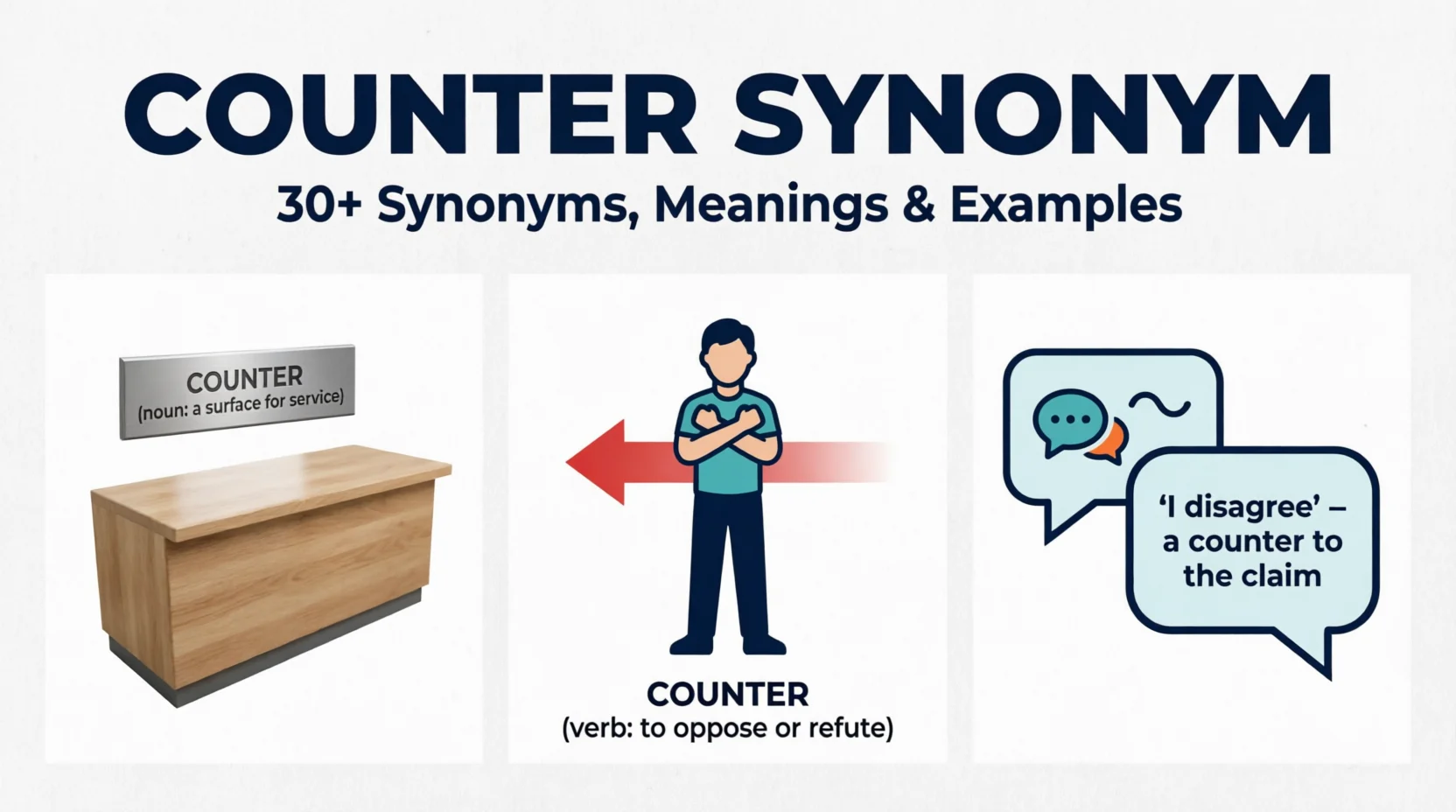
When looking for a counter synonym, the best choice depends on the meaning of “counter.” It can mean a surface in a kitchen or shop, a device that counts, an opposing action, or a verb meaning to respond to or oppose something. This guide explains 30 useful alternatives with simple meanings, examples, and appropriate contexts.
Quick Answer
The best synonym for counter depends on its context. For a kitchen surface, use worktop, bench, or bar. For something that counts, use tally, meter, or calculator. As a verb meaning “oppose,” useful alternatives include combat, oppose, resist, challenge, and rebut.
What Does “Counter” Mean?
The word counter has several meanings in English.
As a noun, a counter can be a flat surface where people prepare food, serve customers, or conduct business.
Example:
The chef placed the vegetables on the counter.
It can also refer to something used for counting or keeping track of numbers.
Example:
The machine has a digital counter that records every item.
As a verb, counter means to respond to, oppose, or take action against something.
Example:
The company introduced a new plan to counter its competitor’s strategy.
Because the word has different meanings, there is no single synonym that works in every sentence.
30 Synonyms for Counter
1. Oppose
Simple meaning: To act against someone or something.
Example: The team worked together to oppose the proposed changes.
Best usage/context: Use “oppose” for disagreements, policies, decisions, opinions, or actions.
2. Resist
Simple meaning: To refuse to accept or give in to something.
Example: The workers resisted the new rules.
Best usage/context: Best for pressure, control, influence, temptation, or unwanted change.
3. Combat
Simple meaning: To fight against or try to stop something.
Example: The organization works to combat poverty.
Best usage/context: Common in formal writing when discussing serious problems, threats, or harmful conditions.
4. Challenge
Simple meaning: To question, confront, or oppose something.
Example: The lawyer challenged the accuracy of the report.
Best usage/context: Useful for arguments, opinions, decisions, authority, or established ideas.
5. Confront
Simple meaning: To face or deal with something directly.
Example: The manager had to confront the problem immediately.
Best usage/context: Use it when someone directly faces a difficult person, situation, or problem.
6. Contest
Simple meaning: To disagree with or challenge something.
Example: The athlete decided to contest the referee’s decision.
Best usage/context: Often used for decisions, claims, results, elections, or competitions.
7. Contradict
Simple meaning: To say that something is not true or correct.
Example: Her evidence contradicted his statement.
Best usage/context: Best when one statement, fact, or piece of evidence conflicts with another.
8. Refute
Simple meaning: To prove that an argument or claim is wrong.
Example: The scientist refuted the inaccurate claim with new evidence.
Best usage/context: Ideal for academic, analytical, and formal writing.
9. Rebut
Simple meaning: To respond to an argument by giving opposing evidence or reasoning.
Example: The spokesperson rebutted the criticism during the interview.
Best usage/context: Common in debates, discussions, journalism, and formal arguments.
10. Neutralize
Simple meaning: To make something ineffective or harmless.
Example: The new security system helped neutralize the threat.
Best usage/context: Useful for threats, risks, harmful effects, or opposing forces.
11. Offset
Simple meaning: To balance or reduce the effect of something.
Example: The company increased efficiency to offset rising costs.
Best usage/context: Best for financial, environmental, numerical, or balancing situations.
12. Balance
Simple meaning: To keep two things equal or stable.
Example: The extra income helped balance the increased expenses.
Best usage/context: Use it when one factor compensates for another.
13. Tally
Simple meaning: A count or record of numbers.
Example: The final tally showed that 250 people attended.
Best usage/context: Best when “counter” means a count or the result of counting.
14. Meter
Simple meaning: A device that measures or records something.
Example: The electricity meter records how much power the house uses.
Best usage/context: Use it for measuring quantities such as electricity, water, distance, speed, or time.
15. Calculator
Simple meaning: A device or tool used to perform mathematical calculations.
Example: She used a calculator to check the total.
Best usage/context: Appropriate when a “counter” refers to a counting or calculation device.
16. Ticker
Simple meaning: A device or display that continuously records or shows information.
Example: The stock ticker displayed the latest market prices.
Best usage/context: Common in finance, markets, clocks, and information displays.
17. Worktop
Simple meaning: A flat surface used for preparing food or doing work.
Example: She cleaned the kitchen worktop after cooking.
Best usage/context: Especially common in British English for a kitchen counter.
18. Benchtop
Simple meaning: A flat working surface.
Example: The tools were arranged neatly on the benchtop.
Best usage/context: Useful for workshops, laboratories, kitchens, and technical environments.
19. Bar
Simple meaning: A long surface where drinks or food are served.
Example: We sat at the bar and ordered coffee.
Best usage/context: Use it when “counter” refers to a serving area in a restaurant, café, or similar place.
20. Desk
Simple meaning: A piece of furniture used for working or studying.
Example: He left the documents on his desk.
Best usage/context: A possible alternative when the counter is primarily being used as a work surface.
21. Booth
Simple meaning: A small enclosed or designated area for serving, selling, or conducting business.
Example: Please visit the information booth near the entrance.
Best usage/context: Useful for some retail, exhibition, ticketing, and service contexts.
22. Stand
Simple meaning: A small structure or area where goods or services are offered.
Example: We bought fresh fruit from a market stand.
Best usage/context: Common for markets, exhibitions, events, and temporary selling areas.
23. Register
Simple meaning: A system or device used to record transactions.
Example: The cashier entered the purchase into the register.
Best usage/context: Particularly useful when “counter” refers to a checkout or payment area.
24. Checkout
Simple meaning: The place where customers pay for purchases.
Example: There was a long line at the checkout.
Best usage/context: Use it in shops and supermarkets when referring to the payment area.
25. Reception
Simple meaning: A place where visitors are welcomed or information is provided.
Example: Please leave the package at reception.
Best usage/context: Useful when a counter is located at the entrance of an office, hotel, clinic, or organization.
26. Opposing action
Simple meaning: An action taken against another action.
Example: The company took opposing action after the competitor changed its prices.
Best usage/context: Useful when explaining the strategic meaning of “counter” rather than referring to a physical object.
27. Response
Simple meaning: An action or answer given because of something else.
Example: The government announced a response to the growing problem.
Best usage/context: Use it when “counter” means a reaction to an action, argument, or situation.
28. Reaction
Simple meaning: Something done or felt in response to an event.
Example: The announcement received an immediate reaction from customers.
Best usage/context: Suitable for general situations where “counter” means a response or reaction.
29. Antidote
Simple meaning: Something that works against or reduces the effect of something harmful.
Example: Exercise can be a useful antidote to a sedentary lifestyle.
Best usage/context: Often used figuratively for something that counteracts an undesirable condition.
30. Alternative
Simple meaning: Another choice or method.
Example: The company developed an alternative approach to the problem.
Best usage/context: Appropriate when “counter” suggests another strategy or course of action rather than direct opposition.
Counter Synonyms Comparison Table
| Synonym | Main Meaning | Best Context | Tone |
| Oppose | Act against | Opinions, decisions, policies | Neutral |
| Resist | Refuse to give in | Pressure, influence | Neutral |
| Combat | Fight against | Problems, threats | Formal |
| Challenge | Question or confront | Claims, decisions | Neutral |
| Confront | Face directly | Problems, people | Neutral |
| Contest | Dispute | Results, decisions | Formal |
| Contradict | Conflict with a statement | Facts, claims | Neutral |
| Refute | Prove wrong | Arguments, evidence | Formal |
| Rebut | Answer an argument | Debates, criticism | Formal |
| Neutralize | Make ineffective | Threats, risks | Formal |
| Offset | Balance an effect | Costs, effects | Formal |
| Balance | Keep equal | Numbers, factors | Neutral |
| Tally | Count or total | Numbers, votes | Neutral |
| Meter | Measure or record | Electricity, water | Neutral |
| Calculator | Calculate numbers | Mathematics | Neutral |
| Ticker | Display or record information | Finance, data | Neutral |
| Worktop | Working surface | Kitchens | Neutral |
| Benchtop | Flat work surface | Labs, workshops | Neutral |
| Bar | Serving surface | Restaurants, cafés | Neutral |
| Desk | Work surface | Offices, study | Neutral |
| Booth | Service area | Events, businesses | Neutral |
| Stand | Selling area | Markets, events | Neutral |
| Register | Transaction device | Retail | Neutral |
| Checkout | Payment area | Stores | Neutral |
| Opposing action | Action against something | Strategy | Formal |
| Response | Answer or reaction | General situations | Neutral |
| Reaction | Response to an event | General situations | Neutral |
| Antidote | Counteracting solution | Problems, effects | Figurative |
| Alternative | Another choice | Methods, strategies | Neutral |
How to Choose the Right Counter Synonym
The correct synonym depends mainly on meaning, tone, and intent.
When “Counter” Means “Oppose”
Choose oppose, resist, combat, challenge, or confront.
For example:
- The campaign aims to counter misinformation.
- The campaign aims to combat misinformation.
- The campaign aims to challenge misinformation.
“Combat” sounds stronger, while “challenge” often suggests questioning or disputing something.
When “Counter” Means “Prove an Argument Wrong”
Choose refute, rebut, or contradict.
Use refute when evidence demonstrates that a claim is incorrect.
Use rebut when someone responds to an argument with another argument or evidence.
Use contradict when one statement conflicts with another.
When “Counter” Means “Balance”
Choose offset or balance.
For example:
Original: Higher sales helped counter the additional costs.
Alternative: Higher sales helped offset the additional costs.
“Offset” is especially natural when one factor reduces the effect of another.
When “Counter” Means a Kitchen Surface
Choose worktop, benchtop, or bar, depending on the setting.
For example:
The plates are on the counter.
In British English, worktop is often a natural choice for a kitchen surface.
When “Counter” Means Counting
Choose tally, meter, or calculator, depending on what is being counted or measured.
For example:
The counter recorded every visitor.
A more specific alternative might be:
The tally recorded the total number of visitors.
Common Mistakes When Using Counter Synonyms
Using “Refute” for Any Disagreement
“Refute” is stronger than simply disagreeing. It normally suggests showing that a claim is false or incorrect.
Incorrect use:
I refuted his opinion because I disliked it.
Better:
I disagreed with his opinion because I had a different perspective.
Using “Combat” for Simple Responses
“Combat” usually suggests active opposition or fighting against something.
Instead of:
She combated his question.
Use:
She answered his question.
Confusing “Counter” With “Checkout”
A counter can be the physical surface where customers are served, while a checkout specifically refers to the place or process where customers pay.
Choosing a Synonym Without Considering Context
A word can be technically related to “counter” but still sound unnatural in a particular sentence. Always consider whether you are talking about opposition, measurement, counting, balance, or a physical surface.
FAQs:
What is the best synonym for counter?
There is no single best synonym because “counter” has several meanings. For opposition, “oppose” is useful; for balancing, “offset” works well; and for a kitchen surface, “worktop” is a common alternative.
What is a synonym for counter as a verb?
Useful synonyms include oppose, resist, combat, challenge, confront, refute, rebut, neutralize, and offset.
What is a synonym for counter as a noun?
Depending on the meaning, alternatives include worktop, benchtop, bar, desk, register, checkout, tally, meter, and ticker.
What is a formal synonym for counter?
For the meaning “oppose,” formal alternatives include combat, contest, refute, rebut, neutralize, and offset.
What is a synonym for counter in an argument?
The most useful choices are challenge, contradict, refute, rebut, and oppose. “Refute” is especially appropriate when evidence is used to demonstrate that an argument is incorrect.
What is a synonym for counter meaning balance?
The strongest alternatives are offset and balance. “Offset” is particularly common when one effect reduces or compensates for another.
What is a synonym for a kitchen counter?
Common alternatives include worktop, benchtop, and work surface. “Worktop” is especially common in British English.
Can “response” be a synonym for counter?
Yes. In contexts where “counter” means an action taken in response to something, response can be an appropriate alternative. However, it does not always imply opposition.
Conclusion
The best counter synonym depends on what you mean by the word. When discussing opposition, words such as oppose, resist, combat, challenge, refute, and rebut are useful. When discussing balance, offset and balance are more natural. For physical surfaces, worktop, benchtop, and bar may fit better, while tally, meter, and calculator work for counting or measurement contexts. Choosing the right synonym makes your writing clearer, more precise, and more natural.