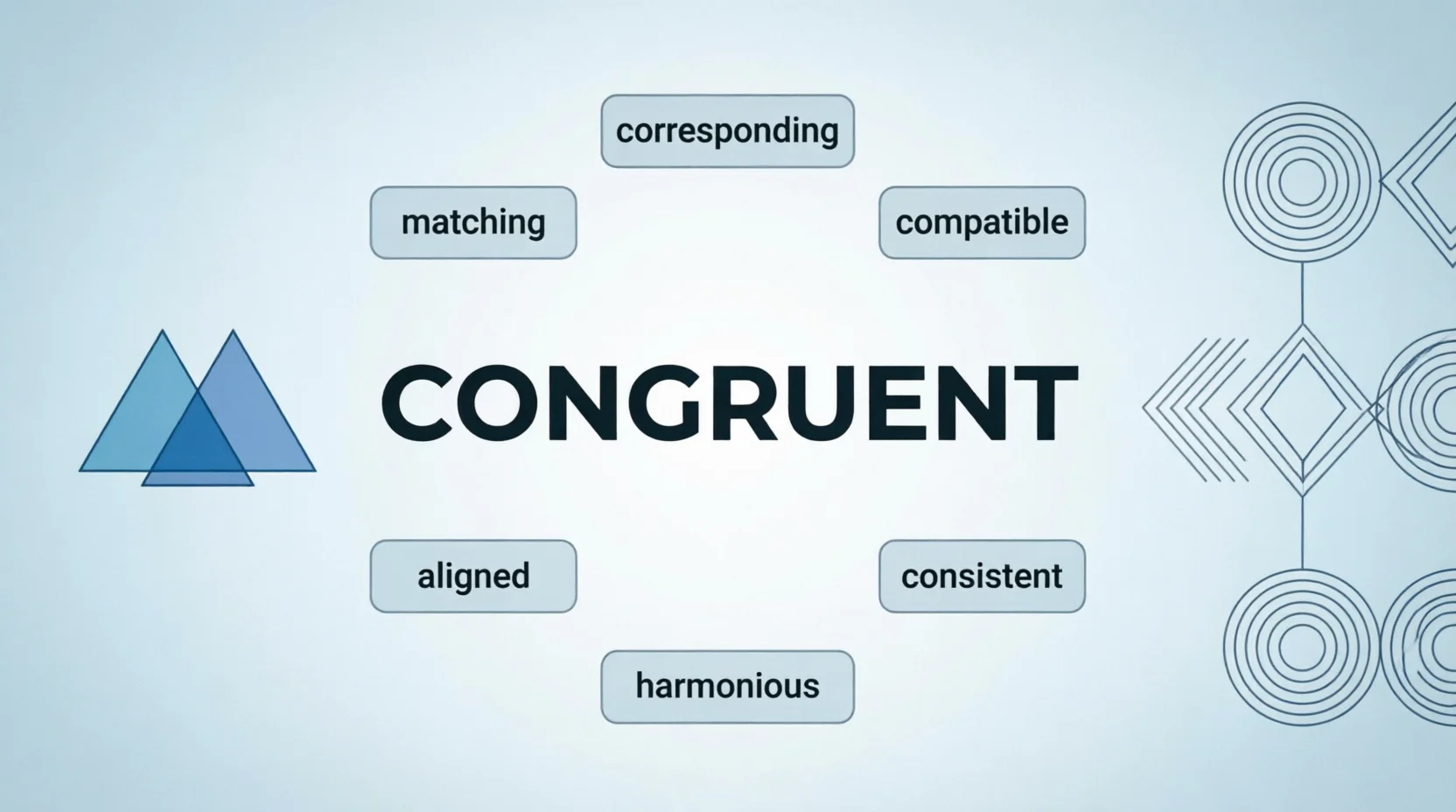
When you need a congruent synonym, the best choice depends on what you mean by “congruent.” In general, congruent means matching, agreeing, corresponding, compatible, or in harmony with something else. Common synonyms include consistent, compatible, corresponding, matching, harmonious, aligned, and fitting. However, these words are not always interchangeable, so understanding their specific meanings helps you choose the right word.
Quick Answer
The best synonyms for congruent include:
consistent, compatible, corresponding, matching, harmonious, aligned, fitting, suitable, agreeable, coherent, conforming, equivalent, analogous, similar, compatible, concurrent, coinciding, accordant, consonant, and in agreement.
For formal writing, consistent, corresponding, compatible, and conforming are often useful. For everyday English, matching, fitting, aligned, and agreeing are easier choices.
What Does Congruent Mean?
Congruent means that two or more things agree, match, or fit together in some important way.
The exact meaning can change depending on the context.
For example:
- Her actions were congruent with her values.
- The two geometric figures are congruent.
- His explanation was congruent with the available evidence.
In general English, congruent often describes ideas, actions, beliefs, information, or qualities that are consistent or in agreement.
In mathematics, however, congruent has a more specific meaning. Two geometric shapes are congruent when they have the same size and shape.
30 Synonyms for Congruent
1. Consistent
Simple meaning: Agreeing with something else without contradiction.
Example: Her behavior was consistent with her beliefs.
Best usage/context: Use it when ideas, actions, facts, or behavior agree with one another.
2. Compatible
Simple meaning: Able to exist, work, or fit well together.
Example: His personality is compatible with the team’s working style.
Best usage/context: Best for people, systems, ideas, technologies, or things that work well together.
3. Corresponding
Simple meaning: Matching or relating closely to something else.
Example: Each student received a corresponding certificate.
Best usage/context: Useful in formal writing when two things have a direct relationship.
4. Matching
Simple meaning: Being the same or going well together.
Example: She wore shoes matching her dress.
Best usage/context: Common in everyday English for colors, objects, clothing, characteristics, and patterns.
5. Harmonious
Simple meaning: Existing together peacefully or pleasantly.
Example: The colors create a harmonious design.
Best usage/context: Best for relationships, sounds, colors, designs, ideas, and situations that work pleasantly together.
6. Aligned
Simple meaning: In agreement or in the same direction.
Example: Our goals are aligned with the company’s mission.
Best usage/context: Useful for goals, values, strategies, opinions, and plans.
7. Fitting
Simple meaning: Appropriate or suitable for a particular situation.
Example: Her response was fitting for the occasion.
Best usage/context: Good for situations, responses, behavior, clothing, and circumstances.
8. Suitable
Simple meaning: Right or appropriate for a particular purpose.
Example: This approach is suitable for beginners.
Best usage/context: Use when something is appropriate for a person, purpose, situation, or task.
9. Agreeable
Simple meaning: Pleasant or in agreement.
Example: The two sides reached an agreeable solution.
Best usage/context: Useful when people, opinions, or arrangements are acceptable or compatible.
10. Coherent
Simple meaning: Logical and connected.
Example: She presented a coherent argument.
Best usage/context: Best for arguments, explanations, writing, ideas, and statements that make logical sense.
11. Conforming
Simple meaning: Following a rule, standard, or expectation.
Example: The product is conforming to safety requirements.
Best usage/context: Useful in formal, technical, legal, and regulatory contexts.
12. Equivalent
Simple meaning: Equal in value, meaning, or effect.
Example: The two expressions are mathematically equivalent.
Best usage/context: Best when two things have the same value, function, meaning, or result.
13. Analogous
Simple meaning: Similar in an important way.
Example: The human heart is analogous to a pump in some respects.
Best usage/context: Useful for comparisons between things that share similar functions or characteristics.
14. Similar
Simple meaning: Almost the same or alike in certain ways.
Example: The two designs are very similar.
Best usage/context: Use for general comparisons when exact agreement is not necessary.
15. Coinciding
Simple meaning: Happening or existing at the same time or in the same place.
Example: Their conclusions were coinciding with the latest research.
Best usage/context: Useful for events, dates, observations, or ideas that occur or agree at the same point.
16. Concurrent
Simple meaning: Happening at the same time.
Example: The two projects required concurrent development.
Best usage/context: Mainly used for events, activities, processes, or actions occurring simultaneously.
17. Accordant
Simple meaning: In agreement or harmony with something.
Example: His decision was accordant with the organization’s principles.
Best usage/context: Formal writing where you need to express agreement or harmony.
18. Consonant
Simple meaning: In agreement or harmony with something.
Example: The proposal is consonant with our long-term goals.
Best usage/context: Particularly useful in formal or academic writing.
19. Agreeing
Simple meaning: Having the same opinion or being consistent.
Example: The witnesses gave agreeing accounts of the event.
Best usage/context: Useful for opinions, statements, accounts, and people expressing similar views.
20. In Agreement
Simple meaning: Having the same opinion or position.
Example: The researchers were in agreement about the results.
Best usage/context: A natural phrase for people, opinions, decisions, and conclusions.
21. Compatible
Simple meaning: Able to work or exist together successfully.
Example: The new software is compatible with older devices.
Best usage/context: Especially common in technology, relationships, systems, and ideas.
22. Unified
Simple meaning: Joined together around the same idea or purpose.
Example: The team presented a unified response.
Best usage/context: Good for groups, opinions, strategies, efforts, and goals.
23. Integrated
Simple meaning: Combined so that different parts work together.
Example: The new system is fully integrated with the existing platform.
Best usage/context: Common in technology, organizations, education, and systems.
24. Complementary
Simple meaning: Completing or improving something else.
Example: The two colors are complementary.
Best usage/context: Use when two things work well together because each adds something the other lacks.
25. Congruous
Simple meaning: Suitable, matching, or harmonious.
Example: The modern furniture was congruous with the room’s minimalist style.
Best usage/context: A close formal synonym, especially when describing harmony or suitability.
26. Consonant with
Simple meaning: Consistent or compatible with something.
Example: The decision was consonant with the company’s values.
Best usage/context: Best for formal writing involving principles, ideas, policies, or beliefs.
27. In Keeping With
Simple meaning: Suitable or consistent with something.
Example: Her response was in keeping with her usual behavior.
Best usage/context: Natural in formal and descriptive writing.
28. In Accord With
Simple meaning: In agreement with something.
Example: The decision was in accord with the established rules.
Best usage/context: Useful for formal writing, policies, rules, principles, and decisions.
29. Correlative
Simple meaning: Having a relationship in which two things correspond or vary together.
Example: The study found a correlative relationship between the two variables.
Best usage/context: Mainly used in academic, scientific, and technical contexts.
30. Well-Matched
Simple meaning: Suitable or naturally compatible.
Example: The two partners were well-matched in terms of experience.
Best usage/context: Good for people, teams, objects, styles, skills, and combinations that work well together.
Congruent Synonyms Comparison Table
| Synonym | Main Meaning | Best Context | Formality |
| Consistent | In agreement | Ideas, actions, facts | Medium |
| Compatible | Able to work together | People, systems, ideas | Medium |
| Corresponding | Closely matching | Formal relationships | High |
| Matching | Similar or identical | Objects, colors, clothes | Low |
| Harmonious | Pleasantly agreeing | Designs, relationships | Medium |
| Aligned | In agreement or direction | Goals, plans, values | Medium |
| Fitting | Appropriate | Situations, behavior | Low |
| Suitable | Appropriate for a purpose | General use | Low |
| Coherent | Logical and connected | Writing, arguments | High |
| Conforming | Following a standard | Rules, standards | High |
| Equivalent | Equal in value or effect | Mathematics, ideas | High |
| Analogous | Similar in an important way | Comparisons | High |
| Similar | Alike | General comparisons | Low |
| Unified | Joined around one idea | Groups, strategies | Medium |
| Integrated | Combined into one system | Technology, systems | High |
| Complementary | Completing each other | Colors, skills, qualities | Medium |
| Congruous | Matching or suitable | Formal descriptions | High |
| In agreement | Having the same view | Opinions, conclusions | Low |
| In accord with | Consistent with | Rules, principles | High |
| Well-matched | Naturally compatible | People, objects | Low |
How to Choose the Right Synonym for Congruent
Choosing the best synonym depends on what you are trying to communicate.
For Agreement
Use consistent, agreeing, consonant, in agreement, or in accord with.
Example:
Her explanation was consistent with the evidence.
These words work well when two statements, ideas, beliefs, or actions support each other.
For Compatibility
Use compatible, harmonious, well-matched, or complementary.
Example:
Their personalities are compatible.
These choices are useful when two things work well together.
For Similarity
Use matching, similar, analogous, or corresponding.
Example:
The two patterns are remarkably similar.
Choose these when the main idea is resemblance rather than complete agreement.
For Suitability
Use fitting, suitable, appropriate, or in keeping with.
Example:
His response was fitting for the situation.
These words emphasize whether something is appropriate rather than whether it is identical.
For Formal or Academic Writing
Use corresponding, conforming, equivalent, analogous, consonant, or accordant.
Example:
The findings are consonant with previous research.
These alternatives are especially useful when writing formally or academically.
For Mathematics
Be careful when replacing congruent with an ordinary synonym.
In geometry, congruent has a precise meaning: two figures have the same shape and size.
For example:
Triangle ABC is congruent to triangle DEF.
Words such as similar or matching may not communicate the same mathematical meaning.
Common Mistakes When Using Congruent Synonyms
Using “similar” when exact equality is intended
Similar means alike but does not necessarily mean identical in size, shape, or value.
For mathematical contexts, use congruent when the shapes have exactly the same size and shape.
Using “compatible” for simple visual similarity
If two colors look alike, matching or similar may be more natural than compatible.
Using “harmonious” for factual agreement
“Harmonious” usually suggests pleasant agreement or balance. For facts or evidence, consistent is usually clearer.
Confusing “equivalent” with “similar”
Equivalent suggests equal value, meaning, function, or effect. Similar only indicates resemblance.
Using highly formal words in casual conversation
Words such as accordant and consonant can sound formal.
In everyday speech, matching, consistent, compatible, or agreeing will usually sound more natural.
FAQs:
What is the best synonym for congruent?
Consistent is one of the best general synonyms for congruent when you mean that two things agree or do not contradict each other. Compatible, corresponding, and matching can also work depending on context.
Is “consistent” the same as “congruent”?
They can have similar meanings, especially when describing ideas, behavior, or evidence. However, congruent can emphasize a closer correspondence or harmony, while consistent often emphasizes agreement without contradiction.
What is a simple synonym for congruent?
Simple alternatives include matching, similar, fitting, agreeing, compatible, and consistent.
What is a formal synonym for congruent?
Formal alternatives include corresponding, conforming, equivalent, consonant, accordant, and in accord with.
What is the opposite of congruent?
Depending on the context, opposites can include inconsistent, incompatible, different, conflicting, contradictory, mismatched, and incongruent.
Can “compatible” replace “congruent”?
Sometimes. Compatible means that two things can work or exist well together, while congruent often means that they correspond, agree, or match.
What is the difference between congruent and similar?
Congruent can mean matching exactly in certain contexts, especially mathematics. Similar means alike but does not necessarily imply exact equality.
What is the best synonym for congruent in academic writing?
Consistent, corresponding, consonant, and conforming are strong choices, depending on the sentence and intended meaning.
Conclusion
The word congruent has several useful alternatives, but the right synonym depends on context. Use consistent for agreement, compatible for things that work together, matching for similarity, harmonious for pleasing relationships, and corresponding for closely related elements.
In formal writing, consonant, conforming, and in accord with can provide a more precise tone. When discussing geometry, keep congruent because it has a specific mathematical meaning that ordinary synonyms may not fully express.