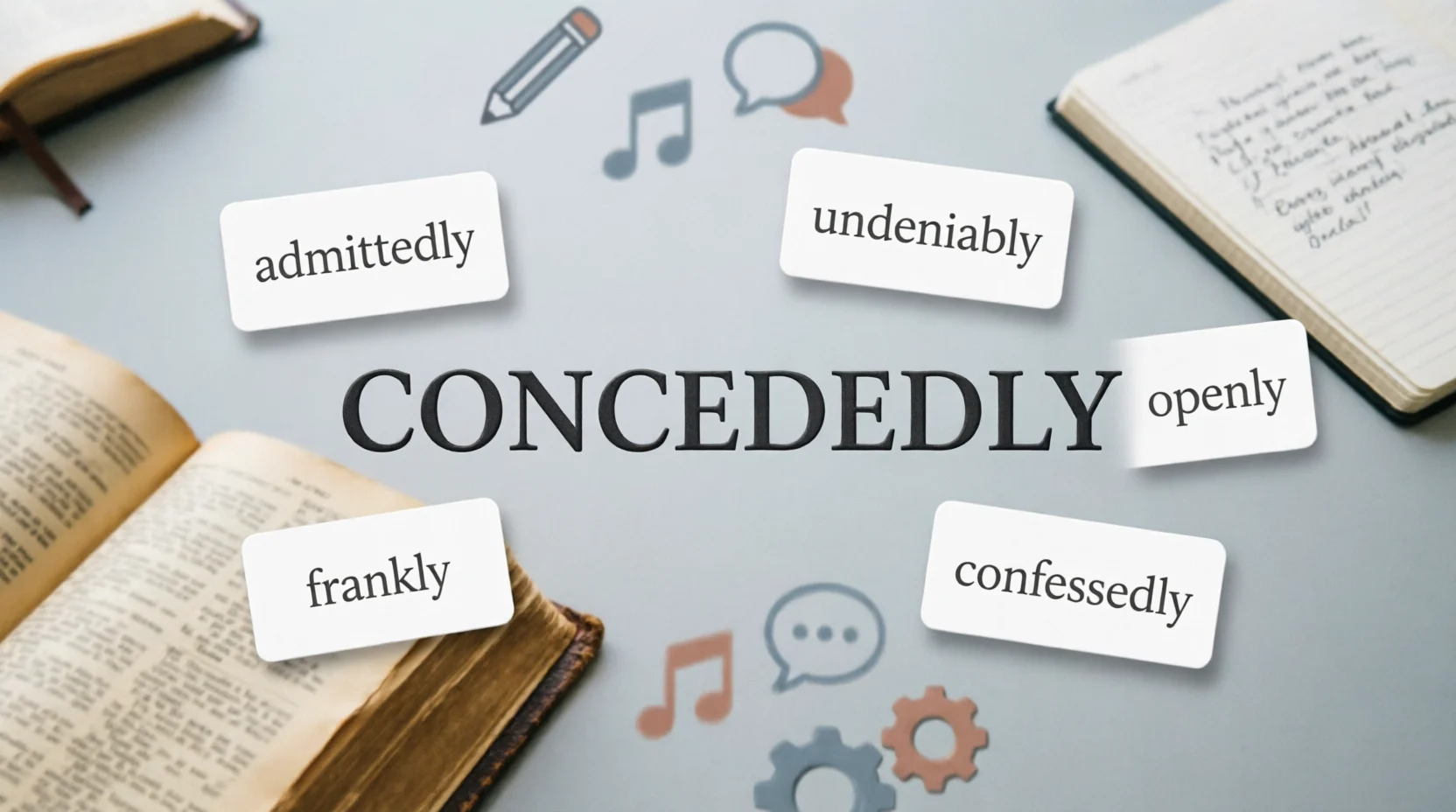
Looking for a concededly synonym? The word concededly means in a way that openly admits or acknowledges that something is true, even when it may not support your main argument. Depending on the context, useful alternatives include admittedly, undeniably, certainly, admittedly, granted, and openly.
Choosing the right synonym depends on what you want to communicate. Some alternatives emphasize admission, while others express certainty, agreement, or acknowledgment.
This guide explains 30 useful synonyms for concededly with simple meanings, practical examples, and the situations where each word works best.
Quick Answer
The best synonym for concededly is admittedly.
Other useful alternatives include:
- Admittedly
- Granted
- Certainly
- Undeniably
- Acknowledgedly
- Indeed
- Clearly
- Obviously
- Confessedly
- Frankly
- Openly
- Truthfully
- Undoubtedly
- Unquestionably
- To be sure
- Without question
- Certainly so
- It is true
- As acknowledged
- By admission
- In fairness
- To concede
- Allowably
- Admittingly
- Even so
- Nevertheless
- Nonetheless
- Grantedly
- As a matter of fact
- Without denying
What Does Concededly Mean?
Concededly is an adverb used when someone openly admits or acknowledges a fact, point, or weakness.
For example:
Concededly, the project was expensive, but it produced excellent results.
Here, concededly shows that the speaker accepts that the project was expensive before presenting a different point.
The word often appears in formal or argumentative writing. It can introduce a fact that someone accepts even though the fact may seem to weaken their position.
How Is Concededly Used in a Sentence?
Concededly commonly appears at the beginning of a sentence or clause.
Example:
Concededly, the plan has several weaknesses.
This means:
Admittedly, the plan has several weaknesses.
Another example is:
The method is, concededly, difficult for beginners.
In this sentence, the writer acknowledges that the method is difficult.
30 Synonyms for Concededly
1. Admittedly
Simple meaning: Used when openly accepting that something is true.
Example: Admittedly, the task took longer than expected.
Best usage/context: This is the closest and most natural synonym for concededly, especially in essays and formal writing.
2. Granted
Simple meaning: Accepting that a particular point is true.
Example: Granted, the proposal is expensive, but it could save money later.
Best usage/context: Useful when admitting one point before presenting a contrasting argument.
3. Certainly
Simple meaning: Without doubt or clearly.
Example: She certainly made a significant contribution.
Best usage/context: Best when the emphasis is on confidence rather than admission.
4. Undeniably
Simple meaning: In a way that cannot reasonably be denied.
Example: The city is undeniably beautiful.
Best usage/context: Use this when emphasizing that a fact is difficult or impossible to dispute.
5. Acknowledgedly
Simple meaning: In a way that recognizes or accepts something.
Example: Acknowledgedly, the approach has some limitations.
Best usage/context: Suitable for formal contexts when emphasizing recognition of a fact.
6. Indeed
Simple meaning: Truly or actually.
Example: The decision was indeed difficult.
Best usage/context: Useful for confirming or strengthening a statement.
7. Clearly
Simple meaning: In an obvious or easy-to-understand way.
Example: Clearly, the company needs a new strategy.
Best usage/context: Best when something is apparent from the available facts.
8. Obviously
Simple meaning: In a way that is easy to see or understand.
Example: Obviously, the team needs more preparation.
Best usage/context: Suitable for informal and general writing, though it can sometimes sound too forceful.
9. Confessedly
Simple meaning: By openly admitting something.
Example: Confessedly, he had little experience with the subject.
Best usage/context: A formal alternative when emphasizing an admission.
10. Frankly
Simple meaning: In an honest and direct way.
Example: Frankly, the original plan was unrealistic.
Best usage/context: Best for direct, honest statements and conversational writing.
11. Openly
Simple meaning: Without hiding or concealing something.
Example: She openly admitted that she had made a mistake.
Best usage/context: Useful when the focus is on honesty or transparency.
12. Truthfully
Simple meaning: In an honest or truthful way.
Example: Truthfully, I was not prepared for the challenge.
Best usage/context: Best when emphasizing sincerity or honesty.
13. Undoubtedly
Simple meaning: Without doubt.
Example: Undoubtedly, the discovery changed the field.
Best usage/context: Use when you want to express strong certainty.
14. Unquestionably
Simple meaning: In a way that cannot reasonably be questioned.
Example: She is unquestionably one of the strongest candidates.
Best usage/context: Appropriate for formal writing where certainty is important.
15. To Be Sure
Simple meaning: Certainly or admittedly.
Example: To be sure, the process is complicated.
Best usage/context: Useful in formal arguments when acknowledging a point before continuing.
16. Without Question
Simple meaning: Certainly or beyond reasonable doubt.
Example: Without question, the decision was important.
Best usage/context: Best for strong statements of certainty.
17. Certainly So
Simple meaning: Clearly or definitely true.
Example: The situation was certainly so serious that action was necessary.
Best usage/context: Works when confirming an already established point.
18. It Is True
Simple meaning: Acknowledging that a statement is correct.
Example: It is true that the system is expensive, but it is reliable.
Best usage/context: Useful when introducing a concession in an argument.
19. As Acknowledged
Simple meaning: As has already been recognized or accepted.
Example: As acknowledged, the policy has several limitations.
Best usage/context: Suitable for formal reports, essays, and analytical writing.
20. By Admission
Simple meaning: According to someone’s own acknowledgment.
Example: By admission, the manager had underestimated the costs.
Best usage/context: Useful when referring specifically to someone’s own acknowledgment.
21. In Fairness
Simple meaning: Considering all sides honestly.
Example: In fairness, the team had very little time to prepare.
Best usage/context: Excellent for balanced arguments and discussions.
22. To Concede
Simple meaning: To admit that something is true.
Example: We must concede that the second option is cheaper.
Best usage/context: Use when directly describing the act of admitting a point.
23. Allowably
Simple meaning: In a way that can reasonably be accepted.
Example: The criticism was allowably strong given the circumstances.
Best usage/context: Rare and formal; use only when the meaning specifically concerns what can be accepted.
24. Admittingly
Simple meaning: In an admitting or acknowledging manner.
Example: Admittingly, the solution is not perfect.
Best usage/context: This form is uncommon. Admittedly is usually the better choice.
25. Even So
Simple meaning: Despite that fact.
Example: The task was difficult; even so, she completed it.
Best usage/context: Useful for contrasting an acknowledged fact with a following idea.
26. Nevertheless
Simple meaning: Despite what has just been said.
Example: The evidence was limited; nevertheless, the researchers continued.
Best usage/context: Best for formal writing when moving from a concession to a contrasting point.
27. Nonetheless
Simple meaning: Despite that or nevertheless.
Example: The approach has weaknesses; nonetheless, it remains useful.
Best usage/context: Suitable for formal essays, reports, and analytical writing.
28. Grantedly
Simple meaning: In an admitted or conceded way.
Example: Grantedly, the proposal could be improved.
Best usage/context: Rare and less natural than granted or admittedly.
29. As a Matter of Fact
Simple meaning: In reality or actually.
Example: As a matter of fact, the results were better than expected.
Best usage/context: Best when confirming a fact rather than specifically making a concession.
30. Without Denying
Simple meaning: While not rejecting or disputing something.
Example: Without denying the risks, the company decided to continue.
Best usage/context: Useful when acknowledging a possible objection while maintaining another position.
Comparison Table of Concededly Synonyms
| Synonym | Main Meaning | Tone | Best Use |
| Admittedly | Openly accepting a fact | Neutral | General writing |
| Granted | Accepting one point | Neutral | Arguments |
| Certainly | Definitely | Neutral | General writing |
| Undeniably | Impossible to deny | Formal | Strong claims |
| Acknowledgedly | Recognizing something | Formal | Academic writing |
| Indeed | Truly | Formal/Neutral | Confirmation |
| Clearly | Obviously apparent | Neutral | Explanations |
| Obviously | Easy to recognize | Casual/Neutral | Conversation |
| Confessedly | Openly admitting | Formal | Formal prose |
| Frankly | Honestly and directly | Direct | Personal opinions |
| Openly | Without hiding | Neutral | Honesty |
| Truthfully | Honestly | Neutral | Personal statements |
| Undoubtedly | Without doubt | Formal | Strong certainty |
| Unquestionably | Beyond reasonable doubt | Formal | Academic writing |
| To be sure | Certainly/admittedly | Formal | Arguments |
| Without question | Certainly | Formal | Strong claims |
| It is true | Acknowledges a fact | Neutral | Concessions |
| By admission | According to an admission | Formal | Evidence or argument |
| In fairness | Considering all sides | Neutral | Balanced discussion |
| Nevertheless | Despite that | Formal | Contrast |
| Nonetheless | Despite that | Formal | Contrast |
| Even so | Despite this | Neutral | Contrast |
| As acknowledged | As already accepted | Formal | Reports |
| Without denying | While accepting a point | Formal | Arguments |
How to Choose the Right Synonym for Concededly
Choosing the best synonym depends on your tone, meaning, and purpose.
For Formal or Academic Writing
Choose:
- Admittedly
- Acknowledgedly
- Confessedly
- Undoubtedly
- Unquestionably
- To be sure
- As acknowledged
Example:
Admittedly, the study has several limitations.
These words work well in essays, reports, research discussions, and analytical writing.
For Arguments and Debates
Choose:
- Granted
- Admittedly
- It is true
- In fairness
- Without denying
- Nevertheless
- Nonetheless
Example:
Granted, the method is expensive, but it produces more accurate results.
These expressions help you acknowledge an opposing point without abandoning your main argument.
For Strong Certainty
Choose:
- Certainly
- Undeniably
- Undoubtedly
- Unquestionably
- Without question
- Clearly
Example:
The discovery was undoubtedly important.
These choices are better when you want to emphasize certainty rather than concession.
For Honest or Direct Statements
Choose:
- Frankly
- Openly
- Truthfully
- By admission
Example:
Frankly, the original proposal was not practical.
These words are especially useful when the sentence focuses on honesty or direct acknowledgment.
For Contrast
Choose:
- Nevertheless
- Nonetheless
- Even so
- Granted
- In fairness
Example:
The process is complicated; nevertheless, it is worth learning.
These expressions work when you acknowledge one fact and then introduce a contrasting idea.
Common Usage Mistakes
Using “Concededly” When “Admittedly” Sounds More Natural
Although concededly is correct, it can sound formal or uncommon in everyday English.
Instead of:
Concededly, the plan has problems.
You can write:
Admittedly, the plan has problems.
The second sentence sounds more natural to most modern readers.
Confusing Admission With Certainty
Admittedly and undoubtedly do not mean exactly the same thing.
Admittedly means you accept or acknowledge something.
Undoubtedly means you believe something is certainly true.
For example:
Admittedly, the book is difficult.
This acknowledges a fact.
Undoubtedly, the book is influential.
This expresses strong certainty.
Overusing “Obviously”
Obviously can sound dismissive when used to describe something that another person may not find obvious.
For professional writing, alternatives such as clearly, certainly, or a direct explanation may be better.
Using Rare Words Unnecessarily
Words such as admittingly and grantedly are uncommon. Although they may appear in dictionaries or specialized writing, simpler alternatives are usually clearer.
In most situations, admittedly or granted is a better choice.
Choosing a Word That Changes the Meaning
Not every synonym listed above can replace concededly in every sentence.
For example, nevertheless expresses contrast, while undoubtedly expresses certainty. Always consider the exact relationship between your ideas before replacing the original word.
FAQs:
What is the best synonym for concededly?
Admittedly is generally the best synonym for concededly because both words indicate that someone openly acknowledges a fact or point.
What does concededly mean?
Concededly means in a way that admits or acknowledges something as true, often before presenting a different or opposing point.
Is admittedly the same as concededly?
They are very close in meaning, and admittedly is usually the more common and natural choice in modern English.
What is a simple synonym for concededly?
Admittedly is the simplest and most useful synonym. Depending on the context, granted, certainly, or openly may also work.
Is concededly formal?
Yes. Concededly is relatively formal and is more likely to appear in essays, arguments, legal writing, or analytical prose than in everyday conversation.
What is the difference between admittedly and undoubtedly?
Admittedly means accepting or acknowledging something, while undoubtedly means something is considered certain or beyond reasonable doubt.
Can I use granted instead of concededly?
Yes, in many argumentative sentences. However, granted usually introduces a concession and is often followed by a contrasting idea.
Which concededly synonym is best for academic writing?
Admittedly, acknowledgedly, undoubtedly, and to be sure can work well in academic writing, depending on the intended meaning.
Conclusion
The best concededly synonym depends on what you want your sentence to express. Admittedly is usually the closest and most natural alternative because it clearly signals an acknowledgment or concession.
For arguments, granted and in fairness can be useful. For strong certainty, consider undoubtedly, unquestionably, or undeniably. For contrast, nevertheless, nonetheless, and even so may be more appropriate.
When choosing a synonym, focus on the exact meaning, tone, and purpose of your sentence. A simple and familiar word is often better than a rare alternative, especially when clarity is your main goal.