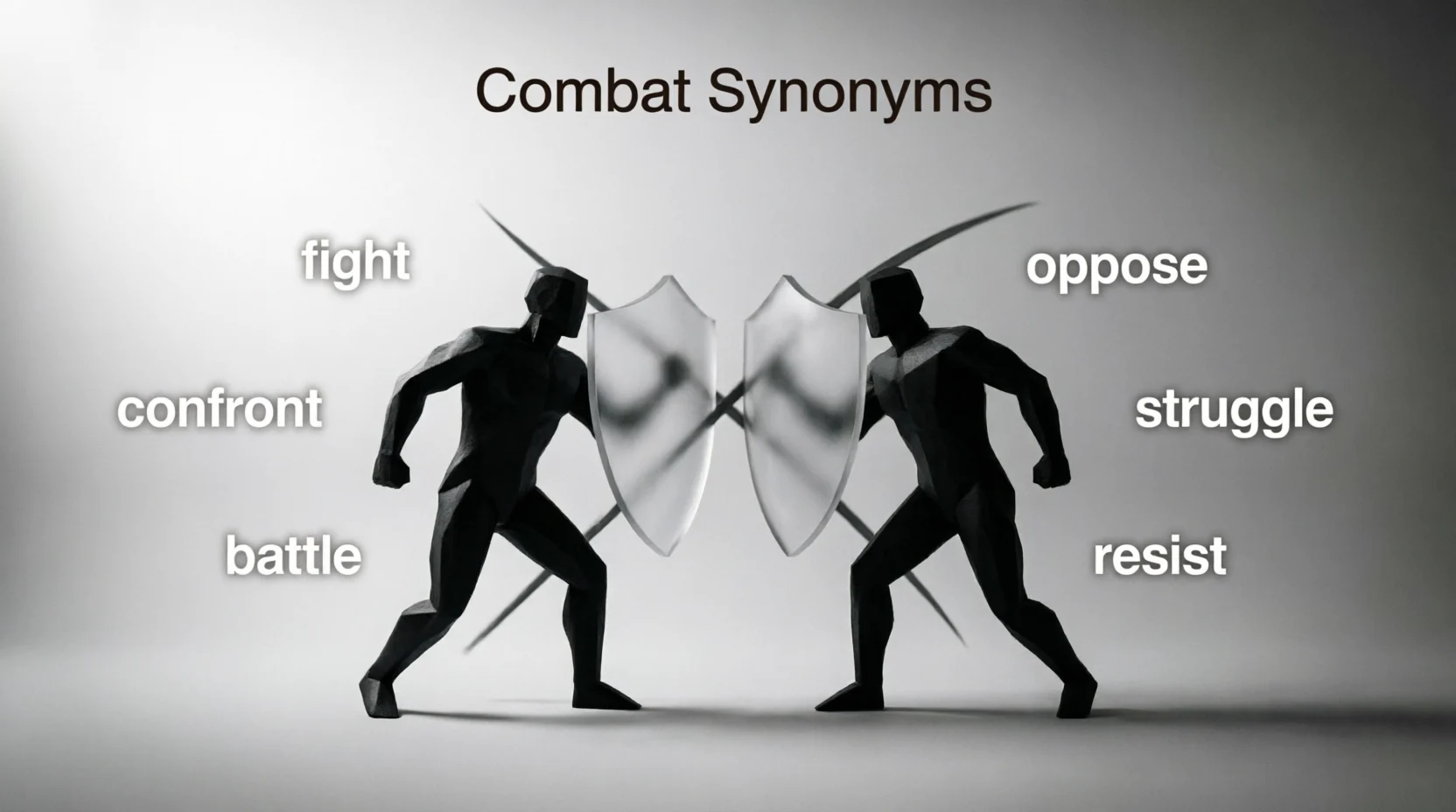
Finding the right combat synonyms can make your writing more precise and natural. Depending on the context, words such as fight, battle, struggle, conflict, confront, resist, oppose, and contend can replace “combat.” However, each word carries a slightly different meaning, tone, or level of intensity. This guide explains 30 useful synonyms for combat with simple meanings, practical examples, and guidance on when to use each word.
Quick Answer
The most common synonyms for combat are fight, battle, confront, oppose, resist, struggle, contend, clash, conflict, attack, challenge, counter, overcome, tackle, and engage.
“Combat” can function as both a verb and a noun. As a verb, it means to fight against something or try to stop or defeat it. As a noun, it means fighting between people, groups, or forces.
What Does Combat Mean?
Combat means to fight against someone or something, especially to defeat an opponent or deal with a serious problem.
For example:
- The soldiers entered combat at dawn.
- The organization works to combat poverty.
- She is trying to combat misinformation.
The word can describe physical fighting, but it is also commonly used figuratively. People can combat problems such as poverty, disease, crime, pollution, corruption, or misinformation.
30 Synonyms for Combat
1. Fight
Simple meaning: To use force or effort against someone or something.
Example: The two teams fought hard for victory.
Best usage/context: Use “fight” in everyday English for physical, competitive, or figurative struggles.
2. Battle
Simple meaning: To fight against someone or struggle strongly with something.
Example: The community battled against severe flooding.
Best usage/context: Useful for serious, prolonged, or difficult conflicts.
3. Confront
Simple meaning: To face a person, problem, or difficult situation directly.
Example: The manager decided to confront the problem immediately.
Best usage/context: Best for directly dealing with a challenge, issue, or opponent.
4. Oppose
Simple meaning: To disagree with, resist, or work against something.
Example: Several groups opposed the proposed changes.
Best usage/context: Common in formal, political, social, and argumentative contexts.
5. Resist
Simple meaning: To refuse to accept, obey, or give in to something.
Example: The workers resisted unfair treatment.
Best usage/context: Best when emphasizing refusal, defense, or standing against pressure.
6. Struggle
Simple meaning: To try very hard to overcome a difficulty.
Example: Many families struggle with rising living costs.
Best usage/context: Appropriate for difficult situations, hardships, and personal challenges.
7. Contend
Simple meaning: To compete or struggle against someone or something.
Example: Several athletes contended for the championship.
Best usage/context: More formal than “fight” and useful in competition or serious writing.
8. Clash
Simple meaning: To fight or strongly disagree.
Example: The two groups clashed over the new policy.
Best usage/context: Useful for sudden physical conflicts or strong disagreements.
9. Conflict
Simple meaning: To be in opposition or disagreement.
Example: The two organizations conflicted over how to proceed.
Best usage/context: Common in formal discussions of disagreements, interests, or opposing forces.
10. Attack
Simple meaning: To try to hurt, defeat, or damage someone or something.
Example: The army attacked the enemy position.
Best usage/context: Use when the action involves an offensive attempt.
11. Challenge
Simple meaning: To question, oppose, or compete against someone or something.
Example: The lawyer challenged the accuracy of the report.
Best usage/context: Good for intellectual, competitive, legal, or argumentative situations.
12. Counter
Simple meaning: To act against something in order to reduce or stop its effect.
Example: The company introduced new measures to counter fraud.
Best usage/context: Especially useful when responding to an action, threat, or strategy.
13. Overcome
Simple meaning: To successfully deal with or defeat a difficulty.
Example: She overcame many obstacles to achieve her goal.
Best usage/context: Best when the emphasis is on successfully defeating a problem.
14. Tackle
Simple meaning: To deal with a difficult problem or task.
Example: The government needs to tackle unemployment.
Best usage/context: Common in everyday and professional English for solving problems.
15. Engage
Simple meaning: To become involved in a conflict, competition, or activity.
Example: The forces engaged in combat near the border.
Best usage/context: More formal and suitable for military, competitive, or serious contexts.
16. Defy
Simple meaning: To refuse to obey or accept something.
Example: The protesters defied the order to leave.
Best usage/context: Use when someone deliberately refuses authority, rules, or expectations.
17. Resist
Simple meaning: To oppose something instead of accepting or submitting to it.
Example: The community resisted the proposed development.
Best usage/context: Particularly useful for describing opposition or defensive action.
18. Strive Against
Simple meaning: To make a strong effort to overcome something.
Example: The organization strives against discrimination.
Best usage/context: Suitable for formal writing about long-term efforts against social or personal problems.
19. Contest
Simple meaning: To compete against someone or challenge something.
Example: She contested the decision in court.
Best usage/context: Useful for competitions, elections, legal matters, and disputed decisions.
20. Repel
Simple meaning: To force something or someone to move away.
Example: The defenders repelled the attack.
Best usage/context: Best for defensive situations, especially when an attack is pushed back.
21. Defend
Simple meaning: To protect someone or something from attack or harm.
Example: The soldiers defended the city.
Best usage/context: Appropriate when the focus is protection rather than attacking.
22. Ward Off
Simple meaning: To prevent something harmful from affecting you.
Example: Regular exercise can help ward off certain health problems.
Best usage/context: Useful for threats, illness, danger, and unwanted effects.
23. Counteract
Simple meaning: To reduce or prevent the effect of something.
Example: The medicine helps counteract the effects of the toxin.
Best usage/context: A formal choice for describing actions that neutralize harmful effects.
24. Neutralize
Simple meaning: To make something ineffective or harmless.
Example: The team developed a plan to neutralize the threat.
Best usage/context: Common in technical, strategic, security, and scientific contexts.
25. Suppress
Simple meaning: To stop something from continuing or spreading.
Example: The authorities worked to suppress the spread of the disease.
Best usage/context: Appropriate for stopping activities, information, symptoms, movements, or harmful effects, depending on context.
26. Defeat
Simple meaning: To win against someone or successfully overcome something.
Example: The team defeated its strongest rival.
Best usage/context: Use when the main idea is achieving victory.
27. Overpower
Simple meaning: To defeat someone by being stronger or more powerful.
Example: The larger team overpowered its opponent.
Best usage/context: Best when strength, force, or superior power is important.
28. Strive
Simple meaning: To work very hard toward a goal.
Example: The organization strives to reduce inequality.
Best usage/context: Useful for figurative struggles where there may be no direct opponent.
29. Adversarialize
Simple meaning: To turn an issue or relationship into a conflict between opposing sides.
Example: The debate became increasingly adversarialized.
Best usage/context: Rare and specialized; use only when discussing the development of an adversarial relationship.
30. Wrestle With
Simple meaning: To struggle with a difficult problem or decision.
Example: The committee wrestled with the difficult question for weeks.
Best usage/context: Excellent for figurative struggles involving decisions, ideas, emotions, or complicated problems.
Combat Synonyms Comparison Table
| Synonym | Main Meaning | Tone | Best Context |
| Fight | Use force or effort against | Neutral | Everyday conflicts |
| Battle | Fight or struggle strongly | Strong | Serious struggles |
| Confront | Face directly | Neutral | Problems and opponents |
| Oppose | Work against | Formal | Ideas and policies |
| Resist | Refuse or fight against | Neutral | Pressure or control |
| Struggle | Try hard against difficulty | Neutral | Hardships |
| Contend | Compete or struggle | Formal | Competition |
| Clash | Fight or strongly disagree | Strong | Groups or opinions |
| Conflict | Be in opposition | Formal | Disagreements |
| Attack | Act offensively | Strong | Physical or strategic action |
| Challenge | Question or compete | Neutral | Arguments and competition |
| Counter | Act against | Formal | Threats and strategies |
| Overcome | Successfully defeat | Positive | Problems and obstacles |
| Tackle | Deal with | Informal/Neutral | Practical problems |
| Engage | Become involved | Formal | Conflict or competition |
| Defy | Refuse to obey | Strong | Authority and rules |
| Contest | Challenge or compete | Formal | Legal or competitive contexts |
| Repel | Push away | Formal | Attacks or threats |
| Defend | Protect against attack | Neutral | Protection |
| Ward off | Prevent harm | Neutral | Threats and problems |
| Counteract | Reduce an effect | Formal | Harmful effects |
| Neutralize | Make ineffective | Formal | Threats and strategies |
| Suppress | Stop or control | Formal | Spread or activity |
| Defeat | Win against | Neutral | Competitions and conflicts |
| Overpower | Defeat through strength | Strong | Physical conflicts |
| Strive | Work hard toward a goal | Neutral | Long-term efforts |
| Wrestle with | Struggle mentally | Figurative | Difficult decisions |
| Strive against | Work against difficulty | Formal | Social or personal problems |
How to Choose the Right Synonym for Combat
Not every synonym for “combat” can be substituted in every sentence. The best choice depends on the meaning, tone, and intention of your sentence.
For Physical Fighting
Use words such as:
- Fight
- Battle
- Attack
- Clash
- Engage
- Overpower
- Defeat
- Repel
Example:
“The soldiers engaged in combat.”
This describes direct physical conflict.
For Opposing an Idea or Policy
Use:
- Oppose
- Resist
- Challenge
- Contest
- Defy
- Counter
Example:
“The organization opposed the proposed policy.”
These words work better than “fight” in many formal contexts.
For Dealing With Problems
Use:
- Tackle
- Combat
- Counteract
- Overcome
- Confront
- Address
- Struggle with
Example:
“The city is tackling air pollution.”
Here, “tackle” sounds natural because the sentence describes an effort to deal with a problem.
For Formal Writing
Consider:
- Contend
- Oppose
- Counter
- Counteract
- Neutralize
- Suppress
- Confront
These choices can sound more precise in academic, professional, or formal writing.
For Figurative Struggles
Use:
- Struggle
- Wrestle with
- Strive
- Overcome
- Battle
- Contend
Example:
“She wrestled with the decision for several days.”
This describes a mental or emotional struggle rather than physical combat.
Combat vs. Fight
“Combat” and “fight” are closely related, but they are not always interchangeable.
Fight is more common in everyday English and can describe anything from an argument to physical violence.
Combat often sounds more serious or formal. It is also frequently used when discussing military conflict or organized efforts against problems.
- They fought over money.
- The soldiers entered combat.
- Scientists are working to combat climate-related risks.
Combat vs. Battle
“Battle” can refer to a specific fight or a prolonged struggle.
- The soldiers fought a battle.
- The organization is battling poverty.
“Combat” often emphasizes the act of fighting or opposing something, while “battle” can emphasize the struggle itself.
Combat vs. Oppose
“Oppose” is usually better when there is disagreement with an idea, policy, proposal, or person.
- The group opposed the proposal.
- The organization works to combat corruption.
Although both words can communicate opposition, “oppose” directly expresses disagreement, while “combat” suggests active efforts to defeat or reduce something.
Common Mistakes When Using Combat Synonyms
Using “attack” for every meaning of combat
“Attack” usually suggests an offensive action. It should not automatically replace “combat” when the sentence describes general opposition.
Using “battle” in every formal sentence
“Battle” can sound vivid or dramatic. In academic writing, words such as “oppose,” “counter,” or “address” may be more precise depending on the intended meaning.
Confusing “defend” with “attack”
Both can occur during combat, but they describe different actions. Defend means protecting against an attack, while attack means attempting to harm or defeat an opponent.
Using “struggle” when victory is guaranteed
“Struggle” emphasizes difficulty or effort. If someone has already succeeded, “overcome” or “defeat” may communicate the result more clearly.
Using formal synonyms in casual conversations
Words such as “counteract,” “neutralize,” and “contend” may sound overly formal in everyday situations. “Fight,” “deal with,” or “tackle” may sound more natural.
FAQs:
What is the most common synonym for combat?
The most common general synonym is fight. However, the best alternative depends on whether “combat” refers to physical conflict, opposition, competition, or dealing with a problem.
What is a formal synonym for combat?
Formal alternatives include oppose, confront, counter, counteract, contend, neutralize, and engage, depending on the sentence.
What is a synonym for combat meaning “deal with”?
Tackle and confront are useful choices when combat means actively dealing with a problem.
What is a synonym for combat meaning “fight”?
Fight, battle, clash, engage, and contend can express the idea of fighting, although their exact meanings differ.
Can “combat” be used for non-physical problems?
Yes. “Combat” is commonly used figuratively for problems such as poverty, crime, corruption, misinformation, pollution, and discrimination.
What is the opposite of combat?
Depending on the context, opposites can include avoid, surrender, accept, cooperate, support, or peace, because the opposite of fighting is not always the same as the opposite of opposing.
Is “struggle” the same as “combat”?
Not exactly. “Struggle” emphasizes difficulty and effort, while “combat” more strongly suggests active opposition or fighting.
Which synonym for combat is best for academic writing?
There is no single best choice. Oppose, counteract, address, confront, contend, or combat may work depending on the precise meaning of the sentence.
Conclusion
The word combat has many useful alternatives, but each synonym carries its own meaning and tone. Fight is simple and widely understood, while battle suggests a serious struggle. Oppose works well for disagreement, resist emphasizes refusal, tackle suits practical problems, and counteract focuses on reducing an effect. For figurative situations, words such as struggle, overcome, strive, and wrestle with can make your writing more precise.
Choosing the right synonym is less about finding a word that looks similar and more about matching the exact meaning, context, and tone of your sentence.