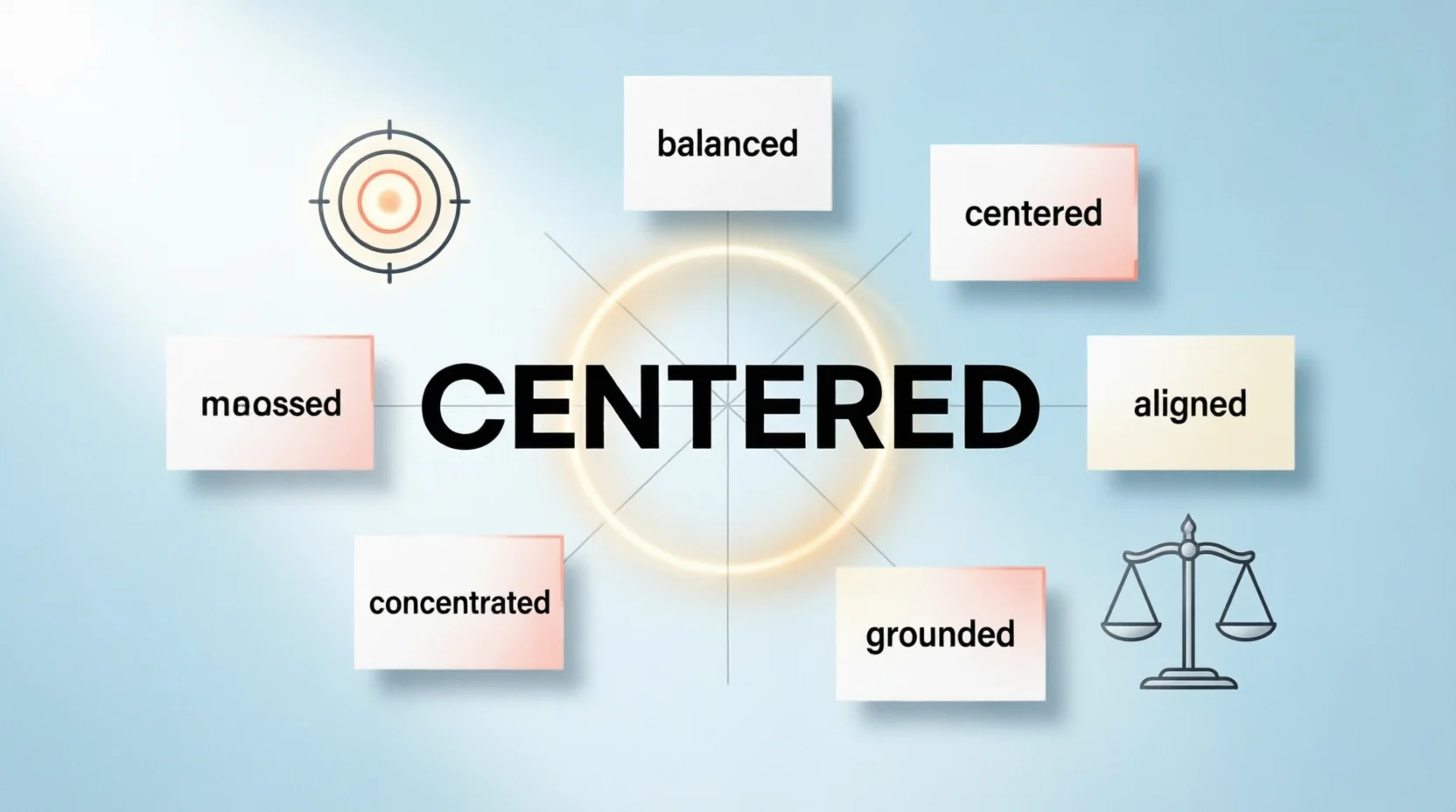
When you need a synonym for centered, the best choice depends on what you mean. “Centered” can describe something located in the middle, someone calm and emotionally balanced, or attention that is strongly focused on something. Useful alternatives include central, middle, focused, balanced, grounded, composed, concentrated, aligned, and core. Choosing the right synonym makes your writing more precise and natural.
Quick Answer
The best synonym for centered depends on the context:
- Central — located in the middle or most important position
- Focused — giving full attention to something
- Balanced — stable and even
- Grounded — emotionally stable and realistic
- Composed — calm and self-controlled
- Concentrated — strongly focused
- Middle — positioned between two sides or points
- Aligned — arranged in a straight or matching position
- Calm — peaceful and emotionally controlled
- Core — central or most important part
What Does Centered Mean?
Centered generally means being positioned around a central point or being mentally and emotionally balanced.
For example:
- “The picture is centered on the wall.”
Here, centered means placed in the middle. - “She stayed centered during the difficult conversation.”
Here, it means calm, balanced, and emotionally controlled. - “The discussion was centered on education.”
Here, it means focused mainly on a particular subject.
Because “centered” has several meanings, no single synonym works in every sentence.
30 Synonyms for Centered
1. Central
Simple meaning: Located in the middle or most important position.
Example: The library is in a central location.
Best usage/context: Places, ideas, subjects, or things that occupy an important or middle position.
2. Focused
Simple meaning: Giving strong attention to something.
Example: She remained focused on her studies.
Best usage/context: Attention, concentration, goals, work, and mental effort.
3. Balanced
Simple meaning: Stable and evenly controlled.
Example: He maintains a balanced approach to work and family.
Best usage/context: Emotions, lifestyles, opinions, designs, and situations involving stability.
4. Grounded
Simple meaning: Emotionally stable, realistic, and sensible.
Example: Her family keeps her grounded during stressful times.
Best usage/context: Personality, emotions, behavior, and personal development.
5. Composed
Simple meaning: Calm and in control.
Example: She remained composed during the interview.
Best usage/context: Formal writing, stressful situations, behavior, and emotional control.
6. Concentrated
Simple meaning: Giving intense attention to one thing.
Example: The students were concentrated on the difficult task.
Best usage/context: Mental attention, effort, study, work, and scientific contexts.
7. Middle
Simple meaning: The position between two sides or ends.
Example: Place the vase in the middle of the table.
Best usage/context: Physical location and simple everyday descriptions.
8. Aligned
Simple meaning: Positioned correctly in relation to something else.
Example: Make sure the text is aligned with the image.
Best usage/context: Design, writing, objects, goals, plans, and positions.
9. Calm
Simple meaning: Peaceful and free from strong emotional disturbance.
Example: She stayed calm throughout the discussion.
Best usage/context: Emotional states and stressful situations.
10. Stable
Simple meaning: Firm, steady, and unlikely to change suddenly.
Example: He has a stable approach to difficult situations.
Best usage/context: Emotions, situations, systems, conditions, and behavior.
11. Steady
Simple meaning: Calm, consistent, and controlled.
Example: She kept a steady voice while explaining the problem.
Best usage/context: Voice, behavior, progress, emotions, and movement.
12. Balanced-out
Simple meaning: Made even or brought into equilibrium.
Example: The designer balanced out the darker colors with lighter shades.
Best usage/context: Design, visual elements, opposing qualities, and informal explanations.
13. Anchored
Simple meaning: Firmly established or emotionally secure.
Example: His values kept him anchored during the change.
Best usage/context: Emotional stability, beliefs, values, and figurative writing.
14. Rooted
Simple meaning: Firmly established or strongly connected.
Example: Her decisions are rooted in experience.
Best usage/context: Beliefs, traditions, values, identity, and strong connections.
15. Positioned
Simple meaning: Put or located in a particular place.
Example: The chair was positioned near the center of the room.
Best usage/context: Physical placement, design, photography, and instructions.
16. Situated
Simple meaning: Located in a particular place.
Example: The hotel is situated near the city center.
Best usage/context: Formal descriptions of places, buildings, and locations.
17. Placed
Simple meaning: Put something in a particular position.
Example: The logo was placed in the center of the page.
Best usage/context: Objects, layouts, documents, images, and physical positions.
18. Oriented
Simple meaning: Positioned or directed toward something.
Example: The seats are oriented toward the stage.
Best usage/context: Physical direction, design, goals, and professional writing.
19. Directed
Simple meaning: Pointed or aimed toward something.
Example: Her attention was directed toward the speaker.
Best usage/context: Attention, movement, purpose, and formal writing.
20. Attentive
Simple meaning: Giving careful attention.
Example: The centered student remained attentive throughout the lesson.
Best usage/context: People, learning, conversations, and careful listening.
21. Absorbed
Simple meaning: Completely interested or involved in something.
Example: He was absorbed in his book.
Best usage/context: Reading, activities, thoughts, creative work, and deep interest.
22. Engaged
Simple meaning: Actively interested or involved.
Example: The students were fully engaged in the discussion.
Best usage/context: Education, conversations, work, activities, and participation.
23. Intent
Simple meaning: Giving serious attention to something.
Example: She was intent on completing the project.
Best usage/context: Strong determination, attention, goals, and formal writing.
24. Mindful
Simple meaning: Aware and attentive to the present moment.
Example: He remained mindful of his words.
Best usage/context: Personal behavior, emotions, awareness, and thoughtful communication.
25. Present
Simple meaning: Fully aware and attentive to what is happening now.
Example: Try to stay present during the conversation.
Best usage/context: Emotional awareness, mindfulness, personal development, and everyday speech.
26. Self-possessed
Simple meaning: Calm and confident in controlling yourself.
Example: She appeared self-possessed during the challenging meeting.
Best usage/context: Formal descriptions of confident and controlled behavior.
27. Collected
Simple meaning: Calm and emotionally controlled.
Example: He remained collected when the unexpected problem appeared.
Best usage/context: Formal or descriptive writing about emotional control.
28. Serene
Simple meaning: Peaceful, calm, and untroubled.
Example: She felt serene after spending time in nature.
Best usage/context: Emotional states, peaceful settings, literary writing, and descriptive language.
29. Core
Simple meaning: The central or most important part.
Example: Trust is at the core of their relationship.
Best usage/context: Ideas, values, systems, relationships, and abstract concepts.
30. Focal
Simple meaning: Being the main point of attention.
Example: The painting became the focal point of the room.
Best usage/context: Art, design, photography, presentations, and important subjects.
Centered Synonyms Comparison Table
| Synonym | Main Meaning | Best Context | Example |
|---|---|---|---|
| Central | In the middle or most important | Location, ideas | The park has a central location. |
| Focused | Giving attention | Work, study | She is focused on her goal. |
| Balanced | Stable and even | Emotions, lifestyle | He has a balanced perspective. |
| Grounded | Emotionally stable | Personality | She stays grounded under pressure. |
| Composed | Calm and controlled | Stressful situations | He remained composed. |
| Concentrated | Strongly focused | Study, work | She concentrated on the task. |
| Aligned | Correctly positioned | Design, goals | The elements are aligned. |
| Middle | Between two points | Physical location | Put it in the middle. |
| Mindful | Aware and attentive | Behavior, emotions | Be mindful of your actions. |
| Focal | Main point of attention | Design, art | The sculpture is the focal point. |
How to Choose the Right Synonym for Centered
For Physical Position
Use central, middle, positioned, placed, or situated when you are talking about where something is located.
Example:
“The logo is centered on the page.”
Possible alternatives:
- The logo is central on the page.
- The logo is positioned in the middle.
- The logo is placed at the center.
For Mental Focus
Use focused, concentrated, absorbed, attentive, engaged, or intent when “centered” means paying attention.
Example:
“She was centered on completing the assignment.”
More natural alternatives include:
- She was focused on completing the assignment.
- She was concentrated on the assignment.
- She was intent on finishing the work.
For Emotional Stability
Use balanced, grounded, composed, calm, steady, collected, or self-possessed when describing emotional control.
Example:
“He remained centered during the crisis.”
Depending on the intended meaning, you could say:
- He remained calm.
- He remained composed.
- He stayed grounded.
- He remained balanced.
For Main Importance
Use central, core, or focal when something is the most important part of a subject.
Example:
“Trust is centered in their relationship.”
More natural alternatives might be:
- Trust is central to their relationship.
- Trust is at the core of their relationship.
- Trust is a focal part of their relationship.
For Mindfulness and Awareness
Use mindful, present, grounded, or calm when centered refers to awareness of the present moment.
Example:
“She took a few minutes to become centered.”
Possible alternatives include:
- She took a few minutes to become calm.
- She tried to remain present.
- She practiced being mindful.
Centered vs. Focused
Centered and focused can overlap, but they are not always interchangeable.
Centered often suggests balance, stability, or a central position.
Focused usually emphasizes attention directed toward a particular goal or subject.
Compare:
- “She felt centered after meditation.”
This suggests emotional balance. - “She felt focused after reviewing her goals.”
This suggests strong concentration.
Centered vs. Balanced
Centered can describe emotional stability, while balanced emphasizes an even or stable state.
- “He felt centered before the presentation.”
- “He maintained a balanced lifestyle.”
Both can describe emotional well-being, but centered often sounds more personal or introspective.
Centered vs. Central
These words are closely related but have different grammatical uses.
- Centered usually describes something that has been placed in the middle or a person who is emotionally balanced.
- Central usually describes something located in the middle or something especially important.
Examples:
- “The image is centered on the page.”
- “The hotel has a central location.”
- “Education is central to the program.”
Common Mistakes When Using Centered Synonyms
Using “focused” for every meaning
“Focused” works well when talking about attention, but it does not always describe physical position.
Incorrect or awkward:
“The photograph is focused on the page.”
Better:
“The photograph is centered on the page.”
Using “central” to describe emotions
“Central” normally describes location or importance rather than emotional stability.
Less natural:
“She felt central after meditation.”
Better:
“She felt centered after meditation.”
Confusing “centered” with “concentrated”
“Concentrated” usually refers to intense attention or a substance with reduced dilution. It does not normally mean emotionally balanced.
Choosing a synonym without considering tone
Words such as calm, grounded, serene, and self-possessed have different shades of meaning. Consider whether your sentence is casual, professional, academic, or literary before choosing one.
FAQs:
What is the best synonym for centered?
There is no single best synonym because “centered” has several meanings. Focused works for attention, balanced works for stability, and central works for position or importance.
What is another word for emotionally centered?
Useful alternatives include balanced, grounded, calm, composed, steady, collected, and self-possessed.
What is a synonym for centered around?
Depending on the sentence, you can use focused on, based on, built around, organized around, concerned with, or revolving around.
What is a synonym for centered in the middle?
Use central, middle, positioned, placed, situated, or aligned, depending on the exact sentence.
Is focused a synonym for centered?
Yes, in some contexts. When centered means giving attention to a particular subject, focused is a natural synonym. It is not a complete replacement when centered means emotionally balanced or physically positioned.
Is balanced a synonym for centered?
Yes, when centered describes emotional or mental stability. For example, “She remained centered” can sometimes become “She remained balanced,” although the exact nuance may change.
What is a formal synonym for centered?
Depending on the meaning, formal alternatives include central, focused, concentrated, situated, positioned, aligned, composed, and self-possessed.
What is a simple synonym for centered?
For basic English, middle, focused, calm, balanced, or central may work, depending on the meaning of the original sentence.
Conclusion
The word centered has several meanings, so the right synonym depends on the context. For physical location, choose central, middle, positioned, placed, or situated. For attention, focused, concentrated, attentive, and engaged are useful choices. When describing emotional stability, words such as balanced, grounded, composed, calm, and steady may be more appropriate.
Understanding these differences helps you make your writing clearer and more precise. Instead of replacing “centered” automatically, first identify whether you mean position, attention, importance, or emotional balance. Then choose the synonym that communicates that specific meaning naturally.