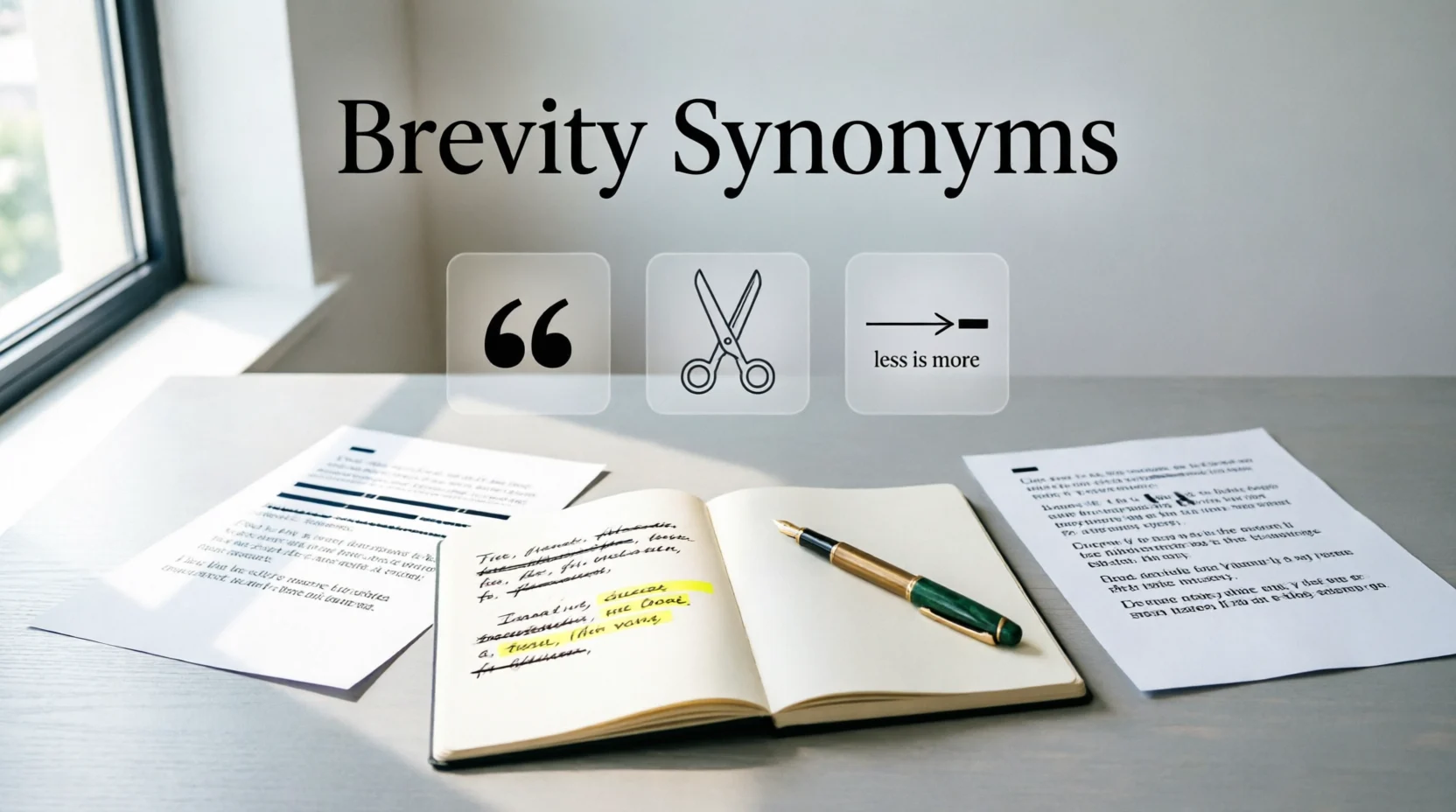
Looking for a brevity synonym? Common alternatives include conciseness, succinctness, terseness, shortness, economy, compactness, and directness. However, these words are not always interchangeable. Some describe clear and efficient communication, while others can suggest that something is overly short or even abrupt.
Understanding the differences between these related words can help students, ESL learners, writers, and content creators choose the right expression for essays, emails, reports, conversations, and professional writing.
This guide explains 30 useful synonyms for brevity with simple meanings, practical examples, and the situations where each word works best.
Quick Answer: What Is a Brevity Synonym?
A brevity synonym is a word that expresses the idea of using few words or keeping something short and concise.
The most useful synonyms for brevity include:
- Conciseness
- Succinctness
- Terseness
- Shortness
- Compactness
- Economy
- Concision
- Directness
- Pithiness
- Laconicism
The best choice depends on what you want to emphasize. Conciseness is usually positive and suggests clear, efficient writing, while terseness may suggest that something is too short or unfriendly.
Brevity Meaning and Usage
Brevity means the quality of being brief or using only as many words as necessary.
For example:
The brevity of her answer made the discussion move quickly.
Here, brevity means that the answer was short.
The word is commonly used when discussing writing, speeches, explanations, messages, conversations, and other forms of communication.
Brevity in a Sentence
- The report was praised for its brevity.
- His speech was notable for its brevity.
- Brevity is useful when explaining a simple idea.
- The editor asked for greater brevity.
- She answered with impressive brevity.
Brevity is generally associated with efficiency, but being brief does not automatically mean being clear. A message can be short yet confusing, incomplete, or rude.
30 Synonyms for Brevity
1. Conciseness
Simple meaning: The quality of expressing something clearly in few words.
Example sentence:
The conciseness of the report made it easy to read.
Best usage/context:
Use this in academic, professional, and formal writing when short and efficient communication is desirable.
2. Succinctness
Simple meaning: Expressing an idea clearly and briefly.
Example sentence:
Her succinctness made the complicated topic easier to understand.
Best usage/context:
Best for formal writing, explanations, presentations, and professional communication.
3. Terseness
Simple meaning: Using very few words, sometimes in a way that seems abrupt.
Example sentence:
His terseness during the interview surprised everyone.
Best usage/context:
Use it when emphasizing extremely brief or somewhat abrupt communication.
4. Shortness
Simple meaning: The quality of being short in length or duration.
Example sentence:
The shortness of the meeting allowed everyone to return to work quickly.
Best usage/context:
A general alternative suitable for length, time, speeches, messages, and events.
5. Concision
Simple meaning: The use of few words without unnecessary information.
Example sentence:
The essay was praised for its concision.
Best usage/context:
Excellent for essays, reports, editing, journalism, and professional writing.
6. Compactness
Simple meaning: The quality of containing information in a small or limited space.
Example sentence:
The compactness of the guide made it convenient to carry.
Best usage/context:
Useful when discussing written information, physical formats, designs, or tightly organized content.
7. Economy
Simple meaning: Using only what is necessary.
Example sentence:
The writer used language with remarkable economy.
Best usage/context:
Common in discussions of writing, language, design, and efficient expression.
8. Directness
Simple meaning: Expressing something clearly without unnecessary details or indirect language.
Example sentence:
Her directness made the instructions easy to follow.
Best usage/context:
Useful for communication, instructions, workplace writing, and straightforward speech.
9. Pithiness
Simple meaning: Being short while expressing an important or meaningful idea.
Example sentence:
The pithiness of his comments made them memorable.
Best usage/context:
Good for memorable statements, commentary, writing, and clever observations.
10. Laconicism
Simple meaning: The habit or quality of using very few words.
Example sentence:
His laconicism was noticeable during the discussion.
Best usage/context:
Best for formal or literary contexts when describing extremely concise speech.
11. Briefness
Simple meaning: The quality of being brief or short.
Example sentence:
The briefness of the announcement was appreciated.
Best usage/context:
A simple and accessible alternative in everyday and general writing.
12. Condensation
Simple meaning: Making something shorter by removing unnecessary material.
Example sentence:
The editor requested a condensation of the original article.
Best usage/context:
Useful for summaries, articles, reports, books, and edited content.
13. Compression
Simple meaning: Reducing something to a smaller or shorter form.
Example sentence:
The compression of the speech preserved its main message.
Best usage/context:
Useful for information, writing, technical content, and summaries.
14. Abridgment
Simple meaning: A shortened version of a longer work.
Example sentence:
The student read an abridgment of the classic novel.
Best usage/context:
Common when discussing books, stories, legal documents, and other lengthy works.
15. Reduction
Simple meaning: The act of making something smaller or shorter.
Example sentence:
The reduction of unnecessary sentences improved the article.
Best usage/context:
Useful in editing, writing, business communication, and general contexts.
16. Curtness
Simple meaning: Being very brief, often in a way that can seem unfriendly.
Example sentence:
The curtness of his reply ended the conversation.
Best usage/context:
Use when brevity carries a negative or impatient tone.
17. Laconicity
Simple meaning: The quality of expressing something using very few words.
Example sentence:
Her laconicity was evident in every response.
Best usage/context:
Best suited to formal, literary, or descriptive writing.
18. Ellipticalness
Simple meaning: Expressing something indirectly or incompletely by leaving some words or information unstated.
Example sentence:
The ellipticalness of the answer confused the new students.
Best usage/context:
Useful in linguistic, literary, and analytical discussions.
19. Abbreviation
Simple meaning: A shortened form of a word or expression.
Example sentence:
The abbreviation made the technical document easier to scan.
Best usage/context:
Use when discussing shortened words, names, titles, or expressions rather than general writing style.
20. Summarization
Simple meaning: Reducing longer information to its main points.
Example sentence:
The summarization of the report took several hours.
Best usage/context:
Useful for reports, articles, lectures, books, and educational material.
21. Condensation of Language
Simple meaning: Expressing an idea with fewer words.
Example sentence:
The condensation of language strengthened the opening paragraph.
Best usage/context:
Useful when discussing editing and improving written communication.
22. Parsimony
Simple meaning: Using only what is necessary and avoiding excess.
Example sentence:
The author’s parsimony with words gave the story a sharp style.
Best usage/context:
Best for formal, literary, academic, or analytical discussions.
23. Restraint
Simple meaning: The practice of avoiding unnecessary excess.
Example sentence:
The writer showed restraint by removing repetitive explanations.
Best usage/context:
Useful when brevity results from deliberate control rather than simply being short.
24. Minimalism
Simple meaning: A style that uses only essential elements.
Example sentence:
The article’s minimalism made its central message stand out.
Best usage/context:
Useful for writing, design, art, communication, and presentation styles.
25. Economy of Words
Simple meaning: Communicating an idea without using unnecessary words.
Example sentence:
The journalist was admired for her economy of words.
Best usage/context:
Excellent for journalism, professional writing, essays, and editing.
26. Precision
Simple meaning: Expressing an idea accurately and clearly.
Example sentence:
The precision of his language prevented misunderstanding.
Best usage/context:
Use when short communication is also exact and carefully worded.
27. Efficiency
Simple meaning: Achieving a purpose without unnecessary effort, time, or material.
Example sentence:
The efficiency of the message made the instructions easy to understand.
Best usage/context:
Useful in professional, technical, business, and workplace communication.
28. Compact Expression
Simple meaning: Communicating a complete idea in a small number of words.
Example sentence:
The writer used compact expression to explain the concept.
Best usage/context:
Suitable for writing instruction, editing, academic discussion, and communication advice.
29. Brevity of Expression
Simple meaning: Communicating thoughts using a limited number of words.
Example sentence:
The brevity of expression gave the speech a powerful rhythm.
Best usage/context:
Useful in literary, academic, and writing-related discussions.
30. Economy of Expression
Simple meaning: Communicating effectively without unnecessary words.
Example sentence:
Good editors value economy of expression.
Best usage/context:
A strong formal phrase for professional writing, editing, journalism, and academic work.
Comparison Table of Brevity Synonyms
| Synonym | Main Meaning | Tone | Best Context |
|---|---|---|---|
| Conciseness | Clear and brief expression | Positive | Professional writing |
| Succinctness | Brief and complete expression | Positive | Formal communication |
| Terseness | Extremely brief expression | Neutral/negative | Abrupt replies |
| Shortness | Limited length | Neutral | General use |
| Concision | Few unnecessary words | Positive | Essays and reports |
| Compactness | Information in a small form | Neutral | Writing and design |
| Economy | Avoiding excess | Positive | Writing and language |
| Directness | Clear and straightforward | Positive | Communication |
| Pithiness | Brief and meaningful | Positive | Statements and commentary |
| Laconicism | Very few words | Neutral | Literary/formal writing |
| Briefness | Being short | Neutral | General use |
| Condensation | Making content shorter | Neutral | Editing and summaries |
| Compression | Reducing size or length | Neutral | Technical and written content |
| Abridgment | Shortened version | Neutral | Books and documents |
| Curtness | Brief and abrupt | Negative | Unfriendly replies |
| Parsimony | Avoiding excess | Formal | Writing and analysis |
| Restraint | Deliberate avoidance of excess | Positive | Editing and style |
| Minimalism | Using only essentials | Neutral/positive | Writing and design |
| Precision | Exact expression | Positive | Technical writing |
| Efficiency | Effective use of words | Positive | Workplace communication |
How to Choose the Right Brevity Synonym
Not every synonym for brevity has exactly the same meaning. Choose your word according to tone, meaning, and intent.
For Positive and Professional Writing
Choose:
- Conciseness
- Concision
- Succinctness
- Economy
- Precision
- Efficiency
These words usually suggest that communication is short and effective.
For example:
The report’s conciseness improved its readability.
For Very Short or Abrupt Communication
Choose:
- Terseness
- Curtness
- Laconicism
- Laconicity
These words can describe communication that contains very few words. Some may also suggest emotional distance, abruptness, or a lack of explanation.
For example:
His terse response gave us little information.
For Literary or Formal Writing
Choose:
- Pithiness
- Parsimony
- Laconicism
- Economy of expression
- Restraint
These options are particularly useful when discussing writing style.
For Summaries and Shortened Content
Choose:
- Condensation
- Compression
- Abridgment
- Reduction
- Summarization
These words are better when something has been made shorter from a longer original version.
For Everyday English
Choose:
- Shortness
- Briefness
- Directness
- Conciseness
These are easier for general readers and are usually straightforward to understand.
Common Usage Mistakes
Mistake 1: Treating Every Synonym as Identical
Words related to brevity can have different emotional meanings.
Conciseness usually has a positive meaning, while curtness can suggest an unfriendly or impatient manner.
Mistake 2: Using Terseness as a Positive Compliment
If you want to praise someone for communicating efficiently, conciseness or succinctness may be more appropriate.
For example:
The report was concise and informative.
This sounds more positive than:
The report was terse.
Mistake 3: Confusing Brevity With Clarity
A short message is not necessarily a clear message.
Good communication should provide enough information for the reader to understand the intended meaning.
Mistake 4: Using Abridgment for Ordinary Short Writing
Abridgment generally refers to a shortened version of a longer work. It is more specific than ordinary words such as briefness or conciseness.
Mistake 5: Assuming Shorter Is Always Better
Brevity is valuable when unnecessary information can be removed without losing meaning. Important explanations sometimes need additional detail.
Brevity vs. Conciseness
Brevity focuses mainly on being short.
Conciseness usually emphasizes being short while avoiding unnecessary words.
For example:
The speech was brief.
This tells us that the speech was short.
The speech was concise.
This suggests that the speech communicated its ideas efficiently without unnecessary material.
Brevity vs. Succinctness
Both words describe brief communication, but succinctness often carries a stronger sense of expressing an idea clearly and completely in few words.
A succinct answer can be short while still providing the information needed.
Brevity vs. Terseness
The difference is mainly tone.
Brevity is generally neutral.
Terseness can suggest that someone uses so few words that the communication feels abrupt.
Compare:
The speaker valued brevity.
with:
The speaker’s terseness made the audience uncomfortable.
FAQs:
What is the best synonym for brevity?
Conciseness is one of the closest general synonyms for brevity when you mean clear communication using few unnecessary words. Succinctness and concision are also strong choices.
What is a simple synonym for brevity?
Shortness or briefness are simple alternatives. They are easy to understand and work well in general contexts.
Is conciseness the same as brevity?
They are closely related but not identical. Brevity emphasizes shortness, while conciseness usually emphasizes short, efficient, and purposeful expression.
What is the opposite of brevity?
Common opposites include lengthiness, verbosity, wordiness, prolixity, and expansiveness. These words describe communication that contains more words or details than necessary.
Is terseness a positive word?
It depends on the context. Terseness can simply mean extreme brevity, but it can also suggest that someone’s communication is abrupt or unfriendly.
What is a synonym for brevity in writing?
Useful choices include concision, conciseness, succinctness, economy, pithiness, and economy of words.
Which brevity synonym is best for academic writing?
Concision, conciseness, succinctness, and economy of words are particularly useful when discussing effective academic writing.
Can brevity improve communication?
Yes, when unnecessary words are removed while important meaning remains. However, excessive brevity can leave out information that readers need.
Conclusion
Brevity is the quality of expressing something in a short and limited form, but its synonyms carry slightly different meanings and tones. Conciseness, concision, and succinctness are useful when you want to describe clear and efficient communication. Terseness and curtness can suggest that communication is excessively brief or abrupt, while abridgment, condensation, and compression are more appropriate when longer material has been shortened.
Choosing the right synonym depends on your purpose. For professional writing, conciseness and succinctness are often natural choices. For literary discussions, pithiness, economy, and laconicism may fit better. For everyday situations, briefness and shortness are simple alternatives.
The key is to consider not only how short something is, but also whether the word communicates the intended tone and meaning. Good brevity removes unnecessary language without removing necessary information.