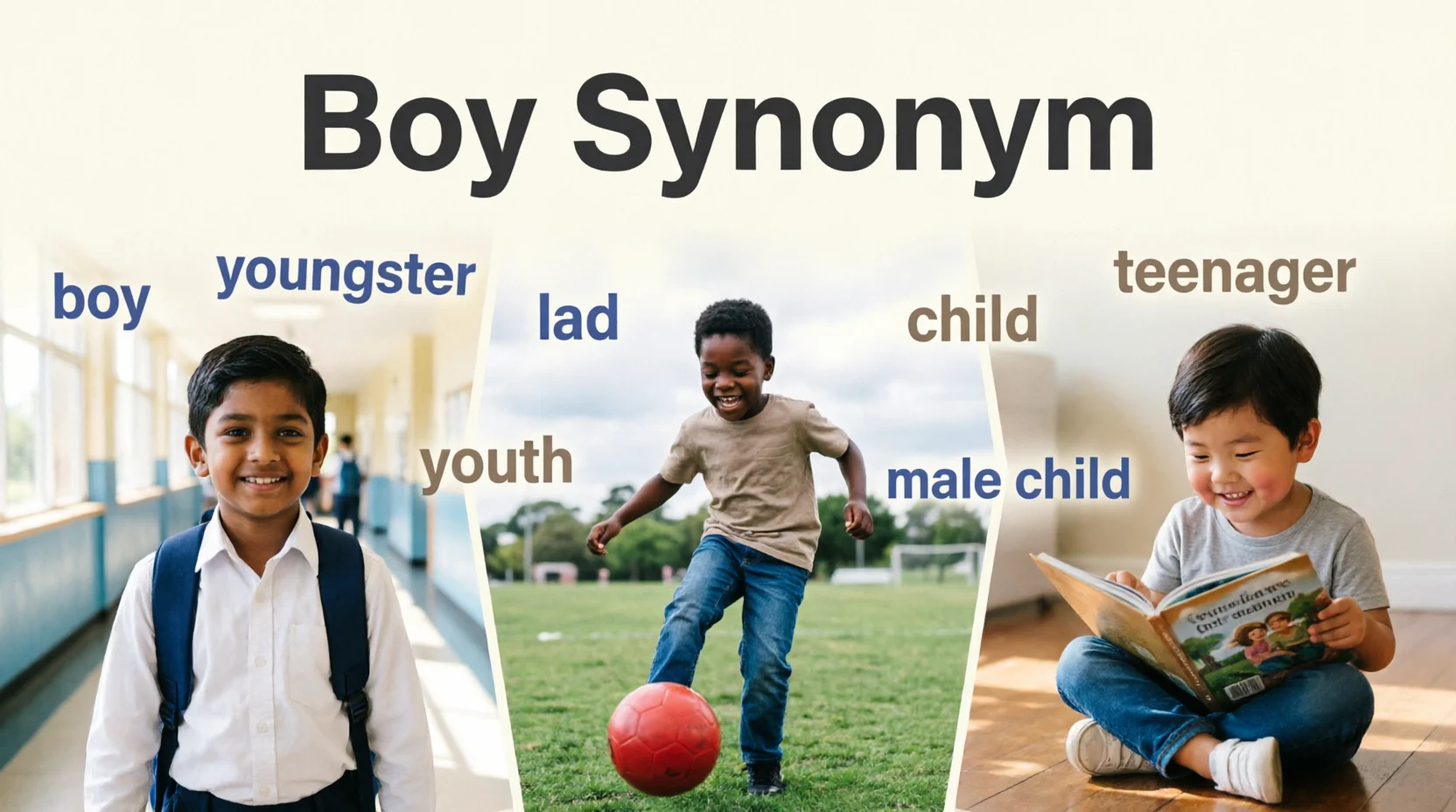
The word boy generally means a male child or a young male person. Depending on age, relationship, tone, and context, you can use words such as lad, kid, youngster, youth, son, child, adolescent, teenager, schoolboy, and young man. Each synonym has a slightly different meaning, so choosing the right word can make your writing clearer and more natural.
If you are a student, ESL learner, writer, or content creator, understanding these alternatives can help you avoid repetition and express exactly what you mean.
Quick Answer: What Are the Best Synonyms for Boy?
Some common synonyms for boy include:
- Lad
- Kid
- Youngster
- Youth
- Child
- Male child
- Adolescent
- Teenager
- Teen
- Schoolboy
- Son
- Young man
- Little boy
- Young lad
- Juvenile
The best synonym depends on the person’s age, relationship, setting, and tone.
Boy: Meaning and Usage
Boy is primarily used for a male child or young male person. It can describe someone from early childhood through the teenage years, although the exact age depends on context.
For example:
The boy was playing football in the park.
Here, “boy” refers to a young male child.
The word can also be used informally for a young man:
The boys went out for dinner after work.
In this example, “boys” refers to a group of male friends, even though they may be adults.
Because boy can cover several age groups and situations, its alternatives are not always interchangeable. Words such as child, kid, teenager, and young man provide more specific information.
30 Synonyms for Boy
1. Lad
Simple meaning: A boy or young man, especially in informal British English.
Example: The young lad helped his grandfather carry the bags.
Best usage/context: Use “lad” in friendly, informal, and especially British or Irish English.
2. Kid
Simple meaning: An informal word for a child or young person.
Example: That kid is very good at playing football.
Best usage/context: Common in everyday conversation and informal writing. It can refer to both kids, so it is not specifically male.
3. Youngster
Simple meaning: A young person, usually a child or teenager.
Example: The youngsters were playing in the garden.
Best usage/context: Useful when talking generally about young people. It is not exclusively male.
4. Youth
Simple meaning: A young person, especially a teenager or young adult.
Example: The youth joined the community sports program.
Best usage/context: More formal than “boy” and often used in social, educational, or official contexts.
5. Child
Simple meaning: A young human who has not reached adulthood.
Example: The child was reading a book quietly.
Best usage/context: Neutral and standard, but “child” does not specify that the person is male.
6. Male Child
Simple meaning: A child who is male.
Example: The hospital treated a male child after the accident.
Best usage/context: Appropriate when biological sex needs to be stated clearly, especially in formal or clinical contexts.
7. Adolescent
Simple meaning: A young person developing from childhood toward adulthood.
Example: The adolescent was learning how to manage his responsibilities.
Best usage/context: Formal writing, education, psychology, healthcare, and discussions about development. It is not exclusively male.
8. Teenager
Simple meaning: A person between the ages of 13 and 19.
Example: The teenager spent the afternoon studying for his exam.
Best usage/context: Use when the person’s age is specifically within the teenage years. It can describe males or females.
9. Teen
Simple meaning: A shorter, informal form of teenager.
Example: The teen bought a new backpack for school.
Best usage/context: Casual conversation, journalism, websites, and everyday writing.
10. Schoolboy
Simple meaning: A boy who attends school.
Example: The schoolboy walked home after class.
Best usage/context: Best when emphasizing that the male child is a student. It is particularly common in British English.
11. Son
Simple meaning: A male child in relation to his parents.
Example: Their son started college this year.
Best usage/context: Use when describing a family relationship rather than simply referring to a male child.
12. Young Man
Simple meaning: A male person who is relatively young, usually older than a child.
Example: The young man offered his seat to an elderly passenger.
Best usage/context: Polite and respectful language for an older teenager or young adult.
13. Little Boy
Simple meaning: A young male child.
Example: The little boy was excited to see the puppy.
Best usage/context: Useful when emphasizing that a boy is very young or small.
14. Young Lad
Simple meaning: An informal expression meaning a young boy or young man.
Example: The young lad showed great courage.
Best usage/context: Informal and conversational, particularly in British English.
15. Juvenile
Simple meaning: A young person who is not legally an adult.
Example: The program provides support for juvenile offenders.
Best usage/context: Formal, legal, social-service, and institutional contexts. It can refer to males or females.
16. Minor
Simple meaning: A person below the legal age of adulthood.
Example: The minor required permission from a parent.
Best usage/context: Legal, administrative, and formal contexts. It does not specifically mean “boy.”
17. Male Minor
Simple meaning: A male person who has not reached legal adulthood.
Example: The male minor was accompanied by his guardian.
Best usage/context: Formal or legal situations where both age and sex need to be specified.
18. Young Fellow
Simple meaning: An informal way to refer to a young male.
Example: A young fellow helped us find the station.
Best usage/context: Friendly and conversational contexts, especially when referring to an older boy or young man.
19. Youngster
Simple meaning: A young person.
Example: Every youngster deserves a safe place to learn.
Best usage/context: General references to young people. Because it is gender-neutral, it should not be used when male gender must be explicit.
20. Chap
Simple meaning: An informal British word for a man or young man.
Example: A friendly chap helped me with my luggage.
Best usage/context: Informal British English. It usually describes an adult or older male rather than a small boy.
21. Fellow
Simple meaning: An informal word for a male person.
Example: That fellow is waiting near the entrance.
Best usage/context: Casual or conversational writing. It generally refers to an older male rather than a child.
22. Young Man
Simple meaning: A male person in the later teenage years or early adulthood.
Example: The young man was preparing for his first job interview.
Best usage/context: Polite descriptions of older teenagers and young adults.
23. Schoolkid
Simple meaning: A child who attends school.
Example: The schoolkid forgot his lunch at home.
Best usage/context: Informal everyday language. It can refer to either boys or girls.
24. Schoolchild
Simple meaning: A child who attends school.
Example: Every schoolchild should have access to good books.
Best usage/context: Neutral and educational contexts. It does not specifically identify a male child.
25. Male Youth
Simple meaning: A young male person.
Example: The organization offers sports programs for male youth.
Best usage/context: Formal, institutional, community, and research-related writing.
26. Young Male
Simple meaning: A male person who is young.
Example: The young male athlete trained every morning.
Best usage/context: Formal, descriptive, scientific, journalistic, or demographic contexts.
27. Boyhood Child
Simple meaning: A male child during the period of childhood.
Example: The story follows a boyhood child growing up in a small village.
Best usage/context: This phrase is uncommon and generally less natural than simply saying “boy” or “male child.” Avoid it in polished everyday writing.
28. Little Lad
Simple meaning: A friendly expression for a young boy.
Example: The little lad smiled when he received the gift.
Best usage/context: Informal, affectionate, and especially British English.
29. Youngster Boy
Simple meaning: An expression intended to describe a young boy.
Example: The youngster boy played with his friends.
Best usage/context: This combination is generally unnatural in standard English. Use “youngster” or “boy” instead.
30. Male Youthful Person
Simple meaning: A young person who is male.
Example: The report described the individual as a male youthful person.
Best usage/context: This phrase is grammatically understandable but unnatural in ordinary English. “Young male” or “boy” is usually clearer.
Comparison Table: Boy Synonyms at a Glance
| Synonym | Age/Meaning | Tone | Best Context |
|---|---|---|---|
| Boy | Male child or young male | Neutral | General use |
| Lad | Boy or young man | Informal | British/Irish English |
| Kid | Young person | Informal | Conversation |
| Youngster | Young person | Neutral | General references |
| Youth | Young person | Formal | Social or official writing |
| Child | Young person | Neutral | General use |
| Male child | Male child | Formal | Clinical/formal contexts |
| Adolescent | Developing young person | Formal | Education and development |
| Teenager | Age 13–19 | Neutral | Age-specific contexts |
| Teen | Age 13–19 | Informal | Everyday language |
| Schoolboy | Boy attending school | Neutral | Education |
| Son | Male child of parents | Neutral | Family relationships |
| Young man | Older teenager/young adult | Polite | Formal or respectful contexts |
| Little boy | Very young male child | Neutral/Affectionate | Children |
| Juvenile | Under legal adulthood | Formal | Legal/institutional |
| Minor | Under legal adulthood | Formal | Legal contexts |
| Young fellow | Young male | Informal | Conversation |
| Chap | Man/young man | Informal | British English |
| Fellow | Male person | Informal | Casual descriptions |
| Schoolkid | School-going child | Informal | Everyday speech |
| Schoolchild | School-going child | Neutral | Education |
| Young male | Young male person | Formal | Descriptive writing |
How to Choose the Right Synonym for Boy
The right alternative depends on what you want to communicate.
For Casual Conversation
Choose:
- Kid
- Lad
- Teen
- Young fellow
- Little lad
These words sound natural in informal speech.
Example:
That kid is really talented.
For Formal Writing
Choose:
- Male child
- Adolescent
- Young male
- Minor
- Juvenile
These terms are more suitable for reports, academic writing, legal documents, and professional contexts.
Example:
The study examined the behavior of male adolescents.
When Age Matters
Use a more specific term when age is important.
- Child — generally a young person
- Teenager — 13 to 19
- Adolescent — developmental stage between childhood and adulthood
- Young man — generally an older teenager or young adult
- Minor — below the legal age of adulthood
When Family Relationship Matters
Use son when you want to show a parent-child relationship.
Instead of:
The boy visited his parents.
You could write:
Their son visited them.
The second sentence gives additional information about the relationship.
For British English
Words such as lad, schoolboy, chap, and little lad may sound especially natural in British contexts.
For example:
The lad scored the winning goal.
For American English
Kid, boy, teen, and young man are common choices in everyday American English.
For example:
The kid was waiting outside the store.
Common Usage Mistakes
Using “son” as a direct synonym for every boy
A son is specifically a male child in relation to a parent or parents.
Incorrect:
I saw three sons playing in the park.
Better:
I saw three boys playing in the park.
Use sons when the family relationship is relevant.
Using “teenager” for every boy
Not every boy is a teenager. A six-year-old is a boy, but he is not a teenager.
Use teenager only when the person is between 13 and 19.
Assuming “kid” means only a boy
“Kid” is gender-neutral.
The kid won the race.
This sentence does not tell us whether the child is male or female.
Using “juvenile” in casual conversation
“Juvenile” can sound formal or institutional.
Instead of:
That juvenile is my neighbor.
Everyday English would usually use:
That boy is my neighbor.
Using “chap” for a small child
“Chap” generally refers to a man or older male rather than a young child.
For a small child, boy, kid, or lad may be more appropriate depending on the context.
Adding unnecessary words
Expressions such as “youngster boy” and “young male person” can sound awkward.
Usually, a simpler word is better:
The boy was smiling.
instead of:
The young male person was smiling.
FAQs:
What is the most common synonym for boy?
Lad is a common synonym, particularly in British English. In informal American English, kid is also widely used, although it can describe any child regardless of gender.
What is a formal synonym for boy?
Depending on the context, formal alternatives include male child, young male, adolescent, minor, and juvenile. The appropriate choice depends on the person’s age and the subject of the writing.
What is another word for a young boy?
You can use little boy, lad, little lad, young lad, or youngster. “Little boy” is particularly clear when you want to emphasize that the child is young.
Is “kid” a synonym for boy?
Yes, but only in some contexts. Kid means a child or young person and is gender-neutral. If you need to clearly indicate that the person is male, boy is more precise.
Is “lad” another word for boy?
Yes. Lad commonly means a boy or young man and is especially associated with informal British and Irish English.
What is the difference between boy and teenager?
A boy can be any male child or young male, while a teenager specifically refers to someone aged 13 through 19. Teenager is also gender-neutral.
Can “young man” replace boy?
Sometimes. Young man is generally more suitable for an older teenager or young adult. It may sound inappropriate for a very young child.
What is the another gender of boy?
The traditional corresponding term is girl, although the appropriate terminology can depend on the context and the person’s own identity. In ordinary age-based vocabulary, “boy” and “girl” are commonly used for male and female children respectively.
Conclusion
The word boy has many possible alternatives, but they do not all carry exactly the same meaning. Lad is informal and especially common in British English, while kid is casual and gender-neutral. Teenager gives specific information about age, son identifies a family relationship, and young man is more appropriate for an older teenager or young adult.
For formal writing, words such as male child, adolescent, minor, and young male can provide greater precision. In everyday writing, however, simple words such as boy, kid, lad, and youngster are often more natural.
When selecting a synonym, consider the person’s age, gender, relationship, formality of the situation, and intended tone. The most accurate word is the one that communicates your meaning clearly without adding unnecessary complexity.