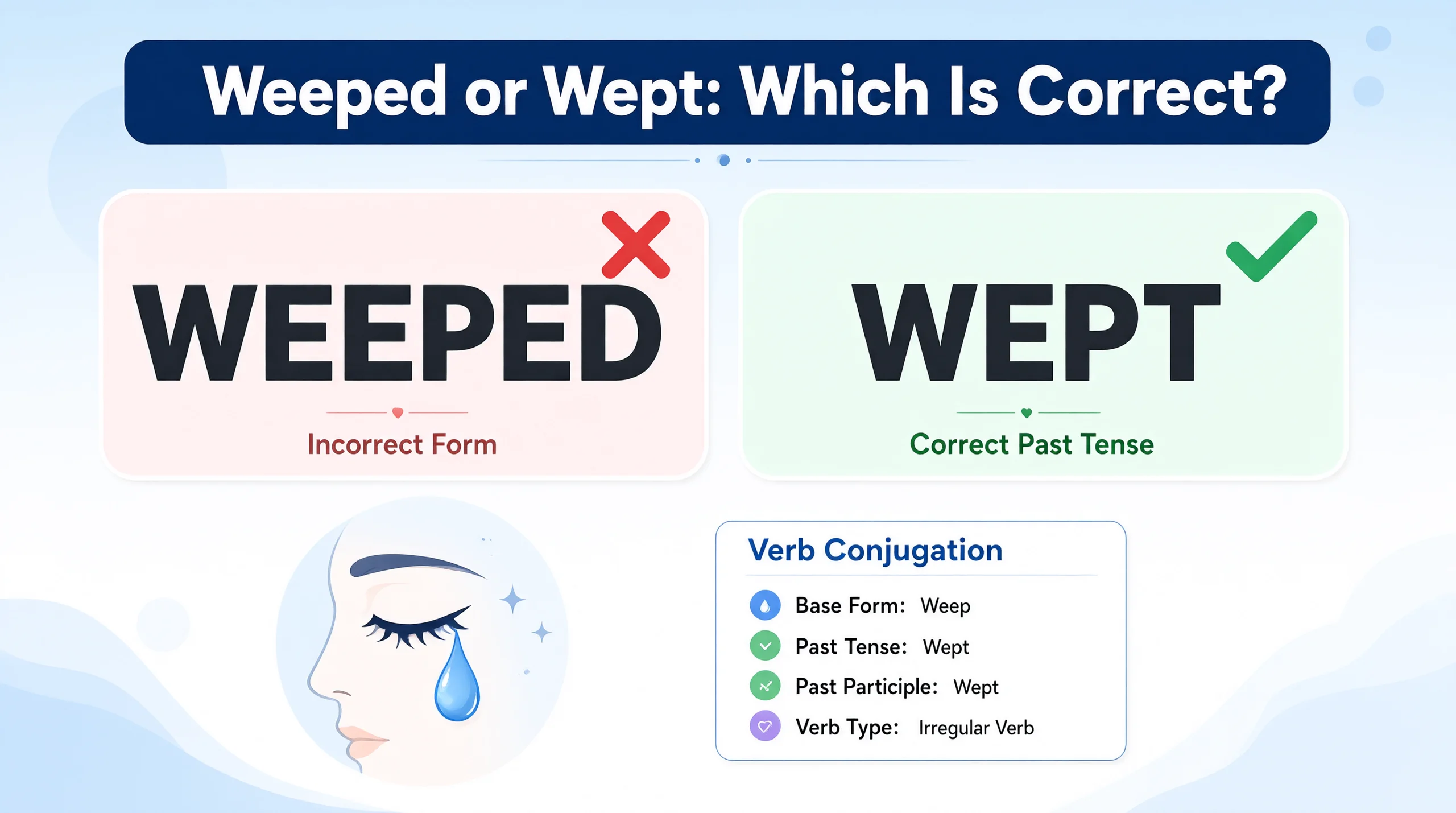
Have you ever wondered if the correct past tense of weep is weeped or wept? Many English learners find these two forms confusing because regular English verbs usually form their past tense by adding -ed. However, English also has irregular verbs that follow different spelling patterns.
The correct past tense and past participle of weep is wept, not weeped. The word weep means to cry, shed tears, or express deep sadness. For example, you can say, “She wept after hearing the heartbreaking news.” Although weeped may seem grammatically logical, it is not the standard form in modern English.
Understanding the difference between weeped and wept will help you improve your grammar, writing, and everyday communication. In this guide, you will learn their meanings, correct usage, grammatical differences, and practical examples so you can confidently choose the right word.
Quick Answer: Weeped or Wept?
Wept is the correct past tense and past participle of weep. The word weeped is nonstandard and should generally be avoided in formal and everyday English. For example, “The child wept when his mother left.” Remember that weep is an irregular verb, so it changes to wept instead of adding -ed.
Why Do People Confuse Weeped and Wept?
People confuse these words because most regular English verbs form their past tense by adding -ed.
For example:
- Walk → Walked
- Talk → Talked
- Help → Helped
- Clean → Cleaned
Following this pattern, some learners naturally assume that weep becomes weeped.
However, weep is an irregular verb. Its spelling changes when forming the past tense and past participle.
- Present: Weep
- Past: Wept
- Past participle: Wept
This irregular pattern is similar to other English verbs, such as:
- Sleep → Slept
- Keep → Kept
- Sweep → Swept
- Creep → Crept
Therefore, wept is the grammatically correct choice.
First Word: Weeped
Weeped is a nonstandard past-tense form that some English learners create by applying the regular -ed spelling rule to the verb weep.
Although the formation may seem logical, it is not accepted as the standard past tense or past participle in modern standard English.
Meaning: An attempted past-tense form of weep, meaning to cry or shed tears.
Examples of incorrect usage:
- Incorrect: She weeped after watching the sad movie.
- Correct: She wept after watching the sad movie.
- Incorrect: The little boy has weeped all morning.
- Correct: The little boy has wept all morning.
Remember: Avoid using weeped in academic writing, professional communication, and standard English conversations.
Second Word: Wept
Wept is the correct past tense and past participle of the verb weep. It describes the action of crying or shedding tears in the past.
It can express sadness, grief, emotional pain, happiness, or deep feelings.
Examples:
- She wept after hearing the terrible news.
- The child wept because he missed his parents.
- They wept with joy at the wedding.
Verb forms of Weep:
| Verb Form | Word |
| Base form | Weep |
| Third-person singular | Weeps |
| Present participle | Weeping |
| Simple past | Wept |
| Past participle | Wept |
Example sentences:
- Present: I weep whenever I remember that day.
- Past: He wept after losing his best friend.
- Present perfect: She has wept many times.
- Past perfect: They had wept before the ceremony began.
Weeped vs Wept: Comparison Table
| Feature | Weeped | Wept |
| Correctness | Nonstandard | Correct |
| Verb type | Incorrect regular formation | Irregular verb form |
| Base word | Weep | Weep |
| Past tense | Nonstandard | Wept |
| Past participle | Nonstandard | Wept |
| Formal writing | Avoid | Recommended |
| Meaning | Intended to cry | Cried or shed tears |
| Example | She weeped. | She wept. |
The main difference is that wept is the standard and grammatically correct form, while weeped is a nonstandard formation.
When to Use Weeped or Wept
Knowing when to use these forms is important for correct English grammar.
When to Use Wept
Use wept when describing someone crying in the past.
Examples:
- The woman wept after losing her husband.
- The audience wept during the emotional performance.
- He wept when he received the heartbreaking letter.
You should also use wept with helping verbs such as has, have, and had.
Examples:
- She has wept many times.
- I have never wept like that before.
- They had wept before the final goodbye.
When to Use Weeped
In standard modern English, you should not use weeped as the past tense or past participle of weep.
Choose wept instead.
12 Examples of Weeped vs Wept in Sentences
Here are practical examples to help you understand the correct usage.
| No. | Incorrect Sentence | Correct Sentence |
| 1 | She weeped loudly. | She wept loudly. |
| 2 | He weeped after the accident. | He wept after the accident. |
| 3 | They weeped with sadness. | They wept with sadness. |
| 4 | The baby weeped all night. | The baby wept all night. |
| 5 | I weeped during the movie. | I wept during the movie. |
| 6 | She has weeped before. | She has wept before. |
| 7 | He had weeped for hours. | He had wept for hours. |
| 8 | The children weeped together. | The children wept together. |
| 9 | My friend weeped at the funeral. | My friend wept at the funeral. |
| 10 | We weeped after saying goodbye. | We wept after saying goodbye. |
| 11 | The old man weeped quietly. | The old man wept quietly. |
| 12 | She has never weeped publicly. | She has never wept publicly. |
These examples show why using wept is important when writing about past actions.
Common Mistakes When Using Weeped and Wept
English learners often make a few mistakes when using irregular verbs.
Here are some common errors to avoid.
1. Adding -ed to weep
- Incorrect: He weeped after the news.
- Correct: He wept after the news.
2. Using weeped with has or have
- Incorrect: She has weeped before.
- Correct: She has wept before.
3. Confusing wept with weeping
Wept describes a completed past action, while weeping is the present participle.
- Past: She wept yesterday.
- Present continuous: She is weeping now.
4. Using weep instead of wept for a completed past action
- Incorrect: They weep after hearing the news yesterday.
- Correct: They wept after hearing the news yesterday.
5. Forgetting irregular verb forms
Remember that not every English verb follows the regular -ed rule.
Memory Trick: How to Remember Wept
An easy way to remember the correct form is to connect weep with sleep.
Both words follow a similar irregular pattern:
- Weep → Wept
- Sleep → Slept
Think of this simple sentence:
“I sleep at night, and I wept last night.”
Both verbs change their spelling instead of adding -ed.
Another useful trick is to remember that wept is a short, established irregular form of weep.
American vs British English: Weeped or Wept
There is no standard American-versus-British spelling difference between these two forms.
Both American English and British English use wept as the standard simple past tense and past participle of weep.
| English Variety | Correct Form | Example |
| American English | Wept | She wept after the news. |
| British English | Wept | She wept after the news. |
| Australian English | Wept | He wept with happiness. |
| Canadian English | Wept | They wept together. |
Although pronunciation and vocabulary can vary across English-speaking countries, the standard verb form remains the same.
Similar Words to Weep and Wept
Several English words have meanings similar to weep and wept. Learning these alternatives can improve your vocabulary and make your writing more expressive.
| Word | Meaning | Example |
| Cry | Shed tears | The child cried loudly. |
| Sob | Cry with repeated breaths | She sobbed quietly. |
| Wail | Cry loudly | The baby wailed all night. |
| Whimper | Cry softly | He whimpered in pain. |
| Bawl | Cry very loudly | The little boy bawled. |
| Snivel | Cry with a runny nose | He sniveled after the accident. |
| Mourn | Express grief | They mourned their loss. |
| Lament | Express sadness or regret | She lamented her decision. |
| Tear up | Begin to cry | I teared up during the speech. |
| Shed tears | Release tears | He shed tears of joy. |
These words are related to crying, but each has a slightly different meaning and emotional tone.
Final Verdict: Weeped or Wept?
The correct choice is wept.
Weep is an irregular English verb, so its past tense and past participle do not follow the regular -ed rule.
- Weep = Present tense
- Wept = Simple past tense
- Wept = Past participle
- Weeped = Nonstandard form
For example:
- Correct: She wept after hearing the news.
- Incorrect: She weeped after hearing the news.
Whenever you need to describe someone crying in the past, choose wept.
FAQs:
1. Is weeped a real word?
Weeped is a nonstandard form sometimes created by applying the regular past-tense rule to weep. However, wept is the accepted standard form in modern English.
2. Is wept the past tense of weep?
Yes. Wept is the simple past tense of weep. For example, “The little girl wept after losing her toy.”
3. What is the past participle of weep?
The past participle of weep is also wept. For example, “She has wept many times.”
4. Why does weep become wept instead of weeped?
Because weep is an irregular verb. Irregular verbs do not always follow the regular rule of adding -ed to form the past tense.
5. Is wept used in American and British English?
Yes. Both American and British English use wept as the standard past tense and past participle of weep.
6. What is the difference between wept and weeping?
Wept is the simple past tense and past participle of weep. Weeping is its present participle, commonly used for an ongoing crying action.
Examples:
- She wept yesterday.
- She is weeping now.
7. Can I say “I have wept”?
Yes. “I have wept” is grammatically correct because wept is the past participle of weep. It is used with the helping verb have.
Remember This
Correct: Wept
- Weep = Present tense
- Wept = Past tense
- Wept = Past participle
- Weeped = Nonstandard form
Always use wept instead of weeped in standard English writing and speaking.
Conclusion
Understanding the difference between weeped and wept is simple once you learn that weep is an irregular verb. Although adding -ed may seem like the natural choice, the correct past tense and past participle are both wept. Using the correct form will make your English grammar more accurate and your writing clearer.
Whenever you describe someone crying in the past, remember to use wept. Practice sentences such as “She wept with happiness” and “He has wept many times” to become more confident. Learning irregular verbs like weep, sleep, and keep will also help you avoid similar grammatical mistakes.