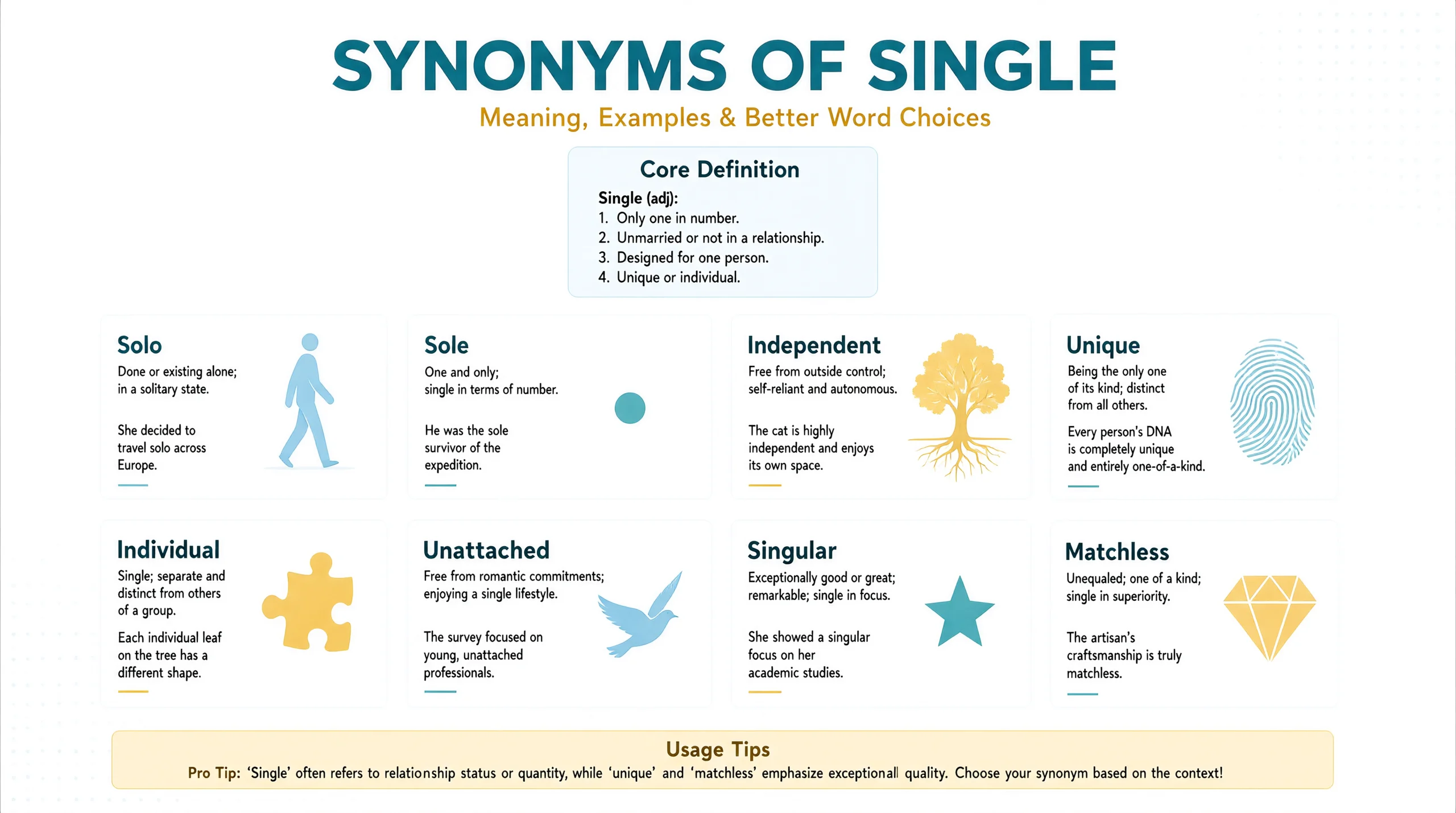
The synonyms of single include alone, individual, separate, sole, solitary, unmarried, and independent. The best alternative depends on the context. For example, “single person” may mean an unmarried individual, while “a single item” means one item. Understanding these differences helps you choose the right word for everyday conversations, academic writing, and professional communication.
Quick Answer: What Are Synonyms of Single?
Here are some common synonyms of single:
- Alone
- Individual
- Sole
- Separate
- Solitary
- Unmarried
- Independent
- One
- Only
- Unique
- Distinct
- Lone
- Isolated
- Exclusive
- Individualized
Each word has a slightly different meaning, so consider the sentence before choosing a replacement.
Meaning and Usage of Single
The word single has several meanings in English. It can describe one person or thing, someone who is not married, or something that exists separately rather than as part of a group.
For example:
- One: She bought a single ticket.
- Unmarried: He is single and enjoys meeting new people.
- Separate: Please put each item in a single container.
- Sole: She was the single winner of the competition.
The correct synonym depends on what you want to communicate.
30 Synonyms of Single With Meanings and Examples
1. Alone
Meaning: Without other people; by yourself.
Example: She prefers to work alone in a quiet room.
Best usage: Use “alone” when describing someone who is by themselves or something done without assistance.
2. Individual
Meaning: One person or thing considered separately.
Example: Each individual student received a certificate.
Best usage: Use it in educational, professional, and formal contexts when referring to one person or item.
3. Sole
Meaning: Being the only one.
Example: He was the sole owner of the business.
Best usage: Use “sole” to emphasize that there is only one owner, reason, responsibility, or option.
4. Separate
Meaning: Not joined or combined with something else.
Example: Please submit each assignment in a separate folder.
Best usage: Use it when describing things kept apart or treated individually.
5. Solitary
Meaning: Alone or spending time without others.
Example: The writer enjoyed a solitary walk through the forest.
Best usage: Use it in descriptive writing when emphasizing solitude or being alone.
6. Unmarried
Meaning: Not married.
Example: She is unmarried and lives with her sister.
Best usage: Use it when discussing marital status rather than the number of people or objects.
7. Independent
Meaning: Free from relying on others.
Example: He became financially independent at an early age.
Best usage: Use it to describe someone who acts or lives without depending on others.
8. One
Meaning: The number represented by a single unit.
Example: I need one pencil for the test.
Best usage: Use it when referring to a quantity of exactly one.
9. Only
Meaning: No more than one or no other.
Example: She was the only person who answered correctly.
Best usage: Use it to emphasize exclusivity or the absence of alternatives.
10. Unique
Meaning: Different from others or having special qualities.
Example: Every artist has a unique style.
Best usage: Use it when emphasizing distinctiveness rather than simply meaning one.
11. Distinct
Meaning: Clearly different or separate.
Example: The report contains three distinct sections.
Best usage: Use it when things can be clearly distinguished from each other.
12. Lone
Meaning: Being the only person or thing in a particular place or situation.
Example: A lone traveler waited at the station.
Best usage: Use it in storytelling and descriptive writing to emphasize being by oneself.
13. Isolated
Meaning: Separated from others or kept apart.
Example: The village is isolated from the nearest city.
Best usage: Use it when describing separation, distance, or limited contact.
14. Exclusive
Meaning: Limited to one person, group, or purpose.
Example: Members received exclusive access to the event.
Best usage: Use it when access, rights, or opportunities are restricted to particular people.
15. Unaccompanied
Meaning: Without someone accompanying you.
Example: The child traveled unaccompanied on the train.
Best usage: Use it when someone is traveling or attending something without a companion.
16. Singular
Meaning: One in number; also unusually remarkable in some contexts.
Example: The teacher asked each student to write a singular answer for the exercise.
Best usage: Use it in grammar to describe a one-person or one-thing form, or in formal writing to mean exceptional. For the example, “one answer” or “individual answer” may sound more natural.
17. Specific
Meaning: Clearly identified or particular.
Example: I am looking for a specific book about history.
Best usage: Use it when referring to one particular item, person, or detail.
18. Particular
Meaning: One specific person or thing among several.
Example: She prefers a particular brand of coffee.
Best usage: Use it when identifying one choice from a larger group.
19. Unattached
Meaning: Not connected to or committed to someone or something.
Example: The document was left unattached to the email.
Best usage: Use it for things that are not connected, or informally for someone who is not in a romantic relationship.
20. Unpartnered
Meaning: Not having a partner.
Example: The unpartnered dancers joined the next group.
Best usage: Use it when discussing relationships, dance partners, or activities requiring a partner.
21. Uncoupled
Meaning: Not joined or connected as a pair.
Example: The two train cars were uncoupled.
Best usage: Use it mainly for things that have been disconnected or separated.
22. One-off
Meaning: Happening only once or made for a single occasion.
Example: The company organized a one-off workshop.
Best usage: Use it for unique events, tasks, or arrangements that are not expected to repeat.
23. Singularized
Meaning: Made singular or expressed in a singular form.
Example: The editor singularized the noun to match the sentence.
Best usage: Use it in grammatical or linguistic discussions. It is not a common general-purpose synonym for “single.”
24. Unitary
Meaning: Forming one whole rather than multiple separate units.
Example: The committee discussed a unitary system of administration.
Best usage: Use it in technical, political, or academic contexts when describing a unified structure.
25. Monadic
Meaning: Consisting of or relating to a single unit.
Example: The researcher used a monadic approach to examine the concept.
Best usage: Use it in specialized academic, philosophical, mathematical, or technical writing.
26. Solely
Meaning: Only or exclusively; an adverb rather than an adjective.
Example: The decision was based solely on the evidence.
Best usage: Use it when explaining that an action or decision depends on only one factor.
27. Singularly
Meaning: In an exceptional way or to a remarkable degree; sometimes meaning individually.
Example: She was singularly successful in her chosen field.
Best usage: Use it as an adverb when emphasizing an unusual quality or achievement.
28. Unmatched
Meaning: Not equaled by another or having no equal.
Example: Her dedication to the project was unmatched.
Best usage: Use it to emphasize superiority or the absence of an equal, not simply the number one.
29. Unparalleled
Meaning: Having no equal or comparison.
Example: The city offers unparalleled views of the mountains.
Best usage: Use it in formal or descriptive writing to emphasize an exceptional quality.
30. Unaccompanied by others
Meaning: Present or acting without other people.
Example: He entered the building unaccompanied by others.
Best usage: Use this phrase when you want to emphasize that someone is present without companions. It is a phrase, not a one-word synonym.
Comparison Table of Single Synonyms
| Synonym | Main meaning | Example phrase |
| Alone | Without company | Sitting alone |
| Individual | One person or thing | Individual student |
| Sole | The only one | Sole owner |
| Separate | Kept apart | Separate room |
| Solitary | Alone or secluded | Solitary walk |
| Unmarried | Not married | Unmarried adult |
| Independent | Self-reliant | Independent person |
| One | Exactly one | One ticket |
| Only | No other | Only option |
| Unique | Distinctive | Unique design |
| Distinct | Clearly different | Distinct categories |
| Lone | The only one present | Lone traveler |
| Isolated | Separated from others | Isolated village |
| Exclusive | Restricted to certain people | Exclusive access |
| Unaccompanied | Without a companion | Unaccompanied child |
How to Choose the Right Synonym for Single
Choosing the right synonym requires understanding the intended meaning, tone, and purpose.
For Number and Quantity
Use one, only, sole, or individual when describing a single item, person, or unit.
- “I need one copy.”
- “She is the sole applicant.”
- “Each individual package has a label.”
For Being Alone
Use alone, solitary, lone, or isolated when describing someone or something without company or connection.
- “He sat alone.”
- “A lone figure stood nearby.”
- “They lived in an isolated area.”
Remember that “isolated” often suggests separation, while “alone” simply means without company.
For Relationship Status
Use unmarried, unattached, or unpartnered when describing someone’s relationship situation.
- “She is unmarried.”
- “He is currently unattached.”
- “The unpartnered participants joined the activity.”
These terms are not identical: someone can be unmarried but still have a romantic partner.
For Formal and Academic Writing
Use individual, distinct, specific, unitary, or singular when the context calls for precise or technical language.
- “Each individual case was reviewed.”
- “The study identified three distinct patterns.”
- “The system uses a unitary structure.”
For Emphasis and Excellence
Use unique, unmatched, or unparalleled when you mean that something is unusual or exceptional.
- “Her approach was unique.”
- “The team achieved unparalleled success.”
These words do not simply mean “one”; they add a sense of distinction or excellence.
Common Mistakes When Using Synonyms of Single
1. Using “Alone” Instead of “Only”
Incorrect meaning: “I have alone one ticket.”
Better: “I have only one ticket.”
“Alone” describes being without company, while “only” limits the number or choices.
2. Confusing “Single” With “Unmarried”
“Single” can describe one item or someone who is not married or partnered, depending on context. “Unmarried” specifically describes marital status.
3. Using “Unique” to Mean Exactly One
“Unique” usually means distinctive or unlike others. If you mean exactly one item, use “one,” “only,” or “sole.”
4. Treating “Separate” and “Individual” as Identical
“Separate” emphasizes being apart, while “individual” emphasizes one person or thing considered independently.
5. Using Formal Words in Everyday Conversation
Words such as “monadic” and “unitary” are appropriate in specialized contexts, but “one,” “only,” or “individual” will usually sound more natural in everyday English.
FAQs:
1. What are the most common synonyms of single?
The most common synonyms include alone, one, only, individual, sole, separate, solitary, and unmarried. The best choice depends on the sentence.
2. What is another word for single person?
“Individual,” “person living alone,” and “unmarried person” may work, depending on the meaning. Use “individual” for one person, “living alone” for someone’s living situation, and “unmarried” for marital status.
3. What is a synonym for single in a relationship?
“Unmarried,” “unattached,” and “unpartnered” can describe someone without a spouse or romantic partner. However, their meanings differ, so choose the term that matches the situation.
4. What is a formal synonym for single?
“Sole,” “individual,” “distinct,” and “singular” can work in formal writing. For example, “sole responsibility” is more natural than “single responsibility” in some contexts.
5. What is the opposite of single?
The opposite depends on the meaning. For quantity, it may be “multiple” or “several.” For relationship status, it may be “married” or “partnered.” For something separate, it may be “combined” or “joint.”
6. Can “unique” replace “single”?
Sometimes, but not always. “Unique” means distinctive or unlike others, whereas “single” often means one. A single item is not necessarily unique.
7. What is the difference between single and solitary?
“Single” can refer to quantity, relationship status, or an individual unit. “Solitary” emphasizes being alone or apart from others, often in a descriptive context.
Conclusion
The word “single” has several meanings, making its synonyms useful in everyday conversation, academic writing, and professional communication. Words such as one, only, sole, and individual are suitable when referring to quantity or one person or thing. Words such as alone, solitary, and lone emphasize being without company, while unmarried and unpartnered describe relationship status.
Other alternatives, including “unique” and “unparalleled,” express distinctiveness rather than simply meaning one. To choose the right synonym, consider the sentence, intended meaning, and tone. Learning these distinctions will help you communicate more clearly and select words that sound natural in different situations.