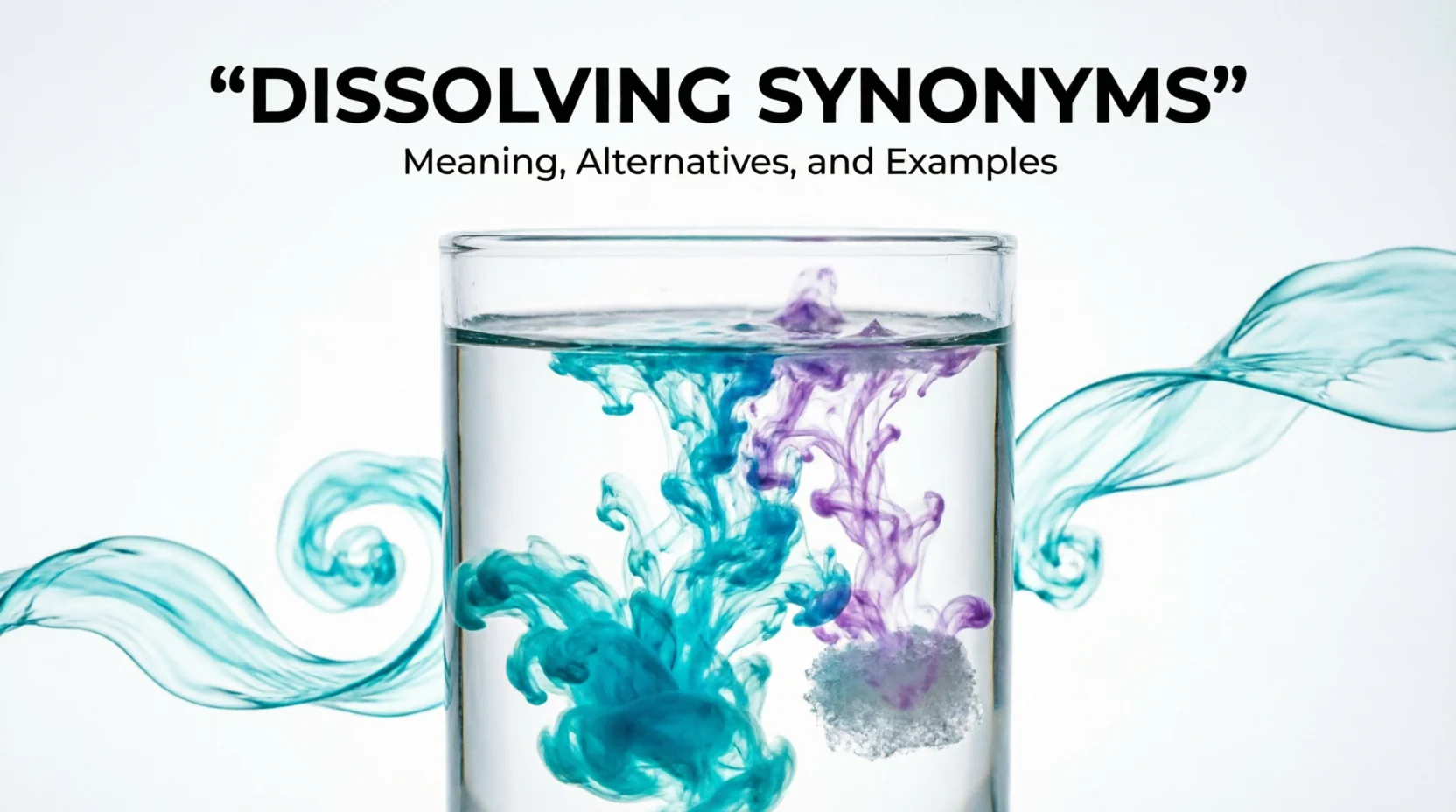
The word dissolving describes the process of mixing a substance into a liquid until it becomes part of the liquid, or the process of breaking apart, disappearing, or ending. Depending on the context, dissolving can refer to sugar dissolving in water, a company dissolving, a partnership ending, or a substance gradually disappearing.
There are several useful synonyms for dissolving, including melting, disintegrating, breaking down, disappearing, dispersing, vanishing, and decomposing. However, these words do not always mean exactly the same thing. The best alternative depends on whether you are describing a chemical process, physical change, gradual disappearance, or the ending of an organization or agreement.
In this guide, you will discover 30 synonyms for dissolving, their simple meanings, example sentences, and the situations in which each word works best. These alternatives can help students, English learners, writers, and content creators express their ideas more clearly and accurately.
Quick Answer: What Are the Best Synonyms for Dissolving?
The best synonyms for dissolving include:
- Melting
- Disintegrating
- Breaking down
- Disappearing
- Vanishing
- Dispersing
- Decomposing
- Diminishing
- Fading
- Liquefying
- Separating
- Dissipating
For example, “The sugar is dissolving in water” can be rephrased as “The sugar is gradually going into solution.” In contrast, “The organization is dissolving” may mean that the organization is disbanding or being disbanded.
Meaning and Usage of Dissolving
Dissolving is the present participle of the verb dissolve. It describes an ongoing process in which a substance mixes into another substance, something breaks apart, or an established arrangement comes to an end.
The word has several common uses.
1. Chemical and Physical Processes
Dissolving often describes a substance becoming evenly distributed in a liquid.
Example: The salt is dissolving in warm water.
Suitable alternatives include going into solution and, in some contexts, dispersing.
2. Breaking Apart
Dissolving can describe something gradually losing its structure or breaking into smaller parts.
Example: The old material is dissolving into smaller components.
Suitable alternatives include disintegrating, breaking down, and decomposing, depending on the process.
3. Disappearing Gradually
The word can also describe something becoming less visible or noticeable.
Example: The clouds are dissolving into the morning sky.
Suitable alternatives include fading, vanishing, and disappearing.
4. Ending an Organization or Agreement
Dissolving may refer to formally ending a company, partnership, committee, or legal arrangement.
Example: The partners are dissolving their business.
Suitable alternatives include disbanding, terminating, and ending.
30 Synonyms for Dissolving With Meanings and Examples
1. Melting
Meaning: Changing from a solid into a liquid through heat.
Example: The ice is melting in the afternoon sun.
Best usage: Use melting when a solid changes into a liquid. Melting and dissolving are different physical processes.
2. Disintegrating
Meaning: Breaking apart into smaller pieces or losing structural unity.
Example: The dry leaves are disintegrating on the forest floor.
Best usage: Suitable for materials that break apart or lose their structure.
3. Breaking Down
Meaning: Separating into smaller parts or simpler substances.
Example: The enzyme is breaking down the food.
Best usage: Use it for digestion, decomposition, chemical processes, or the failure of a structure.
4. Disappearing
Meaning: Becoming impossible or difficult to see or notice.
Example: The mist is disappearing as the sun rises.
Best usage: Best for general situations where something gradually becomes less visible or noticeable.
5. Vanishing
Meaning: Disappearing from sight or ceasing to be noticeable.
Example: The smoke is vanishing into the air.
Best usage: Useful for vivid descriptions of something seemingly disappearing.
6. Dispersing
Meaning: Spreading out over a larger area.
Example: The powder is dispersing throughout the liquid.
Best usage: Appropriate when particles, people, or substances spread out rather than necessarily dissolving completely.
7. Decomposing
Meaning: Breaking down into simpler substances, often through natural processes.
Example: The organic waste is decomposing in the compost bin.
Best usage: Best for organic matter and biological or chemical breakdown.
8. Fading
Meaning: Gradually becoming weaker, lighter, or less noticeable.
Example: The color is fading after repeated washing.
Best usage: Use it for colors, sounds, memories, emotions, and visibility.
9. Diminishing
Meaning: Becoming smaller, weaker, or less intense.
Example: The smell is diminishing as the room fills with fresh air.
Best usage: Suitable when the intensity or amount of something decreases.
10. Liquefying
Meaning: Turning a substance into a liquid.
Example: The material is liquefying under intense heat.
Best usage: Use it when a substance changes into a liquid, not simply when it mixes into one.
11. Dissipating
Meaning: Gradually spreading out or becoming weaker until it disappears.
Example: The fog is dissipating over the lake.
Best usage: Useful for fog, smoke, heat, tension, energy, and worries.
12. Eroding
Meaning: Gradually wearing away a surface or material.
Example: The flowing water is eroding the riverbank.
Best usage: Best for gradual physical wearing away, especially through water, wind, or friction.
13. Disbanding
Meaning: Ending the activities of an organized group.
Example: The committee is disbanding after completing its work.
Best usage: Appropriate for teams, committees, clubs, and other organized groups.
14. Terminating
Meaning: Bringing something to an end.
Example: The company is terminating the agreement.
Best usage: Best for formal, legal, contractual, or professional contexts.
15. Ending
Meaning: Bringing something to a close.
Example: The partners are ending their business arrangement.
Best usage: A simple, versatile alternative for relationships, activities, agreements, and events.
16. Separating
Meaning: Dividing something into distinct parts or components.
Example: The mixture is separating into two layers.
Best usage: Use it when substances or components move apart instead of mixing uniformly.
17. Degrading
Meaning: Breaking down or becoming lower in quality.
Example: The chemical is degrading under direct sunlight.
Best usage: Suitable for materials, pollutants, and substances that deteriorate over time.
18. Disassembling
Meaning: Taking something apart into separate components.
Example: The technician is disassembling the old machine.
Best usage: Use it for objects, machines, equipment, and structures that can be taken apart.
19. Dissolving Away
Meaning: Gradually disappearing through a dissolving process.
Example: The thin layer of salt is dissolving away in the rain.
Best usage: Useful for emphasizing the gradual disappearance of a soluble substance.
20. Evaporating
Meaning: Changing from a liquid into a gas.
Example: The water is evaporating from the warm pavement.
Best usage: Use it for liquids changing into vapor. Evaporation is not the same as dissolving.
21. Disappearing Gradually
Meaning: Becoming less visible or noticeable over time.
Example: The stain is disappearing gradually after each wash.
Best usage: Useful when you want to emphasize that a change happens slowly.
22. Crumbling
Meaning: Breaking into small pieces, often because something is dry, brittle, or weak.
Example: The old wall is crumbling after years of neglect.
Best usage: Suitable for buildings, dry soil, rocks, and fragile materials.
23. Depleting
Meaning: Using up or reducing a supply.
Example: The reaction is depleting the available chemical.
Best usage: Appropriate when the quantity of a resource or substance decreases.
24. Weakening
Meaning: Becoming less strong, powerful, or intense.
Example: The chemical reaction is weakening as the reactants are consumed.
Best usage: Best when the process loses strength rather than physically disappearing.
25. Declining
Meaning: Decreasing in amount, quality, strength, or importance.
Example: The concentration of the substance is declining over time.
Best usage: Useful for measurements, levels, rates, and general downward trends.
26. Resolving
Meaning: Gradually clearing up or reaching a settled state.
Example: The cloudiness is resolving as the particles settle.
Best usage: Suitable for problems, uncertainty, symptoms, and certain changes in mixtures. It is not a direct synonym for chemical dissolving in every situation.
27. Blending
Meaning: Mixing two or more things together so they combine or appear uniform.
Example: The ingredients are blending smoothly in the bowl.
Best usage: Best for ingredients, colors, flavors, and substances that mix together.
28. Integrating
Meaning: Combining separate elements into a unified whole.
Example: The new component is integrating into the existing system.
Best usage: Appropriate for systems, ideas, groups, and processes rather than literal chemical dissolving.
29. Melting Away
Meaning: Gradually disappearing as something melts.
Example: The remaining snow is melting away in the sunlight.
Best usage: Best for ice, snow, wax, and other materials that melt and gradually disappear.
30. Disappearing Into Solution
Meaning: Becoming distributed throughout a solvent as a dissolved substance.
Example: The crystals are disappearing into solution as the water is stirred.
Best usage: Particularly suitable for scientific explanations of a substance dissolving in a liquid.
Comparison Table: Choosing the Right Synonym for Dissolving
| Synonym | Main meaning | Best context |
| Melting | Solid becomes liquid | Ice, wax, metals |
| Disintegrating | Breaking into pieces | Fragile materials |
| Breaking down | Becoming simpler | Digestion, chemical reactions |
| Dispersing | Spreading out | Particles, smoke, crowds |
| Decomposing | Breaking down naturally or chemically | Organic matter |
| Fading | Becoming less noticeable | Colors, sounds, memories |
| Dissipating | Spreading out or weakening | Fog, heat, tension |
| Liquefying | Becoming liquid | Materials under heat |
| Disbanding | Ending an organized group | Committees, clubs |
| Terminating | Formally ending | Contracts, agreements |
| Evaporating | Liquid becomes gas | Water, solvents |
| Blending | Mixing together | Ingredients, colors |
How to Choose the Right Synonym for Dissolving
The most accurate synonym depends on the meaning you want to communicate.
Choose by Meaning
- For substances mixing into liquids: Use disappearing into solution or going into solution.
- For solids turning into liquids: Use melting or liquefying.
- For materials breaking apart: Use disintegrating, crumbling, or breaking down.
- For gradual disappearance: Use fading, vanishing, or dissipating.
- For the ending of a group or agreement: Use disbanding, terminating, or ending.
Choose by Tone
Everyday English: Disappearing, melting, ending, breaking down.
Scientific English: Dissolving into solution, dispersing, decomposing, liquefying.
Formal English: Terminating, disbanding, degrading.
Descriptive writing: Fading, vanishing, crumbling, dissipating.
Choose by Intent
If you are explaining a chemical reaction, choose a scientifically accurate term. If you are writing a story, a descriptive word such as fading or vanishing may communicate the intended image more effectively. If you are discussing a business or legal arrangement, terminating or dissolving may be more appropriate.
Common Mistakes When Using Synonyms for Dissolving
1. Confusing Melting With Dissolving
Melting occurs when a solid becomes a liquid, usually because of a temperature change. Dissolving occurs when a substance becomes distributed within a solvent.
Incorrect: The sugar is melting in the water.
Better: The sugar is dissolving in the water.
2. Using Evaporating When You Mean Dissolving
Evaporation happens when a liquid changes into a gas. It does not describe a solid mixing into a liquid.
Incorrect: The salt is evaporating in the water.
Better: The salt is dissolving in the water.
3. Using Disintegrating for Every Chemical Process
Disintegrating means breaking apart physically or losing structural unity. It does not always mean that a substance has dissolved.
Better: Choose disintegrating for breaking apart and dissolving for becoming distributed in a solvent.
4. Using Disbanding for Physical Substances
Disbanding normally refers to organized groups, not substances such as sugar or salt.
Incorrect: The sugar is disbanding in the water.
Better: The sugar is dissolving in the water.
5. Ignoring the Context
Not every synonym can replace dissolving in every sentence. Always consider whether the original word refers to a physical change, chemical process, gradual disappearance, or formal ending.
FAQs:
1. What is the closest synonym for dissolving?
The closest synonym depends on the context. Going into solution is appropriate for a substance mixing into a solvent, while breaking down or disappearing may work in other situations.
2. What is another word for dissolving in water?
Common alternatives include going into solution and, in suitable contexts, dispersing. For example, “The salt is going into solution in the water.”
3. Is melting a synonym for dissolving?
Not usually in scientific contexts. Melting changes a solid into a liquid, whereas dissolving involves a substance becoming distributed in a solvent.
4. What is a formal synonym for dissolving?
Terminating and disbanding are formal alternatives when dissolving refers to ending an agreement, partnership, or organized group. Decomposing may be appropriate for scientific descriptions of breakdown.
5. What is the opposite of dissolving?
Possible opposites include solidifying, crystallizing, and forming a precipitate, depending on the process. For an organization, an opposite might be forming or establishing.
6. Can disappearing be used instead of dissolving?
Yes, when the emphasis is on something becoming less visible or noticeable. However, disappearing does not explain the physical or chemical process that causes the change.
7. What is the difference between dissolving and disintegrating?
Dissolving means a substance becomes distributed in a solvent. Disintegrating means something breaks apart into smaller pieces or loses its structural unity. A material can disintegrate without dissolving.
Conclusion
Dissolving has many synonyms, but the best choice depends on the situation. Words such as going into solution, dispersing, and blending can describe mixing processes, while melting and liquefying refer to changes into a liquid. Alternatives such as fading, vanishing, and dissipating emphasize gradual disappearance, whereas terminating and disbanding describe the ending of agreements or organized groups.
Understanding these differences helps you choose accurate words, avoid common mistakes, and communicate more naturally. If you are writing an academic explanation, learning English, or improving your vocabulary, using the right synonym makes your meaning clearer.