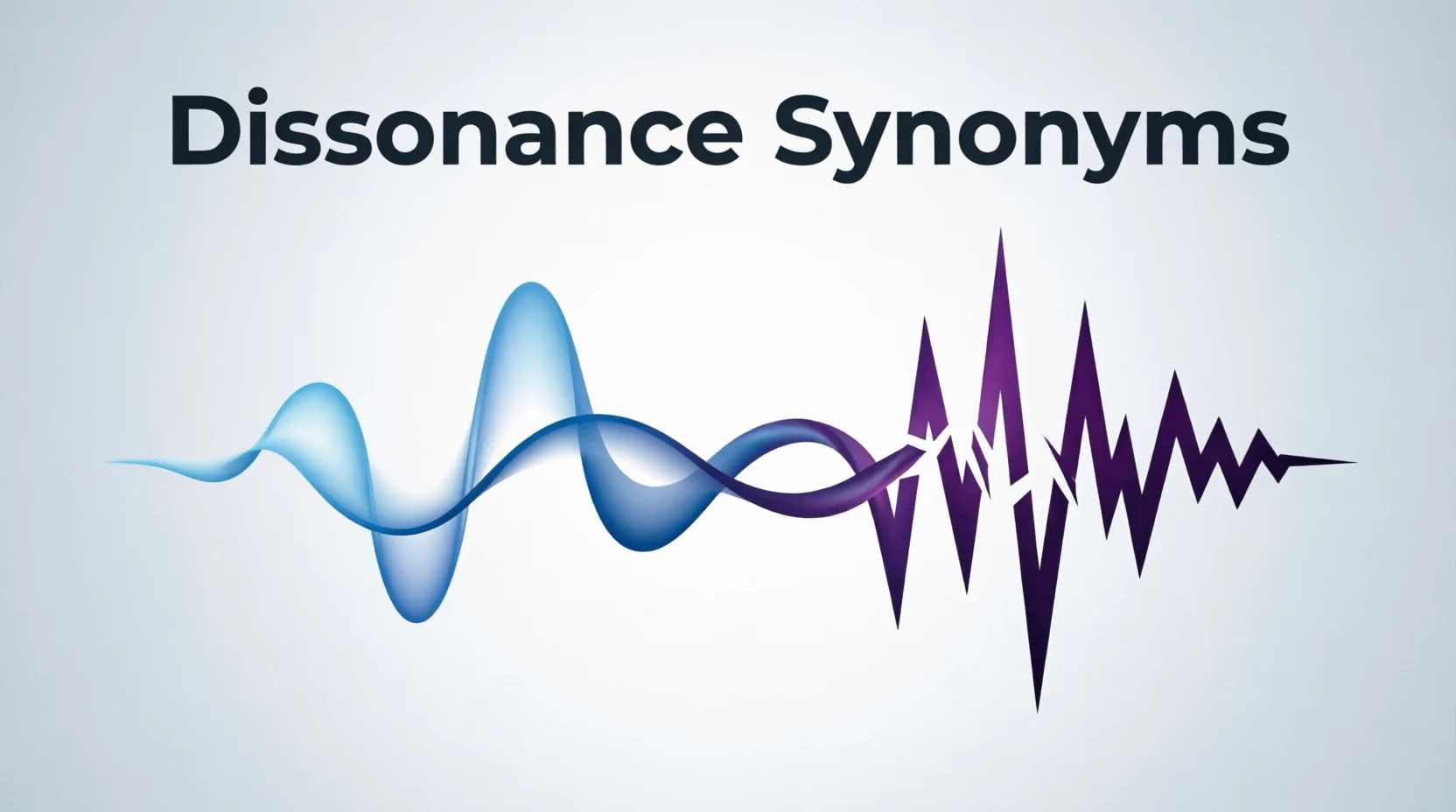
The word dissonance describes a lack of harmony, agreement, or consistency between sounds, ideas, feelings, or opinions. Common dissonance synonyms include discord, disagreement, conflict, disharmony, inconsistency, and tension. The best alternative depends on the situation. For example, discord often describes a lack of harmony, while conflict refers to opposing ideas, interests, or goals.
Understanding dissonance synonyms helps students, ESL learners, writers, and content creators express ideas more clearly. If you are describing unpleasant musical sounds, disagreements between people, or a mismatch between beliefs and actions, choosing the right word makes your writing more precise.
In this guide, you will discover 30 useful synonyms for dissonance, their simple meanings, practical example sentences, and the contexts in which each word works best.
Quick Answer: What Is a Synonym for Dissonance?
The most common synonyms for dissonance are discord, disharmony, disagreement, conflict, inconsistency, friction, clash, contradiction, and tension.
- Discord: A lack of harmony or agreement.
- Disharmony: A state in which things do not fit together pleasantly.
- Disagreement: A difference of opinion.
- Conflict: A serious clash between opposing ideas or interests.
- Inconsistency: A lack of agreement between statements, actions, or facts.
- Clash: A strong difference or opposition.
- Contradiction: A situation in which two statements or ideas oppose each other.
In music, discord and disharmony are useful alternatives. In conversations, disagreement and conflict are often more appropriate. In psychology, inconsistency or tension may better describe a mismatch between beliefs and behavior.
Dissonance Meaning and Usage
Dissonance is a noun that refers to a lack of harmony, agreement, or compatibility. It can describe sounds that seem unpleasant together, opposing opinions, conflicting emotions, or differences between what someone believes and what they do.
Different Types of Dissonance
1. Musical dissonance
In music, dissonance occurs when notes or combinations of notes create a sense of tension or instability.
Example: The composer used dissonance to make the scene feel unsettling.
2. Cognitive dissonance
In psychology, cognitive dissonance describes the mental discomfort a person may experience when their beliefs, values, or actions contradict one another.
Example: He experienced cognitive dissonance after buying an expensive product despite believing in saving money.
3. Social dissonance
Social dissonance occurs when people or groups experience disagreement, tension, or a lack of harmony.
Example: Political dissonance divided the members of the organization.
4. General or conceptual dissonance
This type describes a mismatch between ideas, expectations, statements, or experiences.
Example: There was a clear dissonance between the company’s promises and its actions.
30 Synonyms for Dissonance With Meanings and Examples
The following words are useful alternatives, although they are not interchangeable in every context.
1. Discord
Meaning: A lack of harmony or agreement.
Example: Discord among the team members delayed the project.
Best usage: Describing strained relationships, social disagreements, or unpleasant musical combinations.
2. Disharmony
Meaning: A lack of balance or harmony.
Example: The disharmony between the colors made the design look awkward.
Best usage: Music, relationships, design, and situations that lack balance.
3. Disagreement
Meaning: A difference of opinion between people.
Example: Their disagreement over the budget lasted for hours.
Best usage: Everyday conversations, discussions, meetings, and debates.
4. Conflict
Meaning: A clash between opposing ideas, interests, or goals.
Example: There was a conflict between his personal values and his professional responsibilities.
Best usage: Serious disagreements, competing interests, and internal struggles.
5. Inconsistency
Meaning: A lack of agreement or uniformity between things.
Example: The inconsistency between her words and actions confused everyone.
Best usage: Arguments, facts, behavior, reports, and expectations.
6. Clash
Meaning: A strong disagreement or opposition.
Example: The two managers had a clash over the company’s strategy.
Best usage: Direct disagreements, contrasting styles, and opposing interests.
7. Contradiction
Meaning: A situation in which two statements or ideas cannot both be true in the same sense.
Example: His explanation contained a contradiction.
Best usage: Logic, arguments, statements, and conflicting claims.
8. Tension
Meaning: A feeling of strain, discomfort, or opposition.
Example: Tension grew between the friends after the misunderstanding.
Best usage: Relationships, emotional states, social situations, and music.
9. Friction
Meaning: Disagreement or difficulty between people or groups.
Example: Constant friction between coworkers affected productivity.
Best usage: Workplace relationships, teamwork, and ongoing interpersonal difficulties.
10. Discordance
Meaning: A lack of agreement, consistency, or harmony.
Example: Researchers noticed discordance between the two sets of results.
Best usage: Formal writing, research, technical discussions, and comparisons.
11. Incongruity
Meaning: A lack of fit between things that seem unsuitable together.
Example: The incongruity between his cheerful tone and serious message surprised the audience.
Best usage: Literature, humor, behavior, appearance, and contrasting situations.
12. Disparity
Meaning: A noticeable difference between two things.
Example: The disparity between their expectations and the final results was significant.
Best usage: Comparisons, statistics, opportunities, and differences in outcomes.
13. Opposition
Meaning: Resistance or disagreement against something.
Example: Opposition to the proposal created tension within the committee.
Best usage: Debates, competing viewpoints, political discussions, and conflicting goals.
14. Antagonism
Meaning: Active hostility or opposition.
Example: Antagonism between the rival groups continued for years.
Best usage: Strong interpersonal hostility and prolonged disputes.
15. Divergence
Meaning: A difference or movement away from a common point.
Example: A divergence in their opinions made the decision difficult.
Best usage: Academic writing, ideas, trends, opinions, and interpretations.
16. Incompatibility
Meaning: The inability of two things to work or exist well together.
Example: Their incompatibility became clear when they discussed their future plans.
Best usage: Relationships, systems, beliefs, requirements, and conflicting needs.
17. Misalignment
Meaning: A lack of agreement or proper coordination.
Example: Misalignment between the team’s goals and its actions slowed progress.
Best usage: Business strategy, expectations, objectives, and personal values.
18. Contrariety
Meaning: A state of being opposite or contrary.
Example: The contrariety between the two philosophical positions was obvious.
Best usage: Formal, philosophical, and literary writing.
19. Strife
Meaning: Serious or prolonged disagreement and struggle.
Example: Internal strife weakened the organization.
Best usage: Ongoing disputes, social divisions, and serious conflicts.
20. Turmoil
Meaning: A state of confusion, disorder, or emotional disturbance.
Example: She felt emotional turmoil when her decisions conflicted with her beliefs.
Best usage: Emotional distress, social unrest, and chaotic situations.
21. Unease
Meaning: A feeling of discomfort or uncertainty.
Example: An unexplained unease grew as the conversation continued.
Best usage: Subtle emotional discomfort, uncertainty, and awkward situations.
22. Discrepancy
Meaning: A difference between two things that should match.
Example: The discrepancy between the two reports required further investigation.
Best usage: Data, records, accounts, evidence, and reported information.
23. Anomaly
Meaning: Something that differs from what is normal or expected.
Example: The unusual result appeared to be an anomaly in the experiment.
Best usage: Scientific research, data analysis, patterns, and unexpected results.
24. Contradictoriness
Meaning: The quality of containing opposing or contradictory elements.
Example: The contradictoriness of his statements made his position difficult to understand.
Best usage: Formal analysis of arguments, statements, and ideas.
25. Strain
Meaning: Pressure or difficulty that places stress on a relationship or situation.
Example: The disagreement placed a strain on their friendship.
Best usage: Relationships, emotional pressure, and difficult circumstances.
26. Clashing
Meaning: Being in strong disagreement or opposition.
Example: Their clashing opinions prevented them from reaching a decision.
Best usage: Contrasting opinions, personalities, colors, and styles.
27. Disunity
Meaning: A lack of unity among people or groups.
Example: Disunity among the members weakened the campaign.
Best usage: Teams, communities, organizations, and political groups.
28. Inharmoniousness
Meaning: The quality of lacking harmony or fitting together poorly.
Example: The inharmoniousness of the musical arrangement distracted the listeners.
Best usage: Formal descriptions of sound, arrangement, or elements that do not blend well.
29. Disjunction
Meaning: A separation or lack of connection between things.
Example: The disjunction between the policy and its implementation became apparent.
Best usage: Academic writing, logic, and differences between theory and practice.
30. Dissonance of opinion
Meaning: A difference or lack of agreement between viewpoints.
Example: Dissonance of opinion emerged during the discussion about education reform.
Best usage: Formal discussions, debates, and situations involving different perspectives. This is a descriptive phrase rather than a single-word synonym.
Comparison Table: Which Dissonance Synonym Fits Best?
| Synonym | Main meaning | Best context | Tone |
| Discord | Lack of harmony | Music and relationships | Neutral |
| Disharmony | Lack of balance | Music and general descriptions | Neutral |
| Disagreement | Difference of opinion | Conversations and debates | Neutral |
| Conflict | Opposing interests or ideas | Serious disputes | Strong |
| Inconsistency | Lack of agreement | Facts and behavior | Analytical |
| Clash | Strong opposition | Opinions and personalities | Direct |
| Contradiction | Mutually opposing claims | Logic and arguments | Precise |
| Tension | Strain or discomfort | Emotions and relationships | Neutral |
| Friction | Ongoing interpersonal difficulty | Workplace and relationships | Informal to neutral |
| Discrepancy | A difference between expected matches | Reports and data | Formal |
| Incongruity | Lack of fit | Literature and situations | Analytical |
| Misalignment | Lack of coordination | Goals and strategies | Professional |
How to Choose the Right Synonym for Dissonance
The best synonym depends on what kind of difference or lack of harmony you want to describe.
Choose by Meaning
- For a lack of harmony: Use discord or disharmony.
- For different opinions: Use disagreement or opposition.
- For opposing interests: Use conflict or clash.
- For inconsistent statements: Use contradiction or inconsistency.
- For differences in data: Use discrepancy or discordance.
- For an uncomfortable feeling: Use tension, unease, or turmoil.
- For a mismatch between goals and actions: Use misalignment or incompatibility.
Choose by Tone
Neutral and conversational: Disagreement, tension, clash, friction.
Formal and academic: Discordance, incongruity, discrepancy, divergence, disjunction.
Strong and emotional: Conflict, antagonism, strife, turmoil.
Technical and analytical: Inconsistency, incompatibility, misalignment, anomaly.
Choose by Intent
If you want to describe an argument, choose disagreement or conflict. If you want to explain why two statements do not match, choose contradiction or discrepancy. If you are discussing music, discord and disharmony may work better. When describing the psychological discomfort caused by opposing beliefs and actions, cognitive dissonance is the most precise expression.
Common Mistakes When Using Dissonance Synonyms
1. Treating every synonym as interchangeable
Dissonance, conflict, and discrepancy have related meanings, but they are not identical.
Incorrect: The discrepancy between the two friends caused a heated argument.
Better: The disagreement between the two friends caused a heated argument.
Discrepancy is more appropriate when referring to a difference between facts, figures, or details.
2. Confusing dissonance with disagreement
Disagreement usually refers to differences in opinions. Dissonance can also describe musical tension, emotional discomfort, and inconsistencies between beliefs and actions.
3. Using overly formal words in casual writing
Words such as contrariety and disjunction may sound unnatural in everyday conversation. Choose simpler alternatives when they communicate the idea more clearly.
4. Confusing cognitive dissonance with ordinary confusion
Cognitive dissonance is not simply being confused. It refers to psychological discomfort arising from inconsistent beliefs, values, or behavior.
5. Forgetting the context
Always consider whether you are describing sound, emotion, facts, relationships, or ideas. The context determines which synonym is most accurate.
FAQs:
1. What is the best synonym for dissonance?
Discord is one of the closest general synonyms for dissonance, particularly when describing a lack of harmony. Other good alternatives include disharmony, conflict, disagreement, and inconsistency, depending on context.
2. What is another word for dissonance in music?
Discord and disharmony are common alternatives when describing unpleasant or tense musical combinations. In music theory, however, dissonance has a more specific meaning related to perceived tonal instability.
3. What is a synonym for cognitive dissonance?
Depending on the sentence, alternatives include mental conflict, inner conflict, psychological tension, and internal inconsistency. These phrases describe related ideas, but they do not always replace the established psychological term cognitive dissonance precisely.
4. What is the opposite of dissonance?
Common opposites include harmony, agreement, consonance, unity, and consistency. In music, consonance is a particularly relevant contrast to dissonance.
5. Is discord the same as dissonance?
Not exactly. Both words can describe a lack of harmony, but discord often emphasizes disagreement or unpleasantness, while dissonance can refer to musical relationships or psychological tension caused by conflicting beliefs and actions.
6. What is a formal synonym for dissonance?
Formal alternatives include discordance, incongruity, divergence, discrepancy, and disjunction. The most suitable choice depends on whether you are discussing conflicting ideas, mismatched information, or a lack of harmony.
7. How do you use dissonance in a sentence?
You can use dissonance to describe a mismatch or lack of harmony. For example: “There was a noticeable dissonance between the company’s public promises and its actual behavior.”
Conclusion
Dissonance describes a lack of harmony, agreement, or consistency in music, relationships, emotions, and ideas. Its most useful synonyms include discord, disharmony, disagreement, conflict, inconsistency, contradiction, tension, and friction.
The right word depends on your intended meaning. Use discord for a lack of harmony, disagreement for differing opinions, contradiction for opposing statements, and discrepancy for differences between details or records. For emotional discomfort caused by conflicting beliefs and actions, cognitive dissonance remains the most precise term.
By understanding these distinctions, you can improve your vocabulary, communicate more clearly, and choose more accurate words for academic writing, everyday conversations, and professional communication.