If you have ever wondered if to write panic or panick, you are not alone. These two spellings look almost identical, which makes it easy to choose the wrong one when writing quickly. However, only one is correct in standard English.
The correct spelling is panic. It can be used as a noun or a verb to describe a sudden feeling of fear, anxiety, or loss of control. For example, you might say, “Don’t panic when things go wrong.” The spelling panick is incorrect and should not be used in standard English.
Understanding the difference between panic and panick will help you improve your spelling, write more confidently, and avoid common grammar mistakes. In this guide, you will learn the correct spelling, meaning, pronunciation, grammar rules, and practical examples to help you remember the word.
Quick Answer: Panic or Panick?
Panic is the correct spelling in English. Panick is a common misspelling and is not accepted as a standard English word. Use panic when describing sudden fear or anxiety. Remember that the correct spelling ends with -ic, not -ick.
Why Do People Confuse Panic and Panick?
People often confuse these spellings because English has many words ending in “-ick,” such as:
- Quick
- Trick
- Stick
- Click
- Brick
Since these words are familiar, writers sometimes mistakenly add a k to panic.
However, panic follows a different spelling pattern. Its correct spelling has only one final c, without an additional k.
Another reason for confusion is that the word changes its spelling slightly when certain suffixes are added.
For example:
- Panic (correct)
- Panicked (correct)
- Panicking (correct)
- Panics (correct)
These spelling changes can make the original word confusing for beginners.
1. Panic: Meaning, Definition, and Examples
Panic is the correct English word. It refers to a sudden, overwhelming feeling of fear, worry, or anxiety that can make someone act without thinking clearly.
It can function as both a noun and a verb.
As a noun:
Panic describes a sudden feeling of extreme fear.
Examples:
- There was panic in the crowd.
- She felt panic before her examination.
- The sudden noise caused panic in the room.
As a verb:
Panic means to become suddenly frightened or extremely worried.
Examples:
- Don’t panic during an emergency.
- He began to panic when he lost his phone.
- Try not to panic about the results.
Pronunciation: PAN-ik
Synonyms:
- Fear
- Fright
- Alarm
- Terror
- Anxiety
- Distress
2. Panick: Meaning and Correct Usage
Panick is an incorrect spelling of panic. It is not recognized as a standard English spelling.
People sometimes write panick because they assume the word needs a final K to produce its ending sound. However, this assumption is incorrect.
Incorrect examples:
- Don’t panick about the situation.
- She started to panick.
- He was panicking because he was late.
Correct versions:
- Don’t panic about the situation.
- She started to panic.
- He was panicking because he was late.
Remember: Always use panic, not panick.
Panic vs Panick: Comparison Table
| Feature | Panic | Panick |
| Spelling | Correct | Incorrect |
| Meaning | Sudden fear or anxiety | No standard meaning |
| Grammar | Noun and verb | Not a standard word |
| Pronunciation | PAN-ik | Intended as PAN-ik |
| Dictionary usage | Standard English | Common misspelling |
| Example | Don’t panic! | Don’t panick! |
When Should You Use Panic or Panick?
The choice is simple: use panic in every situation where you mean sudden fear, anxiety, or alarm.
Use panic when:
- Someone feels sudden fear.
- A person becomes extremely worried.
- A crowd reacts with fear.
- Someone loses control in a stressful situation.
- You describe an emergency or frightening event.
Do not use panick in formal writing, school assignments, emails, professional documents, or everyday communication.
10+ Examples of Panic vs Panick in Sentences
Here are practical examples showing the correct spelling and common mistakes.
| Incorrect Sentence | Correct Sentence |
| Don’t panick! | Don’t panic! |
| She began to panick. | She began to panic. |
| He was in a panick. | He was in a panic. |
| They panicked when they heard the news. | They panicked when they heard the news. |
| I don’t want to panick. | I don’t want to panic. |
| Never panick during an emergency. | Never panic during an emergency. |
| The situation caused panick. | The situation caused panic. |
| Why are you panicking? | Why are you panicking? |
| Everyone started to panick. | Everyone started to panic. |
| She panicks too easily. | She panics too easily. |
| There is no reason to panick. | There is no reason to panic. |
| He tried not to panick. | He tried not to panic. |
Notice that panicked, panicking, and panics are also correct spellings.
Common Mistakes to Avoid
Here are some common spelling mistakes related to panic:
- Writing panick instead of panic: The correct spelling never includes a final k.
- Writing panick instead of panicked: The past tense is panicked.
- Writing panicing instead of panicking: When adding -ing, the final c becomes ck.
- Writing panicks instead of panics: The third-person singular form is panics.
- Confusing panic with anxiety: Panic usually describes a sudden, intense reaction, while anxiety can be ongoing worry.
Easy Memory Trick to Remember Panic
Use this simple trick:
Panic ends with C, not CK.
Remember these three forms:
- Panic
- Panicked
- Panicking
Think of the phrase:
“Don’t panic; remember the C!”
This short reminder can help you avoid the common spelling mistake whenever you write this word.
American vs British English: Panic or Panick
There is no spelling difference between American and British English for this word.
Both varieties use:
- Panic
- Panicked
- Panicking
- Panics
Neither American nor British English considers panick the standard spelling.
For example:
- American English: Don’t panic about the test.
- British English: Don’t panic about the test.
The spelling remains exactly the same in both varieties.
Similar Words to Panic
Learning related words can help you understand the meaning of panic more clearly.
| Word | Meaning | Example |
| Fear | Feeling of being afraid | She felt fear in the dark. |
| Anxiety | Feeling of worry or nervousness | He experiences anxiety before exams. |
| Alarm | Sudden fear or concern | The announcement caused alarm. |
| Terror | Extreme fear | The loud explosion filled them with terror. |
| Fright | Sudden feeling of fear | The unexpected noise gave me a fright. |
| Distress | Extreme worry or suffering | She called for help in distress. |
| Nervousness | Feeling uneasy or worried | His nervousness increased before the speech. |
Final Verdict: Panic or Panick?
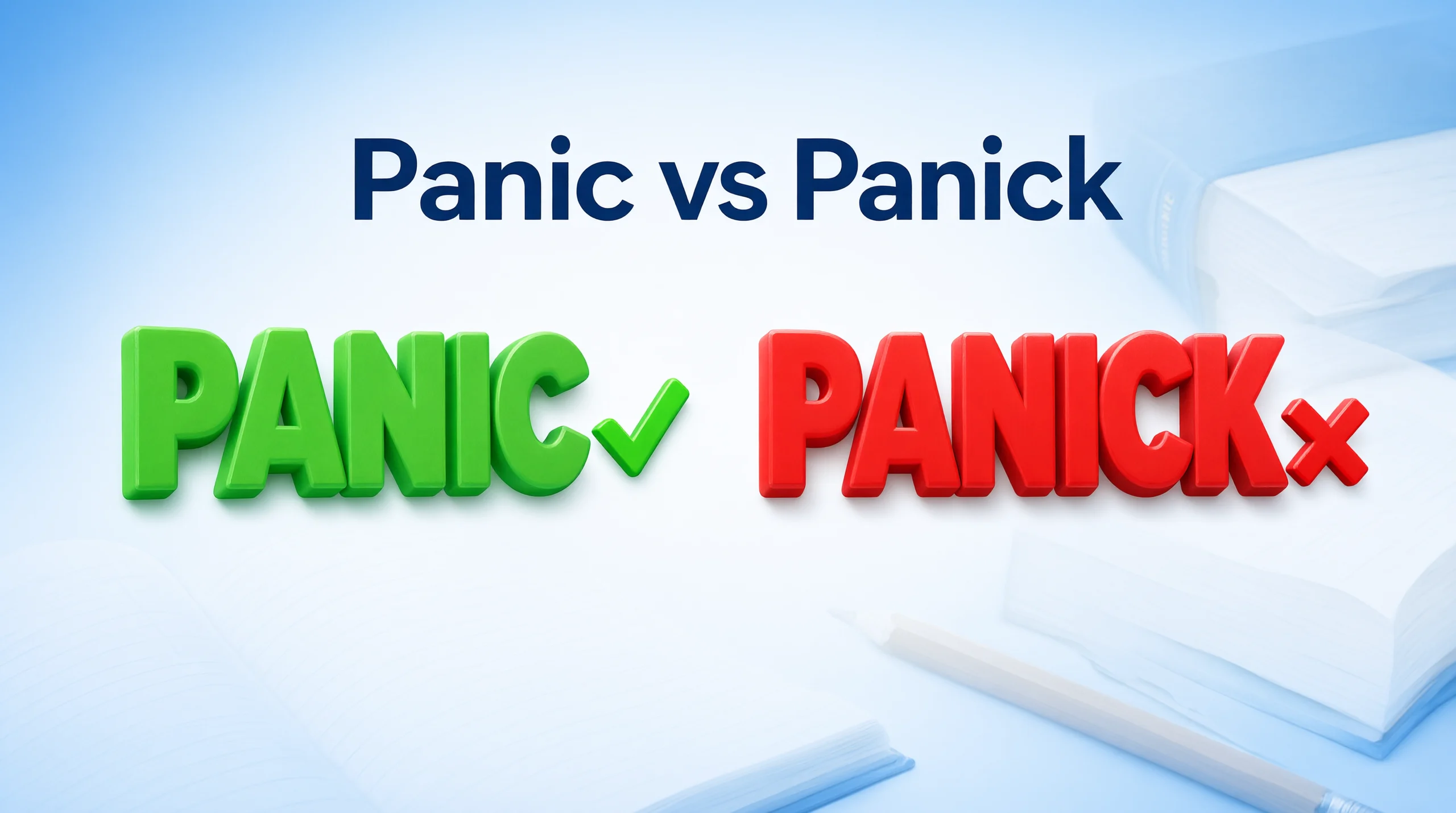
The correct spelling is PANIC.
- Panic = Correct spelling.
- Panick = Incorrect spelling.
Use panic as a noun or verb when describing sudden fear, anxiety, or alarm. When adding suffixes, remember the correct forms: panicked, panicking, and panics.
FAQs:
1. Is it panic or panick?
Panic is the correct spelling. Panick is a common spelling mistake. Always write panic when referring to sudden fear or anxiety.
2. Why is panick spelled incorrectly?
Panick is incorrect because the standard English spelling ends with one c, not ck. People often add k because of confusion with words such as quick and trick.
3. What is the past tense of panic?
The past tense of panic is panicked.
Example: She panicked when she couldn’t find her keys.
4. Is it panicking or panicing?
The correct spelling is panicking. When adding -ing to panic, you add a k after the final c to maintain the hard /k/ sound.
Example: He is panicking about the exam.
5. Is panic a noun or a verb?
Panic can be both a noun and a verb.
As a noun: There was panic in the building.
As a verb: Don’t panic during the interview.
6. Is panick a real English word?
No. Panick is not an accepted standard English spelling. The correct word is panic.
7. Is panic spelled differently in British and American English?
No. Both British and American English use panic, panicked, panicking, and panics. There is no regional spelling difference.
Remember This
PANIC
Correct spelling
PANICK
Incorrect spelling
Always remember: Panic has one final C. Never add an extra K.
Conclusion
Choosing between panic and panick is easy once you understand the correct spelling rule. Panic is the only standard spelling, while panick is a common mistake. You can use panic as a noun or verb to describe sudden fear, worry, or anxiety.
To improve your English spelling, remember the related forms: panic, panicked, panicking, and panics. With regular practice and these simple examples, you can avoid this mistake and use the word confidently in everyday conversations, schoolwork, and professional writing.