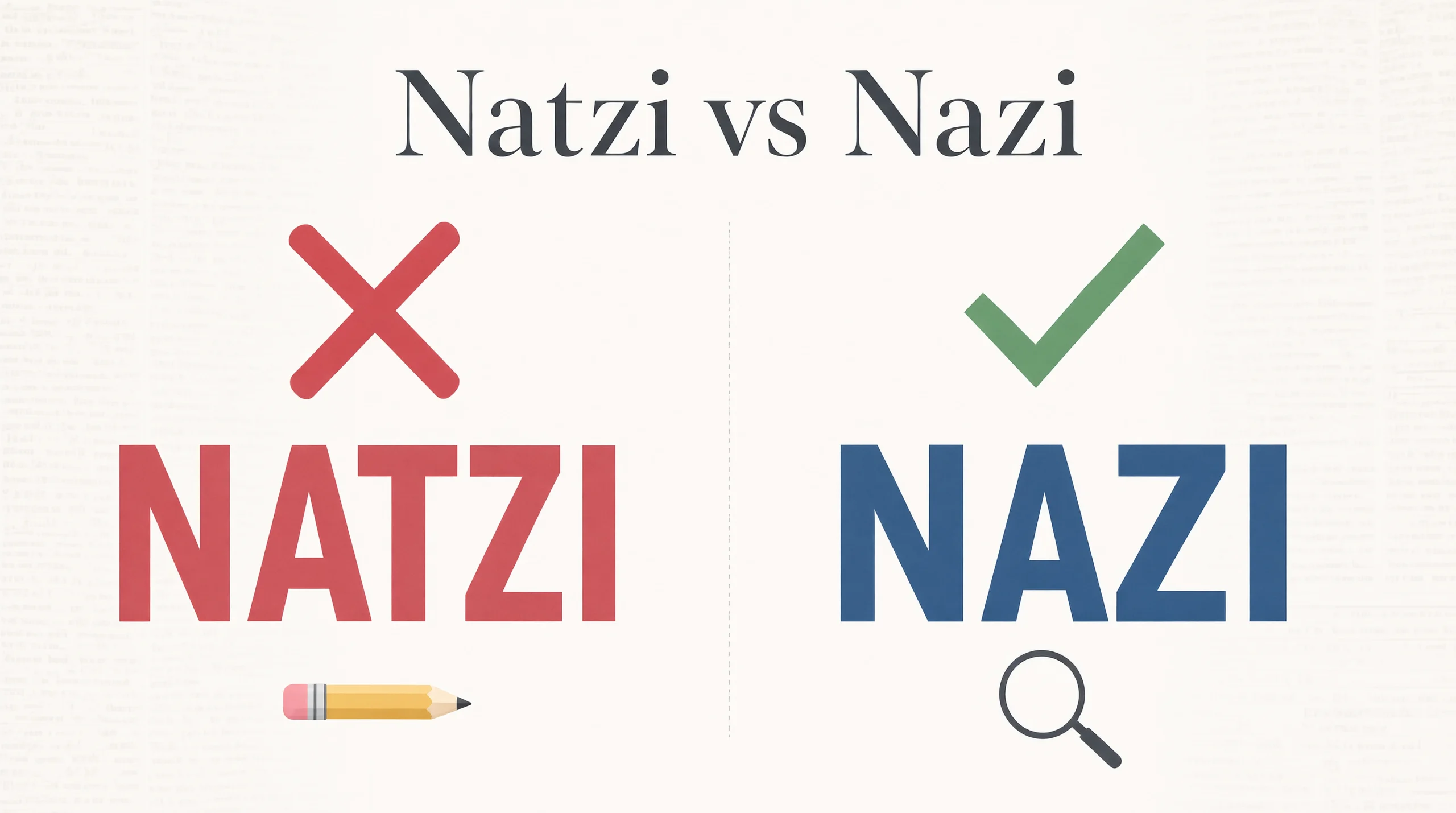
English spelling can sometimes be confusing, especially when two words look almost identical. Natzi vs Nazi is one such spelling question. Although the two forms look similar, they are not equally correct. If you are wondering whether to write Natzi or Nazi, the correct standard spelling is Nazi.
The word Nazi refers to a member or supporter of the National Socialist German Workers’ Party, which was led by Adolf Hitler in Germany. It is also used to describe things connected with Nazi Germany, its ideology, and its historical period.
The spelling Natzi is generally a misspelling of Nazi, not an accepted alternative. Understanding this difference is important for students, writers, and anyone discussing World War II or German history. In this guide, you will learn the correct spelling, meaning, pronunciation, examples, and common mistakes so you can use the word accurately.
Quick Answer
Nazi is the correct spelling, while Natzi is generally incorrect. Nazi refers to a member or supporter of the National Socialist movement in Germany under Adolf Hitler. The word is pronounced approximately NAHT-see. Use Nazi when writing about Nazi Germany, Nazi ideology, or the historical Nazi Party.
Why Do People Confuse Natzi and Nazi?
People often confuse these spellings because they sound similar when spoken aloud.
There are several reasons for this mistake:
- Similar pronunciation: Both spellings may be pronounced similarly by people unfamiliar with the word.
- Unfamiliar spelling: The spelling Nazi may seem unusual to English learners.
- Sound-based spelling: Some people add a “t” because they associate the sound with the spelling Natzi.
- Typing mistakes: Fast typing can lead to accidental spelling errors.
However, only Nazi is the established standard English spelling.
First Word: Natzi
Natzi is generally an incorrect spelling of Nazi.
It is not the standard English spelling used in historical writing, dictionaries, or academic discussions about the Nazi Party.
Meaning of Natzi
When someone writes Natzi, they usually intend to write Nazi. The extra letter “t” makes the spelling incorrect in this context.
Examples of Incorrect Usage
- Incorrect: Hitler was the leader of the Natzi Party.
- Incorrect: Germany was ruled by the Natzi regime.
- Incorrect: The Natzi movement began in Germany.
In all these sentences, Natzi should be replaced with Nazi.
Second Word: Nazi
Nazi is the correct and recognized spelling.
Meaning of Nazi
A Nazi was a member or supporter of the National Socialist German Workers’ Party (NSDAP), which Adolf Hitler led. The party came to power in Germany in 1933 and established a totalitarian dictatorship.
The Nazi regime promoted racist and antisemitic ideology, pursued aggressive expansion, and was responsible for the Holocaust and other mass atrocities.
Pronunciation of Nazi
- Word: Nazi
- Pronunciation: NAHT-see
- Phonetic spelling: /ˈnɑːtsi/
Examples of Correct Usage
- Nazi Germany started World War II in Europe.
- Historians study Nazi ideology.
- The Nazi regime committed terrible crimes.
- Many books discuss the history of the Nazi Party.
Natzi vs Nazi: Comparison Table
| Feature | Natzi | Nazi |
| Spelling | Incorrect | Correct |
| Meaning | Usually intended as Nazi | Historical political term |
| Standard English | No | Yes |
| Dictionary usage | Not the standard form | Recognized word |
| Pronunciation | Intended as Nazi | NAHT-see |
| Usage | Spelling mistake | Historical and political writing |
| Correct choice | No | Yes |
When to Use Each
When Should You Use Natzi?
In ordinary English writing, you should not use Natzi when referring to the Nazi Party or its members.
It is generally a spelling error that needs correction.
When Should You Use Nazi?
Use Nazi when discussing:
- The historical Nazi Party in Germany.
- Adolf Hitler and his government.
- Nazi Germany during World War II.
- Nazi ideology and political beliefs.
- The Holocaust and Nazi persecution.
- Historical events involving the Nazi regime.
Always use the correct spelling when writing educational, historical, or academic content.
12 Examples of Nazi in Sentences
Here are 12 examples showing how to use the correct spelling naturally.
- Nazi Germany: Nazi Germany invaded Poland in September 1939.
- Nazi Party: The Nazi Party gained power in Germany in 1933.
- Nazi regime: The Nazi regime ruled Germany through dictatorship and terror.
- Nazi ideology: Nazi ideology promoted racism and antisemitism.
- Nazi leaders: Nazi leaders were responsible for numerous war crimes.
- Nazi history: Students learn about Nazi history in school.
- Nazi propaganda: Nazi propaganda was used to spread hateful political messages.
- Nazi occupation: Several European countries experienced Nazi occupation during World War II.
- Nazi symbols: Many countries restrict the public display of Nazi symbols.
- Nazi policies: Nazi policies led to persecution and mass murder.
- Nazi concentration camps: Nazi concentration camps were sites of imprisonment, forced labor, and mass atrocities.
- Nazi dictatorship: The Nazi dictatorship ended with Germany’s defeat in 1945.
Common Mistakes
Writers and English learners sometimes make these mistakes when using the word.
- Writing Natzi instead of Nazi: The extra “t” is unnecessary.
- Using the wrong capitalization: Write Nazi with a capital N.
- Confusing Nazi with German: Not every German was a Nazi.
- Ignoring historical context: The word specifically relates to the Nazi movement and its historical associations.
- Using the term carelessly: Because of its serious historical meaning, it should be used accurately and responsibly.
Memory Trick: How to Remember Nazi
A simple way to remember the correct spelling is:
Nazi = N + A + Z + I
Remember that there is no letter “T” between the “A” and “Z.”
You can also remember this example:
- Correct: Nazi Germany
- Incorrect: Natzi Germany
Whenever you write about Hitler’s political movement, remember the four-letter spelling: Nazi.
American vs British English
There is no spelling difference between American and British English for this word.
| Feature | American English | British English |
| Correct spelling | Nazi | Nazi |
| Pronunciation | NAHT-see | NAHT-see |
| Capitalization | Capital N | Capital N |
| Alternative spelling | Natzi is incorrect | Natzi is incorrect |
Both varieties of English use Nazi as the standard spelling.
Similar Words
Understanding related historical and political terms can help you use the word more accurately.
| Word | Meaning |
| Nazism | The political ideology of the Nazi movement |
| Nazi Party | The National Socialist German Workers’ Party |
| Fascism | An authoritarian political ideology |
| Antisemitism | Prejudice, hostility, or discrimination against Jewish people |
| Holocaust | The genocide of six million European Jews by Nazi Germany and its collaborators |
| Dictatorship | A system of government controlled by a dictator |
| Totalitarianism | A system in which the state seeks extensive control over public and private life |
| National Socialism | The political ideology associated with the Nazi Party |
Final Verdict: Natzi or Nazi?
The correct spelling is Nazi, not Natzi.
- Natzi: Generally an incorrect spelling.
- Nazi: The correct standard English spelling.
Use Nazi when discussing Hitler, Nazi Germany, the Nazi Party, or related historical events. Remember that the correct spelling contains four letters and does not include a “t.”
FAQs:
1. Is Natzi or Nazi correct?
Nazi is correct. Natzi is generally a misspelling and should not be used in standard English writing.
2. What does the word Nazi mean?
Nazi refers to a member or supporter of the National Socialist German Workers’ Party, which Adolf Hitler led in Germany.
3. Why do people spell Nazi as Natzi?
People sometimes add an extra “t” because they are unfamiliar with the correct spelling or try to spell the word according to how they hear it.
4. How do you pronounce Nazi?
Nazi is commonly pronounced NAHT-see. Its phonetic pronunciation is /ˈnɑːtsi/.
5. Should Nazi always be capitalized?
Yes. When referring to the historical political movement or its members, write Nazi with a capital N.
6. Is Nazi the same as Nazism?
No. Nazi refers to a member or supporter of the Nazi movement, while Nazism refers to the ideology associated with that movement.
7. Is Natzi an alternative spelling of Nazi?
No. Natzi is not an accepted standard alternative spelling. Use Nazi in formal, academic, and everyday writing.
Remember This
NAZI ✓
Correct spelling: Nazi
NATZI ✗
Incorrect spelling: Natzi
Quick rule: Write Nazi without the extra letter T.
Conclusion
Understanding the difference between Natzi and Nazi is simple once you learn the correct spelling. Nazi is the accepted English word, while Natzi is generally a spelling mistake. The word is historically associated with Adolf Hitler, the Nazi Party, and the events of World War II.
If you are writing a school assignment, preparing an article, or learning English vocabulary, always use the correct four-letter spelling. Remember that Nazi begins with N and contains no extra T. Using accurate spelling helps make your writing clearer and your historical information more reliable.