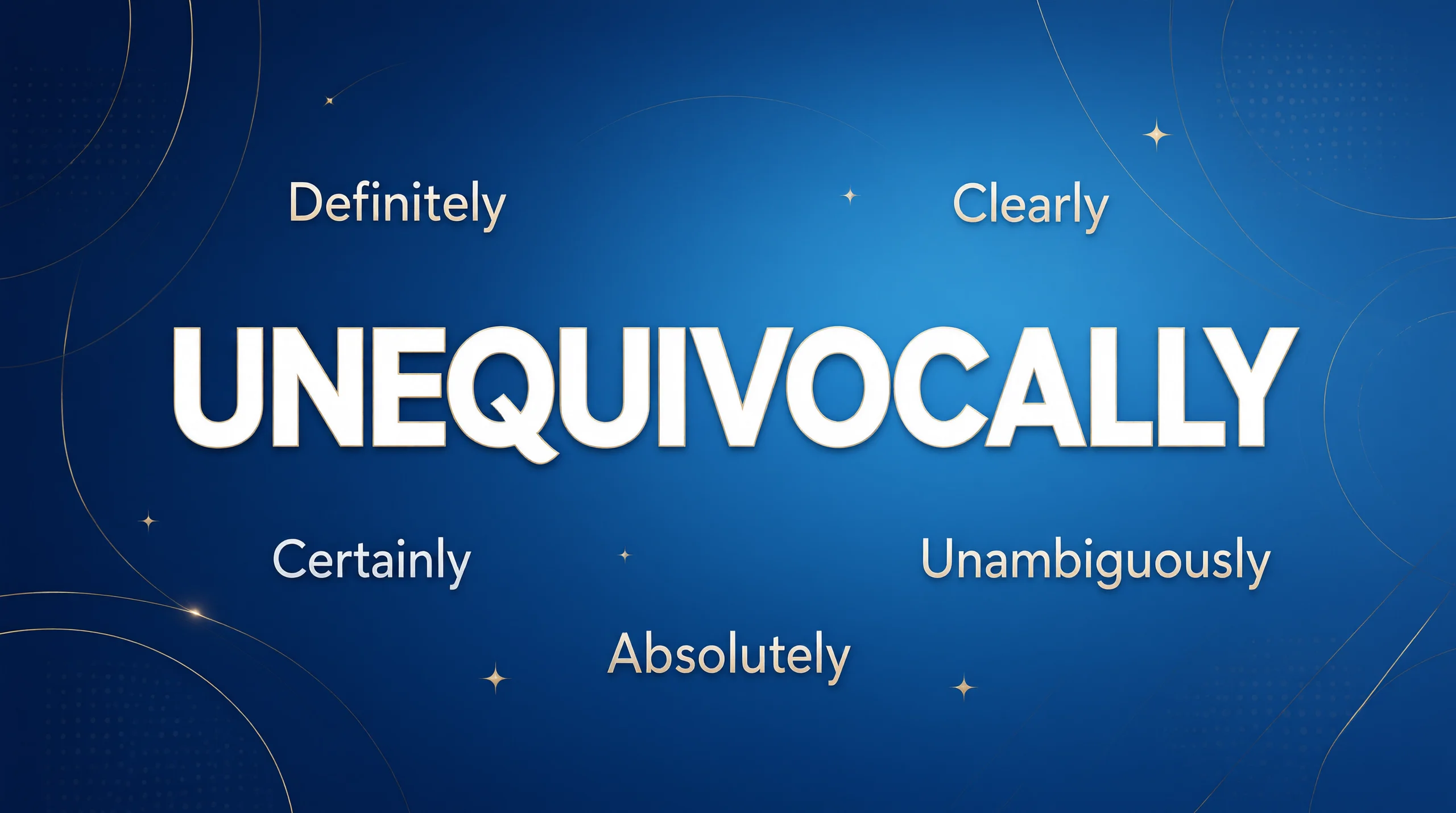
The synonyms of unequivocally include clearly, definitely, categorically, explicitly, unambiguously, indisputably, and undoubtedly. These words express certainty, clarity, or a firm position without confusion or doubt. The best alternative depends on the context, tone, and strength of the statement. Students, ESL learners, writers, and professionals can use these alternatives to communicate ideas more precisely and naturally.
Quick Answer: What Are the Best Synonyms of Unequivocally?
The most useful synonyms of unequivocally are:
- Clearly
- Definitely
- Categorically
- Unambiguously
- Explicitly
- Undoubtedly
- Indisputably
- Unquestionably
- Certainly
- Positively
Example: She unequivocally rejected the proposal.
Alternative: She categorically rejected the proposal.
Both sentences communicate a firm rejection without leaving room for misunderstanding.
Meaning and Usage of Unequivocally
Unequivocally is an adverb that means expressing something in a way that is completely clear, definite, and open to no reasonable misunderstanding. It describes statements, decisions, answers, or actions that leave little or no room for doubt or ambiguity.
The word is often used in formal writing, professional communication, debates, academic discussions, and situations where precision matters.
Examples:
- The manager unequivocally approved the new policy.
- She stated unequivocally that she would not participate.
- The evidence unequivocally supports the conclusion.
In each example, the word emphasizes certainty and clarity.
30 Synonyms of Unequivocally With Meanings and Examples
1. Clearly
Simple meaning: In a way that is easy to understand.
Example: The teacher clearly explained the assignment.
Best usage/context: Everyday conversations, instructions, and explanations where the main goal is understanding.
2. Definitely
Simple meaning: Without uncertainty; certainly.
Example: She definitely wants to join the team.
Best usage/context: Casual conversations and confident statements about decisions, plans, or facts.
3. Categorically
Simple meaning: In an absolute and firm manner.
Example: The spokesperson categorically denied the allegations.
Best usage/context: Formal statements, official denials, and situations requiring a strong, decisive position.
4. Unambiguously
Simple meaning: In a way that has only one clear meaning.
Example: The contract unambiguously defines each party’s responsibilities.
Best usage/context: Legal documents, technical writing, instructions, and situations where multiple interpretations must be avoided.
5. Explicitly
Simple meaning: In a direct and clearly stated way.
Example: The director explicitly prohibited unauthorized access.
Best usage/context: Rules, policies, agreements, and instructions that must be stated directly.
6. Undoubtedly
Simple meaning: Without reasonable doubt.
Example: She is undoubtedly a talented musician.
Best usage/context: Expressing strong confidence in someone’s ability, a conclusion, or an established fact.
7. Indisputably
Simple meaning: In a way that cannot reasonably be disputed.
Example: The discovery was indisputably important.
Best usage/context: Academic writing, factual arguments, and discussions supported by compelling evidence.
8. Unquestionably
Simple meaning: Without question or serious doubt.
Example: He is unquestionably qualified for the position.
Best usage/context: Formal evaluations, confident judgments, and statements emphasizing strong agreement.
9. Certainly
Simple meaning: Without doubt; surely.
Example: We can certainly discuss your proposal tomorrow.
Best usage/context: Professional conversations, polite responses, and expressions of confidence or agreement.
10. Positively
Simple meaning: In a definite or certain manner.
Example: She positively identified the missing document.
Best usage/context: Confirmations and identification. In this sense, the word emphasizes certainty rather than a favorable attitude.
11. Decisively
Simple meaning: In a firm way that settles an issue.
Example: The committee acted decisively after reviewing the evidence.
Best usage/context: Decisions, leadership, and actions that resolve uncertainty or disagreement.
12. Firmly
Simple meaning: In a strong, steady, and determined manner.
Example: He firmly stated his opposition to the plan.
Best usage/context: Expressing boundaries, convictions, objections, and personal positions.
13. Unequivocally Clearly
Simple meaning: This is not a standard synonym phrase; clearly or unambiguously is the natural alternative.
Example: The witness clearly explained what happened.
Best usage/context: Use clearly when you want a natural, concise expression instead of the more formal unequivocally.
14. Absolutely
Simple meaning: Completely or without reservation.
Example: I absolutely agree with your decision.
Best usage/context: Emphatic agreement, strong opinions, and informal or conversational communication.
15. Unmistakably
Simple meaning: In a way that cannot be mistaken.
Example: Her voice was unmistakably confident.
Best usage/context: Describing recognizable signs, obvious qualities, and messages that are difficult to misinterpret.
16. Incontrovertibly
Simple meaning: In a way that cannot reasonably be contradicted.
Example: The records incontrovertibly established the timeline.
Best usage/context: Formal, academic, or legal discussions involving strong and verifiable evidence.
17. Irrefutably
Simple meaning: In a way that cannot be disproved.
Example: The experiment did not irrefutably prove the theory.
Best usage/context: Scientific arguments, evidence-based discussions, and claims about whether something can be disproved.
18. Definitively
Simple meaning: In a final, conclusive, or decisive way.
Example: The investigation definitively established the cause of the failure.
Best usage/context: Final decisions, confirmed results, and conclusions that settle a question.
19. Conclusively
Simple meaning: In a way that settles a question or argument.
Example: The test conclusively demonstrated that the device was faulty.
Best usage/context: Research findings, investigations, and arguments supported by decisive evidence.
20. Unequivocally Without Doubt
Simple meaning: This is not a natural standard phrase; without doubt is the appropriate alternative.
Example: Without doubt, she made a significant contribution.
Best usage/context: Emphasizing confidence in a statement. Use the phrase sparingly to avoid unnecessary repetition.
21. Unreservedly
Simple meaning: Without hesitation, restriction, or reservation.
Example: The organization unreservedly apologized for the mistake.
Best usage/context: Apologies, praise, support, and expressions of wholehearted agreement or acceptance.
22. Emphatically
Simple meaning: With strong emphasis or force.
Example: She emphatically rejected the accusation.
Best usage/context: Strong objections, passionate statements, and situations where the speaker wants to stress a point.
23. Plainly
Simple meaning: In a simple, direct, and understandable way.
Example: The report plainly explains the problem.
Best usage/context: Straightforward explanations, everyday language, and writing that avoids unnecessary complexity.
24. Directly
Simple meaning: In a straightforward manner without avoiding the point.
Example: He directly addressed the concerns raised by employees.
Best usage/context: Meetings, conversations, feedback, and responses to specific questions.
25. Transparently
Simple meaning: In an open and honest way.
Example: The company transparently explained its pricing policy.
Best usage/context: Business communication, public reporting, and situations where openness matters. It emphasizes transparency more than absolute certainty.
26. Assertively
Simple meaning: In a confident and self-assured manner.
Example: She assertively defended her position during the meeting.
Best usage/context: Leadership, workplace communication, and expressing opinions confidently without being passive.
27. Unequivocally Without Ambiguity
Simple meaning: This phrase is understandable, but unambiguously is usually more concise and natural.
Example: The instructions unambiguously describe the required steps.
Best usage/context: Technical instructions, contracts, and explanations where precision is important.
28. Beyond Doubt
Simple meaning: So certain that there is no reasonable doubt.
Example: The documents established his ownership beyond doubt.
Best usage/context: Formal arguments, evidence-based conclusions, and statements emphasizing certainty.
29. Beyond Question
Simple meaning: Clearly established or not reasonably open to challenge.
Example: Her dedication to the project is beyond question.
Best usage/context: Formal writing and confident statements about established qualities, facts, or achievements.
30. Without Reservation
Simple meaning: Completely, with no conditions or hesitation.
Example: The board approved the recommendation without reservation.
Best usage/context: Formal approvals, wholehearted support, agreements, and commitments.
Comparison Table: Which Synonym of Unequivocally Fits Best?
| Synonym | Main emphasis | Best context |
| Clearly | Easy understanding | Everyday explanations |
| Definitely | Certainty | Conversations |
| Categorically | Firm rejection or assertion | Formal statements |
| Unambiguously | One clear meaning | Contracts and instructions |
| Explicitly | Direct expression | Rules and policies |
| Undoubtedly | Strong confidence | Opinions and evaluations |
| Indisputably | Resistance to dispute | Evidence-based arguments |
| Unquestionably | Strong certainty | Professional judgments |
| Decisively | Settling an issue | Decisions and leadership |
| Emphatically | Strong emphasis | Objections and arguments |
| Conclusively | Settling a question | Research and investigations |
| Unreservedly | Complete commitment | Apologies and support |
| Unmistakably | Impossible to mistake | Descriptions and recognition |
| Transparently | Openness | Business communication |
| Assertively | Confident expression | Workplace discussions |
How to Choose the Right Synonym of Unequivocally
The best synonym depends on what you want to communicate. Some alternatives emphasize certainty, while others highlight directness, firmness, or strong evidence.
Choose Based on Tone
For everyday English: Use clearly, definitely, certainly, or absolutely.
Example: I definitely support your decision.
For formal and professional writing: Use categorically, explicitly, unambiguously, or conclusively.
Example: The policy explicitly prohibits sharing confidential information.
For academic writing: Use indisputably, incontrovertibly, or irrefutably when the evidence justifies such a strong claim.
Example: The findings conclusively support the researchers’ conclusion.
For assertive communication: Use firmly, emphatically, or decisively.
Example: She firmly explained why the deadline could not be changed.
Choose Based on Meaning
- To remove confusion: Clearly, plainly, unambiguously.
- To express certainty: Definitely, certainly, undoubtedly.
- To make a firm denial: Categorically, emphatically, firmly.
- To emphasize strong evidence: Indisputably, incontrovertibly, irrefutably.
- To express complete support: Unreservedly, without reservation.
- To communicate a final result: Definitively, conclusively.
Choose Based on Intent
Consider the purpose of your sentence before selecting a synonym.
If you want to explain something, choose clearly. If you want to deny a claim firmly, choose categorically. If you want to show that evidence settles a question, choose conclusively. If you want to express wholehearted support, choose unreservedly.
The most effective alternative communicates your intended meaning without making the sentence sound unnatural or overly formal.
Common Mistakes When Using Synonyms of Unequivocally
1. Treating Every Synonym as Identical
Not every alternative has exactly the same meaning. Clearly emphasizes understanding, while definitely emphasizes certainty. Emphatically highlights forceful expression.
Better approach: Match the synonym to the specific message you want to convey.
2. Using Overly Formal Words in Casual Conversations
Words such as incontrovertibly and irrefutably can sound unnecessarily complicated in everyday speech.
Instead of saying, “I incontrovertibly agree,” say, “I definitely agree.”
3. Confusing Confidence With Evidence
Words such as indisputably and irrefutably make strong claims. They should be used when the available evidence supports that level of certainty.
Better approach: Use apparently, likely, or seemingly when the conclusion remains uncertain.
4. Using Redundant Expressions
Phrases such as “absolutely certain without any doubt whatsoever” may repeat the same idea unnecessarily.
Better approach: Choose one strong expression, such as “absolutely certain” or “beyond doubt.”
5. Ignoring Grammar and Sentence Structure
Unequivocally is an adverb, so it often modifies a verb or an entire statement.
Correct: The director unequivocally rejected the proposal.
Incorrect: The director gave an unequivocally rejection.
Better: The director gave an unequivocal rejection.
Remember that unequivocal is the adjective, while unequivocally is the adverb.
FAQs:
1. What is the closest synonym of unequivocally?
Unambiguously is one of the closest synonyms because both words convey a meaning that leaves little or no room for misunderstanding. Categorically is especially suitable when expressing a firm denial or position.
2. What is a simple word for unequivocally?
Clearly or definitely is usually the simplest alternative. Use clearly when the focus is understanding and definitely when the focus is certainty.
3. What does unequivocally mean in simple English?
It means saying or doing something in a way that is completely clear and leaves no reasonable doubt about the intended meaning.
4. Is categorically the same as unequivocally?
They are similar but not identical. Categorically emphasizes a firm, absolute statement, often a denial. Unequivocally emphasizes the absence of ambiguity or uncertainty.
5. What is the opposite of unequivocally?
Common antonyms include ambiguously, vaguely, uncertainly, hesitantly, and equivocally. These words suggest that a statement is unclear, uncertain, or open to multiple interpretations.
6. Can unequivocally be used in academic writing?
Yes. It can be used in academic writing when a claim is genuinely clear and strongly supported. However, researchers should avoid overstating conclusions when evidence is limited or inconclusive.
7. What is a professional alternative to unequivocally?
Depending on the sentence, explicitly, categorically, unambiguously, or conclusively may work well. Choose explicitly for direct statements and conclusively for results that settle a question.
Conclusion
The 30 synonyms of unequivocally provide useful alternatives for expressing certainty, clarity, firmness, and confidence. Words such as clearly and definitely work well in everyday communication, while categorically and unambiguously suit formal statements. Alternatives such as indisputably and conclusively are particularly useful when discussing evidence and results.
Choosing the right word depends on your intended meaning, audience, and tone. By understanding these differences and practicing them in sentences, you can communicate more accurately, strengthen your vocabulary, and make your writing clearer and more effective.