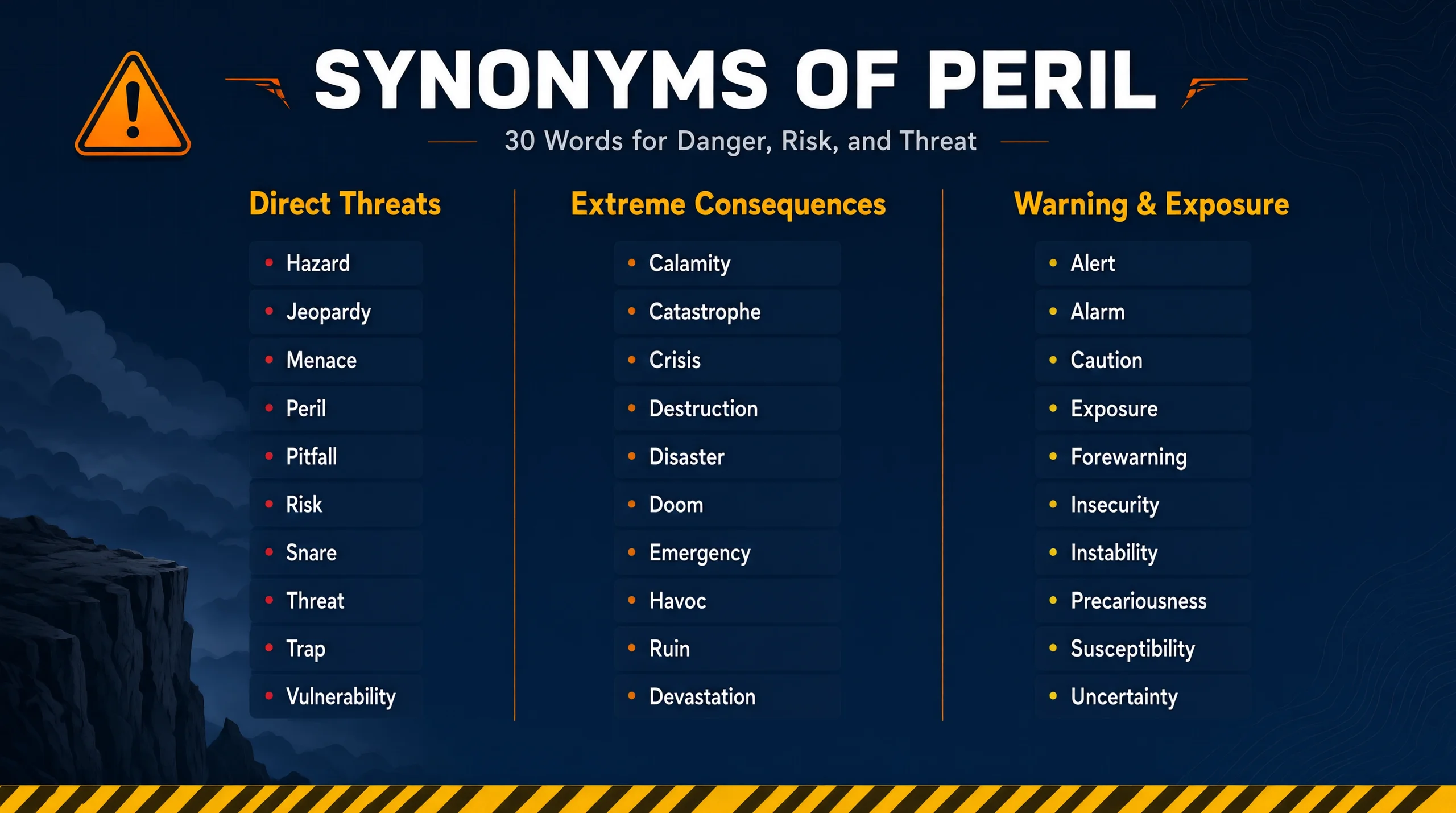
The best synonyms of peril include danger, risk, hazard, threat, jeopardy, and endangerment. These words describe situations in which someone or something may face harm, injury, loss, or serious trouble. However, each word has a slightly different meaning. Understanding these differences helps you choose the right word for academic writing, everyday conversations, storytelling, and professional communication.
Quick Answer: What Are the Synonyms of Peril?
The most common synonyms of peril are:
- Danger
- Risk
- Hazard
- Threat
- Jeopardy
- Menace
- Trouble
- Emergency
- Insecurity
- Vulnerability
- Exposure
- Crisis
- Unsafe condition
- Adversity
- Misfortune
Best overall synonym: Danger is the simplest and most widely understood alternative to peril. Use hazard for a potential source of harm, risk for the possibility of a negative outcome, and jeopardy when something valuable is threatened.
Meaning of Peril
Peril is a noun that means serious danger or a situation in which someone or something faces possible harm.
Peril often suggests a dangerous, threatening, or life-threatening situation. It is more formal and dramatic than the everyday word danger.
Examples:
- The climbers were in peril during the severe storm.
- The ancient building is in peril because of structural damage.
- The rescue team acted quickly to save the passengers from peril.
How Is Peril Used in a Sentence?
Peril is commonly used in expressions such as in peril, at peril, and perilous situation.
For example, “The sailors were in peril after their boat lost power” means the sailors were in serious danger.
The word can describe physical threats, financial difficulties, environmental problems, and situations that put someone’s future or success at risk.
30 Synonyms of Peril With Meanings and Examples
1. Danger
Simple meaning: The possibility of harm or injury.
Example: The hikers were in danger when the weather suddenly changed.
Best usage/context: Use danger in everyday conversation, general writing, and situations involving physical or emotional harm.
2. Risk
Simple meaning: The possibility that something bad may happen.
Example: Driving too fast increases the risk of an accident.
Best usage/context: Use risk when discussing uncertainty, potential losses, health concerns, or possible negative outcomes.
3. Hazard
Simple meaning: Something that can cause harm or damage.
Example: Wet floors are a serious hazard in busy workplaces.
Best usage/context: Use hazard in safety instructions, workplace policies, environmental discussions, and technical writing.
4. Threat
Simple meaning: Something or someone that may cause harm.
Example: Rising sea levels pose a threat to coastal communities.
Best usage/context: Use threat when emphasizing a source of possible harm, danger, or damage.
5. Jeopardy
Simple meaning: A situation in which something important is at risk.
Example: His careless decisions put his career in jeopardy.
Best usage/context: Use jeopardy in formal writing when discussing endangered careers, reputations, rights, or opportunities.
6. Menace
Simple meaning: A person, thing, or situation that threatens others.
Example: The spreading wildfire became a menace to nearby villages.
Best usage/context: Use menace when emphasizing a threatening or harmful force.
7. Perilousness
Simple meaning: The quality of being extremely dangerous.
Example: The perilousness of the mountain route became clear after the snowfall.
Best usage/context: Use this relatively uncommon noun in formal descriptions or discussions of dangerous conditions. In most everyday situations, danger is more natural.
8. Insecurity
Simple meaning: A lack of safety, protection, or stability.
Example: Political insecurity forced many families to leave their homes.
Best usage/context: Use insecurity for situations involving unstable conditions, personal safety concerns, or uncertainty about protection.
9. Vulnerability
Simple meaning: The condition of being open to harm or attack.
Example: The storm exposed the vulnerability of the small coastal town.
Best usage/context: Use vulnerability when discussing weaknesses, exposure to threats, or a lack of protection.
10. Exposure
Simple meaning: The state of being subjected to something harmful.
Example: Prolonged exposure to extreme cold can damage the body.
Best usage/context: Use exposure in health, environmental, workplace, and security contexts.
11. Trouble
Simple meaning: A difficult or dangerous situation.
Example: The stranded travelers were in serious trouble after sunset.
Best usage/context: Use trouble in informal conversations and general writing about difficulties or problems.
12. Crisis
Simple meaning: A serious situation requiring immediate attention.
Example: The medical team worked quickly during the crisis.
Best usage/context: Use crisis when danger develops into an urgent situation that requires action.
13. Emergency
Simple meaning: An unexpected serious situation requiring immediate action.
Example: The lifeguard responded immediately to the emergency.
Best usage/context: Use emergency when quick action is necessary to protect people or prevent serious damage.
14. Predicament
Simple meaning: A difficult situation that is hard to escape.
Example: The explorers faced a predicament when their supplies ran out.
Best usage/context: Use predicament when someone is trapped in a difficult situation, particularly when available solutions are limited.
15. Plight
Simple meaning: A difficult or unfortunate situation.
Example: The documentary highlighted the plight of families displaced by flooding.
Best usage/context: Use plight when emphasizing hardship, suffering, or the unfortunate circumstances of people or groups.
16. Adversity
Simple meaning: Serious difficulty or hardship.
Example: The community remained united despite adversity.
Best usage/context: Use adversity when describing difficult circumstances, obstacles, or challenges rather than immediate physical danger.
17. Misfortune
Simple meaning: Bad luck or an unfortunate event.
Example: Their misfortune began when the storm destroyed their crops.
Best usage/context: Use misfortune when the emphasis is on unfortunate events or bad outcomes, not necessarily an ongoing threat.
18. Hardship
Simple meaning: A condition involving suffering or difficulty.
Example: The families experienced hardship during the long drought.
Best usage/context: Use hardship for financial struggles, difficult living conditions, and prolonged challenges.
19. Distress
Simple meaning: Serious worry, suffering, or difficulty.
Example: The passengers sent a distress signal when their ship began taking on water.
Best usage/context: Use distress when describing suffering, anxiety, or an urgent need for assistance.
20. Calamity
Simple meaning: A disastrous event that causes great harm.
Example: The earthquake was a calamity for the entire region.
Best usage/context: Use calamity for major disasters, devastating events, or severe misfortunes.
21. Catastrophe
Simple meaning: An extremely serious disaster.
Example: Without the evacuation, the flood could have become a catastrophe.
Best usage/context: Use catastrophe when describing events with exceptionally destructive or far-reaching consequences.
22. Disaster
Simple meaning: An event that causes serious damage, loss, or suffering.
Example: The chemical leak became a disaster for the surrounding environment.
Best usage/context: Use disaster for natural events, accidents, organizational failures, and other destructive outcomes.
23. Threatening situation
Simple meaning: A situation that suggests possible harm.
Example: The driver left immediately after noticing the threatening situation.
Best usage/context: Use this phrase when the circumstances themselves indicate possible danger.
24. Unsafety
Simple meaning: The condition of not being safe.
Example: The inspection revealed the unsafety of the damaged equipment.
Best usage/context: This word is uncommon and often sounds unnatural. Prefer lack of safety, unsafe conditions, or danger in ordinary English.
25. Precariousness
Simple meaning: The condition of being unstable or uncertain.
Example: The precariousness of the bridge became obvious during the inspection.
Best usage/context: Use precariousness in formal writing about unstable situations, uncertain finances, or conditions that could deteriorate quickly.
26. Instability
Simple meaning: A lack of steadiness or security.
Example: Economic instability placed many small businesses in peril.
Best usage/context: Use instability when danger results from changing, unreliable, or unpredictable conditions.
27. Uncertainty
Simple meaning: A lack of knowledge about what may happen.
Example: The uncertainty surrounding the storm’s path worried residents.
Best usage/context: Use uncertainty when the outcome is unknown. It does not always imply danger, so context matters.
28. Threat of harm
Simple meaning: The possibility that someone or something may be harmed.
Example: The protective barriers reduced the threat of harm to workers.
Best usage/context: Use this phrase when you want to explain the potential consequences of a dangerous situation clearly.
29. Endangerment
Simple meaning: The act or condition of putting someone or something in danger.
Example: Ignoring the safety rules could result in the endangerment of passengers.
Best usage/context: Use endangerment in legal, safety, environmental, and formal contexts.
30. Imperilment
Simple meaning: The act or state of putting something at risk.
Example: The destruction of the forest led to the imperilment of several wildlife species.
Best usage/context: Use imperilment in specialized or formal writing. The more familiar word endangerment is generally clearer for everyday readers.
Comparison Table: Peril and Its Closest Synonyms
| Synonym | Main meaning | Best context | Example |
| Danger | Possibility of harm | Everyday use | The child was in danger. |
| Risk | Possibility of a bad outcome | Decisions and uncertainty | There is a risk of failure. |
| Hazard | Source of potential harm | Safety and prevention | The chemical is a hazard. |
| Threat | Source of possible harm | Security and protection | Pollution threatens wildlife. |
| Jeopardy | Something important is at risk | Formal writing | Her job was in jeopardy. |
| Menace | A threatening force | Strong descriptions | The storm was a menace. |
| Crisis | An urgent serious situation | Emergencies and major problems | The country faced a crisis. |
| Predicament | A difficult situation | Problems with few solutions | He faced a predicament. |
| Calamity | A devastating event | Major disasters | The drought was a calamity. |
| Vulnerability | Openness to harm | Security and weaknesses | The system had a vulnerability. |
How to Choose the Right Synonym of Peril
The right synonym depends on what kind of danger you want to describe and how formal your writing should sound.
Choose According to Tone
Everyday English: Use danger, risk, or trouble. These words are familiar and easy to understand.
Formal or academic English: Use jeopardy, endangerment, vulnerability, or precariousness when their specific meanings fit your sentence.
Dramatic or literary English: Use peril, menace, calamity, or catastrophe to create a stronger sense of seriousness.
Choose According to Meaning
- Immediate physical danger: Danger, peril, or emergency.
- Possible negative outcome: Risk or threat.
- Something that can cause harm: Hazard or menace.
- Something valuable at risk: Jeopardy.
- An unstable situation: Precariousness or instability.
- A difficult situation: Predicament or plight.
- A devastating event: Calamity, disaster, or catastrophe.
- Being exposed to harm: Vulnerability, exposure, or endangerment.
Choose According to Intent
If you want to warn someone, use danger or hazard. If you want to explain an uncertain outcome, use risk. If you want to emphasize that a career, relationship, or reputation could be lost, use jeopardy. If you are describing a major disaster, catastrophe or calamity may be more appropriate.
For example:
- “The workers faced danger near the damaged machinery.”
- “The damaged machinery created a hazard.”
- “Ignoring the warning increased the risk of injury.”
- “The company’s future was in jeopardy after the financial losses.”
These sentences discuss related ideas but emphasize different aspects of the situation.
Common Mistakes When Using Synonyms of Peril
1. Treating Every Synonym as Identical
Although many words are related to peril, their meanings are not interchangeable in every sentence. A risk is a possibility of harm, while a hazard is something that can cause harm.
2. Using Crisis When You Mean Danger
A dangerous situation does not always become a crisis. A crisis usually involves a serious problem that requires urgent attention.
3. Confusing Misfortune With Peril
Misfortune refers to an unfortunate event or outcome. Peril emphasizes danger or the possibility of harm.
4. Using Overly Formal Words in Casual Conversations
Words such as imperilment and precariousness may sound unnecessarily complicated in everyday speech. Simple alternatives such as danger and risk are often clearer.
5. Assuming That Uncertainty Always Means Danger
Uncertainty means that the outcome is unknown. It becomes related to peril only when that unknown outcome involves possible harm or serious loss.
FAQs:
1. What is the closest synonym for peril?
The closest general synonym for peril is danger. Both words describe situations in which harm may occur. Peril often sounds more serious, dramatic, or formal than danger.
2. What are five common synonyms of peril?
Five common synonyms are danger, risk, hazard, threat, and jeopardy. Each emphasizes a different aspect of possible harm, from an unsafe situation to something valuable being at risk.
3. What is a stronger word for peril?
Words such as grave danger, extreme danger, catastrophe, and mortal danger can communicate greater seriousness, depending on the context. A catastrophe is a devastating event, while mortal danger specifically suggests a threat to life.
4. Is peril a positive or negative word?
Peril is a negative word because it describes danger, possible harm, or serious risk. It commonly appears in discussions of dangerous adventures, emergencies, disasters, and threatened situations.
5. What is the difference between peril and risk?
Peril generally suggests serious danger, while risk refers to the possibility of a negative outcome. For example, a climber may face peril during a severe storm, while choosing a difficult climbing route involves risk.
6. What is the opposite of peril?
Common opposites of peril include safety, security, protection, and harmlessness. The best antonym depends on the sentence. For example, safety is the natural opposite in “The passengers escaped peril and reached safety.”
7. Can peril be used in formal writing?
Yes. Peril is suitable for formal, academic, journalistic, and literary writing. It is particularly useful when describing serious threats to human life, the environment, financial stability, or future success.
Conclusion
Understanding synonyms of peril helps you communicate danger, uncertainty, and serious difficulties more precisely. Although danger is the most straightforward alternative, words such as risk, hazard, threat, and jeopardy offer different shades of meaning. Other words, including predicament, adversity, and calamity, are useful when describing difficult circumstances or devastating events rather than danger itself.
When selecting a synonym, consider the severity of the situation, the source of possible harm, and the tone of your writing. Choose familiar words for everyday communication and more specialized terms when their meanings add useful precision. With practice, you can use these alternatives naturally in essays, professional documents, conversations, and creative writing.