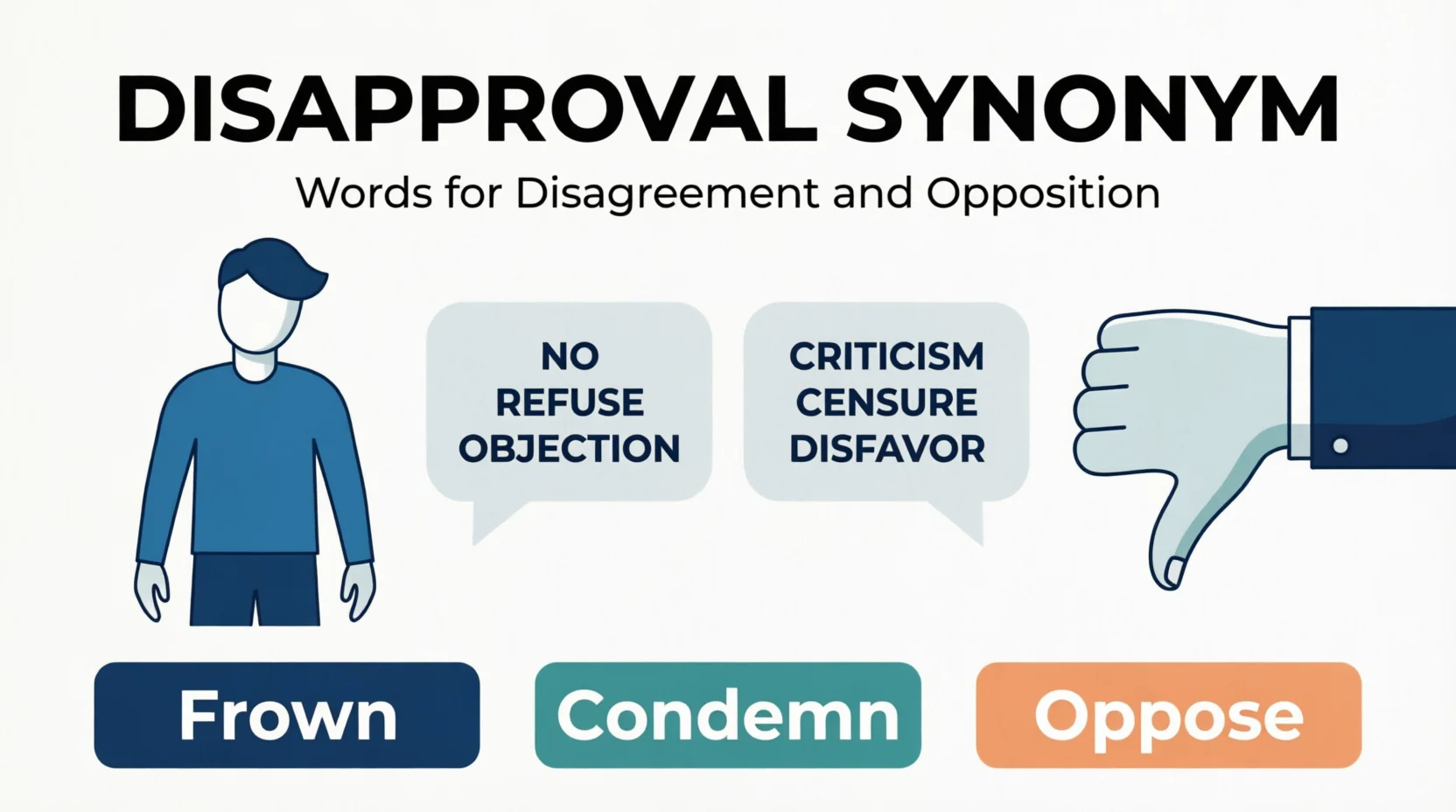
Disapproval means feeling or expressing that something is wrong, unacceptable, unsuitable, or not worthy of support. Common synonyms for disapproval include criticism, objection, dissent, condemnation, opposition, and dissatisfaction. Each word expresses a slightly different level of disagreement, from mild disappointment to strong rejection. Understanding these alternatives helps students, ESL learners, writers, and content creators choose the right word for conversations, essays, professional communication, and everyday situations.
Quick Answer: What Are Synonyms for Disapproval?
The best synonyms for disapproval are criticism, objection, dissent, condemnation, opposition, dissatisfaction, rejection, reproach, censure, and disfavor.
- Mild disapproval: Disappointment, dissatisfaction, reservation
- Formal disapproval: Censure, objection, dissent
- Strong disapproval: Condemnation, denunciation, repudiation
- Disapproval of someone’s behavior: Reproach, rebuke, reprimand
- Disagreement with an idea: Opposition, objection, resistance
What Does Disapproval Mean?
Disapproval is the feeling or expression of a negative opinion about a person, action, decision, or idea. It shows that someone does not agree with or approve of something.
For example, a teacher might express disapproval when a student cheats on an exam. Similarly, a manager might show disapproval of an employee’s repeated lateness.
Disapproval can be expressed through words, facial expressions, gestures, written comments, or formal decisions.
How Is Disapproval Used in Everyday English?
Disapproval is commonly used in personal relationships, workplaces, schools, public discussions, and formal situations.
Examples:
- Her parents expressed disapproval of her decision.
- The committee voiced its objection to the proposal.
- The manager showed dissatisfaction with the team’s performance.
- The public condemned the unfair treatment of workers.
The best synonym depends on whether the situation involves mild disappointment, disagreement, criticism, or strong condemnation.
30 Synonyms for Disapproval With Meanings and Examples
1. Criticism
Meaning: The act of pointing out faults, weaknesses, or problems.
Example: The teacher offered criticism of the student’s incomplete assignment.
Best usage/context: Use criticism when discussing mistakes, weaknesses, or areas that need improvement. It can be constructive or negative.
2. Objection
Meaning: A statement expressing disagreement with something.
Example: Several members raised an objection to the proposed changes.
Best usage/context: Use objection when someone openly disagrees with a plan, decision, suggestion, or action.
3. Dissent
Meaning: Disagreement with an opinion, decision, or commonly accepted position.
Example: The board member expressed dissent during the meeting.
Best usage/context: Best for formal discussions, politics, legal settings, and group decisions.
4. Condemnation
Meaning: Strong expression that something is wrong or unacceptable.
Example: The unfair policy received widespread condemnation.
Best usage/context: Use condemnation for serious wrongdoing, unethical behavior, or actions that deserve strong criticism.
5. Opposition
Meaning: Disagreement with or resistance to an idea, action, or proposal.
Example: The new plan faced opposition from local residents.
Best usage/context: Suitable for political debates, workplace decisions, public policies, and competing viewpoints.
6. Dissatisfaction
Meaning: A feeling that something is not good enough or does not meet expectations.
Example: Customers expressed dissatisfaction with the poor service.
Best usage/context: Use dissatisfaction when people are unhappy with results, quality, performance, or services.
7. Reproach
Meaning: An expression of disappointment or criticism directed at someone.
Example: She looked at him with reproach after he broke his promise.
Best usage/context: Appropriate for personal relationships and situations involving disappointment over someone’s behavior.
8. Censure
Meaning: Strong, often formal criticism of someone’s actions.
Example: The committee issued a formal censure of the official.
Best usage/context: Use censure in professional, political, academic, or institutional settings.
9. Disfavor
Meaning: A state of being viewed negatively or receiving less approval.
Example: The proposal fell into disfavor after the investigation.
Best usage/context: Suitable for describing declining support, popularity, or approval.
10. Rejection
Meaning: The act of refusing to accept or approve something.
Example: The rejection of the proposal disappointed the entire team.
Best usage/context: Use rejection when an offer, request, application, idea, or proposal is not accepted.
11. Disapproval
Meaning: The expression or feeling of not approving something.
Example: His parents showed disapproval of his careless behavior.
Best usage/context: Use this word when you want to communicate a general lack of approval without specifying a particular form of criticism.
12. Denunciation
Meaning: A public or forceful statement criticizing something as wrong.
Example: The organization issued a denunciation of the abusive practices.
Best usage/context: Best for public statements against serious misconduct, injustice, or harmful practices.
13. Rebuke
Meaning: A sharp expression of criticism directed at someone.
Example: The supervisor gave him a rebuke for ignoring safety rules.
Best usage/context: Use rebuke when someone is firmly criticized for an action or mistake.
14. Reprimand
Meaning: An official or serious expression of disapproval.
Example: The employee received a reprimand for repeatedly arriving late.
Best usage/context: Common in workplaces, schools, and disciplinary situations.
15. Displeasure
Meaning: A feeling of unhappiness, annoyance, or dissatisfaction.
Example: The director expressed displeasure with the delayed report.
Best usage/context: Suitable for polite, formal, or professional communication when someone is unhappy about something.
16. Disagreement
Meaning: A difference of opinion between people.
Example: Their disagreement over the budget lasted for several hours.
Best usage/context: Use disagreement for differences in ideas or opinions. It does not always imply strong disapproval.
17. Protest
Meaning: An expression of objection or opposition to something.
Example: Residents organized a protest against the proposed development.
Best usage/context: Appropriate when people actively express opposition through statements, demonstrations, or formal complaints.
18. Resistance
Meaning: The act of opposing or refusing to accept something.
Example: The new rules encountered resistance from employees.
Best usage/context: Use resistance when people push back against changes, demands, policies, or authority.
19. Disdain
Meaning: A strong feeling that someone or something is unworthy of respect.
Example: She expressed disdain for the dishonest proposal.
Best usage/context: Suitable when disapproval includes contempt or a feeling of superiority.
20. Scorn
Meaning: A strong feeling or expression of disrespect and contempt.
Example: The dishonest claim was met with scorn.
Best usage/context: Use scorn when someone openly treats an idea, action, or person as deserving contempt.
21. Contempt
Meaning: A feeling that someone or something is unworthy of respect.
Example: He spoke with contempt about the corrupt practices.
Best usage/context: Appropriate for strong disapproval involving disrespect, moral judgment, or disregard.
22. Objectionability
Meaning: The quality of being offensive, unacceptable, or unsuitable.
Example: The objectionability of the remarks became clear during the discussion.
Best usage/context: Use this relatively uncommon, formal word when discussing the unacceptable nature of a statement, action, or idea. In everyday English, unacceptability is often more natural.
23. Disparagement
Meaning: The act of speaking about someone or something in a belittling way.
Example: The article contained unfair disparagement of the competing organization.
Best usage/context: Suitable when disapproval is expressed by putting someone or something down.
24. Denial
Meaning: A refusal to accept, acknowledge, or grant something.
Example: The denial of the request showed that the committee would not approve it.
Best usage/context: Use denial when someone refuses a request or rejects a claim. It is not a direct synonym for every type of disapproval.
25. Reservation
Meaning: A doubt or concern about accepting something completely.
Example: I have some reservations about the proposed schedule.
Best usage/context: Best for polite, diplomatic, and professional situations where approval is uncertain or conditional.
26. Misgiving
Meaning: A feeling of doubt or concern about something.
Example: She had misgivings about accepting the offer.
Best usage/context: Use misgiving when someone feels uneasy or uncertain about a decision, plan, or situation.
27. Dissension
Meaning: Disagreement that creates conflict within a group.
Example: Dissension among the committee members delayed the decision.
Best usage/context: Suitable for groups, organizations, political parties, and teams experiencing internal disagreement.
28. Refutation
Meaning: An argument or statement that proves a claim to be wrong.
Example: His refutation of the accusation relied on clear evidence.
Best usage/context: Use refutation when disapproval involves challenging an argument or demonstrating that a claim is incorrect.
29. Repudiation
Meaning: A strong rejection of an idea, claim, agreement, or responsibility.
Example: The company issued a repudiation of the allegations.
Best usage/context: Appropriate for formal, legal, political, or public statements involving decisive rejection.
30. Disapproval of conduct: Admonishment
Meaning: A warning or expression of criticism intended to correct someone’s behavior.
Example: The coach gave the player an admonishment for ignoring instructions.
Best usage/context: Use admonishment when someone is criticized or warned about inappropriate behavior, often with the intention of preventing it from happening again.
Comparison Table: Choosing the Best Synonym for Disapproval
| Synonym | Strength | Main meaning | Best context |
| Criticism | Moderate | Pointing out faults | Feedback |
| Objection | Moderate | Expressing disagreement | Meetings and proposals |
| Dissent | Moderate | Holding a different opinion | Formal discussions |
| Condemnation | Very strong | Declaring something wrong | Serious misconduct |
| Opposition | Moderate to strong | Resisting an idea | Policies and plans |
| Dissatisfaction | Mild to moderate | Being unhappy with results | Services and performance |
| Reproach | Moderate | Expressing disappointment | Personal relationships |
| Censure | Strong | Formal criticism | Institutions |
| Reprimand | Strong | Official criticism | Discipline |
| Reservation | Mild | Expressing doubt | Diplomatic discussions |
| Disdain | Strong | Showing a lack of respect | Personal opinions |
| Repudiation | Strong | Rejecting something firmly | Formal statements |
How to Choose the Right Synonym for Disapproval
The best word depends on your tone, intended meaning, and the situation in which you are communicating.
1. Choose According to Tone
For a mild or polite tone: Use reservation, displeasure, dissatisfaction, or misgiving.
Example: “I have some reservations about the new proposal.”
For a neutral or professional tone: Use criticism, objection, disagreement, or dissent.
Example: “The team raised an objection to the revised deadline.”
For a strong or serious tone: Use condemnation, censure, denunciation, or rebuke.
Example: “The organization issued a condemnation of the unethical conduct.”
2. Choose According to Meaning
- Expressing disagreement: Objection, dissent, opposition
- Pointing out faults: Criticism, reproach, censure
- Showing disappointment: Displeasure, dissatisfaction, misgiving
- Rejecting an idea: Rejection, repudiation, denial
- Expressing contempt: Scorn, disdain, contempt
- Correcting behavior: Reprimand, rebuke, admonishment
3. Choose According to Intent
If your goal is to correct a mistake, criticism or reprimand may be appropriate.
If your goal is to disagree politely, reservation or objection may communicate your meaning more effectively.
If your goal is to condemn unethical behavior, condemnation or denunciation may be more suitable.
If your goal is to describe uncertainty rather than outright rejection, choose misgiving or reservation.
Common Mistakes When Using Disapproval Synonyms
1. Treating Every Synonym as Identical
Not every synonym communicates the same level of intensity. A reservation is usually milder than condemnation, while scorn suggests contempt rather than simple disagreement.
2. Confusing Disagreement With Disapproval
Disagreement means having a different opinion. Disapproval means considering something unacceptable or unworthy of support.
For example:
- Disagreement: “I disagree with your interpretation.”
- Disapproval: “I disapprove of your dishonest behavior.”
3. Using Overly Strong Words in Professional Communication
Words such as scorn, contempt, and denunciation can sound harsh. In workplace discussions, concern, reservation, or objection may be more appropriate.
4. Confusing Criticism With Condemnation
Criticism can identify problems and suggest improvements. Condemnation expresses a much stronger negative judgment.
5. Forgetting Natural Word Combinations
English words often appear in common phrases:
- Express disapproval
- Raise an objection
- Voice dissent
- Receive a reprimand
- Face strong opposition
- Express dissatisfaction
- Issue a condemnation
- Show disdain
Learning these combinations helps you use synonyms more naturally.
FAQs:
1. What is the closest synonym for disapproval?
Criticism is a common alternative when disapproval involves pointing out faults. However, objection may be better for disagreement, while condemnation is more suitable for strong moral disapproval.
2. What is a formal word for disapproval?
Censure is a formal word for disapproval, especially when an individual or organization officially criticizes someone’s actions.
3. What is a stronger word for disapproval?
Condemnation, denunciation, and repudiation can express strong disapproval. The best choice depends on whether you are criticizing conduct, publicly denouncing an action, or firmly rejecting a claim.
4. What is the opposite of disapproval?
Common opposites include approval, acceptance, endorsement, support, and favor. These words express agreement, acceptance, or a positive attitude.
5. What is a polite way to express disapproval?
You can use phrases such as “I have some concerns,” “I have reservations about this approach,” or “I am not entirely comfortable with this decision.”
6. Is disapproval the same as disagreement?
No. Disagreement means holding a different opinion, while disapproval involves a negative judgment about something. You can disagree with a person without disapproving of their behavior.
7. What is the difference between disapproval and condemnation?
Disapproval is a general lack of approval. Condemnation is stronger and usually expresses a serious judgment that an action, decision, or behavior is wrong or unacceptable.
Conclusion
Disapproval has many useful synonyms, including criticism, objection, dissent, condemnation, opposition, dissatisfaction, reproach, and censure. Although these words share a general connection with negative judgment or a lack of approval, they differ in tone, intensity, and context.
Choosing the right synonym helps you communicate more clearly, whether you are writing an essay, participating in a professional discussion, or expressing a personal opinion. Use mild words such as reservation for polite disagreement and stronger words such as condemnation for serious wrongdoing. Understanding these distinctions will improve your vocabulary and make your English more precise, natural, and effective.