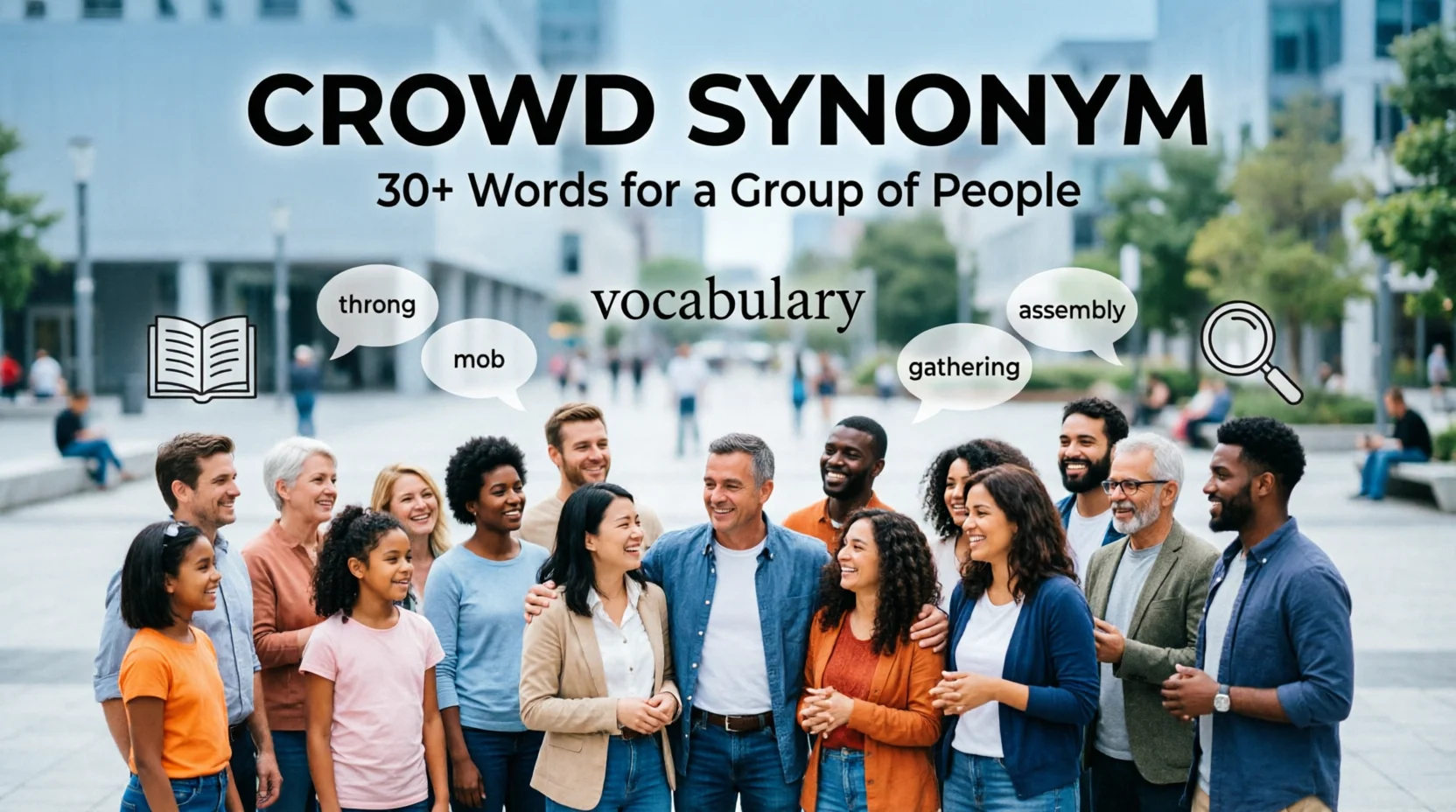
The best synonyms for crowd include group, gathering, throng, mob, audience, multitude, and assembly. Each word describes a collection of people, but the right choice depends on the situation. For example, audience refers to people watching or listening to something, while mob often suggests a disorderly or angry group. Learning these alternatives helps students, ESL learners, writers, and content creators communicate more clearly and avoid repeating the same word.
Quick Answer: What Are the Best Synonyms for Crowd?
Here are some common synonyms for crowd:
- Group
- Gathering
- Throng
- Multitude
- Mob
- Audience
- Assembly
- Mass
- Horde
- Congregation
- Host
- Company
- Collection
- Assembly
- Swarm
Crowd means a large number of people gathered together in one place. Depending on the context, it can also refer to a particular social group or community.
What Does Crowd Mean?
The noun crowd generally describes many people gathered in the same place, often for a shared purpose or event. It can refer to people attending a concert, waiting at a station, watching a sports match, or walking through a busy market.
The word can also describe a social circle, as in “the college crowd.” As a verb, crowd means to gather closely together or fill a space with too many people.
Examples:
- A large crowd gathered outside the stadium.
- She enjoys spending time with the college crowd.
- People crowded around the street performer.
The most suitable synonym depends on whether you want to emphasize the number of people, their behavior, their purpose, or their relationship with one another.
30 Synonyms for Crowd With Meanings and Examples
1. Group
Meaning: A number of people considered together.
Example: A group of students visited the museum.
Best usage: Everyday conversations, schoolwork, and general writing.
2. Gathering
Meaning: An occasion when people come together.
Example: Our family held a small gathering on Sunday.
Best usage: Social events, celebrations, and informal meetings.
3. Throng
Meaning: A large, densely packed group of people.
Example: A throng of fans waited outside the concert hall.
Best usage: Descriptive writing and crowded public scenes.
4. Multitude
Meaning: A very large number of people or things.
Example: A multitude of visitors explored the historic city.
Best usage: Formal writing and descriptions that emphasize quantity.
5. Mob
Meaning: A large group of people, often behaving noisily, aggressively, or without order.
Example: The angry mob gathered outside the building.
Best usage: Situations involving disorder, hostility, or uncontrolled behavior.
6. Audience
Meaning: People who watch, listen to, or follow a performance or presentation.
Example: The audience applauded after the final song.
Best usage: Concerts, speeches, films, theaters, and presentations.
7. Assembly
Meaning: A group of people gathered for a particular purpose.
Example: The school assembly began at nine o’clock.
Best usage: Schools, official meetings, and organized gatherings.
8. Mass
Meaning: A large number of people considered collectively.
Example: A mass of spectators filled the main square.
Best usage: Large-scale gatherings and descriptive writing.
9. Horde
Meaning: A very large group of people, sometimes suggesting an overwhelming or unruly number.
Example: A horde of shoppers entered the store during the sale.
Best usage: Informal descriptions of overwhelming numbers. It can sound negative or exaggerated.
10. Congregation
Meaning: A group of people gathered for religious worship.
Example: The congregation sang together during the service.
Best usage: Religious gatherings and church-related contexts.
11. Host
Meaning: A large number of people or things.
Example: A host of supporters welcomed the team.
Best usage: Literary or formal descriptions of large numbers.
12. Company
Meaning: A group of people spending time together.
Example: She enjoyed the company of her old friends.
Best usage: Social relationships and pleasant gatherings.
13. Collection
Meaning: A group of people or things brought together or considered as a whole.
Example: The event attracted a diverse collection of artists.
Best usage: Describing people with shared characteristics or interests.
14. Party
Meaning: A group of people gathered for a social event or traveling together.
Example: A party of tourists entered the castle.
Best usage: Social occasions, tours, and organized groups.
15. Entourage
Meaning: A group of people accompanying an important or famous person.
Example: The actor arrived with a small entourage.
Best usage: Celebrities, public figures, and professional settings.
16. Fellowship
Meaning: A group connected by shared interests, beliefs, or experiences.
Example: She found fellowship among fellow writers.
Best usage: Community, friendship, shared beliefs, and supportive relationships.
17. Circle
Meaning: A group of people connected by friendship, interests, or social relationships.
Example: He belongs to a close circle of musicians.
Best usage: Social connections and professional networks.
18. Community
Meaning: People who share a location, identity, interest, or common purpose.
Example: The local community gathered to celebrate the festival.
Best usage: Neighborhoods, shared interests, and collective activities.
19. Crowd of Spectators
Meaning: A group of people watching an event.
Example: A crowd of spectators cheered for the runners.
Best usage: Sporting events, public performances, and competitions.
20. Throng of People
Meaning: A densely packed group of people in one place.
Example: A throng of people filled the narrow street.
Best usage: Vivid descriptions of busy streets and public places.
21. Congregation of Worshippers
Meaning: People gathered for religious worship.
Example: A congregation of worshippers assembled before the ceremony.
Best usage: Religious services and ceremonies.
22. Assembly of People
Meaning: People brought together for a meeting or shared activity.
Example: An assembly of residents discussed the new project.
Best usage: Community meetings, official events, and organized discussions.
23. Clamor
Meaning: A loud mixture of voices or sounds, often produced by a group.
Example: The clamor of excited fans echoed through the arena.
Best usage: Emphasizing noise rather than the people themselves. Clamor is not a direct synonym for a crowd.
24. Swarm
Meaning: A large number of people or things moving together in a dense mass.
Example: A swarm of tourists gathered around the famous monument.
Best usage: Informal, vivid descriptions of overwhelming numbers.
25. Horde of People
Meaning: A very large group of people, often perceived as overwhelming.
Example: A horde of visitors rushed toward the exhibition entrance.
Best usage: Informal or dramatic writing; it may sound dismissive.
26. Body
Meaning: An organized group of people acting together.
Example: A governing body approved the proposal.
Best usage: Official, professional, and institutional contexts.
27. Delegation
Meaning: A group chosen to represent others.
Example: A delegation of students attended the conference.
Best usage: Diplomacy, business meetings, conferences, and formal visits.
28. Contingent
Meaning: A group of people representing an organization or participating in an event.
Example: A large contingent of supporters traveled to the final.
Best usage: Sports, official visits, and organized participation.
29. Rally
Meaning: An organized gathering of people who support a cause, person, or movement.
Example: A large crowd attended the environmental rally.
Best usage: Political events, public campaigns, and demonstrations. Rally usually names the event, not the people.
30. Audience Members
Meaning: Individual people who make up an audience.
Example: Several audience members asked questions after the lecture.
Best usage: Presentations, performances, lectures, and public discussions.
Comparison Table: Crowd Synonyms and Their Uses
| Synonym | Main meaning | Best context |
| Group | People considered together | General use |
| Gathering | People coming together | Social events |
| Throng | Dense group of people | Descriptive writing |
| Multitude | Very large number | Formal writing |
| Mob | Often disorderly group | Conflict or unrest |
| Audience | People watching or listening | Performances |
| Assembly | Organized gathering | Meetings |
| Mass | Large collective group | Large public gatherings |
| Horde | Overwhelming group | Informal descriptions |
| Congregation | Religious group | Worship |
| Host | Large number | Literary writing |
| Company | People together socially | Friendship |
| Collection | People considered together | Descriptive contexts |
| Party | Social or traveling group | Events and tours |
| Entourage | People accompanying someone | Celebrities and leaders |
| Fellowship | People sharing a connection | Community and support |
| Circle | Connected social group | Friendship and interests |
| Community | People sharing a connection or place | Neighborhoods |
| Body | Organized group | Institutions |
| Delegation | Representatives | Formal visits |
How to Choose the Right Synonym for Crowd
Choosing the right alternative depends on your meaning, tone, and purpose.
For Everyday Conversation
Use group, gathering, company, or party when you want simple, natural language.
Examples:
- A group of friends met for lunch.
- We attended a family gathering.
- A party of travelers arrived early.
For Formal or Academic Writing
Choose multitude, assembly, body, or delegation when the context is organized or professional.
Examples:
- A multitude of factors influenced the decision.
- The assembly discussed the proposal.
- A delegation visited the research center.
Remember that multitude can refer to things as well as people.
For Large or Densely Packed Groups
Use throng, mass, or swarm when emphasizing density or a large number.
Examples:
- A throng surrounded the performer.
- A mass of people filled the square.
- A swarm of tourists crowded the entrance.
These terms can sound dramatic, so use them when the description supports that tone.
For Noisy or Disorderly Groups
Use mob when the group behaves aggressively or without order. Use horde when you want to emphasize an overwhelming number, although it can sound negative.
Examples:
- An angry mob protested outside the courthouse.
- A horde of shoppers entered the store.
Avoid using mob for an ordinary, peaceful gathering because it can suggest hostility or disorder.
For Social Connections
Choose circle, community, fellowship, or company when the focus is on relationships rather than physical density.
Examples:
- She has a close circle of friends.
- The community supported the local school.
- He enjoyed the company of his colleagues.
Common Mistakes When Using Crowd Synonyms
1. Treating Every Synonym as Identical
Not every alternative can replace crowd in every sentence. An audience watches or listens, while a congregation usually gathers for worship.
Incorrect: The congregation applauded the comedy show.
Better: The audience applauded the comedy show.
2. Using Mob for a Peaceful Gathering
Mob often suggests disorder, anger, or aggression.
Less suitable: A mob gathered to enjoy the outdoor concert.
Better: A crowd gathered to enjoy the outdoor concert.
3. Confusing a Crowd With an Event
Words such as rally and gathering can describe an event rather than the people attending it.
Example: Thousands of people attended the rally.
Here, rally refers to the event, while people identifies the attendees.
4. Using Formal Words in Casual Conversations
Words such as multitude, contingent, and entourage may sound unnatural in ordinary conversation.
Instead of saying, “A multitude of friends came over,” you could say, “A group of friends came over.”
5. Repeating Crowd Too Often
Repeated use of one word can make writing less engaging. Choose alternatives according to context rather than replacing every occurrence mechanically.
For example: “A crowd gathered outside the stadium. The spectators cheered as the players arrived, while a group of fans waited near the entrance.”
FAQs:
1. What is the most common synonym for crowd?
Group is one of the most common alternatives. It works in many everyday situations, although it does not always imply a large number of people.
2. What is a formal word for crowd?
Multitude, assembly, and body can work in formal writing. The best choice depends on whether you mean a large number, an organized meeting, or an official group.
3. What is another word for a large crowd?
Words such as throng, multitude, mass, and horde can describe a large group. Throng especially suggests people gathered closely together.
4. What is a synonym for a noisy crowd?
Mob may describe a noisy, disorderly group, particularly when people are angry or aggressive. For a peaceful group making noise, cheering crowd or excited audience is more appropriate.
5. What is a positive synonym for crowd?
Gathering, community, fellowship, and audience can have positive associations, depending on the context. For example, a friendly gathering suggests people coming together socially.
6. What is the difference between a crowd and a group?
A crowd usually refers to many people gathered in one place. A group is broader and can include a small number of people who share an activity, purpose, or relationship.
7. Can crowd be used as a verb?
Yes. As a verb, crowd means to gather closely together, fill a space, or press around someone or something.
Example: Fans crowded around the entrance to see the singer.
8. What is the best synonym for crowd in creative writing?
Throng, mass, swarm, and multitude can create vivid descriptions. Choose based on the mood you want to convey: throng emphasizes density, while swarm can suggest overwhelming movement.
Conclusion
The best synonyms for crowd depend on the situation you want to describe. Use group for everyday communication, audience for people watching a performance, assembly for an organized meeting, and throng for a densely packed gathering.
Words such as mob and horde can add intensity but may carry negative associations. For social relationships, circle, community, and fellowship are often more suitable. Understanding these differences helps you select precise words, improve your vocabulary, and make your writing clearer and more engaging.