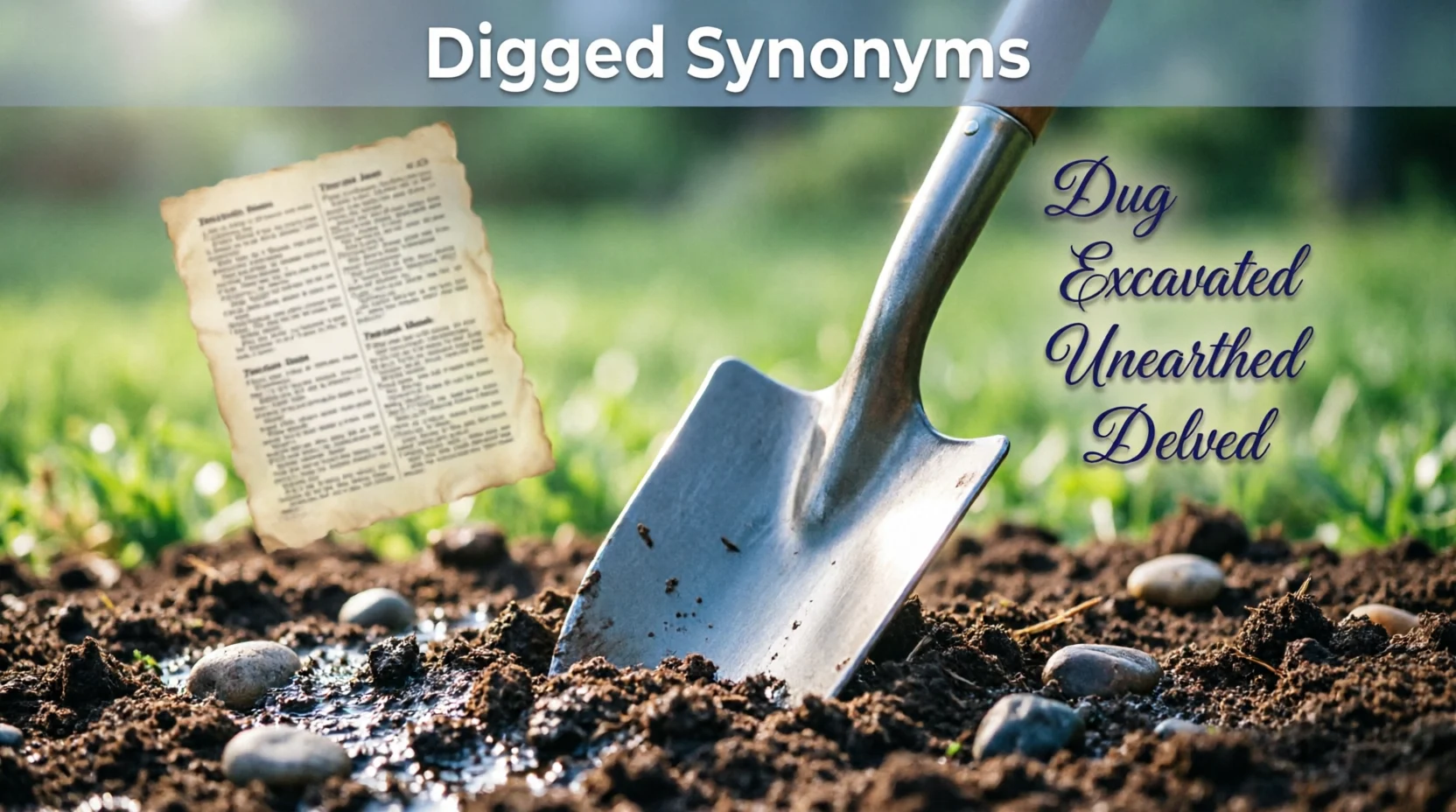
The correct word to use instead of “digged” is usually “dug.” Digged is a common grammatical mistake because the past tense of dig is irregular. Depending on the context, useful synonyms include excavated, burrowed, delved, scooped, unearthed, and searched. Each word has a slightly different meaning, so choosing the right one depends on whether you are moving soil, making a hole, uncovering something, or investigating information.
Quick Answer: What Are the Best Synonyms for Digged?
The best alternatives to “digged” include:
- Dug: The correct past tense of dig.
- Excavated: Removed earth from an area.
- Burrowed: Made a hole or tunnel in the ground.
- Unearthed: Discovered something hidden underground.
- Scooped: Removed material using a tool or your hands.
- Delved: Investigated a subject deeply.
- Searched: Looked carefully for something.
- Trenched: Dug a long, narrow hole.
Remember that digged is generally nonstandard in modern English. In most situations, use dug instead.
What Does Digged Mean?
“Digged” is an incorrect or nonstandard past-tense form of the verb dig in modern standard English. The accepted past tense and past participle are both dug.
For example:
- Incorrect: She digged a hole in the garden.
- Correct: She dug a hole in the garden.
The verb dig means to break up, move, or remove soil using a tool or your hands. It can also mean to search for information or investigate a topic deeply.
The best synonym depends on the intended meaning. For example, excavated is suitable for removing earth, while investigated works better when discussing research.
30 Synonyms for Digged With Meanings and Examples
Here are 30 useful words and expressions you can use instead of “digged,” depending on the context.
1. Dug
Simple meaning: Removed soil or made a hole in the ground.
Example: He dug a hole to plant a tree.
Best usage/context: Everyday conversations and general writing. This is the correct past-tense form of dig.
2. Excavated
Simple meaning: Removed earth from a particular area.
Example: Workers excavated the site before construction began.
Best usage/context: Construction, archaeology, engineering, and formal writing.
3. Burrowed
Simple meaning: Made a hole or tunnel by digging.
Example: The rabbit burrowed beneath the fence.
Best usage/context: Describing animals or people moving into a tunnel or confined space.
4. Unearthed
Simple meaning: Discovered or uncovered something hidden in the ground.
Example: The archaeologists unearthed an ancient coin.
Best usage/context: Discoveries, historical objects, secrets, and hidden information.
5. Scooped
Simple meaning: Removed or lifted material with a tool or curved hand.
Example: She scooped the sand into a bucket.
Best usage/context: Sand, soil, food, snow, and other loose materials.
6. Delved
Simple meaning: Examined or explored something deeply.
Example: The researcher delved into the history of the village.
Best usage/context: Research, reading, investigation, and detailed analysis.
7. Searched
Simple meaning: Looked carefully for something.
Example: He searched the garden for his lost keys.
Best usage/context: Finding objects, examining places, or looking for information.
8. Trenched
Simple meaning: Dug a long, narrow hole.
Example: The workers trenched the field to install drainage pipes.
Best usage/context: Construction, farming, plumbing, and landscaping.
9. Bored
Simple meaning: Made a hole using a drilling or cutting tool.
Example: The technician bored a hole through the metal.
Best usage/context: Engineering, manufacturing, and drilling.
10. Drilled
Simple meaning: Created a hole using a drill or similar equipment.
Example: The team drilled into the rock to collect samples.
Best usage/context: Construction, mining, and mechanical work.
11. Scraped
Simple meaning: Removed a thin layer of material from a surface.
Example: She scraped the soil away from the old stone.
Best usage/context: Careful removal of dirt, paint, or surface material.
12. Shoveled
Simple meaning: Moved material using a shovel.
Example: They shoveled dirt into the planting bed.
Best usage/context: Gardening, construction, snow removal, and landscaping.
13. Raked
Simple meaning: Gathered or moved material using a rake.
Example: He raked the loose soil into a neat pile.
Best usage/context: Gardening and surface preparation. It does not usually mean making a hole.
14. Grubbed
Simple meaning: Dug or removed something, often with effort.
Example: The farmer grubbed out the stubborn roots.
Best usage/context: Removing roots, stumps, or unwanted plants.
15. Rooted
Simple meaning: Searched or dug around, often to find something.
Example: The dog rooted around in the dirt for a bone.
Best usage/context: Animals searching in soil or people rummaging through things.
16. Mined
Simple meaning: Extracted valuable minerals or materials from the earth.
Example: The company mined copper from the mountain.
Best usage/context: Mining, geology, and natural-resource extraction.
17. Dredged
Simple meaning: Removed mud, sand, or debris from the bottom of a body of water.
Example: The crew dredged the river to improve navigation.
Best usage/context: Rivers, harbors, canals, and waterways.
18. Plowed
Simple meaning: Turned over soil using a plow.
Example: The farmer plowed the field before planting.
Best usage/context: Agriculture and preparing land for crops.
19. Tilled
Simple meaning: Prepared soil for planting by turning or breaking it up.
Example: She tilled the garden before sowing the seeds.
Best usage/context: Gardening, farming, and soil preparation.
20. Hollowed
Simple meaning: Made an empty space inside something.
Example: He hollowed out the pumpkin for Halloween.
Best usage/context: Creating cavities in wood, fruit, stone, or other materials.
21. Chiseled
Simple meaning: Cut or shaped a hard material with a chisel.
Example: The sculptor chiseled a small opening into the stone.
Best usage/context: Stonework, sculpture, and detailed carving.
22. Pierced
Simple meaning: Made a hole through something.
Example: The sharp tool pierced the thin layer of soil.
Best usage/context: Making a hole through a surface rather than removing large amounts of earth.
23. Scrabbled
Simple meaning: Scratched or clawed at a surface while trying to move or find something.
Example: The puppy scrabbled in the loose earth.
Best usage/context: Informal descriptions of hurried or awkward digging.
24. Rummaged
Simple meaning: Searched through things carelessly or thoroughly.
Example: She rummaged through the drawer for a spare key.
Best usage/context: Searching through bags, drawers, boxes, or other collections of objects.
25. Investigated
Simple meaning: Examined something carefully to discover facts.
Example: The journalist investigated the unusual incident.
Best usage/context: Research, journalism, and problem-solving.
26. Explored
Simple meaning: Examined or traveled through a place to learn more about it.
Example: The children explored the small cave.
Best usage/context: Places, ideas, subjects, and unfamiliar environments.
27. Probed
Simple meaning: Examined or searched something closely.
Example: The scientist probed the soil for signs of contamination.
Best usage/context: Scientific research, detailed investigation, and careful examination.
28. Uncovered
Simple meaning: Revealed something that was hidden or covered.
Example: The workers uncovered a stone pathway beneath the grass.
Best usage/context: Discovering objects, evidence, facts, or hidden surfaces.
29. Disinterred
Simple meaning: Removed something, especially a buried body, from the ground.
Example: Investigators disinterred the remains for further examination.
Best usage/context: Formal, legal, archaeological, or forensic situations.
30. Burrowed into
Simple meaning: Moved into something or examined a subject deeply.
Example: She burrowed into the archives to find the original document.
Best usage/context: Figurative writing and descriptions of deep research. For physical digging, burrowed into the ground is also correct.
Comparison Table: Which Digged Synonym Should You Use?
| Word | Main meaning | Best context |
| Dug | Made a hole or moved soil | Everyday English |
| Excavated | Removed earth | Construction and archaeology |
| Burrowed | Made a tunnel | Animals and tunnels |
| Unearthed | Discovered something hidden | Archaeology and discoveries |
| Scooped | Lifted or removed material | Loose soil and sand |
| Delved | Examined deeply | Research and ideas |
| Trenched | Dug a long, narrow hole | Construction and drainage |
| Drilled | Made a hole with a tool | Engineering |
| Shoveled | Moved material with a shovel | Gardening and building |
| Mined | Extracted minerals | Industry and geology |
| Dredged | Removed underwater sediment | Rivers and harbors |
| Investigated | Examined to find facts | Research and journalism |
| Uncovered | Revealed something hidden | Evidence and discoveries |
| Rummaged | Searched through objects | Everyday situations |
| Disinterred | Removed from a burial place | Forensic and formal contexts |
How to Choose the Right Synonym for Digged
Choosing the right word depends on what happened and the tone you want to communicate.
1. For Everyday Conversations
Use dug, scooped, or shoveled when describing ordinary physical actions.
Examples:
- He dug a hole in the yard.
- She scooped the dirt into a container.
- They shoveled soil into the garden.
Best choice: Dug, because it is the standard past tense of dig.
2. For Formal or Technical Writing
Use excavated, drilled, trenched, or mined when describing specialized work.
Examples:
- Engineers excavated the site.
- Workers drilled through the rock.
- The crew trenched the land for new pipes.
Best choice: Select the word that accurately describes the technique used.
3. For Discoveries and Hidden Objects
Use unearthed, uncovered, or disinterred when something concealed becomes visible or is removed from the ground.
Examples:
- The team unearthed ancient pottery.
- Heavy rain uncovered an old foundation.
- Experts disinterred the remains for examination.
Best choice: Unearthed is especially useful when the discovery itself matters.
4. For Research and Investigation
Use delved, investigated, probed, or explored when you mean examining information rather than moving soil.
Examples:
- The student delved into the topic.
- Reporters investigated the allegations.
- Scientists probed the underlying causes.
Best choice: Delved is a natural option for exploring a subject in depth.
5. For Informal or Descriptive Writing
Use scrabbled, rooted, or rummaged when you want to describe energetic, messy, or hurried searching.
Examples:
- The dog rooted around in the garden.
- She rummaged through her bag.
- The puppy scrabbled in the dirt.
Best choice: Rummaged for searching through objects; scrabbled for scratching or clawing at a surface.
Common Mistakes When Using Digged Synonyms
Mistake 1: Using Digged Instead of Dug
Incorrect: He digged a hole yesterday.
Correct: He dug a hole yesterday.
The verb dig is irregular, so its past tense is dug, not digged.
Mistake 2: Using Excavated for Every Type of Digging
“Excavated” often describes substantial or systematic removal of earth. It may sound too formal for a small gardening task.
Natural: I dug a small hole for the flower.
More technical: Archaeologists excavated the ancient settlement.
Mistake 3: Confusing Physical Digging With Research
“Delved” generally describes exploring a topic or examining information in depth. It is not the usual word for making a hole in the ground.
Natural: The author delved into historical records.
Physical action: The gardener dug into the soil.
Mistake 4: Treating Every Synonym as Interchangeable
Words such as drilled, dredged, and mined describe specific activities. Use them only when the action matches their meaning.
For example, a person who removes sediment from a riverbed has dredged it, while someone who extracts minerals from the earth has mined them.
FAQs:
1. What is the correct word for digged?
The correct word is usually dug. It is both the simple past tense and the past participle of dig.
2. What are the closest synonyms for digged?
The closest alternatives include dug, excavated, burrowed, scooped, shoveled, and trenched. The best choice depends on the action being described.
3. Is digged a real English word?
“Digged” appears in some historical and nonstandard English usage, but it is not the standard modern past tense of dig. Use dug in contemporary writing and speech.
4. What is a formal synonym for dug?
Excavated is a strong formal alternative when describing the removal of earth. Unearthed is suitable when emphasizing the discovery of something hidden.
5. What is a synonym for digged when talking about research?
Use delved, investigated, explored, or probed. For example, “She delved into the subject” means she studied it in depth.
6. What is the difference between dug and excavated?
Dug is a general, everyday word for making a hole or moving earth. Excavated often suggests a more systematic process, such as archaeological work or construction.
7. Can I use unearthed instead of dug?
Yes, when the meaning involves discovering or revealing something hidden in the ground. For example, “They unearthed an ancient artifact” emphasizes the discovery, not simply the act of digging.
Conclusion
The most important synonym for “digged” is dug, the correct past-tense form of dig in standard modern English. Other alternatives, including excavated, burrowed, unearthed, scooped, and delved, express different actions and meanings.
Choose excavated for formal earth removal, unearthed for discoveries, and delved for deep research. Understanding these differences will help you write more clearly, avoid common grammar mistakes, and choose words that fit your intended meaning.