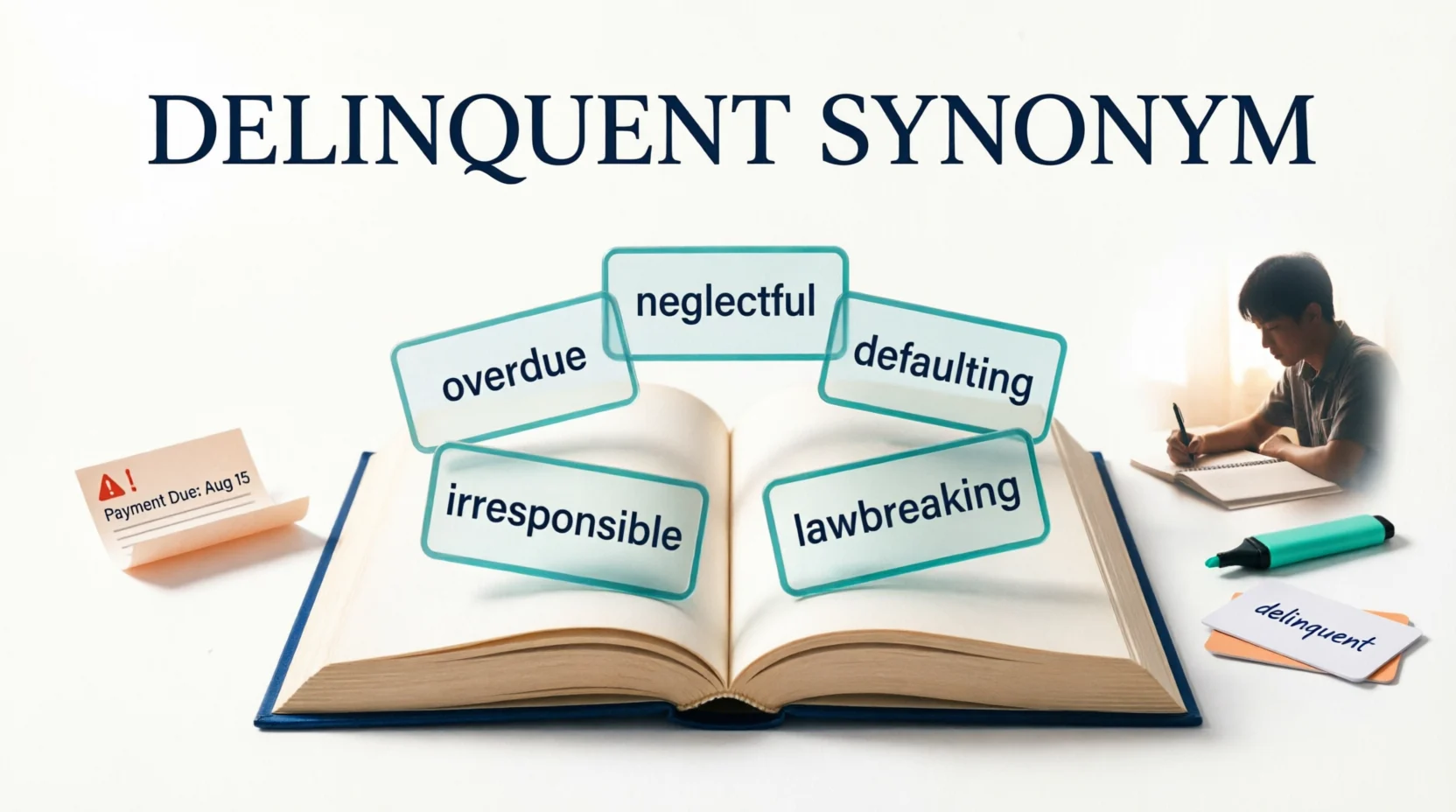
The best synonyms for delinquent include offender, lawbreaker, truant, irresponsible, negligent, overdue, and defaulting. The right word depends on the context. Delinquent can describe someone who breaks the law, a student who frequently misses school, a person who neglects responsibilities, or a payment that has not been made on time.
If you are writing an essay, improving your vocabulary, or looking for a more precise word, understanding these alternatives will help you communicate clearly.
Quick Answer: What Is a Synonym for Delinquent?
A synonym for delinquent is a word that describes someone who fails to meet a responsibility, breaks a rule or law, or fails to make a required payment.
Common synonyms include:
- Offender: Someone who breaks a law or rule.
- Lawbreaker: A person who violates the law.
- Truant: A student who stays away from school without permission.
- Irresponsible: Someone who does not act responsibly.
- Negligent: Someone who fails to take proper care.
- Overdue: Something that has not been paid or completed on time.
- Defaulting: Failing to meet a financial obligation.
- Wayward: Someone who behaves in a disobedient or difficult-to-control way.
Meaning and Usage of Delinquent
The word delinquent has several meanings depending on how it is used.
1. Delinquent as a Person Who Breaks the Law
When describing a person, delinquent often refers to someone who commits an illegal act or repeatedly breaks rules.
Example: The young delinquent was required to attend a rehabilitation program.
In this context, words such as offender, lawbreaker, and wrongdoer may be appropriate.
2. Delinquent as Someone Who Neglects Responsibilities
Delinquent can describe someone who fails to complete an expected duty or obligation.
Example: The company investigated delinquent employees who repeatedly ignored essential procedures.
In this sense, negligent, irresponsible, and derelict may work, depending on the situation.
3. Delinquent in Education
The term can describe a student who repeatedly misses school without permission or engages in misconduct.
Example: The school introduced a support program for students with persistent attendance problems.
Here, truant is often the most precise alternative when the issue is unauthorized absence.
4. Delinquent in Finance
In financial contexts, delinquent usually refers to an account or payment that has not been paid by its due date.
Example: The bank contacted the customer about a delinquent loan payment.
Words such as overdue, unpaid, and defaulting may be more suitable, depending on the stage and nature of the payment problem.
30 Synonyms for Delinquent With Meanings and Examples
The following list explains 30 alternatives, including their meanings, example sentences, and best uses.
1. Offender
Meaning: A person who breaks a law or rule.
Example: The offender received a formal warning from the authorities.
Best usage: Legal writing, criminal justice, and discussions of rule violations.
2. Lawbreaker
Meaning: Someone who violates the law.
Example: The lawbreaker was fined for ignoring the traffic regulations.
Best usage: Direct, everyday descriptions of illegal behavior.
3. Wrongdoer
Meaning: A person who does something morally or legally wrong.
Example: The investigation aimed to identify the wrongdoer.
Best usage: General discussions of misconduct or unethical actions.
4. Criminal
Meaning: A person who commits a crime.
Example: The criminal was brought before the court.
Best usage: Serious or established criminal conduct. Avoid using it when a person’s guilt has not been established.
5. Truant
Meaning: A student who stays away from school without permission.
Example: The school counselor met with the truant student and their parents.
Best usage: School attendance and unauthorized absences.
6. Irresponsible
Meaning: Not showing proper care or responsibility.
Example: It was irresponsible to ignore the important deadline.
Best usage: Everyday writing about poor decisions or neglected duties.
7. Negligent
Meaning: Failing to provide the care or attention required.
Example: The negligent supervisor failed to address the safety concerns.
Best usage: Workplace responsibilities, professional duties, and legal contexts.
8. Derelict
Meaning: Having neglected a duty or responsibility.
Example: The manager was accused of being derelict in his duties.
Best usage: Formal writing about serious neglect of obligations.
9. Wayward
Meaning: Difficult to control or inclined to disobey rules.
Example: The program helped wayward teenagers develop better habits.
Best usage: Describing behavior that strays from accepted expectations.
10. Rebellious
Meaning: Resisting authority or established rules.
Example: The rebellious teenager challenged every classroom rule.
Best usage: Describing resistance to authority rather than a specific crime.
11. Disobedient
Meaning: Refusing or failing to follow instructions.
Example: The disobedient child ignored the teacher’s directions.
Best usage: Family, school, and everyday situations involving rule-breaking.
12. Misbehaving
Meaning: Acting in an inappropriate or unacceptable way.
Example: The teacher spoke privately with the misbehaving student.
Best usage: Informal and relatively mild descriptions of poor conduct.
13. Unruly
Meaning: Difficult to control or manage.
Example: The coach struggled to manage the unruly group.
Best usage: Groups or individuals who behave disruptively.
14. Disorderly
Meaning: Behaving in a disruptive or uncontrolled manner.
Example: The security guard asked the disorderly visitors to leave.
Best usage: Public behavior, disturbances, and formal reports.
15. Miscreant
Meaning: A person who behaves badly or commits wrongdoing.
Example: The villagers reported the miscreant responsible for damaging the fence.
Best usage: Literary, expressive, or slightly old-fashioned writing.
16. Culprit
Meaning: The person responsible for a particular wrongdoing.
Example: Investigators eventually identified the culprit.
Best usage: Identifying the person responsible for a specific incident.
17. Transgressor
Meaning: Someone who violates a law, rule, or moral principle.
Example: The policy explains the consequences for any transgressor.
Best usage: Formal, ethical, religious, or legal discussions.
18. Violator
Meaning: A person who breaks a law, agreement, or rule.
Example: The violator was required to pay a penalty.
Best usage: Regulations, contracts, policies, and legal documents.
19. Offending
Meaning: Causing harm, breaking a rule, or behaving improperly.
Example: The school reviewed the offending student’s conduct.
Best usage: Describing the action or person involved in a particular violation.
20. Incorrigible
Meaning: Unlikely to change despite attempts to correct behavior.
Example: His incorrigible habit of ignoring instructions frustrated the team.
Best usage: Describing persistent behavior that resists correction.
21. Delinquent-minded
Meaning: Inclined toward irresponsible or rule-breaking behavior.
Example: The mentor worked to redirect the delinquent-minded youth toward positive activities.
Best usage: Informal descriptive writing. This is not a standard legal or clinical term, so a more precise phrase is usually preferable.
22. Unlawful
Meaning: Contrary to the law.
Example: The court ruled that the unlawful action violated the regulation.
Best usage: Describing actions, conduct, or activities rather than people.
23. Unethical
Meaning: Contrary to accepted moral or professional standards.
Example: The employee was reprimanded for unethical conduct.
Best usage: Professional, academic, and workplace situations that involve moral misconduct.
24. Defaulting
Meaning: Failing to meet a financial or contractual obligation.
Example: The defaulting borrower contacted the lender to discuss repayment.
Best usage: Loans, debts, contracts, and financial commitments.
25. Overdue
Meaning: Not paid, completed, or returned by the expected deadline.
Example: The customer received a reminder about the overdue invoice.
Best usage: Bills, payments, assignments, library books, and deadlines. It describes something late, not necessarily a person.
26. Unpaid
Meaning: Not yet paid.
Example: The company followed up on the unpaid balance.
Best usage: Bills, wages, debts, invoices, and other outstanding amounts.
27. Outstanding
Meaning: Still unpaid or unresolved.
Example: The customer settled the outstanding amount at the end of the month.
Best usage: Financial writing and professional communication about pending obligations.
28. Remiss
Meaning: Careless or failing to perform a duty properly.
Example: The supervisor was remiss in checking the final report.
Best usage: Formal writing about neglected responsibilities.
29. Careless
Meaning: Not giving enough attention to what needs to be done.
Example: The careless worker overlooked an important instruction.
Best usage: Everyday writing about mistakes, inattention, or poor work habits.
30. Neglectful
Meaning: Failing to provide necessary attention, care, or effort.
Example: The neglectful landlord ignored repeated requests to repair the heating system.
Best usage: Describing a person who repeatedly fails to provide appropriate care or attention.
Delinquent Synonyms Comparison Table
Use this table to choose the most suitable word for your sentence.
| Synonym | Main meaning | Best context | Tone |
| Offender | Person who breaks a rule or law | Legal matters | Neutral |
| Lawbreaker | Person who violates the law | General discussion | Direct |
| Wrongdoer | Person responsible for wrongdoing | Ethics and misconduct | Neutral |
| Criminal | Person who commits a crime | Criminal justice | Strong |
| Truant | Student absent without permission | Education | Specific |
| Irresponsible | Failing to act responsibly | Daily life | General |
| Negligent | Failing to provide required care | Work and law | Formal |
| Derelict | Neglecting a duty | Professional writing | Formal |
| Wayward | Straying from expected behavior | Personal conduct | Descriptive |
| Rebellious | Resisting authority | Behavior and relationships | Descriptive |
| Culprit | Person responsible for an incident | Investigations | Neutral |
| Violator | Person who breaks a rule | Regulations | Formal |
| Remiss | Failing to fulfill a duty | Workplace writing | Formal |
| Overdue | Late or past its due date | Payments and deadlines | Neutral |
| Defaulting | Failing to meet an obligation | Finance | Technical |
| Unpaid | Not yet paid | Accounts and bills | Neutral |
How to Choose the Right Delinquent Synonym
The best synonym depends on what you want to communicate. Consider the tone, meaning, and purpose of your sentence before choosing a replacement.
Choose a Synonym Based on Tone
For neutral or everyday writing: Use irresponsible, careless, disobedient, or wrongdoer when these accurately describe the situation.
For formal writing: Choose negligent, derelict, remiss, or transgressor when discussing neglected duties or violations.
For strong descriptions: Use lawbreaker, offender, or criminal only when the facts support the term.
For literary writing: Words such as miscreant, wayward, and incorrigible can add a more distinctive tone.
Choose a Synonym Based on Meaning
- Breaking the law: Offender, lawbreaker, criminal, violator.
- Breaking school rules: Truant, disobedient, unruly.
- Neglecting duties: Negligent, derelict, remiss, neglectful.
- Behaving irresponsibly: Irresponsible, careless, wayward.
- Missing payments: Overdue, unpaid, defaulting, outstanding.
- Causing a specific problem: Culprit, wrongdoer, offender.
Choose a Synonym Based on Intent
If you want to describe a person who repeatedly breaks rules, offender or rule-breaker may fit.
If you want to explain a failure to perform a duty, negligent or remiss is more precise.
If you are writing about a late payment, overdue or unpaid is generally clearer than delinquent.
If you want to describe a student who skips school without authorization, truant is usually the best choice.
Common Mistakes When Using Delinquent Synonyms
Choosing a synonym simply because it looks similar can change the meaning of your sentence. Avoid these common mistakes.
1. Using Criminal for Every Delinquent Person
Delinquent does not always mean someone has committed a crime. It can also refer to missed payments or neglected responsibilities.
Better approach: Use irresponsible for poor judgment, negligent for neglected duties, and criminal only when criminal conduct is relevant.
2. Confusing Truant With Offender
A truant specifically refers to a student who is absent from school without authorization. An offender has a much broader meaning.
Better approach: Use truant when discussing school attendance.
3. Calling a Person Overdue
Overdue usually describes a payment, task, or item rather than a person.
Incorrect: The man is overdue.
Clearer: The man’s payment is overdue.
4. Treating Negligent and Irresponsible as Identical
Irresponsible is broad and often refers to poor judgment. Negligent emphasizes a failure to exercise the required care or attention.
Better approach: Choose negligent when the failure to provide proper care is central to the meaning.
5. Using Defaulting Outside Financial Contexts
Defaulting commonly refers to failing to meet a financial or contractual obligation. It is not a general replacement for someone who misbehaves.
Better approach: Use disobedient or irresponsible when describing behavior rather than financial failure.
FAQs:
1. What is the closest synonym for delinquent?
Offender is a close synonym when delinquent refers to someone who breaks a law or rule. For neglected responsibilities, negligent or irresponsible may be more accurate.
2. What is another word for a delinquent person?
Depending on the context, you can use offender, lawbreaker, wrongdoer, rule-breaker, or irresponsible person. The most appropriate choice depends on the behavior being described.
3. What is a formal synonym for delinquent?
Formal alternatives include negligent, derelict, remiss, and transgressor. Use each word according to its specific meaning.
4. What is the opposite of delinquent?
Possible opposites include responsible, compliant, punctual, conscientious, and law-abiding. The correct antonym depends on whether delinquent describes behavior, duties, or payments.
5. What does delinquent mean in finance?
In finance, delinquent usually describes a payment or account that has not been paid by its required due date. Depending on the circumstances, overdue or past due may be clearer alternatives.
6. Is delinquent a negative word?
Yes, delinquent often has a negative meaning because it suggests a failure to meet an obligation or follow rules. However, its precise meaning depends on the context, particularly in financial and legal writing.
7. What is a synonym for a juvenile delinquent?
Possible alternatives include young offender, juvenile offender, and youth who has broken the law. In formal writing, use the terminology appropriate to the legal system and avoid labels that unfairly define a young person by their behavior.
Conclusion
Choosing the right synonym for delinquent makes your writing more accurate and easier to understand. Words such as offender, lawbreaker, and wrongdoer are useful for rule-breaking, while negligent, remiss, and irresponsible describe failures to meet responsibilities. In financial contexts, overdue, unpaid, and defaulting may communicate the intended meaning more clearly.
Always consider the context, tone, and intended meaning before replacing delinquent with another word. A precise synonym improves clarity and helps readers understand exactly what you mean.