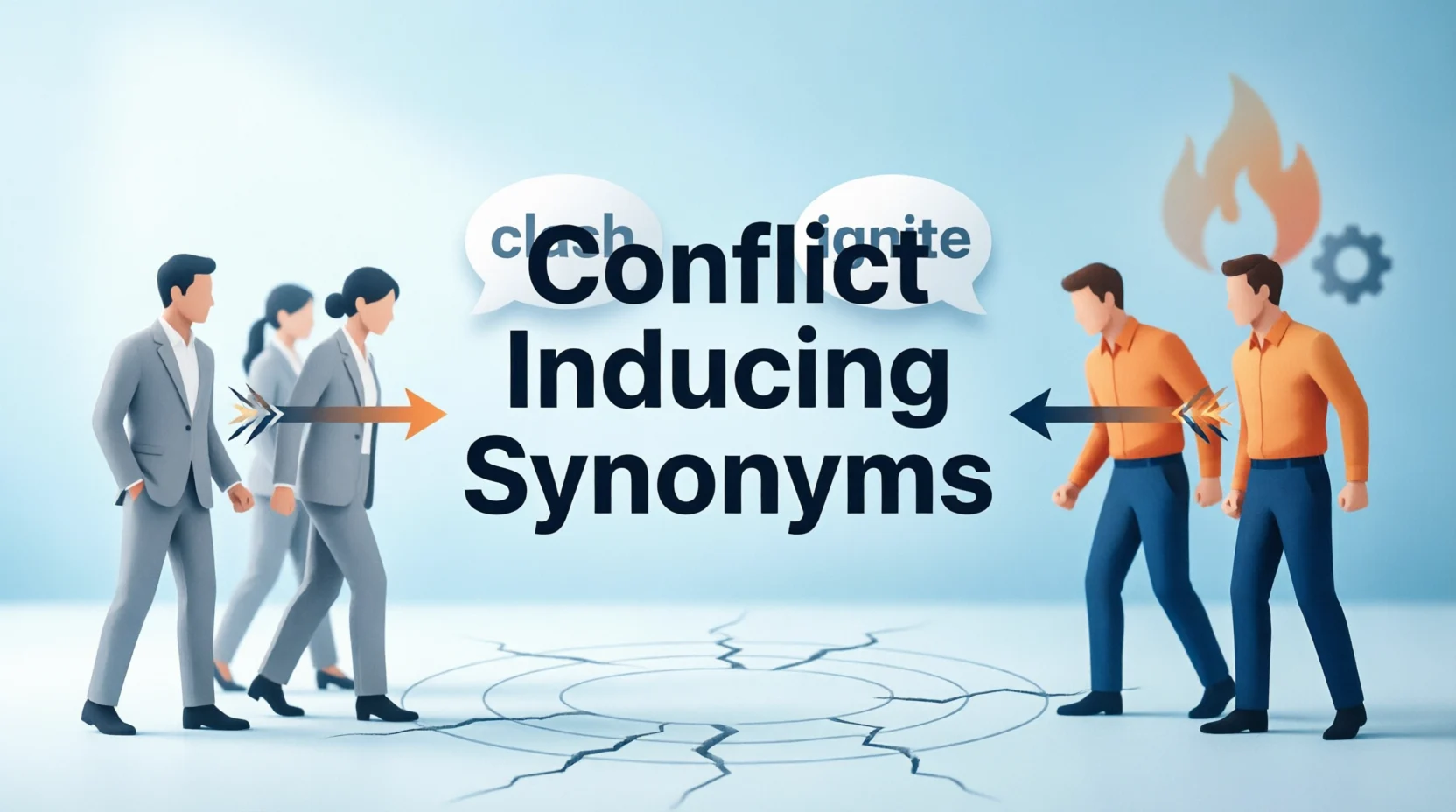
When something is conflict-inducing, it is likely to cause disagreement, tension, arguments, hostility, or disputes between people or groups. Useful synonyms include provocative, inflammatory, divisive, contentious, antagonistic, confrontational, controversial, and provoking. The best choice depends on whether you are describing an action, statement, person, situation, or idea.
Quick Answer
The best synonyms for conflict-inducing include:
- Provocative
- Inflammatory
- Divisive
- Contentious
- Confrontational
- Antagonistic
- Controversial
- Provoking
- Incendiary
- Agitating
These words are similar but not identical. For example, divisive describes something that separates people into opposing groups, while inflammatory usually describes words or actions that intensify anger.
What Does “Conflict-Inducing” Mean?
Conflict-inducing describes something that tends to create or encourage conflict.
It can refer to words, actions, policies, decisions, behavior, situations, or opinions that make disagreement more likely.
For example:
The manager’s conflict-inducing comments created tension among the employees.
Here, the comments caused people to become upset or disagree with one another.
The phrase can be used in professional, academic, social, political, and everyday contexts.
30 Synonyms for Conflict-Inducing
1. Provocative
Simple meaning: Likely to make people react strongly or angrily.
Example: His provocative remarks started a heated discussion.
Best usage/context: Use it for comments, behavior, questions, or actions that deliberately or naturally provoke a reaction.
2. Inflammatory
Simple meaning: Likely to make people angry or increase tension.
Example: The politician’s inflammatory speech divided the audience.
Best usage/context: Commonly used for language, speeches, statements, or remarks that intensify anger.
3. Divisive
Simple meaning: Causing people to separate into opposing sides.
Example: The divisive proposal caused disagreement within the community.
Best usage/context: Best for policies, issues, opinions, leaders, or decisions that create strong divisions.
4. Contentious
Simple meaning: Likely to cause disagreement or argument.
Example: The two sides held different opinions on the contentious issue.
Best usage/context: Useful in formal, academic, legal, and professional writing.
5. Confrontational
Simple meaning: Showing a willingness to argue or challenge someone directly.
Example: His confrontational attitude made the meeting uncomfortable.
Best usage/context: Best for people, attitudes, communication styles, or behavior.
6. Antagonistic
Simple meaning: Showing strong opposition or hostility.
Example: Their antagonistic relationship made cooperation difficult.
Best usage/context: Use it when describing hostile relationships, attitudes, or behavior.
7. Controversial
Simple meaning: Causing strong disagreement or different opinions.
Example: The company made a controversial decision.
Best usage/context: Suitable for topics, decisions, ideas, public figures, and policies that attract opposing views.
8. Provoking
Simple meaning: Causing a strong emotional reaction.
Example: Her provoking question led to an argument.
Best usage/context: Useful for words, questions, behavior, or actions that trigger a reaction.
9. Incendiary
Simple meaning: Likely to create anger, violence, or serious conflict.
Example: The article contained several incendiary statements.
Best usage/context: A strong word, especially for speech, writing, or actions that could seriously escalate conflict.
10. Agitating
Simple meaning: Causing people to become upset, restless, or angry.
Example: The agitating campaign increased tensions between the groups.
Best usage/context: Useful when something creates emotional disturbance or unrest.
11. Combative
Simple meaning: Ready or eager to argue or fight.
Example: His combative response surprised everyone.
Best usage/context: Often describes people, personalities, attitudes, or communication styles.
12. Hostile
Simple meaning: Unfriendly, aggressive, or strongly opposed.
Example: The discussion became hostile after several accusations were made.
Best usage/context: Appropriate for behavior, environments, relationships, attitudes, and interactions.
13. Disruptive
Simple meaning: Causing problems or interrupting normal activities.
Example: The disruptive behavior prevented the team from reaching an agreement.
Best usage/context: Use when conflict interferes with cooperation, work, learning, or normal processes.
14. Aggressive
Simple meaning: Forceful, hostile, or ready to challenge others.
Example: His aggressive approach created unnecessary tension.
Best usage/context: Suitable for behavior, communication, strategies, and attitudes.
15. Belligerent
Simple meaning: Hostile and eager to fight or argue.
Example: The belligerent response made negotiations more difficult.
Best usage/context: A strong and somewhat formal word for openly hostile behavior.
16. Argumentative
Simple meaning: Frequently wanting to argue.
Example: His argumentative nature often caused disagreements.
Best usage/context: Usually describes people or their behavior.
17. Combative
Simple meaning: Inclined to fight, challenge, or argue.
Example: Her combative tone prevented a productive conversation.
Best usage/context: Particularly useful for describing tone, attitude, or personality.
18. Polarizing
Simple meaning: Causing people to develop strongly opposing opinions.
Example: The polarizing issue divided the organization.
Best usage/context: Best for political, social, cultural, or public issues.
19. Antagonizing
Simple meaning: Making someone angry or hostile.
Example: His constant teasing was antagonizing his coworkers.
Best usage/context: Use when a person or action directly causes irritation or hostility.
20. Aggravating
Simple meaning: Making an existing problem or conflict worse.
Example: His comments were aggravating an already difficult situation.
Best usage/context: Best when conflict already exists and something intensifies it.
21. Irritating
Simple meaning: Causing annoyance or frustration.
Example: Her irritating comments frustrated the entire group.
Best usage/context: Better for minor conflict, annoyance, or interpersonal tension.
22. Disputatious
Simple meaning: Likely to argue or disagree.
Example: His disputatious manner made negotiations challenging.
Best usage/context: A formal word for people or situations characterized by frequent disagreement.
23. Quarrelsome
Simple meaning: Often arguing or fighting with others.
Example: The quarrelsome neighbors frequently argued over small matters.
Best usage/context: Mostly used for people, personalities, or relationships.
24. Combustive
Simple meaning: Likely to cause an intense or explosive reaction.
Example: The meeting became tense after several combustive remarks.
Best usage/context: Useful when describing situations, language, or circumstances that can rapidly escalate.
25. Tension-creating
Simple meaning: Causing stress, discomfort, or disagreement.
Example: The new policy was tension-creating for many employees.
Best usage/context: A straightforward phrase for general or professional writing.
26. Disagreeable
Simple meaning: Unpleasant or difficult to deal with.
Example: His disagreeable attitude made cooperation difficult.
Best usage/context: Suitable for people, behavior, experiences, or attitudes.
27. Offensive
Simple meaning: Causing anger, hurt, or resentment.
Example: Some readers found the statement offensive.
Best usage/context: Use when language or behavior causes people to feel insulted or attacked.
28. Provocative
Simple meaning: Designed or likely to stimulate a strong reaction.
Example: The journalist asked a provocative question.
Best usage/context: Excellent for questions, statements, ideas, images, or behavior that challenges people.
29. Aggravating
Simple meaning: Making anger, difficulty, or conflict worse.
Example: The delay was aggravating tensions between the two departments.
Best usage/context: Particularly useful when describing something that intensifies an existing problem.
30. Discordant
Simple meaning: Characterized by disagreement or lack of harmony.
Example: The discordant opinions made it difficult to reach a decision.
Best usage/context: More formal and often useful in academic or descriptive writing.
Comparison Table
| Synonym | Main Meaning | Tone | Best Used For |
| Provocative | Causes a strong reaction | Neutral–strong | Questions, comments, actions |
| Inflammatory | Increases anger | Strong | Speech, statements |
| Divisive | Separates people | Neutral–strong | Issues, policies, ideas |
| Contentious | Causes disagreement | Formal | Issues, subjects, debates |
| Confrontational | Directly challenges others | Strong | People, attitudes |
| Antagonistic | Hostile or opposing | Strong | Relationships, behavior |
| Controversial | Causes public disagreement | Neutral | Topics, decisions |
| Incendiary | Likely to trigger serious conflict | Very strong | Speech, writing |
| Polarizing | Creates opposing groups | Strong | Public issues, politics |
| Hostile | Unfriendly or aggressive | Strong | Behavior, relationships |
| Argumentative | Frequently argues | Neutral | People, personalities |
| Belligerent | Eager to fight or argue | Strong | Behavior, attitudes |
| Quarrelsome | Often involved in arguments | Neutral | People |
| Aggravating | Makes conflict worse | Neutral | Situations, problems |
| Offensive | Causes anger or hurt | Strong | Language, behavior |
How to Choose the Right Synonym
The best synonym depends on what is causing the conflict and how strong the conflict is.
For Mild Disagreement
Choose:
- Disagreeable
- Irritating
- Aggravating
- Tension-creating
These words work when the situation involves annoyance or discomfort rather than serious hostility.
For Strong Disagreement
Choose:
- Contentious
- Controversial
- Divisive
- Polarizing
These are useful when people have clearly opposing opinions.
For Angry or Hostile Behavior
Choose:
- Hostile
- Antagonistic
- Aggressive
- Belligerent
- Combative
These words are better when the conflict involves direct hostility.
For Speech or Statements
Choose:
- Inflammatory
- Provocative
- Incendiary
- Offensive
- Provoking
These words work particularly well when someone’s language contributes to conflict.
For Formal or Academic Writing
Choose:
- Contentious
- Divisive
- Antagonistic
- Polarizing
- Incendiary
- Disputatious
These choices can make formal writing more precise without relying repeatedly on “conflict-inducing.”
Common Usage Mistakes
Using “Controversial” When You Mean “Hostile”
Controversial means something creates disagreement or debate. It does not necessarily mean that something is aggressive.
Incorrect:
The controversial employee shouted at everyone.
Better:
The hostile employee shouted at everyone.
Using “Inflammatory” for Every Disagreement
Inflammatory suggests that something provokes anger or intensifies tension. It is stronger than simply saying something is controversial.
Confusing “Divisive” With “Argumentative”
Divisive usually describes something that separates a group into opposing sides.
Argumentative generally describes a person who frequently wants to argue.
Overusing Strong Words
Words such as incendiary, belligerent, and hostile suggest serious conflict. Do not use them when a mild disagreement is all you mean.
FAQs:
What is the best synonym for conflict-inducing?
Provocative is one of the most versatile synonyms, but divisive, inflammatory, contentious, and confrontational may be better depending on the context.
What is a formal synonym for conflict-inducing?
Contentious, antagonistic, disputatious, polarizing, and incendiary can work well in formal contexts.
What is a synonym for something that causes arguments?
Words such as provocative, contentious, divisive, argumentative, and inflammatory can describe something that causes or encourages arguments.
Is “controversial” the same as “conflict-inducing”?
Not exactly. Controversial means something causes disagreement or debate, while conflict-inducing emphasizes that something tends to create or increase conflict.
What is the opposite of conflict-inducing?
Possible opposites include peaceful, conciliatory, cooperative, harmonious, calming, and unifying.
What is a synonym for conflict-inducing behavior?
Depending on the situation, you can use confrontational, aggressive, antagonistic, hostile, combative, or provocative behavior.
What is a synonym for conflict-inducing language?
Inflammatory, provocative, offensive, antagonistic, and incendiary are strong choices for language that creates or escalates conflict.
Which synonym is best for academic writing?
Contentious is often a strong choice for academic writing, especially when describing an issue, debate, theory, or subject that generates disagreement.
Conclusion
“Conflict-inducing” describes something that creates, encourages, or intensifies disagreement and tension. The right synonym depends on the exact situation. Provocative works broadly, inflammatory emphasizes anger, divisive highlights separation, contentious suits formal discussions, and confrontational describes challenging behavior. Choosing the most precise word makes your writing clearer, more natural, and more effective.