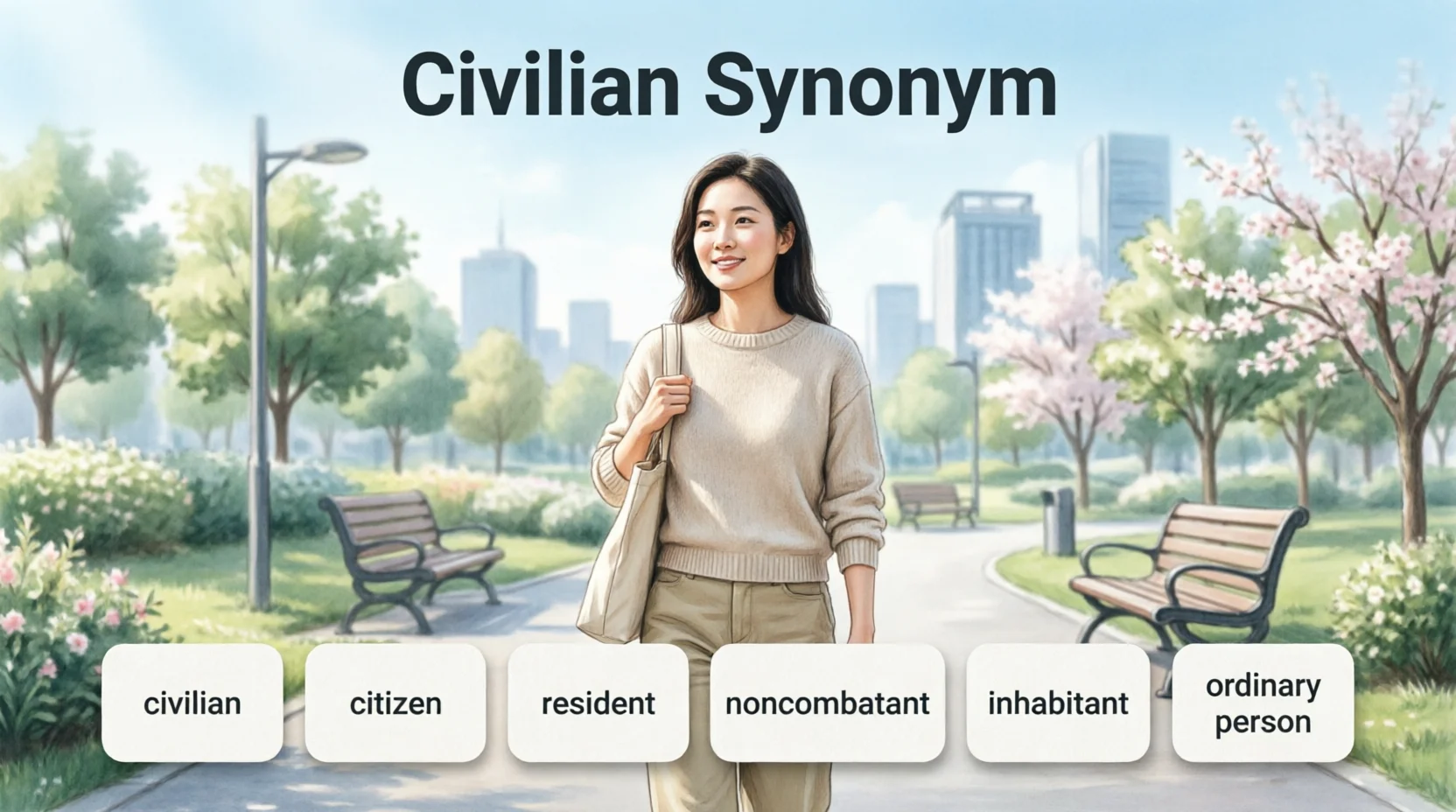
A civilian is generally a person who is not a member of the military or another armed service. The word can also describe someone who is not part of a particular profession, organization, or official group. Choosing the right synonym depends heavily on the context. For example, noncombatant is appropriate when discussing war, while ordinary person works better in everyday conversation.
This guide explains 30 useful synonyms for civilian, with simple meanings, example sentences, and the situations where each word fits best.
Quick Answer: What Is a Synonym for Civilian?
Common synonyms for civilian include noncombatant, citizen, resident, inhabitant, ordinary person, private citizen, nonmilitary person, and member of the public. The best synonym depends on whether you are talking about military status, legal status, residence, or ordinary people.
Civilian: Meaning and Usage
The noun civilian usually refers to a person who is not a member of the military.
Example:
“The soldiers helped evacuate the civilians from the area.”
As an adjective, civilian can describe something connected with ordinary people rather than the military.
Example:
“He returned to civilian life after leaving the army.”
The meaning can change slightly depending on context. In everyday speech, it may simply contrast someone with a professional or official group.
30 Synonyms for Civilian
| Word | Simple Meaning | Example Sentence | Best Usage/Context |
| 1. Noncombatant | A person who does not fight in a war | The soldiers protected the noncombatants. | War and military contexts |
| 2. Citizen | A legal member of a country | Every citizen has certain legal rights. | Government and legal contexts |
| 3. Resident | A person who lives in a particular place | Local residents were asked to leave the area. | Locations and communities |
| 4. Inhabitant | A person who lives somewhere | The island’s inhabitants depend on fishing. | Formal or geographic writing |
| 5. Private citizen | An ordinary person rather than a public official | The issue was raised by a private citizen. | Legal and political contexts |
| 6. Ordinary person | A regular member of the public | An ordinary person may not understand military procedures. | General conversation |
| 7. Member of the public | Someone from the general population | Members of the public were allowed to attend. | Formal and public contexts |
| 8. Nonmilitary person | Someone who is not in the military | The facility is open to nonmilitary personnel. | Military-related contexts |
| 9. Civilian person | A person who is not military | The program provides support to civilian persons. | Formal contexts |
| 10. Local | A person who lives in a particular area | Locals helped visitors find safe shelter. | Communities and places |
| 11. Townsperson | A person who lives in a town | The townspeople gathered in the square. | Small-town contexts |
| 12. Villager | A person who lives in a village | The villagers worked together after the storm. | Rural communities |
| 13. Resident citizen | A citizen living in a particular area | Resident citizens were informed about the changes. | Formal administrative writing |
| 14. Layperson | Someone without professional or specialist training | A layperson may find the technical language difficult. | Professional or technical contexts |
| 15. Nonprofessional | Someone who is not a professional in a field | The course is suitable for nonprofessionals. | Work and education |
| 16. Amateur | Someone without professional status or training | The project was started by an amateur photographer. | Hobbies and skills |
| 17. Outsider | Someone who is not part of a particular group | As an outsider, she had a different perspective. | Groups and organizations |
| 18. Bystander | A person present but not involved in an event | A bystander called the police. | Accidents and incidents |
| 19. Spectator | Someone who watches an event | Spectators were moved away from the area. | Events and public activities |
| 20. Civilian resident | A nonmilitary person living in an area | Civilian residents received emergency supplies. | Conflict and emergency contexts |
| 21. Noncombatant civilian | A civilian who is not participating in fighting | The evacuation focused on noncombatant civilians. | War and humanitarian contexts |
| 22. Commoner | An ordinary person, especially outside an elite group | The king’s decision affected commoners. | Historical or social contexts |
| 23. Layman | A person without specialized professional knowledge | A layman might interpret the rule differently. | General or technical discussion |
| 24. General public | Ordinary people considered as a group | The information was released to the general public. | Public communication |
| 25. Population member | An individual belonging to a population | Each population member was counted in the survey. | Academic and statistical contexts |
| 26. Community member | A person belonging to a community | Community members organized the cleanup. | Local communities |
| 27. Individual | A single person | Each individual received an identification card. | Formal and general writing |
| 28. Person | A human being | Every person deserves basic protection. | Broad everyday usage |
| 29. Civil society member | A person participating in society outside government or military structures | Civil society members supported the relief effort. | Academic and social contexts |
| 30. Non-soldier | Someone who is not a soldier | The program provides services to non-soldiers. | Military and informal contexts |
Comparison Table: Civilian vs. Similar Words
| Word | Main Meaning | Military Context | Everyday Use |
| Civilian | Person outside the military | Very common | Common |
| Noncombatant | Person who does not participate in fighting | Very common | Limited |
| Citizen | Legal member of a country | Sometimes | Very common |
| Resident | Person living in a place | Sometimes | Very common |
| Inhabitant | Person living somewhere | Sometimes | Formal |
| Layperson | Person without specialist knowledge | Rare | Common in technical contexts |
| Bystander | Person present but uninvolved | Sometimes | Common |
| Spectator | Person watching an event | Rare | Common |
| Outsider | Person outside a group | Rare | Common |
| Private citizen | Ordinary person without public office | Sometimes | Formal |
How to Choose the Right Synonym for Civilian
For Military and War Contexts
Use noncombatant, non-soldier, nonmilitary person, or civilian resident when the distinction between military personnel and ordinary people matters.
Example:
“Humanitarian workers provided food to noncombatants.”
For Legal and Government Contexts
Use citizen, private citizen, or resident when discussing legal rights, government services, or official responsibilities.
Example:
“A private citizen filed a complaint with the authorities.”
For People Living in a Place
Use resident, inhabitant, local, villager, or community member when the focus is where someone lives.
Example:
“Local residents were informed about the road closure.”
For General or Everyday Writing
Use ordinary person, person, individual, or member of the public when you simply mean a regular member of society.
Example:
“The information should be easy for an ordinary person to understand.”
For Professional or Technical Contexts
Use layperson, layman, nonprofessional, or amateur when contrasting specialists with people who lack professional training.
Example:
“The instructions are written so that a layperson can understand them.”
For People Watching or Witnessing Something
Use bystander or spectator when the person is present at an event but is not directly participating.
Example:
“A bystander witnessed the accident.”
Common Usage Mistakes
1. Treating Every Synonym as Exactly the Same
Not every alternative to civilian can replace it in every sentence. Citizen, for example, describes legal nationality, while civilian describes nonmilitary status.
2. Using “Resident” When Military Status Matters
A resident is simply someone who lives in a particular place. A resident can also be a soldier.
3. Confusing “Noncombatant” With “Citizen”
A noncombatant is defined by participation in fighting, while a citizen is defined by legal membership in a country.
4. Using “Amateur” as a Direct Replacement
Amateur normally refers to someone who lacks professional status or does something as a hobby. It does not automatically mean civilian.
5. Using “Bystander” for Every Civilian
A bystander is someone who happens to be present at an event. A civilian does not necessarily have to witness or observe anything.
FAQs:
What is the closest synonym for civilian?
Noncombatant is often the closest synonym when civilian is used in a military or war-related context. In other contexts, ordinary person or private citizen may be more suitable.
Is citizen a synonym for civilian?
Sometimes, but they do not have identical meanings. A citizen is a legal member of a country, while a civilian is generally someone who is not part of the military.
What is the opposite of civilian?
Depending on the context, the opposite may be military personnel, soldier, service member, or combatant.
Is noncombatant the same as civilian?
They overlap but are not always identical. Noncombatant focuses on whether someone participates in fighting, while civilian generally focuses on whether someone belongs to the military.
What is a formal synonym for civilian?
Depending on the context, noncombatant, private citizen, member of the public, or nonmilitary person can work as formal alternatives.
Can “resident” replace “civilian”?
Only when the intended meaning is someone who lives in a particular place. Resident does not specifically indicate that a person is outside the military.
What is a simple word for civilian?
Person, ordinary person, or citizen can be simple alternatives, depending on the intended meaning.
What is a synonym for civilian life?
Possible alternatives include ordinary life, nonmilitary life, or life outside the military, depending on the sentence.
Conclusion
The word civilian has several useful alternatives, but each carries its own meaning and context. Noncombatant is especially useful in military and wartime writing, while citizen fits legal and governmental contexts. Resident and inhabitant focus on where someone lives, whereas layperson and nonprofessional emphasize a lack of specialist status.
For everyday writing, phrases such as ordinary person and member of the public are often clearer. Choosing the right synonym means considering exactly what you want to communicate rather than simply replacing one word with another.