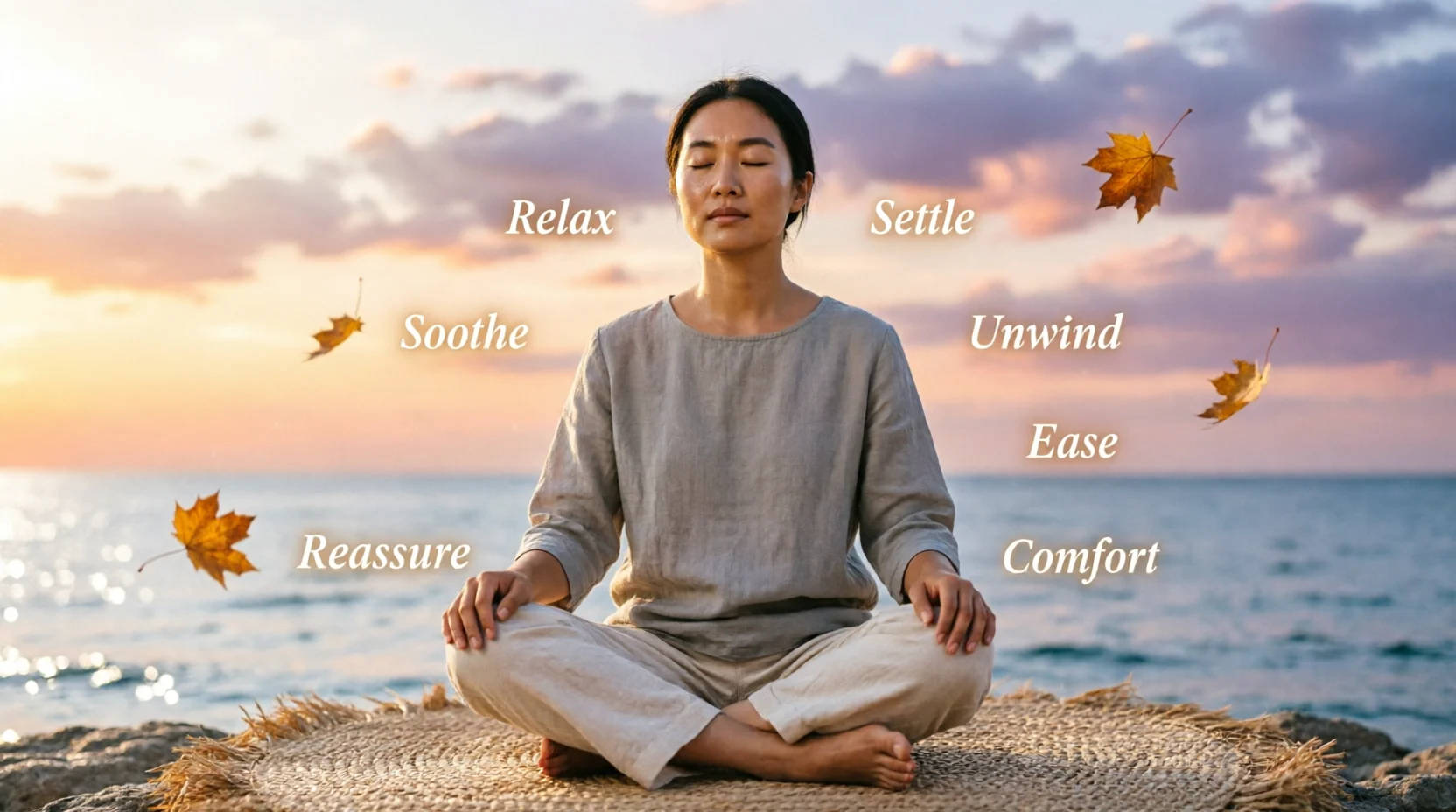
Finding the right calm down synonym depends on the situation and the tone you want to express. Common alternatives include relax, settle down, compose yourself, soothe, reassure, pacify, quiet, unwind, de-stress, and cool off. Some words describe becoming calm yourself, while others describe helping another person become calmer. Understanding these differences can help you choose the most natural word for conversations, writing, schoolwork, and professional communication.
Quick Answer
The best synonym for calm down depends on your meaning:
- Relax — become less tense
- Settle down — become quieter or less excited
- Compose yourself — regain emotional control
- Cool off — become less angry
- Unwind — relax after stress or activity
- Soothe — make someone feel calmer
- Reassure — reduce someone’s worry
- Pacify — calm someone who is angry or upset
- De-stress — reduce stress
- Quiet — make something or someone less noisy or agitated
What Does Calm Down Mean?
Calm down means to become less angry, worried, nervous, excited, or emotionally upset. It can also mean helping another person become more relaxed.
For example:
“Take a deep breath and calm down.”
Here, the speaker is asking someone to become less emotionally upset.
The phrase can also be used when talking about yourself:
“I need a few minutes to calm down after that argument.”
When speaking to someone who is already angry or distressed, however, “calm down” can sometimes sound dismissive. A gentler alternative such as take a moment, let’s slow down, or take a breath may sound more supportive.
30 Synonyms for Calm Down
1. Relax
Simple meaning: Become less tense or worried.
Example: “Try to relax before the interview.”
Best usage/context: Everyday conversations, stress, nervousness, and physical tension.
2. Settle Down
Simple meaning: Become quieter, calmer, or less excited.
Example: “The children eventually settled down after lunch.”
Best usage/context: Groups, children, noisy situations, or emotional excitement.
3. Compose Yourself
Simple meaning: Regain control of your emotions.
Example: “She took a moment to compose herself before speaking.”
Best usage/context: Formal or serious situations involving strong emotions.
4. Soothe
Simple meaning: Make someone feel calmer or more comfortable.
Example: “She spoke softly to soothe the frightened child.”
Best usage/context: Helping another person who is upset, frightened, or distressed.
5. Reassure
Simple meaning: Make someone feel less worried.
Example: “The doctor reassured him that everything was fine.”
Best usage/context: Anxiety, uncertainty, fear, or worry.
6. Pacify
Simple meaning: Make an angry or upset person calmer.
Example: “He tried to pacify the angry customer.”
Best usage/context: Conflict or anger; it can sound formal.
7. Unwind
Simple meaning: Relax after stress or activity.
Example: “I like to read before bed to unwind.”
Best usage/context: Leisure, evenings, vacations, and recovery from a busy day.
8. De-stress
Simple meaning: Reduce stress and tension.
Example: “Walking outside helps me de-stress.”
Best usage/context: Modern everyday English, work pressure, studying, and lifestyle discussions.
9. Cool Off
Simple meaning: Become less angry.
Example: “Give him some time to cool off.”
Best usage/context: Anger or arguments.
10. Quiet Down
Simple meaning: Become less noisy or make someone less noisy.
Example: “The students quieted down when the teacher entered.”
Best usage/context: Noise, groups, classrooms, and busy environments.
11. Still
Simple meaning: Make something or someone calmer or less active.
Example: “The mother tried to still the crying baby.”
Best usage/context: Literary or formal writing; less common in everyday conversation.
12. Tranquilize
Simple meaning: Make someone or something calm.
Example: “The treatment was intended to tranquilize the patient.”
Best usage/context: Medical or technical contexts. It is not usually a casual replacement for “calm down.”
13. Pacify Yourself
Simple meaning: Calm your own emotional reaction.
Example: “He tried to pacify himself before responding.”
Best usage/context: Formal or reflective writing.
14. Regain Composure
Simple meaning: Recover emotional self-control.
Example: “She paused to regain her composure.”
Best usage/context: Formal writing, professional situations, speeches, and serious events.
15. Take It Easy
Simple meaning: Relax and avoid unnecessary worry or effort.
Example: “Take it easy and get some rest.”
Best usage/context: Friendly and informal conversations.
16. Take a Breath
Simple meaning: Pause and relax before reacting.
Example: “Take a breath before you answer.”
Best usage/context: Emotional moments, disagreements, anxiety, and supportive conversations.
17. Slow Down
Simple meaning: Reduce speed, activity, or emotional intensity.
Example: “Let’s slow down and discuss the problem.”
Best usage/context: Arguments, rushed decisions, stressful situations, and conversations.
18. Ease Up
Simple meaning: Become less intense or demanding.
Example: “The pressure finally eased up.”
Best usage/context: Stress, pressure, criticism, or demanding situations.
19. Relax Yourself
Simple meaning: Make yourself less tense.
Example: “She listened to music to relax herself.”
Best usage/context: Personal stress and informal explanations.
20. Unruffle
Simple meaning: Restore calmness after someone becomes upset.
Example: “He remained calm and unruffled during the disagreement.”
Best usage/context: Formal or literary writing.
21. Pacify Someone
Simple meaning: Calm an angry or upset person.
Example: “The manager tried to pacify the customer.”
Best usage/context: Complaints, disagreements, and conflicts.
22. Comfort
Simple meaning: Help someone feel less upset or unhappy.
Example: “She comforted her friend after the bad news.”
Best usage/context: Sadness, grief, disappointment, and emotional distress.
23. Console
Simple meaning: Give emotional support to someone who is sad.
Example: “His friends consoled him after the loss.”
Best usage/context: Serious sadness, grief, or disappointment.
24. Repose
Simple meaning: Rest or become peaceful.
Example: “The quiet garden gave her a place to repose.”
Best usage/context: Formal or literary contexts.
25. Compose
Simple meaning: Bring your emotions under control.
Example: “He composed himself before entering the room.”
Best usage/context: Formal speech and writing.
26. Stabilize
Simple meaning: Make something steady or less unstable.
Example: “The team worked quickly to stabilize the situation.”
Best usage/context: Situations, conditions, systems, or emotions that have become unstable.
27. Pacify a Situation
Simple meaning: Reduce tension or conflict.
Example: “The mediator helped pacify the situation.”
Best usage/context: Workplace disagreements, conflicts, and negotiations.
28. Relieve Tension
Simple meaning: Reduce stress, pressure, or nervousness.
Example: “A short break helped relieve the tension.”
Best usage/context: Workplaces, stressful events, conversations, and physical or emotional tension.
29. Find Your Balance
Simple meaning: Return to an emotionally steady state.
Example: “After a difficult week, she needed time to find her balance.”
Best usage/context: Reflective, supportive, and personal-development writing.
30. Regain Control
Simple meaning: Become emotionally controlled again.
Example: “He stepped outside to regain control of his emotions.”
Best usage/context: Anger, panic, stress, and emotionally difficult situations.
Calm Down Synonyms Comparison Table
| Synonym | Main Meaning | Tone | Best Context |
|---|---|---|---|
| Relax | Become less tense | Neutral | Everyday situations |
| Settle down | Become quieter or calmer | Neutral | Groups and excitement |
| Compose yourself | Regain emotional control | Formal | Serious situations |
| Soothe | Make someone calmer | Gentle | Fear or distress |
| Reassure | Reduce worry | Supportive | Anxiety |
| Pacify | Calm an angry person | Formal | Conflict |
| Unwind | Relax after stress | Casual | Free time |
| De-stress | Reduce stress | Casual | Work or daily life |
| Cool off | Become less angry | Casual | Arguments |
| Quiet down | Become less noisy | Neutral | Groups and noise |
| Comfort | Reduce emotional pain | Supportive | Sadness |
| Console | Support someone grieving | Formal | Loss or sadness |
| Take it easy | Relax | Casual | Friendly conversations |
| Take a breath | Pause and relax | Supportive | Emotional moments |
| Slow down | Reduce intensity | Neutral | Stress or conflict |
How to Choose the Right Synonym for Calm Down
For Casual Conversations
Choose words and phrases such as:
- Relax
- Unwind
- Take it easy
- Cool off
- De-stress
- Take a breath
These sound natural in everyday conversations.
Example: “Take it easy. We have plenty of time.”
For Anger
When someone is angry, these expressions are particularly useful:
- Cool off
- Settle down
- Take a breath
- Slow down
- Regain control
- Compose yourself
Example: “Let’s take a breath and talk about what happened.”
For Anxiety or Worry
When the main emotion is fear or nervousness, consider:
- Relax
- Reassure
- Soothe
- Take a breath
- Find your balance
Example: “Her words reassured me before the presentation.”
For Sadness
For emotional sadness rather than anger, these words are more appropriate:
- Comfort
- Console
- Soothe
- Reassure
Example: “Her friends comforted her after the disappointing news.”
For Formal Writing
Professional or formal contexts may benefit from:
- Compose yourself
- Regain composure
- Regain control
- Stabilize
- Relieve tension
Example: “The spokesperson paused briefly to regain composure.”
For Helping Someone Else
If you are trying to make another person calmer, use:
- Soothe
- Reassure
- Comfort
- Console
- Pacify
The exact choice depends on whether the person is frightened, worried, sad, or angry.
Common Mistakes When Using Calm Down Synonyms
Using “Calm Down” With Someone Who Is Angry
Although calm down is grammatically correct, saying it directly to an angry person can sometimes make the conversation more tense.
Instead of:
“Calm down!”
Try:
“Let’s take a moment and talk about this.”
Using “Cool Off” for Sadness
Cool off usually relates to anger rather than sadness.
Incorrect:
“She needs to cool off because she is grieving.”
Better:
“She needs some time to process what happened.”
Using “Unwind” for an Angry Person
Unwind generally describes relaxing after work, pressure, or activity. It is not normally used to describe someone becoming less angry during an argument.
Natural:
“I watch movies to unwind after work.”
Confusing “Reassure” and “Soothe”
Reassure focuses on reducing worry by giving confidence or information.
Soothe focuses more broadly on making someone feel calmer or more comfortable.
For example:
“The teacher reassured the student that the test would be manageable.”
“The mother soothed the crying child.”
Using Formal Words in Casual Conversations
Words such as unruffle, repose, and tranquilize may sound unnatural in ordinary conversation. Simple alternatives such as relax, settle down, or take a breath are usually more natural.
FAQs:
What is the best synonym for calm down?
Relax is one of the most common synonyms for “calm down,” especially when someone needs to become less tense or worried. For anger, cool off may be more precise.
What is a polite way to say calm down?
Polite alternatives include “take a moment,” “take a breath,” “let’s slow down,” and “let’s talk about this calmly.” These phrases can sound more supportive than directly telling someone to calm down.
What is a synonym for calm down when angry?
Useful choices include cool off, settle down, compose yourself, take a breath, and regain control.
What is another word for calming someone?
Depending on the situation, you can use soothe, reassure, comfort, console, or pacify.
Is “relax” the same as “calm down”?
They are closely related but not always identical. Relax usually means becoming less physically or mentally tense, while calm down can specifically refer to reducing anger, excitement, fear, or emotional intensity.
What is a formal word for calm down?
Compose yourself and regain your composure are useful formal expressions for becoming emotionally controlled again. Stabilize can also work when referring to a situation or condition.
What is the opposite of calm down?
Depending on the context, opposites include become agitated, become upset, become angry, panic, get excited, and lose control.
Conclusion
Choosing the right calm down synonym depends on the emotion, situation, and tone. Relax works well for everyday stress, cool off fits anger, unwind describes relaxing after a busy day, and compose yourself suits more formal situations.
When helping another person, words such as soothe, reassure, comfort, and console can communicate the specific kind of support you mean. Learning these differences makes your English more precise, natural, and expressive. Instead of repeating “calm down” in every situation, choose a synonym that clearly matches the emotion and purpose of your message.