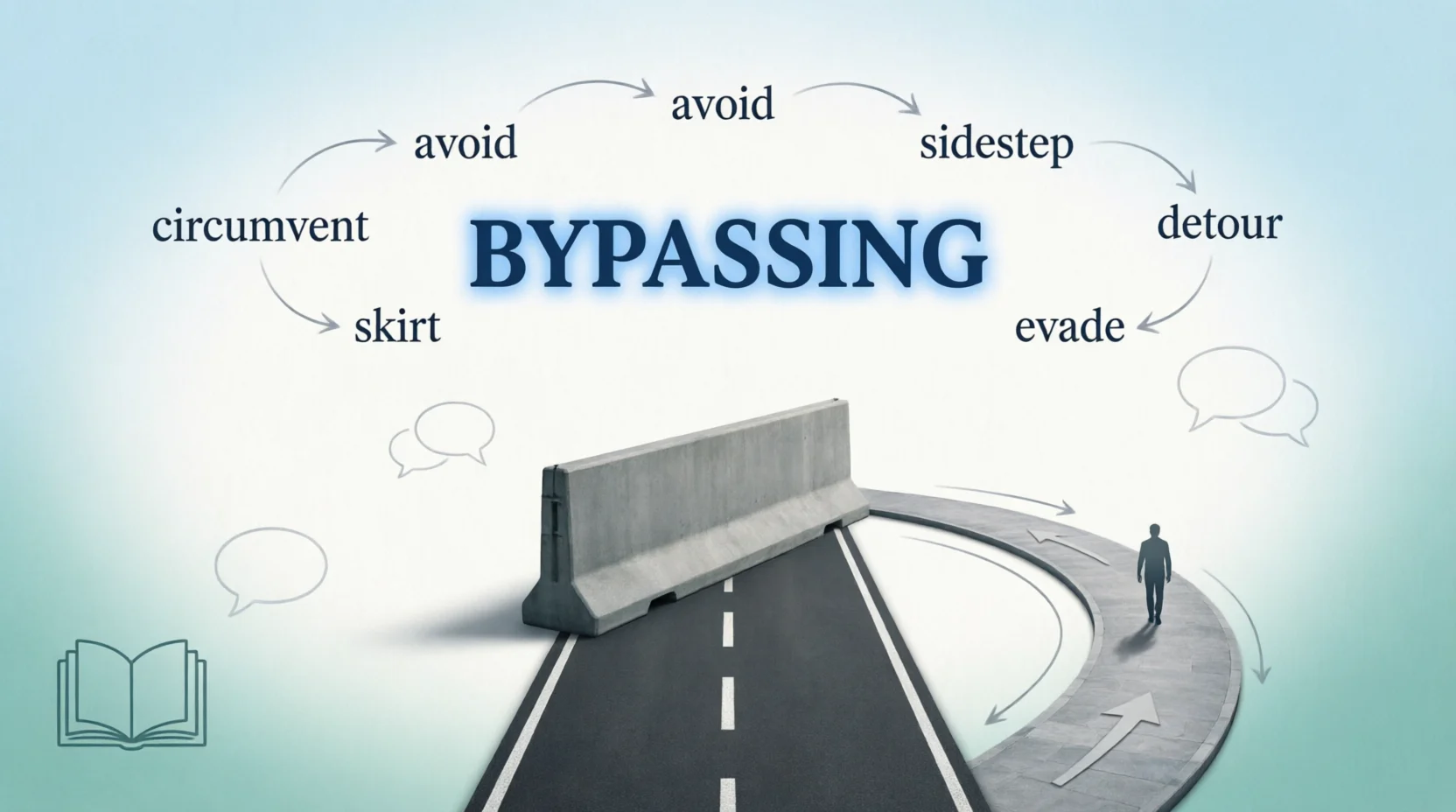
Looking for the right bypassing synonym? The best alternative depends on what you mean by bypassing. In general, bypassing means avoiding something, going around it, skipping a step, or finding an alternative way to reach a goal without following the usual route or process.
For example, you might avoid a busy road, skip an unnecessary step, circumvent a restriction, or sidestep a difficult issue. These words are related to bypassing, but they are not always interchangeable.
This guide explains 30 useful synonyms for bypassing in simple English, with examples and guidance to help students, ESL learners, writers, and content creators choose the most accurate word.
Quick Answer: What Is a Synonym for Bypassing?
Common synonyms for bypassing include avoiding, circumventing, skipping, evading, sidestepping, going around, passing over, ignoring, dodging, and maneuvering around.
The correct synonym depends on the context. For physically taking another route, going around or detouring works well. For avoiding a rule or restriction, circumventing or evading may be more appropriate. For leaving out a step, skipping or omitting is usually clearer.
What Does Bypassing Mean?
Bypassing means avoiding something by taking another route, method, or approach instead of dealing with it directly.
It can describe physical movement, procedures, rules, obstacles, responsibilities, or difficult subjects.
Examples of Bypassing
- We bypassed the crowded highway by taking a side road.
- She bypassed the registration step and went directly to the final form.
- The company tried to circumvent the new restriction.
- He avoided the difficult question during the interview.
The meaning changes slightly depending on the situation, so choosing a precise synonym is important.
30 Synonyms for Bypassing
1. Avoiding
Simple meaning: Staying away from something or choosing not to deal with it.
Example: She is avoiding the crowded downtown road.
Best usage/context: Everyday situations involving people, places, problems, or unwanted situations.
2. Circumventing
Simple meaning: Finding a way around a rule, obstacle, or restriction.
Example: The team found a legal way of circumventing the administrative delay.
Best usage/context: Formal writing, rules, procedures, restrictions, and obstacles.
3. Skipping
Simple meaning: Leaving out something or not doing it.
Example: He was skipping the first step of the instructions.
Best usage/context: Informal and everyday language, especially for steps, activities, or events.
4. Evading
Simple meaning: Avoiding something deliberately, especially something difficult or unwanted.
Example: The witness was accused of evading the question.
Best usage/context: Questions, responsibilities, duties, taxes, authorities, or unwanted situations.
5. Sidestepping
Simple meaning: Avoiding something instead of addressing it directly.
Example: The manager kept sidestepping the employee’s main concern.
Best usage/context: Problems, questions, disagreements, responsibilities, and sensitive topics.
6. Dodging
Simple meaning: Quickly avoiding something.
Example: He kept dodging questions about the missing report.
Best usage/context: Informal speech, questions, criticism, physical objects, or uncomfortable situations.
7. Going Around
Simple meaning: Taking a different route instead of going directly through something.
Example: We went around the construction area.
Best usage/context: Physical routes, obstacles, and everyday conversation.
8. Detouring
Simple meaning: Taking a different route from the normal one.
Example: Drivers were detouring around the closed bridge.
Best usage/context: Roads, journeys, transportation, and physical locations.
9. Passing Over
Simple meaning: Leaving something out or moving past it.
Example: The editor passed over several minor details.
Best usage/context: Details, stages, opportunities, or information.
10. Ignoring
Simple meaning: Choosing not to pay attention to something.
Example: Ignoring the warning could create problems later.
Best usage/context: Warnings, messages, problems, advice, or information.
11. Omitting
Simple meaning: Leaving something out.
Example: The writer omitted an unnecessary paragraph.
Best usage/context: Formal and academic writing, documents, lists, instructions, and reports.
12. Skirting
Simple meaning: Going around the edge of something or avoiding it.
Example: The discussion was skirting the main issue.
Best usage/context: Problems, subjects, rules, boundaries, and physical locations.
13. Bypassing
Simple meaning: Avoiding a normal route, process, or obstacle.
Example: The driver was bypassing the traffic by using a side street.
Best usage/context: General situations where an alternative route or method is used.
14. Avoiding Directly
Simple meaning: Choosing not to confront or approach something directly.
Example: The speaker was avoiding the issue directly.
Best usage/context: Conversations, conflicts, difficult topics, and responsibilities.
15. Maneuvering Around
Simple meaning: Finding a way around an obstacle.
Example: The driver maneuvered around the fallen tree.
Best usage/context: Physical obstacles and situations requiring careful movement or planning.
16. Working Around
Simple meaning: Finding another way to deal with a problem or limitation.
Example: We worked around the software limitation by changing the process.
Best usage/context: Problems, technical limitations, schedules, and practical situations.
17. Getting Around
Simple meaning: Finding a way past or around something.
Example: They found a way to get around the traffic.
Best usage/context: Informal conversation and everyday problem-solving.
18. Passing By
Simple meaning: Moving past something without stopping or dealing with it.
Example: He passed by the damaged building without stopping.
Best usage/context: Physical movement and casual descriptions.
19. Overlooking
Simple meaning: Failing to notice or consider something.
Example: The reviewer overlooked an important detail.
Best usage/context: Mistakes, details, information, and things accidentally left unnoticed.
20. Neglecting
Simple meaning: Failing to give something the necessary attention.
Example: Neglecting basic maintenance can cause expensive problems.
Best usage/context: Responsibilities, duties, maintenance, care, and obligations.
21. Bypassing Directly
Simple meaning: Going past something without using the normal process.
Example: The customer was bypassing the standard procedure.
Best usage/context: Procedures and processes when emphasizing that the normal route was not followed.
22. Overriding
Simple meaning: Replacing or taking priority over an existing rule, decision, or system.
Example: The administrator overrode the default setting.
Best usage/context: Technology, decisions, systems, rules, and formal procedures.
23. Disregarding
Simple meaning: Choosing not to follow or consider something.
Example: Disregarding the instructions may lead to mistakes.
Best usage/context: Rules, instructions, advice, warnings, and formal writing.
24. Deflecting
Simple meaning: Directing something away from its original target or subject.
Example: The spokesperson kept deflecting difficult questions.
Best usage/context: Questions, criticism, conversations, and physical movement.
25. Circumnavigating
Simple meaning: Going around something rather than through it.
Example: The ship was circumnavigating the island.
Best usage/context: Physical geography, travel, navigation, and formal descriptions.
26. Skipping Over
Simple meaning: Moving past something without giving it attention.
Example: The teacher skipped over the final example.
Best usage/context: Lessons, explanations, books, instructions, and conversations.
27. Passing Around
Simple meaning: Moving around something instead of going through it.
Example: The workers passed around the blocked entrance.
Best usage/context: Physical obstacles and informal descriptions.
28. Avoiding
Simple meaning: Choosing not to approach, experience, or deal with something.
Example: He is avoiding unnecessary arguments.
Best usage/context: General everyday situations and broad writing.
29. Escaping
Simple meaning: Getting away from something difficult, dangerous, or unwanted.
Example: The hikers escaped the storm by taking shelter.
Best usage/context: Dangerous situations, restrictions, difficulties, and physical escape.
30. Leaving Out
Simple meaning: Not including or doing something.
Example: The author left out several unnecessary details.
Best usage/context: Informal writing, conversations, lists, instructions, and explanations.
Bypassing Synonyms Comparison Table
| Synonym | Main Meaning | Tone | Common Context |
|---|---|---|---|
| Avoiding | Staying away from something | Neutral | General |
| Circumventing | Finding a way around an obstacle or rule | Formal | Rules and restrictions |
| Skipping | Leaving out a step | Informal | Procedures and activities |
| Evading | Deliberately avoiding | Formal/Neutral | Questions and responsibilities |
| Sidestepping | Avoiding direct involvement | Neutral | Issues and discussions |
| Dodging | Quickly avoiding | Informal | Questions and problems |
| Detouring | Taking another route | Neutral | Travel and roads |
| Omitting | Leaving something out | Formal | Writing and documents |
| Skirting | Avoiding or moving around | Formal/Neutral | Issues and boundaries |
| Working around | Finding another practical method | Neutral | Problems and limitations |
| Ignoring | Not paying attention | Neutral | Warnings and information |
| Disregarding | Choosing not to follow | Formal | Rules and instructions |
How to Choose the Right Synonym for Bypassing
The best synonym depends on your intended meaning, tone, and situation.
For Everyday Situations
Use:
- Avoiding
- Skipping
- Going around
- Getting around
- Leaving out
These words are simple and natural in everyday conversation.
Example:
We avoided the traffic by taking another road.
For Formal Writing
Use:
- Circumventing
- Evading
- Omitting
- Disregarding
- Skirting
These alternatives are more suitable for academic, professional, or formal writing.
Example:
The organization attempted to circumvent the administrative procedure.
When Talking About Rules or Restrictions
Use:
- Circumventing
- Evading
- Disregarding
- Overriding
- Working around
Choose circumventing when someone finds an alternative way around a restriction. Choose disregarding when someone simply chooses not to follow it.
When Talking About Steps or Procedures
Use:
- Skipping
- Omitting
- Skipping over
- Leaving out
- Passing over
Example:
The user skipped an unnecessary step in the application process.
When Talking About Difficult Questions or Issues
Use:
- Sidestepping
- Dodging
- Evading
- Deflecting
- Skirting
These words suggest that someone does not address something directly.
Common Mistakes When Using Bypassing Synonyms
Mistake 1: Using “Skipping” for Every Situation
Skipping usually means leaving out a step, activity, or part.
Incorrect or unnatural:
The company skipped the government regulation.
Better:
The company circumvented the regulation.
Mistake 2: Confusing Avoiding With Ignoring
Avoiding often means deliberately staying away from something.
Ignoring means failing or choosing not to pay attention to it.
Compare:
She avoided the difficult conversation.
She ignored the warning.
The meanings overlap, but they are not identical.
Mistake 3: Using “Circumventing” in Casual Conversation
Circumventing is grammatically correct, but it can sound formal.
Casual:
We went around the traffic.
Formal:
We circumvented the traffic restriction.
Mistake 4: Assuming Every Synonym Has the Same Meaning
Words such as evading, omitting, ignoring, and skipping can all relate to bypassing, but each emphasizes something different.
Always consider what is actually being avoided, omitted, or passed.
FAQs:
What is the closest synonym for bypassing?
Avoiding is one of the closest general synonyms for bypassing. However, circumventing, skipping, or sidestepping may be more precise depending on the context.
What is a formal synonym for bypassing?
Circumventing is a common formal alternative when someone finds a way around a rule, obstacle, or restriction. Evading and sidestepping can also work in appropriate contexts.
What is another word for bypassing a rule?
Useful alternatives include circumventing, evading, disregarding, and working around. The exact choice depends on whether the person finds an alternative route, avoids the rule, or simply refuses to follow it.
What is another word for bypassing a step?
Skipping, omitting, skipping over, and leaving out are useful alternatives.
Is “avoiding” the same as “bypassing”?
They are closely related but not always identical. Avoiding emphasizes staying away from something, while bypassing often emphasizes taking an alternative route or method.
What is a synonym for bypassing a difficult question?
Sidestepping, dodging, evading, and deflecting are useful choices when someone avoids answering a difficult question directly.
What is the opposite of bypassing?
Depending on the context, opposites can include addressing, confronting, following, facing, including, or dealing with directly.
Conclusion
Choosing the right bypassing synonym depends on the exact meaning you want to communicate. Avoiding is a broad everyday option, while circumventing is better for formal situations involving rules or obstacles. Skipping works naturally for steps and activities, whereas sidestepping, dodging, and evading are useful when discussing questions, responsibilities, or difficult issues.
Understanding these small differences can make your writing clearer and more natural. Instead of replacing “bypassing” with any similar word, consider the situation, tone, and intended meaning first. This helps you choose a synonym that communicates your idea accurately and confidently.